
A Christmas Carol Reflection
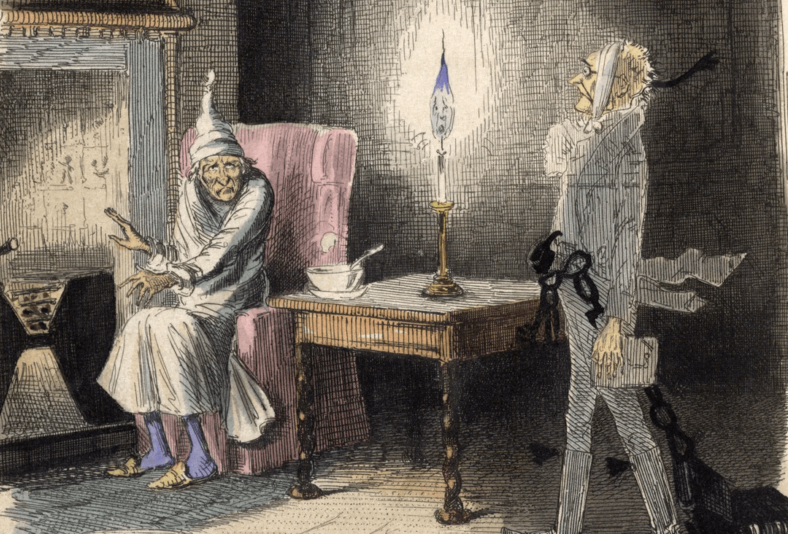
May Christmas be a time of good cheer for you, your family, your loved ones. During this ingathering of family and friends, stories are usually shared about the year, what the next year holds in store, and reminisces of the joys of seasons past. For this Christmas, we offer to you, our incredible readers, reflections on one of the greatest Christmas stories ever written: Charles Dickens’ A Christmas Carol. Assistant editors Filip Bakardzhiev, Darrell Falconburg, and Sarah Tillard share the meaning of the story. “May God bless us, every one.”
~ Paul Krause
A Christmas Carol is a story of the supernatural and the real in equal measure. In fact, the two are far more connected than many would anticipate, for what matters in reality has supernatural implications, especially in relation to Christmas. What we do here, matters somewhere else, and we are all on the same journey. Scrooge’s nephew summarizes this sentiment at the beginning, when he eloquently describes Christmas as “the only time I know of, in the long calendar of the year, when men and women seem by one consent to open their shut-up hearts freely, and to think of people below them as if they were really fellow-passengers to the grave, and not another race of creatures bound on other journeys.”
This sobering statement expresses the true reality of our life on earth and our common, inevitable destination- death and the grave. It is this realization that dispels all myths behind our secular pursuits of wealth, status and image in the City of Man, as personified by Scrooge and Marley. As we later learn, it is even worse than that- our wasteful pursuits are not just making us blind to the woes and needs of our fellow-travelers, but are constructing an eternity of suffering for our life beyond. Scrooge, upon seeing his past, all the missed opportunities of love and contentment he had squandered in his successful war to force all human sympathy to keep its distance, realizes his life has been an endless agony, with his pursuit of money the temporary balm to soothe this open wound.
This sobering tale, however, is ultimately optimistic, not just because of the ending of the story, with a changed Scrooge, doing good works and rejoicing in the here and now, with a hope of the same in the life to come. It is the implicit realization that it is Christ’s birth that has brought hope into the world, and offers us the prospect of a journey the ends quite differently from Marley’s, and that even someone like Scrooge is not beyond redemption. The grave is no longer the end-destination, but a door to a life of blessedness. The story gives a new, more intense meaning to our celebration of Christmas, without the illusions pushed by secular society, with the clear perception those around us are our fellow-travelers, whose company we should cherish and whose well-being is our own. We must, therefore, rejoice in Christ’s birth and be grateful for all the blessings we have received, above all, hope — the greatest gift of all.
~ Filip Bakardzhiev
Originally published in 1843, A Christmas Carol by Charles Dickens was an instant success. In fact, Dickens’ ghost story played a modest but notable role in renewing and reimagining this holiday in the English-speaking world. Battered by industrialization and the forces of novelty, the traditions of the Christmas holiday were under a certain scrutiny. The imagination of Dickens, however, did much to enliven them. Scrooge, who initially considered Christmas a “humbug,” eventually remembers the power of love, generosity, and community for a well-lived human life. As a result of his encounter with three ghosts, he has a kind of conversion. His life takes on a significance that is more than economic and more than material. Christmas itself, as a result, takes on a new significance in his mind. Today, the traditions of Christmas are battered by similar forces — especially by materialism and secularism, which seek to strip this time of year of its traditional religious significance. Then and now, however, A Christmas Carol by Charles Dickens can continue to speak to us. Imagination, after all, really does rule the world. In this story, readers can rediscover even today that there is more to life than material gain and self-advancement. And above all, they may remember, with Dickens, that the God who mysteriously became man in the Incarnation is at the center of this holiday. Today, above all, is a holy day — it is the day of the Christ-Mass.
~ Darrell Falconburg
Prior to the publication of Charles Dickens’ a Christmas Carol, he said, in 1836, “that people will tell you that Christmas is not to them what it used to be.” And I would have to agree with Dickens’ sentiments. As we get older, the magical feeling of Christmas dissipates. Each year gets busier and more overwhelming and stressful, ultimately distracting us from the Christmas season and its joyous purpose; I have been able to tell of this drastic shift over the last few years, primarily upon transitioning into adulthood.
The irony of Dickens’ quote as mentioned above was written ten years before a Christmas Carol was published. With that in mind, it almost seems that Dickens knew exactly his aim before writing the most notorious Christmas story in Victorian literature. That being he wanted to craft a work which pulled readers into, what they thought were, long lost childhood Christmas memories. A Christmas Carol is also Dickens’ fourth Christmas story, and it is more personal and tangible than the other three— because it reminds readers of Christmas’ magic like they used to experience when waking up on Christmas morning, seeing all the presents underneath the tree, stocking with knick knacks, and half eaten cookies and celery for Santa and his reindeer.
Dickens’ novel is not just another Christmas story, rather it is an invoking literary piece that sparks and recreates a child-like attitude we can enjoy no matter the age.
~ Sarah Tillard


Related Posts