A Continent on the Brink, on Foot: Remembering Patrick Leigh Fermor
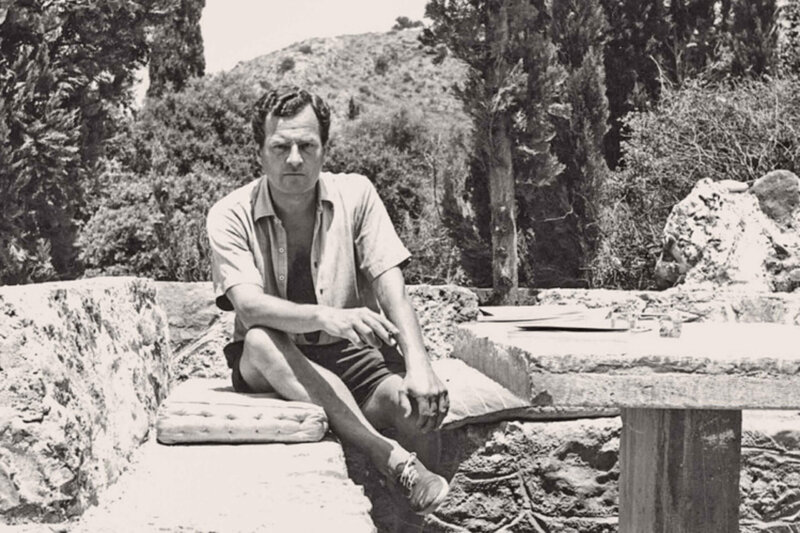
December 1933. An eighteen-year-old Englishman, equipped with sturdy boots and a rucksack, set out on a rain-soaked afternoon from London toward the Dutch coast. He carried little more than a copy of Horace’s Odes, the fervent confidence of youth, and an ambition: to cross Europe on foot, all the way to Constantinople.
That journey was Patrick Leigh Fermor’s. Decades later he would immortalize it in an acclaimed trilogy: A Time of Gifts (1977), Between the Woods and the Water (1986), and The Broken Road: From the Iron Gates to Mount Athos (2013). The books became modern classics and established Leigh Fermor—by virtue of his clarity, erudition, and stylistic grace—as one of the twentieth century’s finest travel writers.
Yet his account is more than the chronicle of a young man’s adventures: a boy who shared campfires with peasants and salons with nobles, who tramped across Hungarian plains, drank tokaji and pálinka with strangers, and drifted with ease between worlds that rarely met. It is also a precise diagnosis of a continent on the brink. The interwar Europe Leigh Fermor walked through was scarred by aggressive nationalism, territorial grievances and fractured identities. Those ghosts have not stayed put: they are once again visible across the continent. Read politically, his journey is less a memoir than a warning—and it helps explain why.
The son of a distinguished geologist serving the Empire in India, Leigh Fermor spent his early years in England, largely in the care of relatives. The experience seems to have nourished a stubborn self-reliance. After being expelled from several schools, he set out for Constantinople (the “Second Rome”) in search of freedom and adventure. He left in the winter of 1933 and reached the Byzantine capital in January 1935.
He wrote the odyssey up much later, with the detachment of maturity. The final volume was left unfinished and published posthumously. That gap in time matters: it lends the story both polish and perspective. Almost without meaning to, the young man who walked into interwar Europe became a witness to a continent undone by its own politics—an undoing whose echoes are audible again, nearly a century on.
Leigh Fermor’s continental route begins in Holland and soon winds through Germany, where Adolf Hitler had risen to power only months earlier. He follows the Rhine, crosses the Rhineland and Bavaria, and traces the Danube through Austria, Czechoslovakia, Hungary (with its Alföld plains and luminous Budapest) then Romania and Bulgaria. But to read Leigh Fermor is not merely to travel through countries; it is to travel through time. His journey transcends youthful adventure. It immerses the reader in resentments, tensions, and wounds that had not closed and would soon open wider.
At the outset of A Time of Gifts, his memoir of the winter trek across Central Europe, he describes his arrival in Goch, one of the first German towns he visits after crossing the border. Beneath a sea of swastika flags, columns of brownshirts marched to martial chants. In shop windows, Hitler Youth daggers and portraits of the Führer glinted. In the square, a uniformed crowd listened fervently to a speaker with a sonorous voice. At the end, a triple Heil! rose in unison.
Lodging in inns, hostels, and Gasthäuser, talking to innkeepers, peasants, and aristocrats, Leigh Fermor offers an X-ray of a Germany now almost unrecognizably distant. Beneath his footsteps still lay the embers of the First World War. His journey through Mitteleuropa began as the order born of Versailles—new states, rigid borders—started to fracture. Leigh Fermor did not know what would follow. But the signs were visible for those willing to read them: the humiliations that lingered, the grievances that hardened into politics, the mood that turned history into a weapon.
As in the third canto of Childe Harold’s Pilgrimage, Leigh Fermor follows the winding Rhine (sharing with Byron not only a love for Greece but even the feat of having swum the Hellespont) and takes in jagged mountains, suspended cliffs, Gothic churches, and medieval castles. He walks through the heart of a humiliated and militarized Germany, forming friendships along the way. He also notices that behind the grim facade of the Hitler Youth beat something recognizably human: camaraderie, and a deep attachment to folklore, nature, and music.
He leaves the Rhine for the Danube. On his way to Vienna, news reaches him of violent clashes between Austrian social democrats and the Austrofascist chancellor, Engelbert Dollfuss (an episode that prefigured the Anschluss). During a fierce storm near Vienna, a truck driver and his daughter, Trudi, pick him up. Approaching the outskirts of the Kaiserstadt, they meet a grim tableau: barbed wire, soldiers with bayonets, distant gunfire. Trudi, broad-smiling, bright-eyed, exclaims: “Maybe it’s war!” Leigh Fermor notes that it is not bloodlust but a desperate craving for any change.
That smile has returned, in one form or another, across Europe’s long history: a continent repeatedly seduced by the promise of renewal through confrontation, and often unsure what to do with peace. The nineteenth-century Concert of Europe, with its shifting coalitions and fratricidal wars, privileged national interest over durable cooperation. Post-1945 Europe built something different: a peace institutionalized, not merely hoped for. The European Union replaced confrontation with obligations to cooperate. In our own time, the same impulse toward upheaval can be redirected; one can imagine Trudi smiling again—not at the prospect of war, but at the possibility of peace.
The journey continues through a Czechoslovakia disoriented by the fall of the Austro-Hungarian Empire and into a Hungary traumatized by the loss of two-thirds of its territory under the Treaty of Trianon. In Transylvania—once Hungarian, now Romanian—he encounters a powder-keg of ethnic tension.
Travelling with him through the European interbellum, the reader discovers a world now irrecoverable: seemingly distant, yet still shadowed by fallen empires and old resentments. In a sense, Leigh Fermor evokes, though in a less elegiac key, the Europe portrayed by Stefan Zweig in The World of Yesterday. But whereas Zweig’s true homeland was the Europe before 1914, Leigh Fermor maps what came after the Great War: a continent fractured, embittered, and unfinished.
Different in form, the empires that shaped that world share an instructive resemblance to Europe’s present arrangements. The Austro-Hungarian and Ottoman empires gathered multiple peoples, languages, and religions within a single structure. In the Schlösser where Leigh Fermor stayed (through a hospitality reminiscent of the Greek notion of xenía) he meets aristocrats formed by a cosmopolitan, supranational world: polyglot, cultivated, with memories scattered across Vienna, Prague, Budapest.
The European Union today is no empire, but it is a kind of Vielvölkerreich (an “empire of many peoples,” as the Habsburg realm was known) composed of sovereign states compelled to coexist. In varietate concordia. Yet suspicion persists: North against South, East against West. Fueled by economics, fiscal policy, and cultural stereotype, and sharpened by crises such as the eurozone debt crisis (2008) and the migration crisis (2015), these tensions converge on a question that resists a clean answer: who is “more” European?
“Qui donc est l’Europe?” Otto von Bismarck wondered in 1863. Years later, the statesman who unified Germany wrote, with disdain, to a Russian official: “Qui parle d’Europe a tort”—to speak of Europe, he implied, was to speak in error. A similar thought surfaced much later in Jean Monnet, one of the European Union’s founding architects: “Europe has never existed. One must genuinely create Europe.” Defining Europe precisely, it turns out, is as elusive as fixing its borders for good.
Leigh Fermor’s trilogy suggests that the deepest borders are seldom political. They form organically among peoples through religion, ethnicity, custom, and language. In Bratislava he encounters three languages in close proximity and feels the crossing of something deeper than a line on a map. He notes invisible divides of faith—Protestant North, Catholic South—and even of drink: the Rhine, land of vineyards; Bavaria, kingdom of beer. “Two more invisible lines had been crossed and important ones,” he writes. “The accent had changed and wine cellars had taken the place of beer-halls […] Instead of those grey mastodontic mugs, wine-glasses glittered on the oak.”
Claudio Magris pursued a similar intuition in Danube, his sentimental journey through Central Europe. Identity, Magris shows, is fluid, definitely more fragile and nuanced than modern borders imply. Cities such as Trieste or Bratislava defy rigid partitions, advertising mixture as their natural condition.
In an age of resurgent nationalism and populism, the lesson is worth stating plainly: identity is compounded, borders are inventions, and cultural richness grows from encounter, not isolation.
After the First World War, the collapse of European stability created a power vacuum that turned the continent into a cauldron of resentment and revanchism. On his way to Koblenz—birthplace of Metternich—Leigh Fermor crosses the Rhineland, a region both stage and catalyst of profound political change. Demilitarized by the Treaty of Versailles, the Rhineland remained an open wound for Germany until Hitler remilitarized it in the spring of 1936, Nazi Germany’s first blatant violation of an international treaty. Two years later came the annexation of Austria and the occupation of the Sudetenland.
In a different context, yet haunted by the same specter of a fallen empire, Russia has fueled a familiar revanchism and longing for past glory: the invasion of Georgia in 2008; the annexation of Crimea and the war in Donbas in 2014; and, most dramatically, the full-scale invasion of Ukraine in 2022. The rhetoric portraying Ukraine as an artificial state and Ukrainians as malorussy (“Little Russians”) echoes, in register if not in detail, the slogans that once justified expansionism elsewhere in Europe.
The simmering ethnic landscape Leigh Fermor records—its insecurities and identity reactions—helped feed the rise of fascism. Today, nationalism and identity politics have again acquired force across the continent. Interwar Central Europe’s democracies proved brittle. Some of today’s democracies, tested by illiberal currents, may be less secure than they appear.
Leigh Fermor could not foresee Europe’s future. But he documented the preconditions of disaster. His books illustrate the danger of punitive treaties (Versailles, Trianon) that humiliate nations and breed resentment. Similar tensions reappear in different guise: the euro crisis straining North–South relations; NATO’s eastward expansion entwined with confrontation with Russia. He also observed, at ground level, how fragile democracies buckle under populist pressure. Without meaning to, he recorded the unravelling of an era—and, by doing so, offers a lens through which to read our own.
Yet not all is shadow. Where Leigh Fermor needed passports and visas, and worried about currency exchange at every border, citizens of the European Union now move freely within the Schengen area. Twenty-one of its twenty-seven member states share a common currency, an integration unimaginable in his time. As I write these lines, I am standing in Salzburg’s central station, having arrived from Vienna and bound for Munich. In a few weeks I will return—without visas, without checks—to my hometown in Spain.
European citizenship, which grants more than 450 million people rights such as freedom of movement, would have seemed implausible in the 1930s. Then, Europeans spoke of their neighbors with easy suspicion: “Bah, the French!” or “Watch out for those Tommies!” In a profound sense, Europe was once both larger and more fragmented than it is today: its extremes were farther apart not only on maps, but in habits, loyalties, and the stories Europeans told about one another. Leigh Fermor’s trilogy celebrates the hospitality and cosmopolitanism of a supranational Europe—prefiguring the European project—while also revealing how distant Europeans then were from any shared consciousness. Today that consciousness exists, however faintly, beneath the continent’s renewed tensions.
A political reading of Leigh Fermor’s Central European journey underscores the urgency of preserving the institutions that uphold peace in Europe. His books are not manifestos, but they capture, often with unnerving delicacy, the beginnings of revenge, nationalism, and identity fracture. Through descriptions sharpened by time, he reveals political and social fissures at the moment they start to widen. Had we not known the outcome, would we have sensed Europe’s destiny through his eyes alone?
To read Leigh Fermor, then, is not merely to admire his prose or indulge nostalgia. It is, above all, to acquire an instrument of political diagnosis for our own time.


Related Posts