The Eric-Voegelin-Bibliothek in Erlangen: A Resource for Voegelin Scholarship
The diffuse infrastructure that supports scholarly work on Eric Voegelin today mirrors the transatlantic life of the man. Stretching from the bedrock Eric Voegelin Papers at the Hoover Institution at Stanford to the Eric Voegelin Institute in Baton Rouge and the Eric Voegelin Society in the United States, it includes the Eric Voegelin Book Collection at the University of Manchester, the Eric-Voegelin-Archiv of the Eric Voegelin Gesellschaft in Munich and the Voegelin-Bibliothek in Erlangen, Germany. However, within this complex map, the European parts of this infrastructure remain somewhat lesser known to the scholarly community.
In this short text we hope to address this by presenting the Voegelin-Bibliothek (“the Library”) as an underexplored intellectual resource of the Voegelinian universe.[3] The Library contains five collections:
Eric Voegelin’s Private Library: contains the books of the private library of Eric Voegelin with around 4,900 titles.
The Voegelin Papers: contains microfiche copies of the Voegelin-Papers archived in the Hoover Institution at Stanford University (California, USA).
The Voegelin Reprints Collection: contains publications sent to Voegelin by other authors, who were mostly friends or colleagues of Voegelin.
The Gebhardt & Vondung Collections: contains publications by different scholars on Voegelin, lecture notes of Voegelin lectures by Prof. Dr. Jürgen Gebhardt, copies of manuscript notes and correspondence between Eric Voegelin and other scholars. Some of the materials are originals. The smaller “Klaus Vondung” Collection contains seminar syllabi and the lecture notes of Klaus Vondung who studied with Eric Voegelin at the University of Munich.
The University of Erlangen Voegelin Special Collection: contains Eric Voegelin’s Collected Works and much of the international secondary literature on Voegelin as part of the University Library Collection.
While there is work to be done in order to systematize the collections and make them more accessible, in the following we make the case that the Library’s considerable collection can improve our understanding of Voegelin’s intellectual development and its broader European and American context by providing insights into his reading habits and his intellectual network as well as interesting clues for further research on his intellectual biography. A beautiful and well-equipped facility, the Library provides an ideal place for research on the life and work of this great American of Central European descent.
Introduction
“Show me your library and I will tell you who you are,” – this saying is perhaps especially true of twentieth century philosophers. A bounded space of intellectual freedom away from the cares of everyday life, the private library was the place where the deeply personal inner dialogue of thinking typically took place in the pre-digital world.[4]
It is hardly an exaggeration to say that libraries functioned as a kind of spiritual maternity ward where thinkers gave birth to themselves – that is, to their own mature soul. This process was central to Voegelin’s own meditative self-exploration.[5] The library was an intimate space of intellectual creation, largely inaccessible to others. While we may recognize the curiosity that draws us to browse the bookshelves of friends that we are visiting or to imagine our favorite thinkers immersed in their libraries, the true entry point into this world of self-formation remains closed to us for as long as its inhabitant lives. Even those students or friends fortunate enough to witness a glimpse of it typically encountered only its surface: the thinker as a knowing rather than thinking being.
Upon their passing, however, the maternity ward turns into a kind of treasure map, offering clues as to the thinker’s mind. It is here that our work begins. We can retrace their intellectual journey with our own wits, at our own pace, and in our own time. And if we succeed, the thinker may reward us by becoming our intellectual midwife.
Two decades ago, Tilo Schabert beautifully evoked how Voegelin created his philosophical work in his “workshop.”[6] Over a decade ago, the book Voegelin Recollected presented Voegelin through the memories of those who knew him.[7] But what might his books have to say about him?
Voegelin-Bibliothek in Erlangen
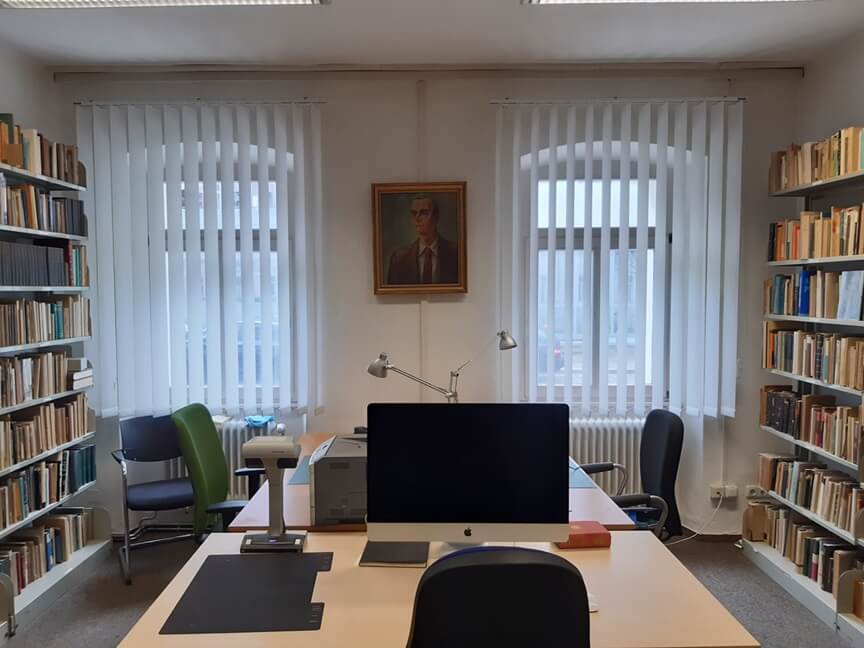
The core of the Eric Voegelin Library is made up of the books he accumulated throughout his life, which were in his possession in Palo Alto, California, when he passed away. Through the efforts of his former student, Prof. Dr. Jürgen Gebhardt, the books were brought to the Friedrich-Alexander-University in Erlangen near Nuremberg in southern Germany. Institutionally affiliated to the Chair of Political Theory and History of Ideas that is headed by Prof. Dr. Eva Marlene Hausteiner, the Library is located in Glückstrasse 5, close to the Botanical Garden and the University’s Garden, the Main University Library, and the beautiful town center. The Library occupies three comfortable rooms, one of which is more than twice the size of the rest and contains most of the nearly 5000 books, with several working desks, computers, printers, a microfilm reader, a scanner and the like.
The Library is organized thematically. Does the division of the sections and the arrangement within them come from Voegelin himself? We do not know. The thematic division includes sections on America, communism, the history of Austria, France and other countries, constitutional law, political theory, Greek, Christian, German, Russian, French, English philosophy, theology and history of Christianity, sociology, and gnosis. Separate shelves are occupied by fictional works from English, Russian, French, American and Italian writers.
Among the books, we find not only works that are to be expected in Voegelin’s bookshelves, but also surprising titles, such as books on agriculture, the programme for the coronation ceremony of Elizabeth II, or an 18th century edition of a book in defense of slavery. The most interesting works are, of course, the philosophical, legal and political works. Whether we are talking about his contemporaries, the nineteenth century, or earlier, they all tell us something about Voegelin’s interests at the time. In the case of books published early in Voegelin’s life, which he was in the habit of signing when he bought them, they can help us to determine the exact schedule of their reading. The Library also has no shortage of books that are difficult to find today, as well as books autographed by their authors from different periods of Voegelin’s life. In some books we find letters from their authors, postcards or dedications, which can also tell us about the acquaintanceship that linked the author to Voegelin. They complement the published and unpublished material available at the Hoover Institution.
The Private Library is complemented by the other collections. Among the materials in The Gebhardt Collection there are a number of important historical documents on the last years of Voegelin’s life in Austria and his exile, including letters from the Vienna Faculty of Law and Political Science from 1938 regarding the revocation of his teaching license and his dismissal with the termination of his salary as Privatdozent. The lecture notes and syllabi of Klaus Vondung from Voegelin’s time in Munich also await further research. Together with the various notes and cards scattered in the books of the Private Library, the Reprints may help to map out Voegelin’s intellectual exchanges with other scholars. And, finally, the Voegelin-Papers, the Collected Works and the rest of the secondary literature within one roof enable undistracted scholarly work on the lovely premises.
How to do things with books?
There seem to be two ways of looking at Voegelin’s Library.
First, we can view it as the collection of books that he built over the years and that reflects his intellectual interests and passions. In this way, we can determine what interested him, with some probability to determine at what period. Given that Voegelin did not just read but wrestled with full intellectual force with the history of political thought as testified by the adventures of his mammoth History of Political Ideas, this dimension is not to be underestimated. Here there is much that we also do not know: did his father-in-law send all his books from Vienna after Voegelin and his wife Lissy made their hasty escape to Zurich in 1938? Did he change the way he annotated his books precisely at that time? Are there books in the Library beyond the ones evidently gifted by others, that do not come from him at all?
The second way of looking at it is as an “antilibrary” in Umberto Eco’s sense. Some of the books have never been read at all as attested by the fact that they have not been cut up. He received others as a gift. Letters from the authors accompanying some of them attest to this. Finally, and most importantly, some of the books contain marginalia, underlined sections, comments, cards or bookmarks – tangible evidence of reading, even if only selectively or hastily.
Studying Voegelin’s library as an antilibrary can help us learn about what he did not explicitly address.[8] His unread books can allow us to identify problems and questions that preoccupied him but did not find theoretical completion. The books that he read but did not reference can tell us about intellectual influences and pathways that were taken but never found theoretical completion. The Gebhardt Collection calls on us to precise the political circumstances of his life in Vienna under the authoritarian regime of Engelbert Dollfuss and the circumstances surrounding his departure from Austria and the early phase of his exile. And the Library together with the Reprints Collection can help us to map out the networks of intellectual relationships and influences considering the books from his close friends (A. Schütz, E. Winternitz), colleagues (F. Engel-Janosi, A. Verdross), mentors (H. Kelsen, O. Spann) and others. Were they sent as expressions of appreciation, invitations to dialogue, or are they a form of academic bonnes manières? Finally, the Library is also the physical evidence of Voegelin’s intellectual work. The analysis of marginalia, bookmarks, cut or uncut books can be a starting point for interpreting Voegelin’s thought and its relationship to other thinkers. In this way, library books function not only as ideas, but also as things or tools in the philosopher’s workshop.
Certainly, Voegelin’s Library also contains unwanted books, books donated for various reasons, often as a courtesy gesture, left unread by their owner. But even this can mean something to us. It can testify to a relationship, to the environment in which authors and readers functioned, or to the practices of certain intellectual networks. Books with dedications carry traces of past emotions, friendships, collegial ties, and perhaps even tensions or conflicts, becoming a form of autobiography that is not written in the owner’s words.
With its various collections, well-equipped workspaces, that even include a small kitchen, as well as its intimate atmosphere and beautiful location, the Eric-Voegelin-Bibliothek provides an ideal space for international scholars interested in an important part of twentieth century intellectual history. Much of what we know, especially about the early pre-exile Voegelin, relies on his and his wife’s, Lissy Voegelin’s testimony and the presumably benevolent recollections of some of his colleagues and friends mainly in the Voegelin Recollected volume.[9] Comparatively, the work that has been done on his contemporary exiles Hannah Arendt and Leo Strauss – as well as the respective centers in Bard College and the University of Chicago dedicated to promoting their study – provide models to be followed. Recent scholarship has shown that the similarities between the three are far greater than the evident differences indicate. Together with the thirty-four volume Collected Works from the University of Missouri Press, the Voegelin-Papers at Hoover, and the rest of the Voegelin infrastructure, we believe that the Eric Voegelin Library can help fill this gap in the scholarly research.
*Dr. Eno Trimçev (University of Erlangen-Nuremberg)[1]and Dr. Łukasz Święcicki (University of Siedlce)[2]
[1] Eno Trimçev is a post-doctoral fellow at the Chair for Political Theory and History of Ideas at Friedrich-Alexander University in Erlangen-Nürnberg and contact person for the Eric-Voegelin-Bibliothek. E-mail: [email protected] .
[2] Łukasz Święcicki is an assistant professor in political science at the University of Siedlce in Poland. As part of a project funded by the Polish National Science Centre (NCN) titled “Eric Voegelin (1901-1985): toward an intellectual biography. A research visit to the Voegelin-Bibliothek at Friedrich-Alexander-Universität in Erlangen-Nürnberg”, he carried out a pilot research stay at the Eric Voegelin Library in Erlangen from February 23 to April 6, 2025, where he reviewed books from the first three decades of the 20th century with the aim of studying marginalia and handwritten notes. E-mail: [email protected] .
[3] Eric Voegelin Library, https://www.pol.phil.fau.eu/institute/theory/abteilung-geistesgeschichte/eric-voegelin-bibliothek/ .
[4] We cannot resist the well-known quote by the exiled Machiavelli: “When evening comes, I return home and go into my study. On the threshold, I strip off my workday clothes, covered in mud and mire, and put on the robes of court and palace, and in this graver dress I enter the antique courts of ancient men, where, received by them with affection, I nourish myself on that food which alone is mine and for which I was born. There I make bold to speak to them and ask the reasons for their actions, and they, in their humanity, reply to me.” A. H. Gillbert, The Letters of Machiavelli (Chicago: University of Chicago Press, 1988), p. 142.
[5] Eric Voegelin, Anamnesis: On the Theory of History and Politics, trans. M. J. Hanak, ed. David Walsh The Collected Works of Eric Voegelin, vol. 6 (Columbia: University of Missouri Press, 2002).
[6] Tilo Schabert, “Die Werkstatt Eric Voegelins,” Zeitschrift für Politik, 2002, Vol. 49 (1), pp. 83-95.
[7] B. Cooper, J. Bruhn, Voegelin Recollected. Conversations on a life, University of Missouri Press, Columbia, 2008.
[8] For example, in his autobiography or in his scholarly works and their footnotes. See Eric Voegelin, Autobiographical Reflections, revised edition with glossary, ed. Ellis Sandoz (Columbia: University of Missouri Press, 2011).
[9] See the Autobiographical Reflections and the “Vienna” chapter in Voegelin Recollected, op. cit., pp. 220-254. For the early years in America, see also Robert Heilman, “Eric Voegelin: Reminiscences,” Southern Review 32 (1996), pp. 147-165.


Related Posts