
The Psychology of Domination: When Tyranny Becomes Sacred
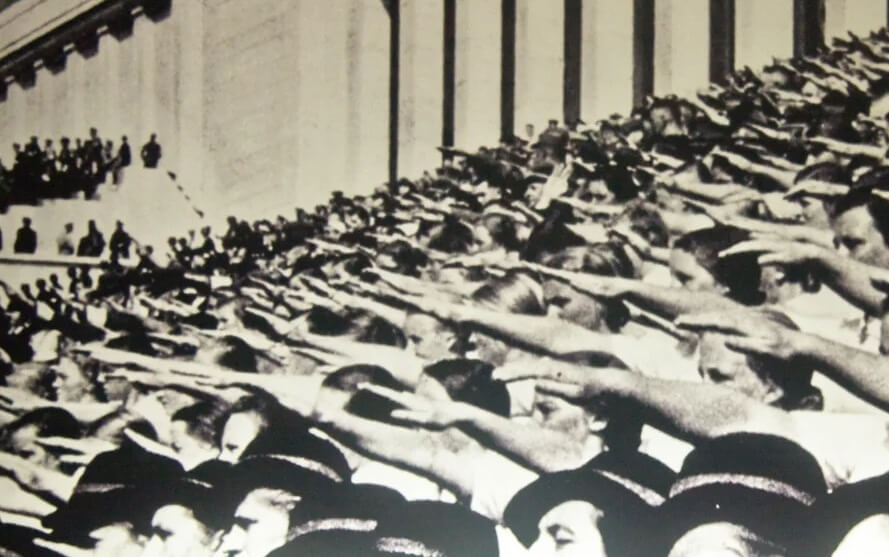
In Nazi Germany, loyalty to Adolf Hitler was not merely a political obligation. It became a public ritual. His portrait appeared in homes and institutions. His image was reproduced on posters and in films. The Nazi salute transformed ordinary encounters into declarations of allegiance. Propaganda portrayed him not simply as a politician, but as the embodiment of a wounded nation’s redemption.
The spectacle was carefully manufactured. Yet its effectiveness depended on something that propaganda alone could not guarantee: the willingness of some Germans to experience political submission as an expression of personal dignity.
This raises a question that extends far beyond the history of fascism. Why do people sometimes develop genuine moral attachments to political authorities that restrict their freedom? Why does criticism of a ruler become, for some, indistinguishable from an attack on their own identity?
The conventional explanation of dictatorship begins with fear. Authoritarian governments control institutions, punish dissent, and restrict political competition. These mechanisms matter enormously. But coercion explains why people obey; it does not fully explain why some come to admire the power that commands them.
There is a fundamental difference between obeying a ruler because disobedience is dangerous and believing that obedience itself is virtuous.
I call the latter phenomenon the sanctification of authority: the process through which a fallible political institution acquires the moral status of something that should not be questioned.
It is not unique to dictatorships. Nor does it require religious belief. It emerges whenever political loyalty becomes entangled with personal identity so completely that criticism of power begins to feel like a violation of the self.
The Comfort of Political Certainty
Political psychology offers several explanations for this paradox, though none is sufficient on its own.
In 2004, psychologists John Jost, Mahzarin Banaji, and Brian Nosek reviewed research on what they called system justification: the tendency, under certain circumstances, to defend existing social arrangements even when those arrangements impose disadvantages.
The theory suggests that political beliefs are not always straightforward expressions of material interest. They may also help people preserve a sense of stability, predictability, and coherence.
Consider the psychological consequences of admitting that an authority to which one has devoted years of loyalty is fundamentally illegitimate. Such a realization may require more than changing an opinion. It can threaten friendships, family relationships, social status, and the narrative through which a person understands a lifetime of decisions.
Under these conditions, defending the established order may protect something more intimate than political conviction: the continuity of the self.
A citizen confronted with evidence of government wrongdoing might reassess the government’s legitimacy. But another might reinterpret the wrongdoing as a necessary sacrifice for national security, historical progress, or collective survival.
Repression becomes protection. Privilege becomes responsibility. Submission becomes patriotism.
This is not an inevitable response, and the underlying psychology remains contested. A cross-national study published in Political Psychology in 2025, drawing on more than 24,000 participants in 42 countries, found stronger support for several explanations based on social identity and social dominance than for some predictions of system justification theory.
That finding matters. People do not necessarily defend a political order because they possess a generalized psychological need to rationalize inequality. They may defend it because they identify with its beneficiaries, perceive threats to their group, or believe their position depends on its survival.
The distinction complicates the familiar image of the submissive authoritarian follower. Some people are frightened into obedience. Others calculate that loyalty is advantageous. Still others genuinely identify their own worth with the prestige of political authority.
Identical public behavior can conceal profoundly different motivations.
When Loyalty Replaces Truth
The most consequential form of political devotion emerges when authority begins to determine not only what people are permitted to do, but what they are prepared to believe.
In ordinary political disagreement, citizens may dispute evidence, values, or institutional priorities. But when authority becomes sacred, disagreement takes on a different character. The question is no longer whether a leader’s claims are accurate. It is whether questioning those claims constitutes disloyalty.
Political identity becomes a filter through which reality is interpreted.
Evidence favorable to the leader confirms his exceptional wisdom. Evidence against him demonstrates the hostility of his enemies. Failure can be attributed to sabotage, while success is credited to the leader’s unique virtues.
The result is an epistemic inversion: power ceases to be an object of judgment and becomes a standard by which judgment itself is measured.
Nazi propaganda offers an especially disturbing historical illustration. The United States Holocaust Memorial Museum documents how the regime cultivated a public image of Hitler as Germany’s savior, employing mass rallies, visual symbolism, and carefully controlled appearances. The propaganda apparatus helped mobilize support and facilitate persecution, while also encouraging acquiescence among bystanders.
But historical precision is essential. The presence of public enthusiasm does not establish that every participant believed the propaganda. Fear, opportunism, social conformity, and sincere ideological commitment operated simultaneously.
The lesson is not that entire populations become psychologically incapable of resistance. It is that political systems can create environments in which independent judgment becomes socially costly and loyalty becomes a measure of moral belonging.
Once that happens, citizens may begin policing one another’s allegiance without waiting for direct orders.
Domination becomes partially self-reproducing.
The Problem Karl Popper Understood
The philosopher Karl Popper approached political authority from a different direction.
In The Open Society and Its Enemies, published in 1945, he challenged the traditional question of who ought to rule. Instead, he asked how political institutions might be organized to prevent bad or incompetent rulers from causing excessive harm.
This was more than a defense of constitutional government. It was an argument grounded in human fallibility.
No ruler, party, or political movement possesses immunity from error. Political institutions must therefore be designed around the possibility that those exercising power will make mistakes, abuse their authority, or misunderstand the society they govern.
Popper’s insight becomes particularly important when examined alongside the psychology of political devotion.
If citizens believe that a leader embodies the nation’s moral destiny, institutional restraints may appear unnecessary or even offensive. Courts become obstacles. Independent journalism becomes sabotage. Opposition becomes betrayal.
The institutions designed to correct political error are reinterpreted as threats to political unity.
The danger is not simply that a ruler claims to be infallible. It is that supporters may begin treating the possibility of his fallibility as morally unacceptable.
A political community organized around such assumptions loses more than its capacity to remove leaders. It weakens its capacity to learn from mistakes.
The Difference Between Fear and Faith
There is a temptation to explain authoritarian durability by describing populations as naturally obedient, psychologically dependent, or insufficiently committed to freedom.
Such explanations are both analytically weak and morally misleading.
People living under repression face constraints that outsiders may scarcely comprehend. Public conformity may be a rational response to imprisonment, unemployment, surveillance, or threats against one’s family.
Silence is not consent. Compliance is not devotion.
The distinction is crucial because political domination operates through multiple mechanisms at once. Institutions can compel obedience while propaganda seeks to cultivate identification. Economic dependence can discourage dissent while social belonging rewards conformity.
These forces reinforce one another without becoming identical.
The more interesting question is what happens when political authority is internalized so deeply that external coercion becomes less necessary for some of its supporters.
A person who fears punishment may obey while privately rejecting the ruler’s legitimacy. A person who regards the ruler as the embodiment of national virtue may instead defend that ruler against criticism, even when no punishment is threatened.
The second relationship gives domination a different kind of durability. It recruits the individual into the defense of the authority that governs him.
Yet such identification is neither permanent nor universal. Political identities can change, and institutions once regarded as legitimate can lose their credibility. No society is condemned to reproduce the beliefs of its rulers indefinitely.
The Right to Be Wrong About Power
The central vulnerability of political freedom is not merely that governments can become coercive. It is that citizens can lose the distinction between respecting an institution and worshipping its authority.
A government may deserve support for particular decisions. A leader may inspire admiration. Institutions may command legitimate obedience. None of these relationships requires the surrender of independent judgment.
The boundary is crossed when political allegiance becomes an obligation to believe, when evidence is evaluated according to its usefulness to authority, and when criticism is treated as a moral transgression rather than a civic act.
This is why the psychology of domination cannot be separated from the institutions of an open society.
Independent courts, a free press, political competition, and protections for dissent do more than constrain governments. They preserve the conditions under which citizens can revise their beliefs without treating intellectual disagreement as an existential threat.
Popper’s insistence on political fallibility offers a useful antidote to the sanctification of power: the legitimacy of an institution must remain compatible with the possibility that it is wrong.
Tyranny does not become sacred simply because rulers demand reverence. It becomes sacred when some of the governed begin to supply that reverence themselves.
The deepest danger is not that people are forced to obey power. It is that they may come to regard the surrender of judgment as proof of moral conviction.
A society remains open not because its citizens always recognize political truth, but because no political authority is entitled to decide, once and for all, what truth must be.


Related Posts