Artificial Intelligence Cannot Replace the Soul of Writing
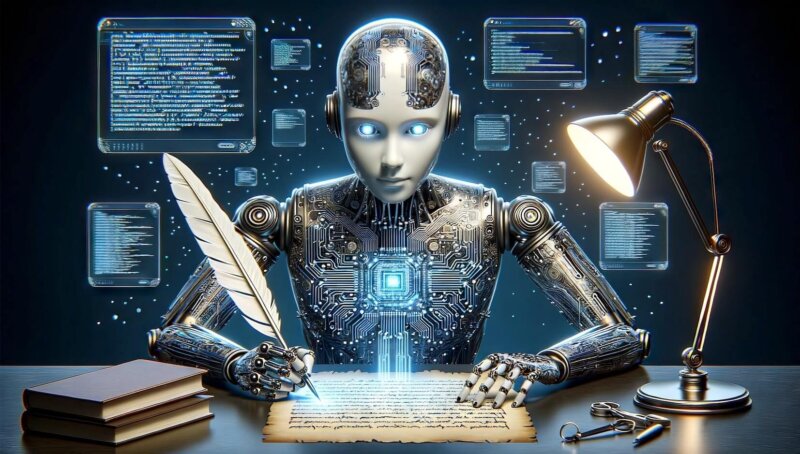
A few years ago, I was employed as a U.S. economist on the Economics team at Bloomberg LP. One morning, in a team chat on the IB messaging app that connects Bloomberg terminal subscribers, our chief U.S. economist described anxious discussions with her husband about the possibility that artificial intelligence (AI) could do our jobs more efficiently than we could, making our jobs obsolete.
It was not the best way to boost team morale, but she presumably had no ill intent in conveying concerns that are increasingly common in a world in which people can and often do use ChatGPT to compose emails, memoranda, reports, and full-length essays. One prominent aspect of our team’s responsibility was to write insightful “reacts” to data releases (e.g., monthly reports on employment and inflation from the U.S. Bureau of Labor Statistics) within 20-30 minutes of the release—just the kind of thing ChatGPT seems designed to do, only in less than five minutes.
As economists tasked with regularly monitoring, analyzing, and writing about the U.S. economy, we were like journalists with subject matter expertise in economics—not unlike the hundreds, if not thousands, of news analysts, reporters, journalists, and news anchors that Bloomberg has on its payroll. According to the U.S. Bureau of Labor Statistics (BLS), these jobs are considered at “high risk for automation” and are forecast to decline by 11.2% in the United States between 2019 and 2029. This trend highlights concerns about more broad-based job destruction in the coming years due to the spread of AI technology. One source estimates that a whopping 47% of all U.S. jobs are susceptible to automation “over some unspecified number of years, perhaps a decade or two.”
These concerns, however, are, if not misplaced, almost certainly exaggerated. As BLS notes, when technological advancement makes production more efficient, it can lead to increases in demand for the products and services, and thus the jobs of people who are involved in the production of those products and services. For example, “partial automation of warehouses may lower retail prices and expand the use of e-commerce so that the total number of warehouse workers might grow even as staffing patterns within each warehouse become leaner”—similar to how automatic teller machines (ATMs) reduced the number of bank tellers in individual bank branches, but also expanded the number of branches overall, leading to a doubling of the employment of tellers in the United States in the 45 years that followed the introduction of ATMs.
In the same vein, AI may replace tasks, but not necessarily the jobs in which workers perform those tasks. The jobs remain, but the workers perform tasks less susceptible to automation while AI performs tasks more susceptible to automation. For example, bank tellers “became less like checkout clerks and more like salespeople, forging relationships with customers, solving problems, and introducing them to new products like credit cards, loans and investments.” Lawyers previously may have billed a lot of hours reviewing documents produced during discovery, but now they can presumably let AI search for “hot docs” in electronic databases while they spend more time taking depositions of expert and fact witnesses in the cases they are working on.
In short, there is a great deal of concern about AI replacing jobs, but the concern is likely exaggerated. But when it comes to writing, and creative activity in general, I would suggest there is yet another glaring oversight in discussions about the effects of AI. In expressing worry about AI coming for her job, Bloomberg’s chief U.S. economist stressed the importance of finding ways to add value. It may be that large language models can spit out 500-1000 words of crisp, if generic, prose providing a competent, fine-tuned breakdown of the most recent U.S. macroeconomic data release, but it is still within the purview of an expert economist to distinguish herself with her own voice, perspective, and insights culled from diligent research and imaginative thinking.
In other words, effort matters. AI may be able to generate sophisticated “reacts” that become virtually indistinguishable from those we would expect from an expert, but one aspect of productive activity that AI can never replicate is the actual experience of writing a “react”—or an essay, a book, even a poem. Aside from unease about theft relating to patent infringement or labor exploitation, the use of AI in fields that involve writing—news articles, essays, etc.—also robs us of the rewarding experience of composing a work of prose (or poetry) through one’s own genuine effort.
In a society where “time is money” and corporations try to commodify everything in pursuit of the almighty dollar, we might say that the whole point is to find ways to save homo economicus the hassle. I would like to suggest, however, that saving ourselves the trouble is not worth the extra dollar in the same way that a philosopher might suggest that a politician tethering his rhetorical exultations to the weathervane of capricious public opinion is not worth the victory he or she may obtain. It is the signature of an empty suit rather than the mark of a man of virtue who has sincerely devoted the time and effort to articulate a platform of policy and reform on his own time.
Writing is an experience. Like food, water, or even religious worship, it nourishes the mind and soul in a way that no one else, or no other thing, can. The “inefficient” experience of journeying through the writing of an essay even if AI can do it in half the time or less—conducting research and assembling facts into a coherent narrative, composing an essay or article with cogency and perspicacity—rewards us with a sense of achievement. It makes us, dare I say, happier people. We may not be more efficient than an AI bot, but we are healthier and happier in mind and soul.
Many examples in life illustrate the point. When we are in grade school, we learn how to add, subtract, multiply, and divide. Sure, calculators can do it for us, but then we would be deprived of the satisfaction of learning how to do it ourselves, an exercise that will prove helpful throughout our lives in many situations. We also lose the sense of achievement that, for example, an athlete enjoys when he or she trains for a competition and wins. It is the fulfillment one derives from creative expression that is inherent in journeying through the writing of an essay. It gives us a sense of meaning and purpose. Even in a society where the pursuit of profit and wealth reigns supreme, we are still able to appreciate that money alone—e.g., the hourly wages a company may save an employee takes less time to compose memorandums—cannot buy the meaning, purpose, or sense of achievement that comes, for example, with composing the memorandum for oneself.
One of the ways that Nobel Laureate Elie Wiesel sought meaning and purpose as a Holocaust survivor was to write about his experience. As Victor Frankl, a Nazi concentration camp survivor, wrote in Man’ s Search for Meaning, “each man is questioned by life; and he can only answer to life by answering for his own life; to life he can only respond by being responsible.” It does not seem a stretch to infer that neither Wiesel nor Frankl would have found any peace, meaning, purpose, or satisfaction had they not taken responsibility for their unfeigned coming-to-terms with tragedy by relying on AI to describe their experiences with a few prompts in ChatGPT.
It is a truism of economics that there is no free lunch. When we use AI to write an article, essay, story, or poem, the time and effort we save is not free. It may come at the expense of a journey in which we are able to find our unique creative voice—and thus a profound feeling of meaning, purpose, and satisfaction—precisely by way of the time and effort it takes to discover our voice. We may worry that AI will take over the world of writing while it enriches shareholders, but the Bible warns, “For what shall it profit a man, if he shall gain the whole world, and lose his own soul?”


Related Posts