The Haunting Wages of Sin in Poe’s “Fall of the House of Usher”
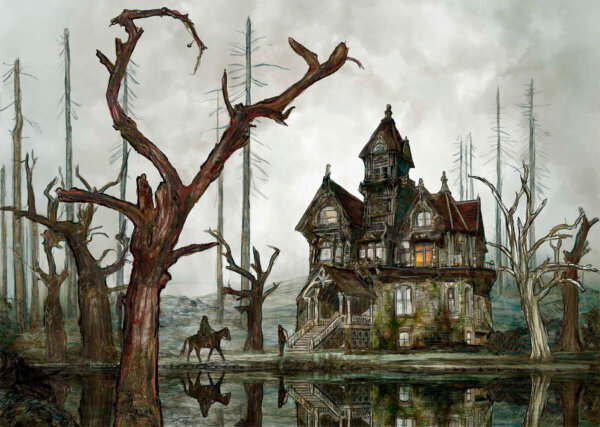
Edgar Allan Poe’s “The Fall of the House of Usher” is a classic of Gothic literature, dark romanticism, and an enduring reminder of the reality of sin. Written in a time when American optimism was still reverberating across the North American continent and around the world, Poe’s horror story casts skepticism over the “new man” and the “new race” of Americans lauded by Crevecoeur in Letters from an American Farmer. Poe’s infatuation with death, darkness, and guilt—the dread terror of the sublime—creates an antidote to the dreams of eternal progress.
“During the whole of a dull, dark, and soundless day in the autumn of the year, when the clouds hung oppressively low in the heavens, I had been passing alone, on horseback, through a singularly dreary tract of country; and at length found myself, as the shades of the evening drew on, within view of the melancholy House of Usher.” Poe’s opening is a great contrast with the light and beauty of the “American Eden” of so many early American writers who cast the North American continent as a paradisical world untainted by the corrupting spirit of prejudice, sin, and death. Even other Gothic writers like Irving and Hawthorne, while casting skepticism over the “American Eden” and the “American Adam” prevalent in early republican literature, still carry the traces of that serenity in their writings. One need just read “The Legend of Sleepy Hollow” or even The Scarlet Letter to find those glimpses (however short lived they are) to realize that no such Edenic serenity exists in Poe’s totalizing world in “The Fall of the House the House of Usher.”
Immediately, then, Poe brings us into an atmosphere of the dark, the supernatural, and the dreary. There is something deeply unsettling about the narrator’s entry to his boyhood friend’s home. Furthermore, the individual lauded by Crevecoeur and Emerson is equally attacked in the opening paragraph: the narrator is “alone.” So too is Roderick Usher, for that is why Usher has called upon his old childhood friend to keep him company as he slowly dies from the many illnesses that plague him. The self-making individual of hope and progress is non-existent in Poe’s world.
Nature, man, and man’s creations are all crumbling and decaying as we journey into the world of the Usher family. The narrator states that the mansion has “an atmosphere which had no affinity with the air of heaven, but which had reeked up from the decayed trees, and the gray wall, and the silent tarn – a pestilent and mystic vapour, dull, sluggish, fainty discernible, and leaden-hued.” He goes on to say of the prison-like environment of the mansion, “The discoloration of ages had been great. Minute fungi overspread the whole exterior, hanging in a fine tangled web-work from the eaves. No portion of the masonry had fallen; and there appeared to be a wild inconsistency between its still perfect adaption of parts, and the crumbling condition of the individual stones.” The semiotic language Poe gives us is decline, decay, and inevitable death. It captures our minds. It defines the reader experience, intentionally.
Physician and music are no remedies to the malady afflicting Roderick Usher and his crumbling home. The first description of the owner and last man (rather than new man) of the long line of Usher paints an equally horrific but gripping depiction of man as a sick, ghostly, and dying creature:
The now ghastly pallor of the skin, and the now miraculous lustre of the eye, above all things startled and even awed me. The silken hair, too, had been suffered to grow all unheeded, and as, in its wild gossamer texture, it floated rather tan fell about the face. I could not, even with effort, connect its Arabasque expression with any idea of simple humanity.
The narrator serves as the American Adam, the American rationalist and scientist, the “human” of the story entering into that dark and foreboding world that America was supposed to be leaving behind and, perhaps, even destroying in its ever restless pursuit of science, industry, and progress. Here, Poe is rather brilliant in showing the limits of rationalistic science. The actual physicians trying to help Usher are failing, thereby showing the limits of medicinal science. The narrator cannot see the “simple humanity” of his old friend, calling into question whether humans have that beauty which is often just asserted or if the image of the ghostly and ghastly Usher is humanity in its actuality. Usher’s own words do not bring hope but a gloomy despair, ‘I shall perish,’” he says to his friend, the narrator.
Rather than living for life itself or living to create a new life, the narrator has come to join in Usher’s descent to death. Once again, Poe implicates the meaning of existence here: death is the journey we are on whether we admit to it or not. What makes Usher the ironic hero, then, is that he admits he is on the path to death and simply wants the narrator’s friendship to accompany him in that descent to the grave.
As we know, the narrator learns that Usher has a sister, Lady Madeline, who is also dying. The brother and sister are all that remain of the Usher family line. And while she is “his sole companion” and he cannot bear the idea of her death for it would leave him “hopeless,” adds a twist to the drama of sin and death in the story. There is a strong implication and insinuation of incest between Roderick and Madeline, and he who cannot bear to live without her has plans to bury her alive.
Why did Usher bring his friend to visit him? To bury Lady Madeline alive! He needs the strength and help of his friend to accomplish this and to prevent the possibility that any other man could live or have company with Madeline if he dies first. So Usher lies to the narrator that she has died and the two bury her alive, unbeknownst to the narrator.
The climax of the story involves the guilt of Usher in burying his sister alive—for he knows and is wrecked by his crime—to which the narrator is initially unaware about. Outside, nature transforms from decay to storm, mirroring the internal disturbance and destabilization of Usher (and the narrator). The narrator, still clinging to rationalistic explanations for the horror and dread mystery he encounters in the mansion and with Usher, explains the increasing madness of his friend with the frightful thunder, lightning, and wind storm outside as compounding the tragedy of losing a sister:
The impetuous fury of the entering gust nearly lifted us from our feet. It was, indeed, a tempestuous yet sternly beautiful night, and one wildly singular in its terror and its beauty. A whirlwind had apparently collected its force in our vicinity; for there were frequent and violent alterations in the direction of the wind; and the exceeding density of the clouds (which hung so low as to press upon the turrets of the house) did not prevent our perceiving the life-like velocity with which they flew careering from all points against each other, without passing away into the distance. I say that even their exceeding density did not prevent our perceiving this—yet we had no glimpse of the moon or stars, nor was there any flashing forth of the lightning. But the under surfaces of the huge masses of agitated vapor, as well as all terrestrial objects immediately around us, were glowing in the unnatural light of a faintly luminous and distinctly visible gaseous exhalation which hung about and enshrouded the mansion.
“You must not—you shall not behold this!” said I, shuddering, to Usher, as I led him, with a gentle violence, from the window to a seat. “These appearances, which bewilder you, are merely electrical phenomena not uncommon—or it may be that they have their ghastly origin in the rank miasma of the tarn. Let us close this casement;—the air is chilling and dangerous to your frame. Here is one of your favorite romances. I will read, and you shall listen:— and so we will pass away this terrible night together.”
When the narrator beings reading a story to calm Usher, the story within the story makes things even worse for it mirrors the reality of the situation everyone is in. A loud noise is heard banging in the distance. The narrator realizes it is not his own fantastical imagination but truly real. Then, of course, the horrifying climactic reveal hits the reader right at the end of the story: Lady Madeline was buried alive! “[T]here did stand the lofty and enshrouded figure of the lady Madeline of Usher. There was blood upon her white robes, and the evidence of some bitter struggle upon every portion of her emaciated frame.”
Poe’s final revelation of Lady Madeline is telling. She is dressed in white robes, white garments, as if prepared for a marriage, but also emaciated and dressed in white to give the appearance of a ghost come back to life. Just as Roderick Usher and Lady Madeline lived together in a state of decay (and almost certainly, sin), she falls upon him in a final embrace and dies in his arms and the fright of her sudden “resurrection” and fall into his arms causes him to die. The two die together in an ironic eternal embrace for the wages of sin truly are death. The brother and sister who could not truly be separated die together as their intertwined lives were always destined. The narrator flees and looks behind him to see the mansion destroyed.
Poe’s short story, brilliant for its “totality,” reminds us that death is an ever-present reality in the world. Though we flee from it, we cannot escape it. Though we often ignore it, the more we ignore it the more it comes knocking at our door. I myself am thankful for Poe’s reminding us of this dark and horrifying reality even if he often goes too far into the just darkly and dreary. Yet within his own dark and terrible world of dread horror, there remains an odd beauty to it all, and a hope that there is a Love and Beauty that exists beyond the grave. Poe allows us, as readers, to return to the world of the dark, deadly, and the supernatural while not joining Roderick and Madeline in an embrace of ashen blood. The narrator does escape and there is still hope for him (and us) in the end. Hope in a world of death, hope in a world that is imperfect, hope in a world where the wages of sin is death, is a hope greater than the empty hope preached by Crevecoeur and others who do not see the darkness around them.


Related Posts