Faust and the Confrontation with Darkness
Have you ever felt paralysed, heartbroken, or caught wagering with the devil himself? If so, you may relate to Johann Wolfgang von Goethe’s protagonist in his episodic work, Faust. Heinrich Faust can be noted as not sharing the same first name as the legend Johann Faust, perhaps because Goethe did not want to render the story as a self-insert.
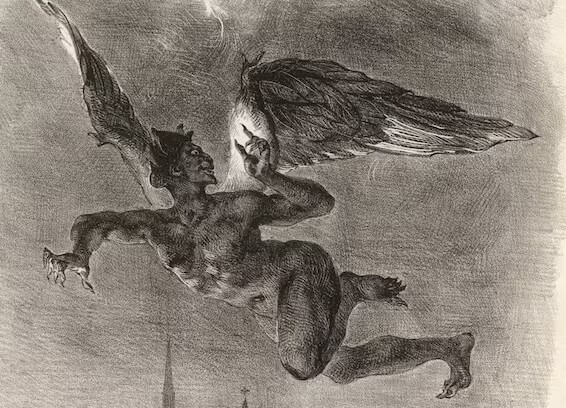
Goethe’s Faust is notorious for the impossibility of regurgitating it in a synopsis, especially regarding its second part. If I were to try and confine it somewhat laconically, I’d define it as a scholar who wagers with the devil, with whom he journeys through both parts and explores everything from ephemeral romance to politics and the classical world, concluding with what I believe we could deem a re-evaluation of Christian values. Of course, this summary would be lacking for the tastebuds of the intellectual readers of VOEGELINVIEW; thus, I must expatiate and elucidate on what I’d immaturely call the greatest fictional book ever.
Firstly, I wish to candidly disclose that I read Goethe’s Faust at a somewhat manqué and gloomy moment in my life. I had experienced intellectual paralysis and, as at the time a bereft, yearning individual, I found myself coping with solitary reading, through which I stumbled upon Goethe’s Faust. The poetry of Faust, for me, is that in these dramatic plays Heinrich Faust tries to find fulfilment, while finishing both parts left me intellectually sated.
I remember feeling catharsis at the beginning of part 2. In the first part, Faust goes through many moments of grief and retreating to the woods, and we would get an overly histrionic speech from him for Mephistopheles to bring back down-to-earth using comedy. The opening of part 2 sees Faust washed in the dews of Lethe by spirits who do not care about whether you’re good or evil. This sets up the start of part 2’s mysticism. When washed, there’s no remorse or even recalling of his past relationship with the girl Gretchen, whom Faust loved in part 1, as it’s all washed away. His paralysis is cured, and he moves forward to the grand scheme of politics and classics.
One may interpret this recovery as time; time heals all wounds, especially because this was written by a much older Goethe, who indeed had past relationships similar to his protagonist Faust. Do you still feel sadness for a relationship you had decades ago? I doubt it. For me, being 18 years old, I’m just a couple of years younger than Goethe when he wrote his book that went popular overnight, Die Leiden des jungen Werther (The Sorrows of Young Werther).
It’s also really important to me personally, because I went through angst and dwelled on the past. It taught me the lesson that you should constantly push forward, so while tragic Faust forgets all of Part 1, it was essential for him to continue striving, which is the most important endeavour.
To an English audience, many will be unfamiliar with the name of Goethe, but will likely have stumbled upon Faust through Christopher Marlowe’s version. This is because Shakespeare is the apex of the English canon, whilst Goethe is that for the Germans. Because of this, each school in England will have a de facto mandatory requirement of being acquainted with Shakespeare’s tragedies and, in some schools, his comedies; whilst for Germany, their curriculum is likewise, but instead with Goethe.
I certainly wish I could describe every important detail in granularity, but sadly this would be impossible for this great epic. However, one small detail I enjoyed is that at the start of part 1, Mephistopheles gives this student appalling advice, masquerading as a professor of academia with Faust’s robes, and concludes with the Latin “Eritis sicut Deus, scientes bonum et malum.” I will not translate and leave that up to the classicists.
Mephistopheles and the student reencounter in part 2, and the student has become a solipsist. Not only that, but he believes the professors represent the old way of doing things and that they should be removed. Goethe knows the young students who will watch the play in person will be in front, so Mephistopheles says that he knows none of the young people at the front are clapping for him or what he is saying regarding his conversation with the student. This is why I think it would be derailing if the students who were acquainted with Goethe’s Faust beforehand did clap.
In the first part, Faust finds the nonsense of the devil world sickening. This is surprising because at the start of the play, Faust attempts to terminate his life after being rejected by the Erdgeist. Some exegesis is required apropos of the story. Faust has mastered all the university faculties and is displeased with his human limits and cannot understand the truth; therefore, he takes up the mystical book of Nostradamus. He then summons the Erdgeist who, after their brief conversation, tells Faust, “Thou art like the spirit whom thou comprehendest, Not me!” This is Platonic philosophy on being unable to see the true object and only its shadow because of human comprehension, the famous example being the allegory of the cave.
Of course, this breaks Faust and drives him to do another dramatic speech, to which is interrupted by his famulus Wagner. This interruption should be seen as Wagner representing the rationality of the world and bringing Faust back to the everyday world after his dramatic experience in his study room. Faust throughout the play, readers will know, despises the nonsense from the witches when they’re crafting the rejuvenation potion, as it goes against what a scholar should do.
When drinking the rejuvenation potion, Mephistopheles notes that he will see every woman as Helen of Troy, representing that his youthful drive has returned, which is needed to abandon the dry, tedious, pedantic world Wagner lives in that many of you readers may be familiar with. It’s humorously foreshadowing, as Mephistopheles and Faust in part 2 do meet Helen of Troy.
To meet Helen of Troy, Faust is told by Mephistopheles he has to go to the Mothers — a place representing nothingness and emptiness, which Mephistopheles fears. This is ironic as Mephistopheles, at the start of the play, addresses himself as part of that power which eternally wills evil yet eternally works good, and most importantly in this context, the devil that negates. The Mothers is consonant with Mephistopheles’ philosophy, yet he is afraid of being in such a place, ironic I’d say.
Though I should add it’s consistent. As Mephistopheles somewhat says (but I’m paraphrasing): ‘Sex with young witches, cheap tricks — I’m your guy. But the ancient world is foreign to me, as she’s a pagan soul in a classical world not accessed by Christianity.’ Which I found rather puzzling as a Catholic because Lazarus, Jesus Christ’s good friend, had been sent to Hades; so, the classical world is definitely bridged to Christianity. But that is a conversation for another time.
Faust retrieves Helen of Troy and Paris as they are the epitome of beauty, but the nobles who see her, especially the women, grumble that she’s much prettier in their parts. But Faust is completely enamored by her beauty. So the question we all should ask is, why does Faust find Helen beautiful but Faust’s contemporaries don’t? I believe this is because Helen represents the timeless, atemporal beauty Faust has been longing for, in contrast to his short and destructive romance with Gretchen. This is also the continuation of his pursuit of the eternal feminine, which would be a familiar theme to readers of The Divine Comedy with the relationship of Dante and Beatrice.
To expand, Faust now seeks something more permanent. I, as well, even though the classical world is being obscured to us every day as we move towards a more modern society, still see beauty in classics as Faust does. Even if others cannot, I relate to this love for classics, and anyone who has read this timeless work of Faust can see this grand theater of classics in Classical Walpurgisnacht.
At the end of Faust, he is 100 years old and attempting to tame the sea, as he sees it as unused energy. Once again, he wants to undertake a permanent project that is purposeful. He is visited by four allegorical women: Want, Debt, Distress, and Care, but only Care (anxiety) can come to a rich man’s house. Faust doesn’t acknowledge Care and mentions how she can make a wise man go insane. In the end, she tells him to be blind, Faustus, and blows into his face, causing Faust to lose his sight.
Blindness mustn’t be viewed as losing life; rather, it is the affirmation of life. The famous example is Oedipus Rex of Thebes gouging his eyes out, which, through a Nietzschean lens, is to affirm life, which finally implies he takes control of his life and a psychological escape from a term called learnt helplessness.
The God in Faust is not like the God of the Bible, despite the clear reference to the Book of Job in the prologue in Heaven. God in Faust believes striving is the most important thing and would not like monks who do nothing but would likely forgive Erasmus as he did not follow monastic life. This is why he uses the devil to make Faust strive and not to rot in his study room with his father’s heirlooms. Striving in the end is what redeems Faust, as mentioned, the eternal feminine is a key theme as Gretchen embodies the divine and saves Faust despite what she was put through.
The angels in Faust, in the end, somewhat seduce Mephistopheles and throw roses to the fiend of the devils, to which Mephistopheles notes these are the devils’ tactics, showing how they are kin to him. I find that a rather cool detail.
Genuine tragedies in the world are not conflicts between right and wrong. They are conflicts between two rights, a concept often attributed to Hegel’s philosophy. I recall thinking of this quote when Antigone wishes to bury her brother Polynices, which she believes is an important aspect of life and love. Meanwhile, Creon, who represents the necessity of the legal world for a society to function, will not allow this burial to happen, indicating two rights contrasting each other.
This theme can be applied to Philemon and Baucis, an elderly couple who happen to live where Faust wishes to perform his grand coastal empire. Every night, the bell of their chapel haunts Faust and attacks his ego. He asks Mephistopheles and his grunts to evict them from their house, to which they deliberately misinterpret and kill the couple. Faust is horrified when he hears this news, yet ironically, he is to blame for this.
This represents two rights: the elderly couple who lived there for decades and their right to humanity and peace, and Faust’s technocratic expansion and desire to make the world a better place. This is what makes Faust such a great tragedy, even if Nietzsche doesn’t believe it to be one.
It was quite comedic when Faust shouts “Gang-master!” and Mephistopheles responds “Here!” instead of “It’s me, Mephistopheles”. I doubt the parts would be half as good if the deuteragonist or antagonist, if you will, Mephistopheles, wasn’t there.
Indeed, I could go on for hours about why this is the greatest book of all time, and you shouldn’t read it solely for the story but also how it can cure you, as it did for me. Goethe’s Faust is a timeless piece for anyone that believes paper money is the work of the devil!
Goethe’s Faust is for the Marlovian overweeners who are sarcastic and cynical, often like Shakespeare’s Hamlet, who is known to extend metaphors and go against human limits. When someone tells you your limits, don’t think you should abide by them, but instead, learn how to remove them and become boundless — that’s my advice. Just make sure for fellow Catholics to remember in the beginning it was the word and not the deed!
We should all be like Faust and not be afraid of darkness. When he went blind, he imposed himself onto reality, just like how he continued to tell his men to dig, even if it happened to be a bunch of demons or lemurs, depending on whether you read David Constantine, digging your grave. The beautiful moment may be a lie and not what actually happens, but that striving is something we all need, I’d say.


Related Posts