Futurism and the Global Market State
The age of the nation-state is over. Some may not want to hear this, but it is true. National states still exist in a legal framework, but their purpose is no longer contained to that framework of national law and economy. Instead, national states exist to optimize individuals living in their jurisdiction the fruits of transnational global capitalism.
Before one laments the end of the nation-state, it should be pointed out that political societies are organized on ever-changing realities. Despite pretentions claiming otherwise, the age of the nation-state was preceded by regional and localist loyalties only nominally attached to a superstructural monarchy (in most cases); part of the struggles waged in early modernity as monarchies centralized into their protonation-state form were with the local nobilities, the appanage lands, where great power and citizen loyalties were found and needed to be overcome in order to achieve centralized conformity. Other polities were organized around the merchant city-state—one can think of late medieval and Renaissance Novgorod, Venice, Florence, Milan, Genoa, etc., as some examples. Of course, there were also transnational empires, polyglot entities that were rebuffed by city-states in even earlier examples. Political organization is constantly shifting and changing, and we’re living through such a change right now.
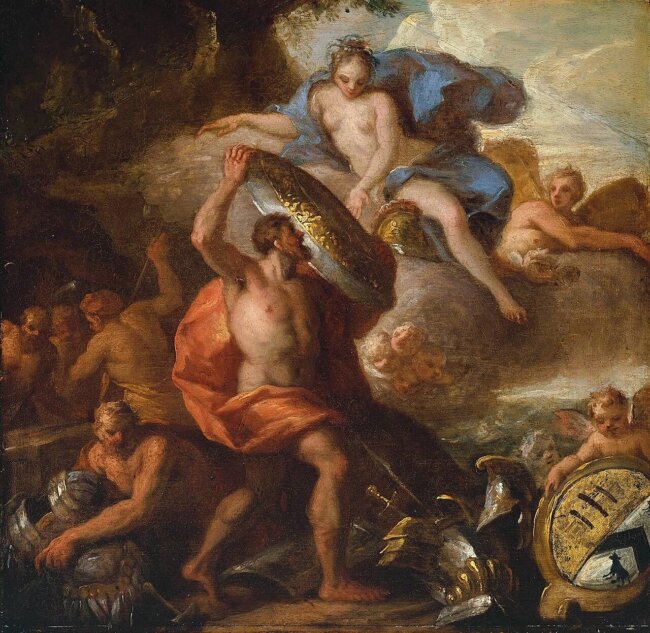
The reality of the global market state has been observed over the past two decades, none more powerfully so than by Philip Bobbitt in his The Shield of Achilles. He popularized the term “market state” to describe the emerging socio-political reality of the western world but also the rest of the developing world where individuals of talent, merit, and daring would seize the opportunity to migrate into western market states to better enhance their own lives and reap the fruits of a developing global economy than if they remained in their native countries. As is always the case in economic reality there are “winners” and “losers;” the winners being those who have the knowledge, skill, and perhaps even luck, to benefit from the global market and the losers being those who are unable to benefit from the global market whether it be through economic dislocation, their own lack of knowledge and skills in an ever transforming economy, or even their geographic home.
This global market state was, not unironically, the product of a nation-state—principally the United States. After the Second World War, the United States was the only advance economy that was not destroyed by the maelstrom of global conflict. This meant that the United States had a monopoly of economic production while the rest of the world needed to be rebuilt or achieve independence from the still existing imperial powers of Europe. The United States exported its produced surpluses to the rest of the world, especially Western Europe and Japan, which also served the new geopolitical purpose of containment of the Soviet Union in the early days of the Cold War. The mercantile system of the British Empire was dismantled and the hegemony of an American-led “free-trade” system was established.
Much of the contemporary political crisis in the United States is a byproduct of this economic one-off moment. By the 1970s, a rebuilt (West) Germany and Japan began to eat into American economic production. So too was Soviet economic productivity and exportation as part of their Cold War strategy which put stress on the American dominated production monopoly the United States enjoyed after 1945. The election of Ronald Reagan and the implementation of neoliberal economic policies advocated by Milton Friedman transformed the essence of the American economy from a producer economy to a consumer economy (though the United States still does produce a lot)—this had the direct impact of facilitating the rise of China as an economic producer and ensured the graduation transition into a preferential consumer economy where the American market benefited from the import of affordable goods. Margaret Thatcher’s embrace of neoliberal economic policies also helped revitalize a de-industrialized United Kingdom’s transition into a consumer economy; the European Union, by and large, would subsequently follow suit.
By the law of comparative advantage, the western world became a high capital consumer economy while the east Asian world, especially China, became a producer economy. The west and east were united into the interplay of supply and demand, consumption and production, with western consumer capital funding the products made by (cheap) east Asian labor. Western consumption, therefore, did facilitate China’s economic rise because China’s productivity was largely spurred by Western consumption and capital investment for the purpose of cheap consumption which made goods widely affordable to many and not just the wealthy few. Luxury goods were not affordable and available en masse.
When the 1990s “end of history” set in, the western world had effectively completed its transition into a capital-focused consumer economy. Service and retail replaced the old labor and manufacturing jobs. Cheap consumer goods flowed into the western world ensuring relatively low-cost goods would be affordable to nearly all individuals and families regardless of socio-economic status. It then became the “managerial” purpose of the west, led by the American government and its alliance with corporate capital, technology, and the military industrial complex to “protect” this emergent global market state from disturbance and imbalance. Further, people from around the world began mass migrations into western states to try and reap the fruits of the globalized network between west and east—the humanitarian impulse of western bureaucracy and law generally provided shelter to these individuals which has subsequently wrought the cultural problems we see today, especially in Europe, and to a lesser extent portions of the United States. The purpose of western governance, then, has been twofold: to maintain the consumer economy to which citizens have benefited even if ungratefully so in light of contemporary protests and conspiracy theories and trying to incorporate and integrate migratory peoples into their own societies. Many of these migratory peoples come from the producer economies that the consumer economies of the west rely, the many southeast Asian, Indian, and Chinese immigrants want to enjoy the fruits of high consumerism that define the west but is only sparsely available in their native countries; those also fleeing from war and failed regime change quickly seek the same. The dominance of the neoliberal market mentality of the self-creating self and rational consumer, rather than the citizen of the polis, ensures the relative openness of western governing elites to welcome these people as consumers.
This, however, is not necessarily a rosy reality. There are significant cultural issues that still need sorted out, but the high level of American assimilation and Christianization of immigrants is still a good model of hope for the global market state as it exists and operates within the United States. The anti-assimiliationist and anti-Christian ideology of culture war in the United States is more a byproduct of white Americans leaving the American and culturally Christian identity of the United States than the increase of foreign immigration into the country. The cultural battles in America have become a wedge point between secular progressives using foreign born immigrants against predominately white Christian citizens who fall prey to nativism which perpetuates the secular stranglehold on otherwise religious and socially conservative or moderate immigrants who are made to believe their opponents are white, Christian, citizens. While this culture war must still play itself out, the apoplectic apocalyptic attitude of some seems unwarranted. The fact that most secular progressives do not marry or have few, if any, children ensure their eventual demographic demise.
Let us now, for a moment, return to the matter of the global market state, or its sometimes-derisive epithet of neoliberalism. What is neoliberalism (the global market state)? I would caution against the faulty, and ultimately prejudicially Whig, conceptualization of (neo)liberalism as some rights and liberty-affirming, law-based, democratic system invented from the supposed discoveries of the Enlightenment. Ancient societies also had rights and liberties, perhaps not to the extent we do today but the prejudice of the Whig is to cast aside any notion of liberty from the ancient world to make rights and liberty the exclusive discovery of modernity which is historically ignorant and demonstrably false. Likewise, the rule of law existed even in the agrarian societies that emerged after the Neolithic Revolution so it is equally historically ignorant and demonstrably false to assert the rule of law as a discovery or invention of the Enlightenment. Some ancient polities also practiced forms of democratic governance which directly inspired the democratic and republican movements of modernity as readers of political philosophy know well. So rather than the tired old Whig conceptualization what should we understand neoliberalism to be? I’d say neoliberalism is the political order of capital, technology, and the (American) military industrial complex (including the security-surveillance state) united in its management (protection) of the global market and has its legitimacy conferred through democratic elections. This reality of neoliberalism also has its direct influences from the (classical) liberalism of early modernity in its materialistic, economistic, and scientific understanding of the world and purpose of human life.
It is here that we must contend for a future worth having in the neoliberal global market state which has transcended the nation-states of the previous two centuries that have defined societal governance and identity. The alliance of capital, technology, and the military-security-surveillance complex which protects the flow of economic productivity and consumption on a transnational basis can either be utilized to enhance individual liberty, choices, and movement or restrict individual liberty, choices, and movement. The Chinese Communist Party represents the more totalitarian and restrictive model within neoliberalism, utilizing the application of capital, technology, and the security-military apparatus (neoliberalism) for the purpose of constricting individual liberties, choices, and free-movement of people (and even surplus capital). Then there is the American way, still struggling for its survival, wherein the Constitutional guarantees of individual rights, liberty, and the ease of travel, movement, and capital allocation (free enterprise) act as the bulwark against the restrictive aspirations of monopolistic capital and technology through the lobbying of the military-security-surveillance state (the government). A third way, which appears to be emerging in Canada and the European Union, is a softly restrictive model where technology is closely monitored, regulated, and controlled which restricts individual liberty and information under the guise of various civil rights rhetoric and the language of the “common good” or “saving the planet.” This third way is the “progressive” ideology of the west—one that would use the levers of government to control capital and technology for specially-designated groups or individuals while restricting the rights, freedoms, and fruits of global market consumption for other designated groups or individuals. This operates under the ideology of equity. In both the American and third way (European) model, the legitimacy of the actions of capital, technology, and the security-surveillance state is ritualistically affirmed through democratic elections which grants an illusion of freedom not conferred by the more totalitarian model of China.
The legitimate criticism of the neoliberal paradigm is in its flexibility of either being a model which will allow hard or soft totalitarianism. But, as just outlined, this need not be the case. The global market state within neoliberalism can equally permit high degrees of freedom and self-creation, as is still the case in the United States which is why America remains the attractive destination for people wanting to enjoy the benefits of the global consumer economy (which exists in its most developed and dignified form in the western world, the United States most especially). This, of course, should be the cause of liberty-loving people everywhere.
Further, while it is unarguable that the metaphysic of neoliberalism, drawn from the crude and vulgar materialism of classical liberalism, portends to an anti-spiritual and ultimately de-humanized vision of life, this need not be the case either since the backsliding into such a worldview is ultimately the result of individual-cum-collective resignation. There is no reason why a vigorously spiritual and humanistic culture cannot flourish within the neoliberal paradigm. After all, for much of the existence of the soft liberalism of modernity, people remained religious and dedicated to humanistic culture and learning. The world wars, more than the mere liberalism that softly governed European and American society over the past two centuries, seems to have drained the spiritual and humanistic confidence and strength of Euro-Americans who, without that spiritual and humanistic core, succumbed to the temptations of scientistic and materialistic collectivism in the forms of fascism and communism and now the third way managerial progressivism of the twenty-first century. In fact, the most beneficial reality within the neoliberal global market state would be a result of spiritual and humanistic revival—this has been the view of many of the great intellectuals who didn’t fall for the captive mind of the totalitarian seduction: Irving Babbitt, T.S. Eliot, Eric Voegelin, Russell Kirk, and Roger Scruton to name a handful of individuals.
Futurism recognizes the epochal transformation we are living through. And this epochal transformation is the end of the nation-state and the emergence of the global market state, or neoliberalism. It is our task, then, to first recognize this world historical transformation and contest for a positive future within this emergent order and reality. As America is still the de facto leader of this emergent order, America remains the epicenter for the future of a better and more hopeful tomorrow. Yet the emergence of China as a competitor within the neoliberal order with its vision of a far more restrictive form of governance within the global market state marks it out as both competitor and challenger of the broadly speaking libertarian vision still possible in the United States. It is also of the upmost importance for a restoration of European self-confidence and transatlantic partnership that Americanizes Europe (and Canada) away from the third way model and toward a more libertarian futurism rather than the Europeanization of the United States to being the predominate force of the third way managerialism which percolates much of the bureaucracy of the European Union.
The battles of the twenty-first century revolve around what kind of order and society we will have in the neoliberal model which has transcended the nation-state. Futurism accepts there is no going back, but it doesn’t preclude the possibility of recovery of past wisdom and goodness for the purpose of building a better tomorrow. Count me as a humanistic futurist, a “conservative” futurist, who believes—alongside Matthew Arnold—that “the best which has been thought and side” about the human condition, the cultural and political wisdom of our forebears and Founding Fathers, still counts for something and can ensure a freer future within the neoliberal paradigm where capital, technology, and the military industrial complex provide the skeletal structure for the loves of the human heart and soul to flourish.
To this end I will conclude by saying that the spiritually strong will be the bulwark against the totalitarian temptation embedded in the scientistic and materialistic undercurrent of neoliberalism. The call and demand for sacrifice will not be answered by those already surrendered to the apathetic and passive nihilism of the Last Man. Neither will the resentful who seek the destruction of the current order through a return of some cosmic wisdom of the pre-Socratics, a world of perpetual flux and struggle; we saw what the embrace of this worldview led to as it specifically relates to Nazism. A life of adventure, creation, and possibility is now available to more than ever before—this is an undeniable positive good of the emergence of the global market state. Now, to borrow from Plato, it is incumbent for those who have had the grace to leave the Cave to return and guide many more out of the Cave to the better world just over the horizon.


Related Posts