Educating for Virtue
What is the purpose, the philosophy, of education? Most people agree that education is important. Dissatisfaction with the current state of education isn’t evidence of animosity toward the importance of education but a disagreement over what the intent of education should be about. Although most of us agree that education is important and want our children to do well with their education, most do not have an understanding of what the goal of education is.
“Teach these boys and girls nothing but Facts. Facts alone are wanted in life. Plant nothing else, and root out everything else.” Those are the famous words of Mr. Thomas Gradgrind, the aloof and utilitarian headmaster in Charles Dickens’s novel Hard Times. The main characters of the story get trapped in the dour materialism of Gradgrind’s philosophy of education which eradicates wonder, awe, and imagination from life.
At face-value, the elevation of “facts” as the only priority of education seems like a conservative rallying cry. We hear that famous phrase often retorted all the time on college campuses by the likes of Ben Shapiro and Charlie Kirk, “Facts don’t care about your feelings.” This approach, though, is actually steeped in the progressive model of education – turning students into cogs of the zeitgeist. The older tradition of education replaced by John Dewey’s model of progressive education, the same one reflected in Mr. Gradgrind’s “Facts alone” speech in Hard Times, used to concern itself with awe, wonder, imagination – the “moral imagination” of Edmund Burke, G.K. Chesterton, and Russell Kirk.
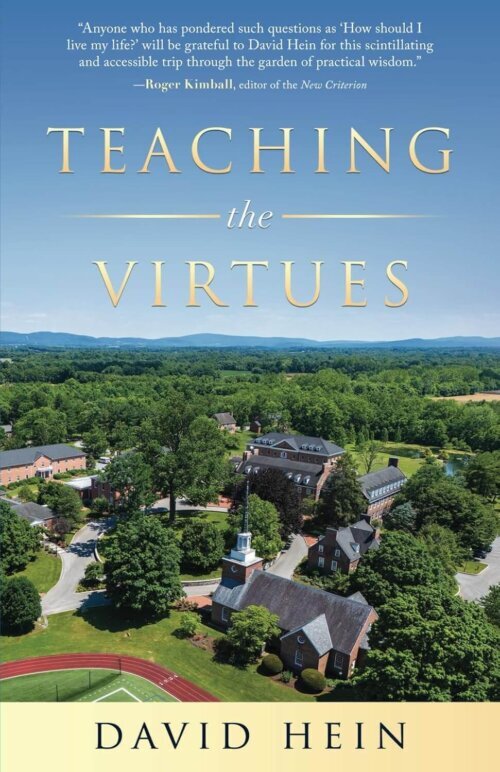
What does an education in the moral imagination entail? The teaching of the virtues. This is the perennial debate in education, one that goes back to Plato and Socrates and whether virtue can be taught (and should be taught). In his newest book, Teaching the Virtues, David Hein offers a concise and robust defense of the necessity of teaching the virtues and the moral imagination. “Can virtue be taught?” That’s the question that Hein asks, and he answers emphatically “Yes”!
However, the teaching of virtue “requires the eradication of a vice.” Hein uses his own life as an example through how he quit smoking and how this simple choice of eradicating the vice of smoking entailed so many virtues within it:
The acquisition of a virtue typically requires the eradication of a vice. A cigarette smoker in my late teens and early twenties, I knew (at some level) that I wanted to do right by myself (justice), I sought self-control (temperance), I desired a long and healthy life (hope), I didn’t want to keep being foolish (prudence), I wished to be strong and not weak (fortitude), and so forth. Most of all, I wanted to be free and no longer the slave of my addiction.
Here, Hein puts his thumb on a critical issue concerning the problem of “freedom” in the modern mind. Freedom, since the time and development from the philosophy of Thomas Hobbes, John Locke, and others, has meant choice without the concern for consequence. To be free means you can choose to smoke even if it enslaves you to the consequences of smoking – how free we are to have that choice! Yet true freedom, as explained by many ancient Greek philosophers like Plato, Aristotle, and Epictetus, Roman stoics, Christians, and even other early modern philosophers, meant freedom from vice, the ability to know and choose the Good in all things. Choice is entailed in freedom, but not all choices lead to freedom.
Furthermore, Hein importantly distinguishes the difference between education and schooling. To be educated means to develop “the habits—in particular, the moral traits—of a good life than it is about delivering content, as important as knowledge is.” Education concerns itself with taking knowledge for self-empowerment in pursuit of the good life whereas schooling merely entails the delivery of content to students who, in turn, become robots of that content able to regurgitate the facts, ideas, proofs, and methods delivered to them. Schooling means a student is ultimately passive. Education seeks to empower and liberate students into the freedom of the good life embodied by virtue.
As a teacher of the humanities and a writer, I wholeheartedly agree with Hein’s defense of the moral goodness of education, the need for education to aim at virtue, and how even writing and reading (subjects I teach as a Literature instructor at a preparatory school) entail the virtues of the moral imagination. “Writing,” Hein reminds us, “is a moral act.” How? Writing develops excellence, excellence in thinking, expression, logic, and more. Writing should be hard as it strives for excellence in communication, which is the manifestation of excellent thought, labor, logic (composition), and respect for your reader. At the same time, writing is moral in its claim to authorship. Writing develops integrity in a writer in claiming what is theirs and acknowledging what is the writing or thought of another. Therefore, writing is inherently relational. Writing invites friendship with readers and writers, past, present, and future.
Likewise, the study of history shouldn’t just be about names, dates, and facts. It should be about the virtue of courage found in acts and individuals of history. Here, Hein shines as he gives brief list and exploration of profiles in courage, from Booker T. Washington to George C. Marshall and why these individuals are exemplars for us to study and, more importantly, to emulate. Not so we become the next Booker T. Washington or George C. Marshall, but so we become the incarnate embodiment of the virtues that they lived by.
Hein ultimately rearticulates and revises an understanding of the “moral imagination” that links past, present, and future. The task of educating in the virtues is to take the good of the past to create strength in the present and hope for the future. This spirit of education is an absolute necessity for our world. There is hope for education’s future if we just know where to look and what to support.
Teaching the Virtues
By David Hein
Mecosta: Mecosta House, 2025; 222pp


Related Posts