Golden Age Movies: On the Two American Dreams
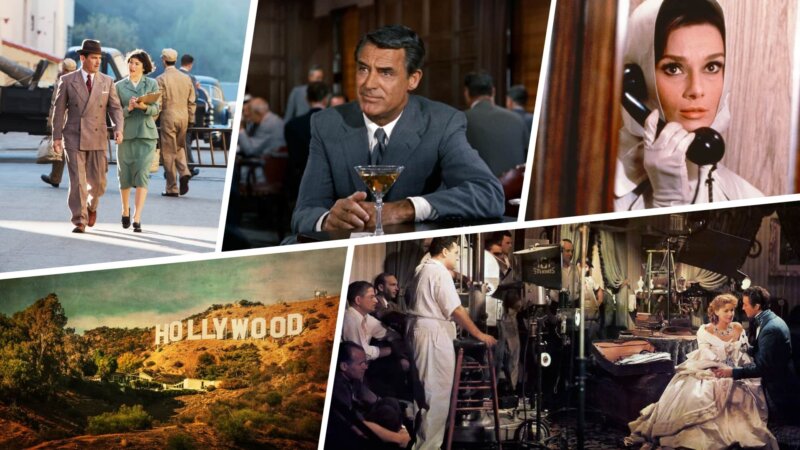
Images, and films in particular – being movies, or moving images – play a fundamental and often ignored role in understanding our reality. Our memory is stored in the form of two-dimensional images; this is why images can interfere with it, and thus have been rightly recognised as potentially dangerous. However, and for the same reason, images can tap directly into the unconscious, personal or collective, causing the images or films of great artists to have exceptional and genuine power. In this essay I try to offer some ideas about the way Golden Age movies were tapping into the collective unconscious of “America” – a term that in itself is a “collective myth.”[1]
The American Dream
If any moving image is bound to touch upon memories, even archetypal memories and events, then American films are obviously bound to evoke American memories, and dreams, and the key American archetypal memory-dream is the American Dream. This dream is very simple and indeed archetypal, even in a way eternal: it is to have one’s own land to cultivate, and animals to raise, with one’s family. Bringing in immediately an example from a film that will be analyzed in detail later, and which I happen to consider as one of the best films of all times, El Dorado by Howard Hawks, this is the dream – and indeed reality – of the McDonald family: a name of Northern Irish origin. This dream is also closely connected to a certain idea of “economic freedom,” and is ages-old, back to Greek oikos and polis, with its autonomy and autarchy, and beyond.
In this dream, however, as I have already indicated, there is nothing specifically American: it is rather an old European Dream. While the claim is seemingly provocative, even preposterous, it is trivially so: the American Dream is certainly not connected to the Native Americans, but European immigrants and settlers. And they brought this from their own memories and dreams: a dream that is perfectly formulated in the American Constitution, as “Life, Liberty and the pursuit of Happiness.” America is the land of exiles, of waves and waves of exiles, originally from Europe, who were trying to reach here what they could not realise back home. This is way more important than the Puritanical-religious inspiration of the first New England settlers; one might claim, in a perfectly Max Weberian manner, that this religious background only provided the breakthrough force for realising this ages-old concern; and this is the reason why “America” was not just populated by Puritans, but almost since the start by all kinds of Catholics: Irishmen, Italians, Germans, and then other Central and Eastern Europeans. Turning back to the films, this is visible by the background of many if not most of the great Golden Age directors: John Ford was of Irish descent, Frank Capra was born in Sicily, while Michael Curtiz, George Cukor and King Vidor of Hungarian descent; the list can be continued.
However, while this was the original American Dream, it has been replaced, certainly by the twentieth-century, by a very different kind of “dream.” Thus, as indicated in the title of this paper, I suggest that there are two American Dreams, and not just one; and now will introduce the second.
The Second American Dream
The Second American Dream is not to have one’s own land to cultivate, and animals to raise, but to have as much of everything as possible: especially as much money; and, most of all, to be Number One! In the whole world! This seems an almost natural extension of the First Dream: at first wanting just a farm and a few animals; then more and more, always more, until there is no perceived limit to acquisition. And yet, it is not so – all this is not at all natural, as this “logic” implies a thorough betrayal of the original ideal. This original ideal implied concreteness and personal connections, friendliness, an openness to everybody – while the new one is aggressive, hostile, unfriendly, sees a competitor and a potential enemy in everyone. Life, liberty, and the pursuit of happiness is replaced by a frenetic and insatiable drive for more and more.
This implies that, instead of a natural evolution between the two Dreams, there had to be an inflection point: somehow, at some point, due to some reason, certain limits were trespassed, some natural constraints were ignored, or destroyed, and this led to the Second American Dream. Instead of having a “natural” progress between the two, the opposite is the case: this progress was artificial, and was due to the willful and trick-ful destruction of normal, reasonable constraints; the respect for others, a kind attention to the other person that is a taken-for-granted aspect of traditional European culture, and in this sense again natural, as the main values of European culture are identical to the proper cultured way of behaving.
The problematic character of this transition can be seen through historical examples. A major difficulty faced in early monasticism, back to the Desert Fathers, was that the attempted return to the evangelical life, through working but not consuming, led to the accumulation of products, thus wealth, which somehow had to be disposed of. This came up again, in a slightly different way, in the early Renaissance, when the re-opening of commercial routes, especially alongside the via Francigena pilgrimage road, again led to the accumulation of wealth, leading the son of a wealthy merchant, called by his father Francesco exactly due to the wealth he gained on the ”French Road,” to found a new, mendicant monastic order, eventually called “Franciscan.” This order prohibited members to own any wealth – which, again paradoxically, resulted eventually in the emergence of limited liability companies – historically traced to the Franciscans. While the historical analogies might seem too distant, they have their direct relevance, as the Puritans, the original New England settlers, similarly wanted to return to the purity of an Evangelical life.
The central question, then, is to identify what happened; how these natural limits heightened by the American pioneer experience were transgressed.
There is a film, one of the most classic films of the Golden Age, that offers a perfect entry to this issue, even if evidently it does not contain all the answers: Scarface (1932) by Howard Hawks.
Scarface (Howard Hawks)
Scarface is one of the first absolute classics of Golden Ages talkies; a film that – for a series of reasons – never received the full credit it deserves. Howard Hawks always gained more recognition in Europe than in the US – famously, none of his films won the Oscar, only one being ever nominated, while Jean-Luc Godard, a major figure of the French New Wave, considered Scarface as the best sound film of all time. Scarface had a particularly rough time, it was attacked and censored in several countries and in various ways, so it is considered as one of the most highly censored films in the history of Hollywood. Hawks had to remake several scenes, some of which he refused, which were then done by somebody else, and so a version resembling the original was only circulated in 1979.
Such censorship was due, first, to the violence of the film – now certainly seems excessive, and which Hawks intelligently and indirectly defended inside the film, in the words of a newspaper editor who stated there that he was not instigating to violence by his reports, only telling the truth; second, the presumed glorification of gangsters – which was a misunderstanding, as Hawks only tried to explain and understand the character of the protagonist, instead of just demonizing him; and the presumed incestuous link between the protagonist and his sister, which in my reading again misses the main point. The central issue is rather that Hawks understood the existence of two different versions of the American Dream, and this film goes a long way not only to show their difference, but also the way the first transmuted into the second.
In an excellent book, Raymond Carney quite rightly identified Hawks and Capra as the two main Golden Age directors, but claimed that while Hawks made realistic films, it was Capra who presented the American Dream as a genuine utopia. This is a bit simplistic; the difference between the two great directors is that Capra made the accent on the First Dream, while Hawks presented the inevitable side-tracking of the Second. This was much due to their different backgrounds: Capra was son of Italian immigrants, who came to the US when he was 5; while Hawks was descendent of the original pioneers – his ancestors came over from England in 1630. Thus, the discriminating eye of Hawks made the film that in a way Capra should have made, at the time when Capra was still only making comedies – as the film is about the paradoxical, ambivalent insertion of Italian immigrants into the American Dream.
Tony Camonte, closely modelled on Al Capone, is Italian, and the family background, as presented, is prototypical. There is the mamma who, while worrying about the fate of his son and daughter, in the evident absence of a father figure accepts everything from and tells everything to the son. There is the son who, according to Mediterranean customs, is extremely protective of his sister, and the incestual overtones are only consequences of this protectiveness, and not the other way around. Furthermore, in his personal world, Camonte is loyal and caring towards his close associate-friends: Angelo, who is half-witted, but extremely faithful; and “Little Boy” Guino, his similarly loyal hit man.
It were these close relations that resulted in the consideration that the film heroized gangsters; but, instead, it only showed, indeed realistically, and with great ethnographic insight, the original small world of Italian – or, in a similar manner, Irish – gangsters. The problem emerged when this world encountered the similar – or perhaps quite differently – “real” world of the Second American Dream: unlimited money and richness.
The inflexion from the first to the second American dream was a problem even for the original pioneers, as it meant the betrayal of their most important values and features – direct personal relations, concreteness, honesty, loyalty. But in their case, at least, the transition was gradual. However, for more recent immigrants, coming to pursue the American Dream, the shock was sudden. They were used to live in the limited circle of their loved – or hated – ones, and now suddenly found themselves in a wide-open void, together with an enormous number of unknown others, competing with them, while the best places, especially in the cities, were already taken – this is while the call for “competition” is always an ideology as, in contrast to an athletic game, in real life nobody ever starts from the “same” position. Still, they were faced with the obligation of “making it” – as, otherwise, why on earth would they have left their home? Here it should be noted that the main gangsters in Scarface, in an anthropologically and sociologically fully correct manner, are Italian or Irish, not English, French, or German, or were coming from those rural places where the hunger for land, central for the original American Dream, was the greatest, and familiarity with the daily reality of modern large towns the smallest.
But it is also here that the great tricks of the modern world, first of all advertisements, enter to play their dirty game. This is central for Scarface: perhaps the key, certainly the most symbolic image of the film is the huge billboard advertisement for Cook’s Tours, “The World Is Yours,” appearing twice: first, when Tony shows Poppy (the lover of his boss, who would be killed by him, not the least because of Poppy) his new flat, with its special features; and second, the very last frame of the film, after he was gunned down by the police. The not just symbolic but theoretical importance of this image cannot be exaggerated, as it is here that Hawks hit upon the main instrument pushing forth people from the first to the second American Dream: the convincing power of advertisement, key tool of enslavement and stupidification, the greatest modern trick, compared to which all the tricks of Hermes, the Greek trickster deity, are mere trifles, as modern advertisement is based on technologically produced and manipulated images. It is also the existence of advertisement that demonstrates the mendacious fallacy of the greatest and most efficient of modern ideologies, economic theory, as economics considers advertisement as a way to rationally inform rational customers, which nobody in his right mind can possibly believe.
Turning to the meaning of this symbolic slogan masterpiece, “The World,” our world, is not anybody’s, as it simply is, in the Heideggerian sense of Being: we are in the world. Whoever invented that slogan should have been taken to court as a public propagator of outrageous lies. But he wasn’t – and why?! – and now it is too late – but is it?!
At any rate Camonte, O’Hara, Rinaldo, Gaffney, and countless others, coming from rural Italy or Ireland, or elsewhere, facing such billboards came to believe that the world was indeed theirs, and acted as if it were. Because, if “The World” is really ours, we can do whatever we want with it, right? At any rate, so they did.
But, of course, it wasn’t, and it isn’t. And here comes the responsibility of those who support such an absurd lie – apart from the advertisers and the economists. Hawks places the emphasis on two groups. The first are the corrupt politicians and their lawyers who help the gangsters escape police custody until there is decisive proof against them – which for some reason never arrives. This is the standard charge against political corruption which is certainly valid but intellectually less interesting. The second can be seen behind the wanderings of the police chief about the supposedly incredibly corrupt and perverted mind of these gangsters. However, Hawks has shown – and, again, in my view this is the real reason behind the heavy censoring of the film – that these gangsters, who certainly were not nice guys, are not unspeakably perverted and evil, rather – in their own, certainly reprehensible but understandable way – took literally the ad: “The World Is Yours”: so, if it is “ours”, or “my”, I can do whatever I wish. So the real culprits are those who corrupted their mind, and who got away with it and are still free – in our days perpetuating even bigger and more corrupting lies.
Thus, in sum: the First American Dream is rather European, and indeed millennial, and is simply about the good life. It is about a purported chance, given again, to live a good life. Whether it was genuine or not; whether there was indeed a free space, is another question – let me only mention the Natives, who after all were there, and before: and the real, daily conflict between the Natives and the settlers, and its lasting stakes, were explored in such masterpieces of John Ford’s The Searchers or Two Rode Together. The Second American Dream was a lie since the first moment, as this was signaled, in the most evident manner, by the emergence of slavery – one does not need slaves to work the land about which one’s ancestors were dreaming for centuries. The big question, which films cannot answer, but which needs to be answered, outside fashionable ideologies, is how people were lured into accepting the unacceptable: the transition from the First to the Second American Dream. Wherever we look, always the same conclusion comes up: modernity is a Trickster Land.
Returning to the films, it is to be noted that the protagonists or promoters of the Second American Dream are always among the villains of the main Golden Age films. One might evoke Gatewood the banker from Stagecoach, Potter the banker from It’s a Wonderful Life (remember that due to it Capra was almost accused of being a Communist!), Kirby the banker from You Can’t Take It with You, or the attorneys of Semple the magnate, from Mr Deeds Goes to Town, to mention only a few. This means that, while films can hardly give an exhaustive analysis of the character of this historical transition, between the first and second dreams, they realized, tapping into the collective unconscious at the level of archetypes, that something went desperately wrong there.
So the question is: in what ways do the best American films of the Golden Age illuminate us the problem of pursuing “Life, Liberty and the pursuit of Happiness”.
I will only discuss films in three genres, by the arguably three best or most important Golden Age directors: screwball comedies, Westerns, and the way these as if occasionally “spilled over” into films discussing more direct and contemporary economic or political matters, in the films of Howard Hawks, Frank Capra, and John Ford.
Screwball comedy
Capra and Hawks are main masters, even the masters of the genre, as the first two main screwball comedies were It Happened One Night and Twentieth Century.
Screwball comedy, as a genre, never received serious philosophical attention, and does not seem to have much to do with the American Dream. Yet, this is twice wrong, as the genre, while very recognisable, has no concrete historical precedents. Of course comedy goes back to Classical Greece, and the modern theatre was re-born as comedy, primarily, and not tragedy.[2] American screwball comedy represents a very specific modality of comedy, being fundamentally different from the comedies of Plautus and Terentius, which helped – for better or the worse – to revitalise theatre in the later Renaissance, in contrast to Passion Plays and similar medieval-Byzantine “sacred representations.”
Classical Roman and (post-)Renaissance comedy was about inciting desire, in the precise sense analysed by René Girard (1961, 2004). Putting it as simply as possible, comedies revolved around the attractiveness of women who incited, and were supposed to satisfy, the desires of men. All this was thoroughly couched in ambivalence, also as the female roles at the time were played by male authors, with predictable results.
Screwball comedies represent a quite radical and theoretically little recognised innovation in this regard, comparable to the innovations of Shakespeare and Molière. Fast-talking and quick action, usually listed as their main characteristics, were only means by which this novelty was realised, allowed by the new technology, but this was not the main issue, just as questions of class, so beloved by Marx-inspired academics, were only secondary. The main point of screwball comedies concerned the manner in which its heroes were related to each other – in particular the male and female protagonists. In other words, it was related to the character of the love story, and especially the way it developed towards its end.
In classical theatrical comedy a man sees a woman, falls in love, and the question is whether and how the woman will reciprocate. The plot of screwball comedies is radically different. There is no question of “love at first sight” – the main “romantic lie,” in René Girard’s analysis. Far from one seeing the other as an “object” of desire, the two rather encounter: a very significant sociological-anthropological word, placing the emphasis on events, and not on purposiveness or intentions, and on the “in-between” of the two characters, instead of the inner developments or obsessions of one of them. This initial encounter – or accidental return, as in His Girl Friday – is followed by further events, and especially certain activities which the protagonists end up doing together, originally perhaps only coincidentally, but increasingly requiring their inter-action, in a proper Simmelian sense. It is during these inter-actions that a certain mutual understanding, or appreciation, develops between them, often due to the fact that eventually (or, etymologically, ultimately resulting from events) they are required to resolve things together. It is these difficulties that eventually (again!) result in bringing them together, even though originally the difficulties rather act, or are supposed to act, to divide and antagonise them. Bringing Up Baby by Howard Hawks, now – but significantly not upon its release – widely considered as one of the very best screwball comedies, embodies this perfectly, even in its title, as Baby is the leopard that the female protagonist is supposed to “bring down,” from the city to her aunt’s countryside place, but they end up, instead of “bringing up” Baby, rather being brought together by it. And this expression, “bringing together,” is really the key to the genre, as while in a comedy the hero is supposed to “conquer” the heroine, or at least overcome the obstacles to reach the object of his desire, here both sides share in this eventuality of “being brought together,” And this is the real “first” American Dream, embodied, for e.g., by the “bringing together” of Ringo Kid (the first great role of John Wayne) and Dallas in Stagecoach, after each having suffered much on their own, and moving at the end of the film to Ringo’s ranch.
I hesitate to say that the two sides here are “equal,” as they are not “equal” in any meaningful sense, performing quite different acts, playing different parts in the story, which could hardly be exchanged. It is not even the reversal of the conventional storyline: in Bringing Up Baby, for e.g., the female protagonist is certainly the more active side, especially originally, but she is not trying to seduce the man, reversing the ”man-seducing-woman” storyline in a feminist key, and is not even just playing with him, but it starts, on her part, as a relatively light and easy fun that becomes ever more serious – and, in a parallel way, the man who for long only finds the woman extremely irritating ends up becoming, by the same events which for long only further trouble him, eventually ever more attracted to her.
It is here that we return to freedom, and the American Dream, in a meaningful sense. As freedom does not imply the right to do what one wants to do. Any act of freedom immediately entails a series of obligations which limit one’s freedom; but breaking them does not make one more free, only would deprive one’s life of any serious meaning. If classical comedy is played around the purported “freedom” to satisfy one’s desire, no matter what social and personal obstacles – meaning laws, morality, etc. – it entails, screwball comedy, in its best examples, asserts the need for freedom to get tied down, through our own actions and life history, in ties that meaningfully bind us – forever. Here His Girl Friday offers a prototypical example, as the protagonists brought together by the action of the films by their own “work” activity; they are not persons that were previously unknown to each other, but a divorced couple. What Hawks implies here, in the background only – as no flashbacks are provided to the events of the former married life – is that what matters is not the legal or moral bond of marriage – as that can be broken and even annulled – but whether such a bond has real, solid foundations, in common activities. The events of the film provide this foundation, what evidently previously was lacking – the first marriage had to be the result of some caprice, whether mutual or one-sided.
Westerns
If in the case of screwball comedies the link to the American Dream was not obvious, had to be brought out from the background, in the case of Westerns it is only too obvious. Westerns evoke the frontier mentality, described by Frederick Turner, a founding figure of American historiography. It is supposed to be the story of the heroic pioneers, conquering the land and submitting nature.
There are indeed plenty of Westerns that fulfil this storyline, but not the best films of John Ford or – again especially – Howard Hawks. They rather place the emphasis on the paradoxicality of this kind of standard story-line – though not simply in order to debunk it, but only to reassert the value of and the need for freedom, in a real sense – and a sense very closely connected to the main underlining message of screwball comedies.
The central point, again, is the ambivalence of freedom: completely free acts might start a process in which eventually everyone will be not simply entangled, but entrapped – as free acts might entail all kind of excessive or even extreme consequences, which can only be avoided if one not only learns to respect the freedom of others, but realises that one’s own meaningful freedom, and real happiness, can only be reached if one is able to set up limits to one’s own will to freedom. The most important such limits are not the consequences of exerting one’s own will, but rather the ability to allow oneself to participate in the playful and joyful flow of life.
Here I will focus on the last three Westerns of Howard Hawks: Rio Bravo,[3] El Dorado, and Rio Lobo, which capture an arche-typal situation. But what?!
Let me start with a few basic facts. Hawks was well past 60 when he made Rio Bravo; 70 while shooting Eldorado; and 74 when making Rio Lobo, which turned out to be his last films. The three films, but especially the first two, very closely resembled – one might even say “imitated” – each other. For many, this was a mistake, an evidently meaningless repetition, even a sign that Hawks became old. Tarantino famously claimed that he wanted to close his career early, in order to avoid making something like Rio Lobo.
However, this only shows how little Tarantino understands life – though this is also evident from his films, even the best ones. This is also a very standard modernist error, leading to the belittling of the late works of classics – even giants like Plato and Dickens. But this is a genuine prejudice, even worse, a misjudgement, as late works are fruits of intense maturation, if products of genuine minds, not obsessions or outcomes of senility. These films, especially the last two, were kind of swan songs to the entire Golden Age of American movies. Hawks somehow stumbled upon and matured in himself an archetypal situation, and we must understand what exactly this was.
The most important scenes, and the greatest innovation of Hawks in the genre, is connected to his use of the jail, central for all three films. The centrality of the jail in a film about the American Dream of freedom is of course paradoxical, and even twice so, as the action is not about the escape from the jail by a wrongly condemned hero. The jail is rather the scene where a genuine camaraderie develops between some of the protagonists, recalling – again paradoxically – the way a bonding is developing between the protagonists of the screwball comedies. Still, the situation is quite different: instead of a love story between a man and a woman, here an exclusively male bonding develops inside the jail.
This bonding, first of all, is exclusively a friendship; anybody who reads more into it is guilty of ideological fooling around. Second, a jail as scenery of male bonding is not so absurd as it would seem on a first look. One only has to evoke the affinities between a jail and a monastery, recognised by Foucault, and that monasteries were considered as places of brotherhood. This is now the second time that a strange-sounding affinity is recognised between the American Dream and monasteries – seemingly so radically different concerns – but there are manifold connections. The way in which hermits and monks in the 4th-5th centuries were attempting to return to the purity of the Evangelical life, escaping a decaying and decadent civilisation, were not so different from the Puritan New England dreams. It is certainly not accidental that the hero of the best “spaghetti Western,” Sergio Leone’s A Few More Dollars, is called “the Monk.” This film, by the way, has many parallels to El Dorado: it is also a second film, a kind of remake of the first, more famous For a Fistful of Dollars; however, one can even here argue that, not taking anything away from the first, this is actually the better film – even better than the much more famous later Sergio Leone films. These latter are more symphonic, or concerto-like, in contrast to the chamber-music-character of the other films, El Dorado or A Few More Dollars, but these capture and reveal better the philosophy or world-vision of the directors. They can be compared to similar-like masterpiece-films as Jules and Jim (Truffaut), or Unfinished Pieces for a Player Piano (Nikita Mikhalkov); or even Tarkovsky’s Stalker, where the eponymous protagonist can even be considered the Russian-Soviet-Communist equivalent of the Texan-American lone ranger.
In Hawks’ archetypal Westerns, the bonding does not develop between prisoners – as it does in another great and also archetypal French film, The Great Illusion; neither between prisoners and guards, rather among “guards,” who are indeed only guarding. Such guarding is the activity necessary for developing camaraderie, the other being the “closed institution” setting.
Being a prison guard, in our contemporary context, is one of the lowest prestige occupations possible – but the heroes of these films are not “prison guards” in this sense. This is because a jail is different from a prison: in a prison there are those legally condemned to be there, by a sentence that deprived them of their liberty; while those guarded in a jail are only there until they receive a sentence from a judge. Their role is therefore much more serious, especially in the concrete settings of these films, comparable to the Platonic guards, as they are upholding the values of civilization: instead of taking the law in their hands, punishing (killing) the evidently guilty, they are rather guarding them until the proper authorities arrive. This means that this archetypal setting involves not just a closed institution, but also a suspended time: a heightened moment of transitionality, until the US marshal arrives.
Such a combination of a closed institution and a time of transition implies that Hawks stumbled upon something quite significant in these three movies. The most important historical sociologists who tried to give an account about the effective rise of modernity, outside a teleological-evolutionist narrative of economic growth, technological development, and overall progress, Max Weber, Lewis Mumford, Norbert Elias, Eric Voegelin, Franz Borkenau, Reinhart Koselleck, and Michel Foucault, all came to emphasise the role of closed institutions – monasteries, sects, courts, secret societies, hospitals, asylums, prisons – and times of transition – the Renaissance, the Reformation, the decades around 1650, or the Sattelzeit of 1775-1823 – in this emergence. The two can be brought together through the anthropologically based term “liminality,” as a combination of spatial and temporal liminality or in-between-ness. Now, amazingly, it turns out that Howard Hawks, in his late trio, directed after he passed 60, stumbled upon, at an archetypal level, the same combination of closed institutions and times of transition as being central for the genesis of modern “America.”
While the law plays a fundamental role in these films, it does so only as a last resort, or ultimate authority: it will come, eventually, pronouncing an ultimate judgment, but indeed only as a kind of “last judgement,” which comes at the end, but an end that in a way never comes: at least, we as an audience certainly do not witness it; in the three Hawks films the problem is resolved, is forced to be resolved, before this arrival.
This carries two important messages. One is that it is not sufficient to wait for the judge, for the Law, even for God and the fulfilment of the Divine Law: a kind of “Waiting for Godot.”[4] It is indeed the ultimate instance, which will eventually come, but in the meanwhile, and according to the best of our abilities we must act and do what we are required to do. The second is that these films are fully religious, and in the best sense of the word, without making the least explicit evocation of official religiosity, in a way comparable to Tolkien’s Lord of the Rings. This means that if we do our best, and are on the right side, then eventually, without making ourselves visible, God will be on our side, and we will manage to succeed.
This can be best seen in the resolution of the conflict presented as a rivalry between the two top hired guns, Cole Thornton (played by John Wayne) and Nelse McLeod.[5] As the right side of Thornton is paralysed due to a former injury, so that he cannot even shoot, McLeod prematurely announces himself as the winner: “I’m sorry it had to end this way.” At that point, Thornton explores the possibility of shooting with his left hand, and invents a scenario – based on something he had just learned from his “greenhorn” jail friend – by which he could and actually does win. In his dying moments McLeod claims that Thornton did not even give him a chance, and Thornton agrees, but this is not fully true – his strategy was very risky, his friends considering his plan little short of being crazy, and its success has a “Deus ex Machina” character: without, again, the film declaring this, impossible at any rate already by 1966, he certainly had God by his side. This is the real meaning of Golden Age Hollywood happy ends, and this indeed could not have been otherwise.
From screwball comedy to political drama
The expression “From screwball comedy to political drama” perfectly captures the Golden Years of Frank Capra, 1934-1939, when he won three Academy Awards in five years, a feat nobody else managed to imitate. Capra’s related films, Mr Deeds Goes to Town and Mr Smith Goes to Washington, coming after the great success of his screwball comedies, especially It Happened One Night, repeat an identical scenario just as closely as Hawks’ jailhouse Westerns. The protagonists, young men living a happy and contented life in a small and remote place, are suddenly thrown into the heart of America: New York, the financial centre, due to a sudden and unexpected inheritance; and Washington, the political centre, as the voting machinery selected them, due exactly to their perceived innocuousness. They arrive, full of youthful idealism and belief in the American Dream and its heroes that supposedly made it into reality, only to realise that the actual political and economic system is not simply full of crooks but is run on the principle of corruption. The two storylines, and their heroes, are so similar that at an early stage Mr Smith Goes to Washington was called Mr Deeds Goes to Washington, and Gary Cooper was primarily considered for the role.
This move, from screwball comedy into political drama, had a catalyst, Capra’s famous reckoning about the better use of his talents and his subsequent turn towards making thematic films. This visibly came with the 1937 Lost Horizon; however, he wanted to make this film earlier, filming being postponed only due to the leading actor not being available. With this film, Capra also gave a specific twist to the American Dream motive, towards Utopia – a much older and decisively European theme, seemingly even alien to American realism and pragmatism. However, the idea that Utopias are central for the American vision was proposed by one of the greatest American thinkers, Lewis Mumford, who as if prefaced his three great books about American civilization, Sticks and Stones, The Golden Day, and The Brown Decades, written between 1924 and 1931, by the 1922 The Story of Utopias, his first book, which explicitly argued about the American Dream being a direct continuation of European utopian thinking. Lost Horizon thus clearly holds the key, not simply to Capra’s whole oeuvre, but to his work as capturing America at the level of archetypes.
Lost Horizon
Lost Horizon has a quite unique background history, apart from the delay in its making – a delay that actually turned out to be, as it is often the case, beyond our intentions, vital for Capra’s success, as he thus had to make Mr Deeds Goes to Town first, which earned his second Oscar, while Lost Horizon would actually cost too much, losing money, but after his two Oscars it did not jeopardize his career – at least then. In its first version the film ran to about three and a half hours. Not just Capra but the executives at Columbia were delighted with it, declaring after its first in-house screening that this was the best film ever made. The first preview audience not only found it tediously long, but took it as a comedy, with many leaving after the first 15-20 minutes, deeply wounding the director, who immediately destroyed the first two reels.
While Shangri-La, the imaginary location of the film and of the 1933 novel by James Hilton which it quite closely followed since then has become a synonym of Utopia, the film is also hyper-realistic, even prophetic. Its quasi-apocalyptic prophecies about the explosion of violence, following WWI and alluding to the imminent WWII, apply even for our days, and with particular force: “Look at the world today. Is there anything more pitiful? What madness there is; what blindness; what unintelligent leadership. A scurrying mass of bewildered humanity crashing headlong against each other, compelled by an orgy of greed and brutality.” The film therefore is not about the situation of America, not even the problem of social classes, or political and economic corruption and crisis, but about the misdirection of our entire civilisation. In the solution it proposes, as the only way out, it is as historically realistic as possible, as he suggests what political anthropologists, back to Marcel Mauss, and sociologists back to Weber and Simmel, but even more fundamentally back to Plato, suggest as always being the foundation of human social life: living life as and through gift-giving, sociability and kindness, as charis, in the classical Greek sense.[6] This is resumed in the central scene of the film, the first encounter between the protagonist, Robert Conway and the founder of Shangri-La, the Belgian priest Father Perrault, who mysteriously survived from the early 18th century into the present. Here, right after the diagnosis of the times quoted above, Father Perrault states that “this world will be destroyed by its own force,” and the new life that must come will be “based on one simple rule: be kind.” This is verbatim identical to the call for charis; and it is most important that while this scene, with similar ideas, is there, the text, with all its key words, and in particular the expression “be kind”, is not there in the novel, so evidently is inspired by Capra.
The evocation of charis, and the classical Greek culture beyond, is not accidental, and is most important, as it could be added to the similar evocations of the Greek polis, or early Christian monasticism. This shows that the American Dream did not emerge in a void, and is not a bag full of winds, but ties back to the best of European culture, understood in the longest possible time horizon.
Capra’s innovation, even though faithful to the spirit of the original novel – during their second conversation, Father Perrault actually states the maxim in the book as “be gentle and patient”, faithfully repeated in the movie – evokes the very heart of Platonic realism: charis is not a legal or moral obligation, neither wishful thinking, but is simply the basis of real human existence – as realistic as Mauss’ idea that the foundation of social life is gift relations. It is in this fundamental, foundational sense that the American Dream is realistic – in the sense of the Declaration of Independence and of Human Rights, and not in the contemporary sense of money-making and power-politics.
And it is from the height of this seemingly “utopian” realism that Capra moves from screwball comedies to economic and political “dramas.” Washington, Lincoln and Grant, heroized by the main protagonists of these films, effectively created a country to promote the reality of the American Dream, but for some reason, a century or so later, it is not just corruption but existential corruptness that has become endemic in economic and political life. Capra is presenting corruption as a fact of life, and is not offering a socio-political analysis. Still, this corruptness, while corresponding to the description offered by the Belgian priest, is not reality – an “orgy of greed and brutality” is not real life, only effective madness. Reality, real-ness, is a value, not a fact.
In Capra’s films, the “lone ranger” hero leaves Westerns and enters screwball comedy, taking up its logic, but turning it towards an economic or political “drama.” The fight of a lonely man against the “system” is an old theme, formulated in a classical way by Heinrich von Kleist in Michael Kohlhaas, where the hero, naturally, lost – and will lose again, in America, in Ragtime, Doctorow’s novel and Forman’s film. In Capra’s films, the outcome is different, as the genre of the screwball comedy offers new possibilities – not as a Hollywood lie, but as a way to realise the real truth behind the First American Dream.
It’s a Wonderful Life
Capra’s explorations of the American Dream culminate in It’s a Wonderful Life, another candidate for the “best film of all times” title, in which the Dream is fulfilled by its evident reversal. Everything is exceptional about this film, and the history of its reception in itself would deserve a full article – how and why it was made as Capra’s first film after WWII and the huge break in his career this necessarily implied; how and why this film, since long having reached an iconic status, could have been a major box office flop, which basically destroyed Capra’s until then stratospheric career; how and why could it have happened that for long it failed to make an impact even after, so that in 1974 its copyright was not renewed upon expiration. But by now, and since about the 1980s, when Roger Ebert, in the famous Ebert and Siskel show, declared in prime time, just before Christmas 1982, that according to him it was the best film ever made – at once a catalyst and a symptom – the status of the film as one of the greatest of classics is not in doubt, rather on the contrary, it is its failure to make a proper impact at the time of its first screening and for such a long time that defeats belief.
The film’s hero, George Bailey, in one of the most important performances of James Stewart, desperately wants to pursue the Dream, captured as if in between the First and the Second Dream, to “shake off the dust” of his small provincial town and to “see the world” – note, it is “The World” again! – but he is time and again prevented to do so, as the moment in which his dream is about to be fulfilled, he having made the decision and committed himself, a situation comes up in which he must do the only right thing which prevents him to go; an obligation that is concrete, personal and existential, and not universal and moral. Thus, he always stayed home, which is the opposite of the Second Dream, implying something like a contentment in the original First Dream – though he was not really content in this.
It is in this his state, half a happy family father, half a frustrated and no longer that young man who was always prevented to pursue his great dream, that a major crisis breaks out at his family-owned savings-and-loan business, that seemed to be beyond a possible solution, threatening him with a full-scale existential crisis. At this point he not only contemplates suicide but expresses a wish that is the direct opposite of the First American Dream: instead of a happy life, the wish of not being born, or complete nothingness, total void.
At this point, the film moves into a new register, rarely pursued in movies, though explored by Capra already, in Lost Horizon: the wish is granted, through supernatural intervention; a would-be angel arrives, directly from Heaven, to show him what the world would have been had he never been born. Heaven granting one’s wish is the ultimate Catholic dream of a genuine miracle – but here, as if following the inside-out handling of the American Dream, it is also turned inside out, as the wish is not about life and happiness, but it is opposite, not-Being.
This and of course, is not the end of the story – and even twice so. First, because George Bailey repents: he realizes that after all, and in spite of everything, he had a most happy and – even more importantly – “useful” life: useful for others, not “the other” but concrete people who without his help would have indeed been unable to live a happy life. And second, because this moment of deep crisis was the time in which his help was to be reciprocated, and his friends, and everyone he ever helped, came to his rescue.
From Western into political myth: The Man Who Shot Liberty Valance
If the two masterpieces of Capra explored the links between transcendental mystery and in-depth human reality, The Man Who Shot Liberty Valance, still another strong candidate for the best film of all times, turns the Western into a kind of political drama by playing on the connection between myth and reality beyond a typical all-American political success story. It is not a political drama in the conventional sense. It does not focus on the daily business of politics, does not contain a political conflict, is not even mentioning political corruption, only alluding to the abuses of rhetoric. Yet, and even in two important senses, it is super-political, and specifically American. First, it demonstrates, in working, the logic of the classical, two-layered American constitutional politics, where local vote was not directly cast on figures or parties of national politics, but on people known locally, who then, through their own interactions, selected the people deemed proper for being directly engaged in national politics. The second point is even more important, and certainly more theoretical. It demonstrates possibly the only way in which the ideals of the First American Dream could be reconciled with the exigencies of modern mass politics.
The problem is serious, even vital. The ideal, or the dream, is that national politics should be conducted by genuine local American heroes of free life. This dream is impracticable, as such local heroes are not suited to effectively participate in the political life of an urban centre, not to mention the capital. Even Jefferson Smith could only triumph by laying bare corruption, but it is doubtful that he would be able to participate in the work of the committees which by then have already become identical with political activity. This is even more true concerning the possible political activity of a genuine lone ranger. One should note that the ideal is present, practically up to our days, in the political career of actors like Clint Eastwood, Arnold Schwarzenegger, or even Ronald Reagan – however, they were exactly “just” actors, and not real-life lone rangers.
The Man Who Shot Liberty Valance presents what evidently is the only possibility for a genuinely successful political career of a lone ranger. Ranse Stoddard (played by James Stewart) arrives as a young lawyer to a Western frontier town, and soon learns the hard way that local customs don’t correspond to his ideals. So grudgingly he starts to take shooting lessons, and in the eventual, inevitable showdown appears to successfully gun down the local outlaw, Liberty Valance – a talking name, if there ever was one. This makes him into a local hero, helping him to a successful political career – though, at a certain point, it is revealed to him that the deed was done by Tom Doniphon (played by John Wayne), who preferred to stay down and die in the locality. Thus here, among many other matters of symbolic relevance, John Wayne plays the character of James Stewart in It’s a Wonderful Life, while James Stewart takes up the role that a real-world John Wayne-like person should have played, but evidently could not. The First American Dream of freedom and modern mass politics can only be reconciled at the level of a myth.
The Man Who Shot Liberty Valance was made in 1962, the moment when the “Golden Age” of American cinema was about to end. And this can be considered as quite heavily symbolic on its own.
Bibliography
Girard, René (1961) Mensonge romantique et vérité romanesque, Paris: Grasset.
Girard, René (2004) The Theatre of Envy, South Bend, IN: St Augustine’s Press.
Horvath, Agnes (2021) Political Alchemy: Technology unbounded, New York: Routledge,
MacLachlan, Bonnie (1993) The Age of Grace, Princeton: Princeton University Press.
Szakolczai, Arpad (2013) Comedy and the Public Sphere: The Re-birth of Theatre as Comedy and the Genealogy of the Modern Public Arena, London: Routledge.
Szakolczai, Arpad (2022) Post Truth Society: A political anthropology of trickster logic, New York: Routledge.
NOTES:
[1] The writing of this essay was inspired by Pedro Blas Gonzalez’s November 3, 2024, review essay for VoegelinView, “Movies and the Soul”.
[2] For details, see Szakolczai (2013).
[3] Robin Wood, perhaps the best known British film critic, considered this film as the best of all time, writing a 2003 book on it.
[4] Beckett had a strong Puritanic background.
[5] The character of McLeod, by the way, is most interesting. He is not immoral at all, but purely professional, who takes up any job for which he is paid, in contrast to Thornton, who returns the same charge when learns the real story behind, involving the dispossession of the McDonalds. The permanent “professional” smile on the face of McLeod is also worthy for serious attention, as “we” see it in our days everywhere. Another intriguing character in the film is Bart Jason, the villain, who cannot even shoot and smokes cigars – so represents the arrival of high-class city crooks at the frontier.
[6] Based among others on Bonnie MacLachlan’s 1993 The Age of Grace, Agnes Horvath (2021) claimed that charis as benevolent kindness was not only the animating principle of classical Athenian culture, but is the foundation of any decent human-social life. On this basis I argue (Szakolczai 2022) that the assertion of this charis-logic was central both to Heraclitus and the Gospel of John. The transmogrification of the First American Dream into the Second American Dream thus has the character of a Moebius-strip-like transformation of a charis-logic into a trickster logic.


Related Posts