Predestined to Greatness: Patton in Mexico
History is replete with men, whether good, bad, or ugly, who considered themselves great or at least more historically significant than the rest of humanity. One only needs to remember Napoleon, with his regular, maniacal musing in his diary about his destiny. Though a man who undoubtedly believed he made his own destiny due to his own greatness and bold actions, he still delicately promoted a certain mysticism surrounding his achievements, implying there was some external force that assisted him. Hegel, through his philosophy of history, further enigmatized Napoleon’s successes and incorporated them into a quasi-spiritual system of world-historical significance.
Then, we have Winston Churchill, who also believed the world was his oyster, but not so much due to his achievements to come, but rather as of right. As a descendant of the Duke of Marlborough, whose greatness he promoted in his books, it was only natural for him to follow in his footsteps. Even after the catastrophic Gallipoli fiasco over which he presided, Churchill remained confident in his blood, that his own moment of greatness would inevitably come. Churchill, by writing about his glorious ancestors, successfully conflated the retrospective with the prospective, and, after the war, had the opportunity, again, through his books, to cement himself as someone who had not merely emulated but exceeded the glorious feats of his family.
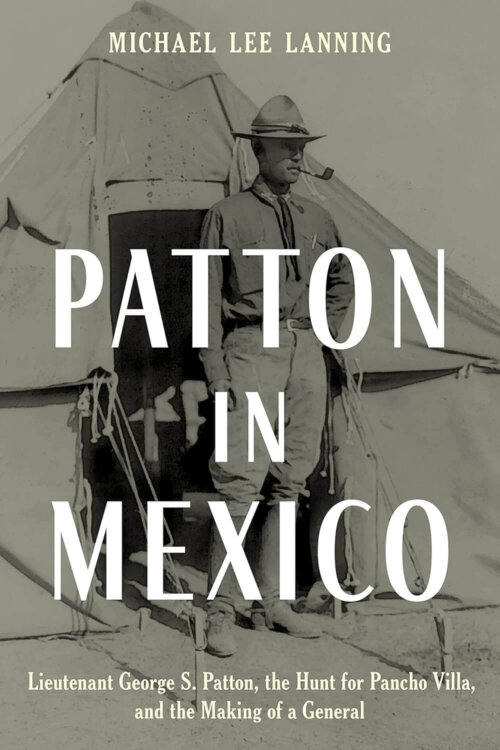
Unexpectedly, in Patton in Mexico: Lieutenant George S. Patton, the Hunt for Pancho Villa, and the Making of a General, the future General Patton emerges as a man who not only had an absolute belief in his own destiny and self-importance, but also one who, to all intents and purposes, appeared to have been predestined to achieve everything and anything, from the day he was born. It is rare to find a figure in which natural ability, wealth, social status, connections, self-belief, endless opportunities, and the nous to grasp them with both hands can exist simultaneously and extraordinarily harmoniously.
Patton’s parents “made a powerful couple.” His mother “brought the wealth and privilege of the founding California Anglos.” His father “contributed vestiges of the Old South aristocracy.” In summary, this union “melded peaches and magnolia blossoms with oranges and palm trees.” Writing about his childhood, Patton later wrote, “we never wanted a thing we did not get.” This maxim, as we will discover, was applicable to Patton’s entire life, at pretty much every stage of it.
Having spent his boyhood exploring his family’s vast holdings and family estate—learning about the exploits of Alexander the Great and Julius Caeser at one of the best schools money could buy—at the age of 17, he met the love of his life and future wife, Beatrice, the daughter of a wealthy Boston industrialist. This was followed by courtship, mainly by means of letters, for some 8 years before their inevitable and inevitably happy marriage. There were, of course, some setbacks along the way, such as having to overcome dyslexia at school and later on at West Point, not being accepted to West Point immediately (though Patton’s father’s adroit use of his contacts and Patton’s own efforts eventually secured this too) and persuading Beatrice’s father to give his blessing for their marriage.
However, given all the gifts and blessings in which Patton bathed from birth, all his undoubted struggles and difficulties appear as mundane, insignificant blips on the path of predetermined greatness. This is no exaggeration, for Patton’s belief in his predestination to greatness reached almost megalomaniacal proportions, which may have emanated from his peculiar spirituality. Patton believed in reincarnation, and in his letters and meticulously kept diary, he would make references to how he remembered taking part in the Napoleonic wars, including battles fought in Germany, or how he could recall dying as a Viking warrior, with everyone around him saying he was not yet ready to go to Valhalla.
Patton succeeded at West Point despite his problems with dyslexia, maths, and French and having to repeat a year. Apart from this, he proved to be an exemplary soldier and leader. During his time at West Point and later in life, Patton lived by the following motto, as he wrote in his notebook: “never, never, never stop being ambitious…you have but one life, live it to the full glory…nothing is too small to do to win… never stop until you have gained the top or the grave.” This attitude extended to his marriage. In the last letter he wrote to his wife-to-be before their wedding, a mere 4 days beforehand, he stated: “may our love never be less than now and our ambition as fortunate and as great as our love.”
Whilst the young family was enjoying a life of luxury, completely atypical for that of a young officer, Patton was busily engaged in meeting important people and building connections. And then more opportunities came. Given his position and abilities, it was only natural for Patton to spot and seize them immediately.
In 1912, he was selected to represent the United States in the new discipline of Modern Pentathlon, which included swimming, running, shooting, fencing, and riding. Despite failing to win a medal, Patton received much praise for his performance. Thereafter, Patton got around to designing his own cavalry sword, “one that promoted thrusting rather than slashing.” This was met with approval, and twenty thousand sabres were produced. These became known as “Patton’s Swords.”
It is worth noting that Patton had achieved so much as a mere junior lieutenant who had hitherto seen no combat. This was one thing that had to change if Patton was to ever achieve the greatness to which he felt entitled. He wrote to his father, clearly frustrated: “I certainly am aging…I fixed twenty-seven as the age when I should be a brigadier and now I am twenty-nine and not a first lieutenant.”
The young lieutenant’s saving grace in this regard did not come from any obvious source, such as deployment to the United States’ colony in all but name, the Philippines, or a premature involvement in the Great War in Europe. It came in the form of Pancho Villa, the Mexican revolutionary bandit, who, with his audacious raids into American territory, kindled the ire of the otherwise apparently tame President Wilson. As a consequence, in a state of an uneasy alliance with official Mexico, the United States embarked upon its Punitive Expedition into the country, hunting for the scalps of Pancho Villa’s bandits. Not only did the expedition provide Patton with the combat experience and fame as a warrior he so craved, but also, and more significantly, it gave him an all-important mentor—the living legend General Pershing, with his vast experience, celebrity-like reputation and innovative spirit. In Pershing, Patton “had found the perfect example of a senior commander, whom he later successfully emulated, refining to his own lofty standards what he had learned.” This expedition is what truly propelled Patton to his own much-craved stardom, and taught him all-important lessons which he would use to great success in North Africa, Italy and Europe in general during the Second World War.
During this expedition, Patton was met with a practical lesson in the rapidly changing nature of modern warfare—the replacement of horses by machines, modern logistics, and airplane reconnaissance missions. He also observed Pershing’s meticulous leadership and extreme attention to detail, which he himself would emulate to a fault in his own later campaigns.
In general, for Patton, this campaign was defined by boredom and lack of action, of which he complained regularly in his letters to his wife. However, on 14th May 1916, Patton was sent on a mission with a small detachment to purchase corn, and he was ambushed by some of Villa’s henchmen. Patton killed three of them, including Colonel Cardenas, one of Villa’s leaders. The Olympian athlete’s killing of such a high-profile bandit attracted the media’s attention, and Patton was celebrated in most newspapers. Shortly thereafter, he was interviewed by the New York Times. Such was the popularity of Patton’s bravery in what was a campaign that did not get as much cover as the inevitably more interesting war in Europe that several competing accounts of what had actually happened appeared, which then turned into legend.
The Punitive Expedition itself was seen as both a success and a failure. It failed in the sense that Villa was never caught or killed, though he later met his demise by being killed by other bandits several years later. It did, however, achieve its main goal—it put to a definitive end all large-scale incursions by Villa’s forces.
It is true that without his involvement in the Punitive Expedition, Patton would have had difficulty acquiring such hands-on experience, especially under the mentorship of the great Pershing. But, as we have established, Patton was beyond blessed with good fortune, so, looking back, there appears to be a certain inevitability about what transpired.
With sinister irony, despite achieving true greatness and an immortal name, despite enjoying a life of luxury and a loving, impossibly successful marriage, the one thing that did not go according to plan was Patton’s end, which appears to have caused him to die in a state of regret.
Patton died in hospital after having had his spinal column separated by a car accident in Germany, many months after the war had ended, in circumstances that can only be described as a shambolic, easily avoidable collision. The last words of the hero of the North African campaign and the Battle of the Bulge, the devoted hunter of Pancho Villa were “it’s too dark. I mean it’s too late.” A few days earlier, he had told his wife, “I guess I wasn’t good enough,” a reference “to his belief that a professional soldier should ‘die of the last bullet in the last battle of the last war.’”
Despite his great success and true greatness in the historical sense, Patton’s end remains somewhat more instructive than his life, especially when contrasted with it. Such is the fate of all truly great men, and the lesson is always the same.
Patton in Mexico: Lieutenant George S. Patton, the Hunt for Pancho Villa, and the Making of a General
By Michael Lee Lanning
Stackpole Books, 2023; 253pp


Related Posts