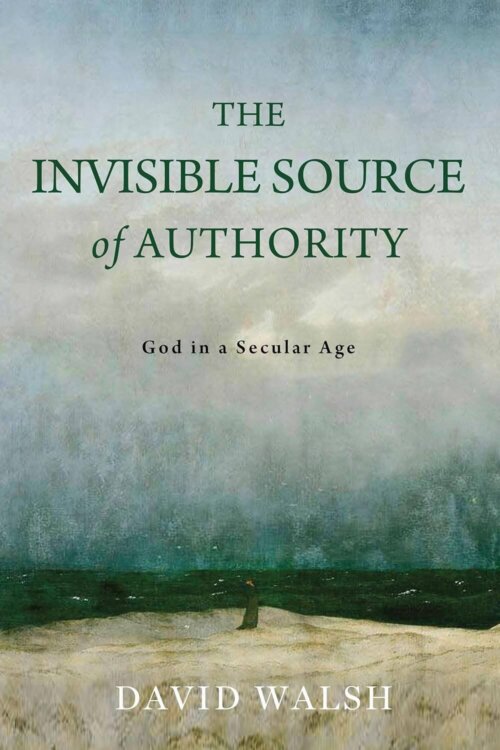
David Walsh’s The Modern Philosophical Revolution: Glenn Hughes
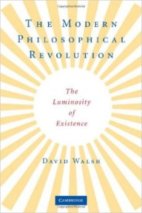
I have learned more from this book, philosophically, than from any book in years. I do find its central hypothesis persuasive. And not only does it often speak beautifully about love, it was clearly written from and with enormous love.
Professor Walsh’s book is masterful in its erudition, depth, and importance. The book’s purpose is announced in its Preface: it aims to do what has scarcely been attempted before, which is to present the era of philosophy from Kant to the present as a whole and as a continuity. It does this by following the “interpretative hypothesis” that “philosophy, since Kant, has explicitly” and ever more rigorously “shifted from an account of entities and concepts to an existential meditation on the horizon within which it finds itself” (p. xiii).
Thus the modern philosophical revolution, as the book’s Epilogue puts it, has entailed an ever-deepening “meditation on the priority of existence over all reflection,” and a “reversal of the priority of the subject in intentionality to include the luminosity of existence that precedes it” (394). As such, the development traced in the book is that of an evermore expansive exploration of the many consequences of the fact that “[human] knowledge always fails to account for its source” (222); and that the truth of the transcendent origin of human existence cannot be said or known, or theoretically attained or contained, but only lived in a continual striving of existential openness within and toward it (449). Walsh offers up many pithy formulae for summing up this key point. For example: “The truth of life [is] forever exceeding the life of truth” (225).
In the course of Walsh’s long argument supporting his hypothesis, he brilliantly clarifies a large number of key topics associated with his eight chosen philosophers. For example:
1) that Kant remained a deeply Christian thinker, and that his notion of autonomy has been largely misunderstood in too secular a fashion;
2) that Hegel’s category of “system” ought to be read more existentially than it typically is;
3) how Schelling’s thought functions as a link between Idealism and the existentialists;
4) how profoundly Nietzsche draws from Christianity even as he battles with it;
5) how Heidegger’s ignoring of the relation of action to morality is linked to his failure to address that which primordially grants morality itself;
6) how Levinas provides a crucial corrective to Heidegger, especially in his recognition that openness to the ultimate occurs through the social, the personal other, the “face;”
7) that Derrida’s theology is remarkably traditional in its orientation despite its novel formulation, and that his work as a whole points towards a Christian eschatological understanding of existence; and
8) why Kierkegaard most fully instantiates the modern philosophical revolution regarding the impossibility of objectivizing the process in which the struggle for the philosophical articulation of existence arises.
These are a few of the explicatory riches in the book. I must also add the brilliant expositions throughout the book of the meaning of responsibility, marriage, and love, especially in the chapters on Levinas and Kierkegaard.
A question that might be on the minds of some here present: why is there not a chapter in this book devoted to Voegelin? Walsh has appropriated his terminology of luminosity and intentionality as fundamental for his analysis; Voegelin is cited a few times admiringly, and his uniquely relevant philosophy of history referred to on the last page; and any reader of Voegelin will find at least 20 or 30 phrasings of key insights that are indebted to Voegelin. So, why no chapter?
Now, Walsh has already supplied his answer to this question at length, in his 2007 article published in Modern Age, “Voegelin’s Place in Modern Philosophy” (Modern Age, Winter 2007). Let me note some of what we may take as reasons proffered there for excluding Voegelin from the pantheon of key members of the modern philosophical revolution. As Walsh sees it, Voegelin did not keep up with, and thus did not learn from, the philosophical writings of his great 20th century contemporaries.
More importantly, he did not “follow out the logic” of the prioritizing of luminosity over intentionality (18); he failed to clarify that “the beginning of [the human questioning process] can never be found” (22); he gives the impression that the human question is a “largely internal movement, confined to the realm of consciousness” (23); he relies too heavily on a not sufficiently un-Kantian notion of “experience” (21); and “he seems not to have thought through what the meaning of transcendent being must entail”—that is, as that which “cannot become present, what cannot be revealed” (19).
I will not belabor the matter, but I disagree with Walsh with regard to each of these conclusions except the first: that Voegelin did not keep up with the works of his contemporary philosophers. Regarding the unrevealability of transcendence, for example, here is a pertinent quote from “Anamnesis: “(1) in the tension toward the ground we have experience of a reality that incomprehensibly lies beyond all that we experience in participation, and . . . we (2) can speak of the incomprehensible only by characterizing it as reaching beyond the symbolic language of participation” (CW 6, 396). I see no advance in Levinas or Derrida, or in Walsh, beyond such a formulation of the unspeakable and unrevealed—bearing in mind the equivalences of experience and symbolization.
Let me expand a little on this point. Walsh is perfectly accurate in saying that Voegelin scarcely read his contemporary philosophers, did not enter dialogue with them, did not join the “philosophical community.” He is also correct when he asserts in his 2007 article that an essay such as Voegelin’s “Eternal Being in Time” is “remarkable” in “the extent to which it echoes all of the language of post-subjective metaphysics” (19), and that although Voegelin only seems “dimly aware of the pivotal dimension of [the] turn that philosophy takes from Kant onward”—that is, the entire trajectory discussed by Walsh—“[Voegelin’s] efforts virtually parallel it” (16-17, my emphasis). That is quite a statement. I am not suggesting, however, that Walsh was wrong not to include a chapter on Voegelin in his book. Why not?
Because Voegelin is, in my view, part of a larger philosophical movement than the revolution so richly elucidated by Walsh. What larger movement is this?
I will suggest that the philosophical revolution Walsh so eloquently explains might be considered part of an even longer historical dialectical unfolding in philosophy, in which the reversal of the dominance of the subject and of the subject’s intentionalist ambition to master and contain and possess truth, in favor of the insistence on the priority of luminosity, of the unsayability and unknowability of that which grants and contains existence, of existence or life over knowing and truth, is itself a swing in the pendulum, whose next movement would be a reconsideration of intentionality, subjectivity, truth, and historical existence in light of the Kant to Derrida revolution.
The next phase in this dialectical unfolding of philosophizing would involve the re-exploration and more subtle examination, in a properly balanced way—in a way that constantly remembers the priority of luminosity—of the structure of conscious intentionality. It would elucidate the precise manner in which truth about endless facts within reality are validly attained by finite, contingent, real individual human subjects through proper performance of cognitional operations that result in sound judgments, which are neither claims to absolute knowing, nor are made irrelevant through recognizing the instabilities of language and the inescapable différance which both permeates and constitutes existence and language.
In other words, recognizing the priority of luminosity, and of life over truth, does not invalidate intentional truth and its achievements within, and for the sake of, engaging in living. It simply establishes the proper interpretative limits of intentionality, and requires an intentionality analysis that shows that intentional truth is neither a reaching of absoluteness, nor a cognitive subjectivism. The only philosopher who has accomplished such an analysis on a truly vast scope is Bernard Lonergan. Voegelin, too, has contributed to this revaluation of intentionality in light of the priority of luminosity, by stressing that luminosity and intentionality are equiprimordial structures of consciousness, and co-constitutive of consciousness—a consciousness that is, not so incidentally, presented by Voegelin in a post-postmodernist manner through its explication in terms of its metaxic character, and through constant emphasis on the inescapably ambiguous meaning of “truth” as both the truth that grants existence and the truth obtained through intentional knowing.
Likewise, what history “is” would need to be thoroughly rethought in light of the modern philosophical revolution, so that the realizations that every human subject is a locus where the infinite is revealed in its unrevealability (or is “glimpsed,” an ocular metaphor that Walsh often uses to express how we apprehend that transcendence which contains us, for example on pages 119, 155, 225, 278, 317, and 416) and that all humans are thus in some radical sense contemporaries, becomes the guiding realization for investigating the lines of meaning that in fact constitute historical meaning. The modern revolution described by Walsh inscribes a philosophical arc that nevertheless leaves philosophy of history more or less paralyzed since the early 19th century. After Hegel and Schelling—nothing. Do Kierkegaard, Nietzsche, Heidegger, Levinas, Derrida offer anything remotely like a philosophy of history? They do not.
Would there not be some benefit in taking the insights of the great revolution that properly prioritizes luminosity over intentionality and applying them to the question of historical meaning in a large and penetrating way? There would. Who has done this? Only Voegelin, so far as I know. On the last page of his book, Walsh writes that Voegelin—and Voegelin alone, we can gather—concluded that historical narrative “must move backward and sideways as well as before and after, if we are to move within the richness in which we find ourselves,” but that Voegelin, he says, “never fully elaborated” on this insight (466). Well, indeed he didn’t fully elaborate on it—but The Ecumenic Age is an extraordinary, complex, deeply challenging partial elaboration of it, and quite enough to establish along with his other writings Voegelin as the only radical existence-and-luminosity-prioritizing philosopher of history.
I would suggest, then, that there is another stage in the “modern philosophical revolution” implied by, but not quite addressed, in Walsh’s book: the further dialectical unfolding of the meaning of the subject, truth, consciousness, reality, existence, and history that recovers what is valid about insights into these in the philosophical traditions stretching from classical times into the postmodern present, but recontextualizes them in a way that is responsive both to the prioritization of luminosity and to the challenges of present intellectual, political, and cultural life. I can only identify two philosophers who have made startlingly broad advances in that phase of the dialectical unfolding of philosophizing—which, after all, does not reach an end with Derrida—and those are Voegelin and Lonergan. Many contemporary philosophers see these two as somewhat retrograde, neo-conservative thinkers, who have missed the postmodernist boat. I believe that is a mistaken view, and that both are ahead of the postmodern philosophical curve. In support of this idea, I will quote two sentences about Walsh’s book from his close friend and teacher, Brendan Purcell: “[M]y encounter with The Modern Philosophical Revolution has been one of the most formative experiences in my life as a philosopher. I’ve no hesitation in placing it along with Bernard Lonergan’s Insight and Eric Voegelin’s Order and History as one of the greatest works in contemporary English-language philosophy.” 1
Note
1. Brendan Purcell, “Comments at the Launch of David Walsh’s The Modern Philosophical Revolution: The Luminosity of Existence, April 8, 2009.”
An excerpt of the book is here and other reviews of book are as follows: reviews of book are as follows: James V. Schall, Thomas Heilke, Brendan Purcell, Henrik Syse, and Rouven J. Steeves.


Related Posts