The Inseparable Marriage: Athens and Jerusalem
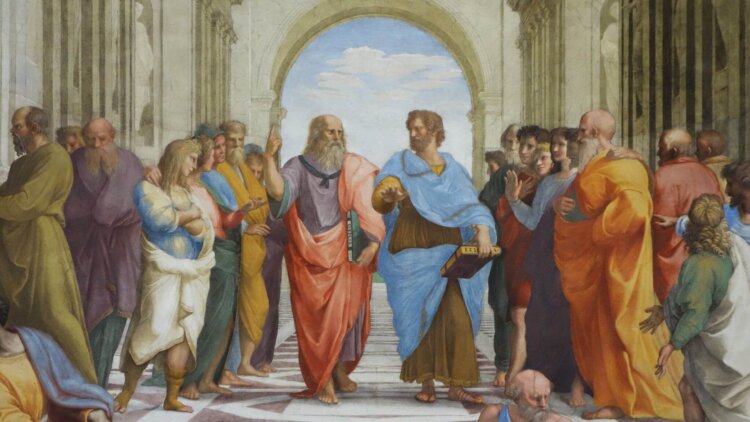
While central to Western conceptions of time, history did not commence with the birth of Christ. Centuries of pagan culture, art, and thought laid a foundation that predated and ultimately influenced the Christian tradition. Consequently, Christianity has always been shaped by — and in response to — these pagan influences. This dual inheritance introduces a tension: Christians are called to be “in the world, but not of it,” shaped by their cultural surroundings yet also set apart, caught between human reason and divine faith. Early Church Fathers and official Church documents frequently warned against association with pagan practices. The Didascalia Apostolorum urged Christians to “have nothing to do with pagan books,” Tertullian famously questioned, “What has Athens to do with Jerusalem?” and St. Jerome recounted a troubling vision of being accused before a divine tribunal of valuing Cicero’s works over Christ.
Political philosopher Leo Strauss expanded on Tertullian’s question, identifying the ongoing challenge of balancing the influences of Athens and Jerusalem. He observed in Jerusalem and Athens that, “All the hopes that we entertain in the midst of the confusion and dangers of the present are founded, positively or negatively, directly or indirectly, on the experiences of the past. Of these experiences, the broadest and deepest — so far as Western man is concerned — are indicated by the names of two cities: Jerusalem and Athens. Western man became what he is, and is what he is, through the coming together of biblical faith and Greek thought.” In this sense, the Western world, with Christianity at its center, represents a synthesis of Hellenistic thought and Christian teaching. Athens has everything to do with Jerusalem. Despite the early Fathers’ concerns — and lingering unease even today — the Catholic Church and its many champions over the centuries have defended this blending as a vital component of the faith. While Christianity has historically warned against pagan influences, the synthesis of Greek philosophy and biblical faith has proven indispensable to the development of the Catholic intellectual tradition. Despite early cautionary calls to avoid secular knowledge, figures like Dante, Aquinas, and Pope Benedict XVI illustrate how integrating pagan philosophy with Christian doctrine has enriched the Church’s theological framework. This fusion — best exemplified by the careful “plundering of the Egyptians” — reveals that an educated engagement with both reason and faith is essential to a complete understanding of divine truth within the Catholic tradition.
Dante’s Reliance Upon Virgil
In the opening canto of Dante’s Inferno, as he is being chased by some unearthly beast, Dante pleads for help from a figure he cannot tell as being a “shade or real man.” The figure reveals himself to have been a man once upon a time, though no longer. The figure “was a poet and sang of that just son of Anchises who came from Troy after proud Ilium was burned” and lived “at Rome under the good Augustus, in the time of the false and lying gods.” Dante realizes that the being before him is the deceased poet Virgil, Dante’s “master and author.” It is Virgil and adopting the poet’s style that has brought Dante his honor.
Virgil declares that he shall be Dante’s guide to lead him out of this realm, as it is a treacherous path, “Therefore, considering what is best for thee, I judge that thou shouldst follow me, and I shall be thy guide and lead thee hence through an eternal place where thou shalt hear the despairing shrieks of the ancient spirits in pain who each bewail the second death.” In light of this opening of the Inferno, it is undeniable that Dante has set up Virgil as a representative of the ages before Dante’s own, of what Virgil describes as the age of “false and lying gods.” The age of false gods is acknowledged for what it is: false, yet the wisdom of the age embodied in Virgil is still accepted and rejoiced over. Dante in this way acknowledges that his work is guided and colored by the pagans before him.
Ultimately, however, Virgil’s presence and guidance is faulty. In Canto XXX of Purgatorio, it is upon being struck with a divine awe at the sight of heavenly Beatrice that Dante turns to find his light gone. In his stupor, Dante had turned “to the left with the confidence of a little child that runs to his mother when he is afraid or in distress,” seeking out Virgil for assurance, when he realized that “Virgil had left us bereft of him, Virgil sweetest father, Virgil to whom I gave myself for salvation,” and Dante weeps at the loss. However, Virgil is a pagan soul and can’t enter Heaven with Dante. Instead, Virgil returns to the Limbo of Virtuous Pagans in Hell to spend eternity.
In analysis of the usage of Virgil’s role in the Divine Comedy, the ancient poet serves to show how the Christian, specifically Catholic, tradition is rooted in and guided by the wisdom of voices before Christ, but ultimately these voices point to and fall short of God. Virgil represents the strength and force of human reason. Exemplified by the lasting knowledge of Virgil’s accomplishments on earth and Dante’s trusting of the deceased man because of them, Virgil is thus swiftly accepted as Dante’s guide through the underworld showing the man the way through the terrain and its experiences. Virgil also embodies the pre-Christian virtues of courage, temperance, and wisdom. Virgil displays all of the noble virtues attributed to the perfect Roman. He represents reason and wisdom, making him the perfect guide. As the journey progresses, his treatment of Dante changes, depending on the situation. Often and most importantly, Virgil is very protective of Dante. However, Dante cannot glorify his beloved idol and guide for forever. Because Virgil was never a proper Christian, the poet must be bid adieu. Human philosophy, reason, and virtue eventually reach their limits, and faith in God must take precedence over them. Yet, it is these pagan, more so human, virtues and practices and their guidance that point to God, leading to the impression that human reason is oriented to the divine in its end.
Aquinas in Conversation with Aristotle
Alongside Dante’s literary usage of pagan figures and their wisdom, there is the purely pragmatic fact that Greek culture was infused into early Christianity “Not only were the Gospels and other NT texts written in Greek, much of the thinking in the early Church used the Greek language, but also Greek philosophical notions, to give a rational account of the faith.” The language of the early Christian, of founding councils and creeds, was Greek before it was ever Latin. The former inherently colors and partially defines the latter, despite progress or time passed.
In light of this interconnectivity of ages and the effusive nature of Greek pagan culture in early Christianity, recovering Greco-Roman culture and philosophy was the aim of vast swaths of medieval effort in the ages following. St. Thomas Aquinas is a key example of this period of the interconnectivity between Catholic theology and philosophy and its pagan past. St. Aquinas sought to understand the Greek philosophers before him, particularly Aristotle in writing his Summa, so that he might “make use of this understanding in a theological context.” By understanding Aquinas’s commentaries on Aristotle, and comparing such “with his independent philosophical writings, polemical and otherwise,” Aquinas’s Aristotelian commentaries “enable us to comprehend his basic philosophical outlook and to see the contributions he made to philosophy,” and see how the Aristotelian framework revolutionized Christian theology and philosophy.
The prime example of Aquinas’s work shaped by Aristotle is his Summa Theologicae. In the treatise, the third article of the second question of the second part is whether it is necessary for salvation to believe anything above the natural reason — the intellectual capacities given to every human being. The first objection St. Aquinas describes is that it seems unnecessary for salvation to believe anything above the natural reason. The salvation and perfection of a thing seem to be insured by its natural endowments. Matters of faith surpass man’s natural reason, as faith entails things unseen, making belief unnecessary to man’s salvation. Salvation can instead be fully procured within the limits of human abilities.
In response to Objection One, it is stated that natural knowledge does not suffice for the perfection of man’s nature. This is because his nature is dependent upon a higher nature, with some supernatural knowledge and teacher needed to reach perfection in time. This is similar to Objection Three, which states that faith perceives the invisible things of God “in a higher way than natural reason does in proceeding to God from His creatures.” Sirach 3:23 is used here to state that, “Many things are shown to thee above the understandings of man.” This highlights the imperfections of man’s natural reason, and how a divine help is needed to reach the highest understanding and happiness. Once more, like Dante and Virgil, pagan human knowledge is useful, but can only reach so far.
In review of these selections from St. Aquinas’ work, perhaps most significant to the question of the relationship between faith and philosophy is his aforementioned conception of knowledge and natural reason as “preambles to the articles” of faith. Faith presupposes natural knowledge, according to St. Aquinas, making the two inherently combined. To St. Aquinas, then, man must be both a philosopher and being of faith. It is the capacity for philosophy and reason that enables man to accept faith at all. While faith may itself still be an act of the will, an understood gap to be leapt between the worldly and the other-worldly, it is the reason that leads man to the knowledge of this leap in the first place that allows the choice for faith to take root to be made.
In response to Objection One, St. Aquinas states that the existence of God and other like truths about God, all of which can be known by natural reason, are not articles of faith, but rather “preambles to the articles; for faith presupposes natural knowledge, even as grace presupposes nature, and perfection supposes something that can be perfected.” There is nothing to keep a man who cannot grasp a mathematical proof from accepting, as a matter of faith, something which is inherently able to be scientifically demonstrated and known.
Faith, St. Aquinas has established, is a natural knowledge. This settles faith even deeper in man’s being than philosophy, as any natural knowledge is that which man is naturally equipped with and a reflection of the divine. Combining this and the above article, it is clear that Aquinas is pointing at a vision of the Christian life that utilizes the goods of pagan Greek philosophy to Christo-centric ends. Athens paves the way and bolsters Jerusalem.
On Leo Strauss
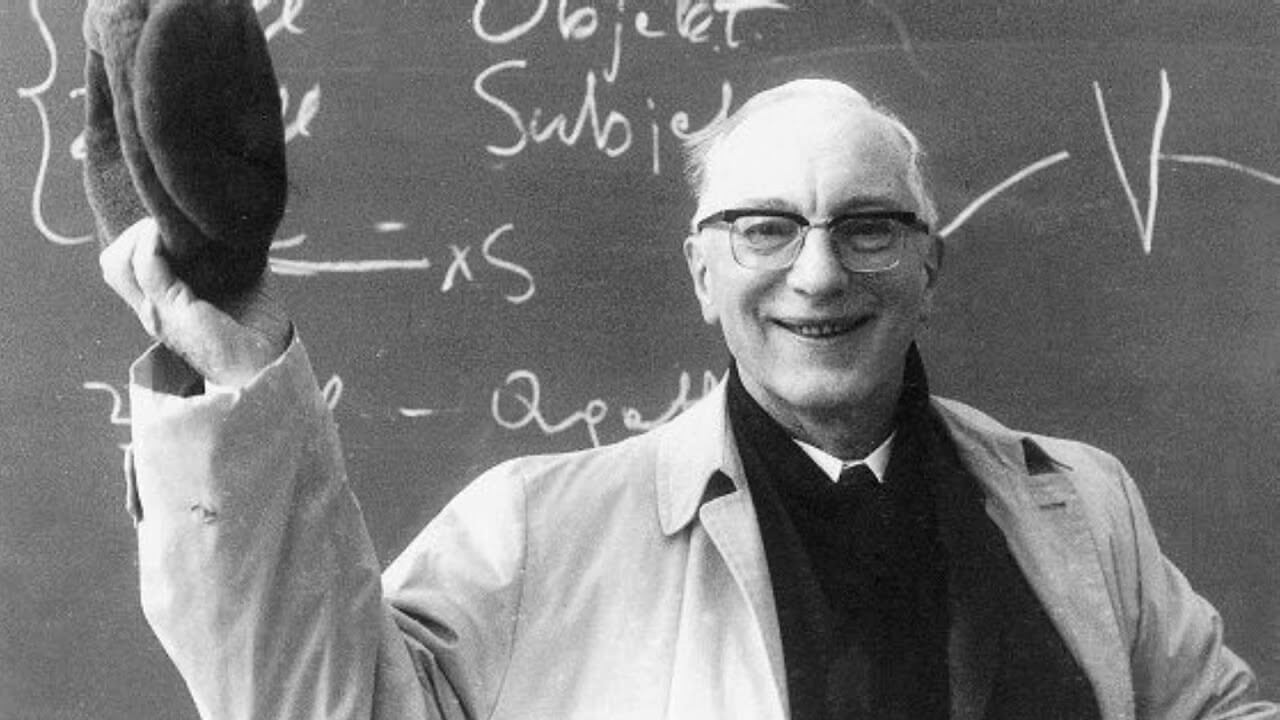
In Strauss’s commentary Jerusalem and Athens: Some Introductory Reflections, the political philosopher attempts to reconcile the seemingly contrasting natures of the two societal hubs that have created the Christian tradition. Strauss points to wisdom as being the unifying factor between the two, “a word that points to the highest that both the Bible and the greatest works of the Greeks claim to convey.” Both the Greek philosophers and poets, and it is possible to posit their Latin successors by extension, were considered to be wise men, and the Torah to be “your wisdom in the eyes of the nations.” Yet while the two traditions are connected by wisdom, the form of such differs vastly. Both claim to be the true wisdom, Strauss says, thus “denying to the other its claim to be wisdom in the strict and highest sense.” To the Bible, fear of the Lord is the beginning of wisdom, while to the Greeks, wonder is.
Individuals, including Christians, are forced to choose between the wonder of Athens or the fear of Jerusalem then, according to Strauss. Strauss asserts that “we ourselves are not wise but we wish to become wise. We are seekers for wisdom, ‘philosophia.’” Yet, because “we say that we wish to hear first and then to act or to decide [between the aforementioned options], we have already decided in favor of Athens against Jerusalem.” To Strauss, it is impossible to be open to the question of Athens or Jerusalem at all. To be open is to be already sided to Athens, implying that to align oneself to Jerusalem, to faith, is to forgo reason and philosophy. This creates a stark contrast between the two, standing in tension with the Catholic voices of St. Aquinas and Pope Benedict on the issue, both of whom posit that pagan philosophy is compatible with the faith.
St. Basil and the Christian Use of Hellenic Education
While Strauss claims that Athens and Jerusalem cannot coexist in an individual, Father Kevin Kalish of the Russian Orthodox Church offers a synthesis of the relationship between pagan Hellenic knowledge and the education and formation of Christian youth through the theology of St. Basil. St. Basil, in his Address to Young Men on the Right Use of Greek Literature, suggests that young Christians be educated and guided through secular texts before “turning to the higher truths of the Bible.” In the same address, St. Basil states: “Indeed, so long as you are unable, on account of your age, to comprehend the depth of their [the Holy Scriptures] meaning, in the meantime we might, as it were, train the eyes of the soul in shadows and reflections, imitating those who practice drills in military exercises; who, after acquiring experience by weight-lifting and dancing, when the contest comes, reap the benefit from their training.”
In a scene reminiscent of Socrates’s treatment of the young guardians in the Republic, young students must be like soldiers, whose guided training, and thus habituation, prepares them for a greater battle or test. Hellenic, and thus pagan, literature is the habituation and training needed in this metaphor because it postures the young mind and soul to be open to virtue and it’s exercise, before being turned to the truly divine: “[we must follow these men (who praise virtue) and attempt to manifest their words in our lives.” According to St. Basil, reading the pagan authors should present no difficulties, and indeed reading things like Homer and Hesiod one can learn elementary lessons in virtue. Basil explains, “I maintain that, because these examples lead to nearly the same end as our principles, it is right for those of your age to imitate them.” Since the pagans had access to the same principles as those depicted in Scripture, and even imitated them, then they are of exceptional benefit. The pagans did not happen by chance to alight upon the same notion of virtue: “It is difficult to believe that they correspond with our principles by chance, and not by imitating them in earnest.” Thus the youth, when they imitate virtuous men in pagan literature, are in essence imitating Christian virtue.
Secular learning, if St. Basil is to be taken seriously, is preparatory to further study of the higher truth of God’s word. St. Basil’s language of “training the eyes of the soul in shadows and reflections” is in fact reminiscent of such a Hellenistic education, calling to mind the Platonic Allegory of the Cave, with Basil nearly directly reiterating the process of the man leaving the cave and seeing the sun’s light gradually to youth being brought up and trained to see divine truth, “like those becoming used to seeing in water the sun, so too we shall direct their eyes to the light itself.” One cannot start off looking directly at the sun because its radiance would be too bright; instead, one needs to strengthen the eyes by looking at reflections of the light.
Pope Benedict XVI and the Necessity of Athens
Most recent of the Catholic voices to promote the interconnectivity of pagan Hellenic thought and the Catholic tradition is Pope Benedict XVI. Throughout his time as Holy Father, Pope Benedict XVI was a champion of the marriage between pagan Hellenic, and by extension Roman, thought to Christianity. Pointing to the opening verse of the Gospel of John, “ ἐν ἀρχῇ ἦν ὁ λόγος, καὶ ὁ λόγος ἦν πρὸς τὸν θεόν, καὶ θεὸς ἦν ὁ λόγος,” wherein “λόγος,” or logos, translates as both word and reason, Pope Benedict urged that the relationship between the reason oriented culture of Athens and the heart of faith in Jerusalem were two sides of the same coin. The two cannot, indeed must not, be separated from one another.
Alongside this belief in the marriage of Athens and Jerusalem, however, Pope Benedict asserted that the Catholic Church need not fear being overtaken by pagan or secular forces it finds itself interacting with. Rather, Pope Benedict believed that the Church should sanctify culture, rather than simply accommodate it. The power of reason, or logos, Pope Benedict believed was a means to transform classical culture. Christ, as the embodiment of logos, sanctified the goods of classical culture, much as St. Basil attested.
Pope Benedict proposed that it has been the combination of Hellenistic culture’s development of reason and speech with the final revelation of the Incarnate Word that has created the cultural foundation of Europe and the broader Western world. Europe received a “world-historical privilege” in that “the pre-modern cultural formation that combined the final revelation of the Incarnate Word and his salvific message with the high development of human logos — reason and speech — in Hellenistic culture. In the context of imperial Rome, divine Ratio and philosophical reason encountered and engaged in a mutually beneficial (if often contentious) dialogue. This was the cultural foundation of Europe that eventually emerged from the rubble of Rome.” It is the separation of Hellenic influences from Christianity, of “de-hellenization,” that is “injurious to both faith and reason.” Rather, Athens must submit itself to Jerusalem, but not un-sync their steps from each other.
Conclusion
Despite early Church Fathers’ concerns, the Catholic Church, over centuries, has upheld the integration of Hellenistic philosophy as essential to its intellectual and spiritual mission. This blending, evident in Dante’s Divine Comedy, St. Thomas Aquinas’s dialectic with Aristotle, and Pope Benedict XVI’s affirmation of the Church’s Hellenic roots, illustrates how faith and reason coalesce in the Catholic tradition. St. Basil similarly paints a vision of education, and more specifically Christian education, that is contingent and built upon a pagan basis.
The Christian must not forgo the wisdom of the ancients, of those voices before Christ, for it is within those pagan voices that prophecy and signs of the truth of Christ are to come. Even the pagans pave the way for the light and truth of the Word, much as St. Basil alludes to via the Platonic Allegory of the Cave that those who escape the darkness must light upon half truths before seeing the truth in its entire glory. Thus, the Catholic tradition is a synthesis of Athens and Jerusalem that requires wisdom, discernment, and the “educated hand” necessary to “plunder the Egyptians” of their treasures, bringing forth the riches of both Greco-Roman wisdom and the faith of the Church to craft a fuller vision of divine truth within the human experience.


Related Posts