The Sacrifice of Jesus
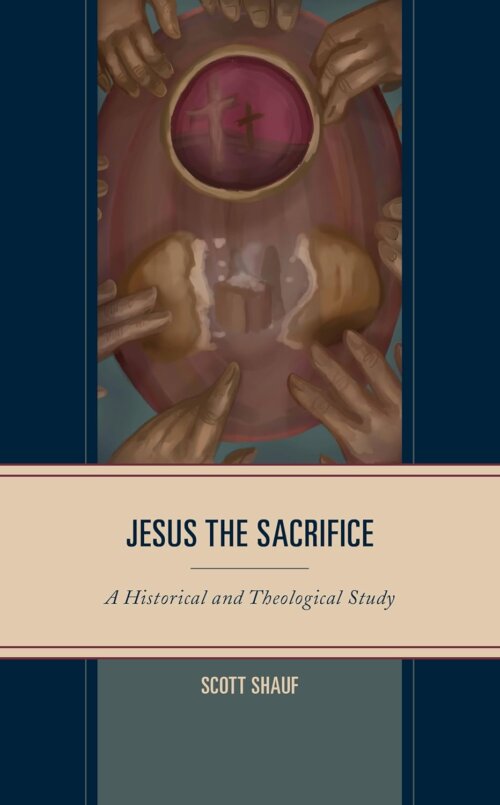
Scott Shauf’s Jesus the Sacrifice: A Historical and Theological Study attempts to trace a genealogy of the structure of sacrifice at the heart of Christology. Traditionally, Christology has been divided into two main interpretations: the predominantly western atonement theory (which includes both ransom theory and penal substitutionary theory) as well the “Christ the victor theory” which is largely the position of the eastern and orthodox churches. However, both of these theories were articulated in the aftermath of the event of Christ’s life and death and subsequent development of the church and are thus influenced by the cultural and sociological needs of the church as it attempts to understand the meaning of Christ’s sacrifice. To this end, Shauf believes that something has been lost in the present discussion, which he attempts to rectify through a historical recollection of the idea and meaning of sacrifice, as it is interpreted through various populations, including non-Jewish, Jewish, and Christian perspectives.
Each chapter builds on the preceding one attempting to develop a logic that culminates in the Christian interpretation of sacrifice. To this end, he works through the following perspectives: firstly, sacrifice in the ancient Mediterranean World; secondly, sacrifice in the Jewish Scriptures; thirdly, sacrifice in Second Temple Judaism; fourthly, sacrifice in the New Testament; and lastly, the penultimate chapter “Jesus the sacrifice” which brings together the preceding logics of sacrifice into an interpretation that challenges the contemporary interpretations. Shauf makes it clear that he believes such a historical investigation is necessary because of the historical distance we have from the event—one which has made the very idea of sacrifice foreign and alien to us, and hence leads us to fail to appreciate the subtlety of the operative structures in play in the Christian interpretation. He states as much saying, “We cannot understand what the New Testament authors meant in interpreting Jesus’ death as a sacrifice if we do not understand sacrifice itself.” Hence, the purpose of developing a historiography of sacrifice is to produce a deep exegesis of the New Testament texts that account for the meaning of Christ’s death and resurrection as sacrifice (whether for ransom or penal substitution).
He states in the introduction, “A key point of our study will be that this conception of the relationship between sacrifice and atonement is backward. Sacrifice should not be understood as a subcategory of atonement.” This is because, according to Shauf, the ancient world had a “multivalent” interpretation of sacrifice which cannot be easily located within the theological logics that developed subsequently. In discussing what sacrifice meant in the Mediterranean world, he brings up figures as diverse as Henri Hubert, Marcel Mauss, Sigmund Freud, Karl Meuli, and René Girard to demonstrate the depth and diversity of meaning that sacrifice had in the ancient world, concluding “Asking ancients about why sacrifice was important might be like asking lovers why kissing is important—the certainty of the act’s importance would be agreed upon, even if providing an explanation as to why might be difficult!” To this end, he attempts to impress on the reader that while sacrifice may seem unnecessary and foreign to us, it is no less irrational than any number of customary practices we maintain today. One thinks of a possible response to the prohibition on eating certain meats (like pork in Judaism and Islam and beef in Hinduism and Sikhism) to similar prohibitions that countries in the western world have to eating dogs or horses (sorry, Frenchmen!). The ancient world was a world filled with mystery and signs, not all which are apparent to scientific reason, and yet continue to sustain our lives even today. However, this starts to demonstrate an inherent weakness throughout Shauf’s argument: if it is the case that the logic of sacrifice was opaque even to the practitioners who took it for granted, what would be the utility or even possibility of rendering such a logic transparent, and in what way would antecedent views of sacrifice be applicable to the development of subsequent views, which are ostensibly also opaque and unavailable to their practitioners.
These problems compound as Shauf continues to build his argument. In discussing Sacrifice in the Jewish Scriptures, he starts through a summary of “documentary hypothesis” which believes that the Hebrew Bible was a product of the intersection of four hypothetical documents, two of which Shauf believes are the main contributors to the text known as Leviticus today; namely, the priestly and holiness documents. This attests to discrepancies in the finished text which contribute to the multivalent interpretation of sacrifice. Nevertheless, Shauf contends that there is general consensus that sacrifice in the Jewish scriptures had three main purposes: “to establish communion with God, to provide gifts to God, and to make atonement.” This leads him to the conclusion, quoting Gary Anderson, that “[w]hereas prior to the revelation at Mt. Sinai, God had appeared to his chosen only sporadically, now this divine presence could be routinely and made available on a regular basis.” Such communion seems to have purposes beyond simply atonement since, as Shauf explains, “God smelling the aroma of the sacrifices, in the oft-used expression “pleasing aroma” suggests that what is at stake is not simply an accountancy or ledger of legal transgressions, but genuine and living participation with God. While this does not preclude atonement, Shauf seems to intend to argue that it cannot be simply subsumed into Christological logics which reduce it to atonement. However, this argument seems unfulfilling: after all, is not the celebration of Christ’s sacrifice in Christian circles largely contained in the remembrance of the last supper through the distribution of the sacrament of Eucharist/communion? It would seem to behoove Shauf’s argument to explain the continuity of the ancient and contemporary practices, as it seems that his argument relies on a rather anemic and somewhat strawman conception of what the contemporary/modern understanding is.
In the final chapters of the book, Shauf shifts from the Hebrew and Judaic conceptions of sacrifice to specifically Christian ones, as contained in the New Testament texts. This leads to an account of how various figures, such as Mary and Joseph, maintained Jewish practices, and how this formed the basis for Christ as a sacrifice, himself. This also leads to a rather surprising outcome, where in Philippians 2:17, the apostle Paul even understands his own minister as a sacrificial act: “But even if I am being poured out as a libation over the sacrifice and the offering of your faith, I am glad and rejoice with all of you.” This demonstrates the hold that sacrificial logic had in interpretation the purpose of Christian faithfulness and piety. After a discussion which mirrors the previous chapters on how the logic of Jewish sacrifice is maintained by the Jewish community surrounding Jesus, Shauf recounts how even the book of Revelation uses sacrificial imagery with “heaven described as a temple, complete with an altar and angels performing the priestly duties.” This leads Shauf to conclude that such references “attest to the continuing power of the temple and sacrifices as religious institutions, practices and ideas.” Again – a major weakness in the argument emerges; in what way is the Jewish practice modified, extended or developed through the continued witness of the New Testament texts and the subsequent Christian community? While Shauf has certainly demonstrated the facticity of sacrifice as a practice, he has hardly elaborated on what its interpretation should be, or how the historiography he developed should change our own contemporary understandings of the ancient practice. This leads us to the final chapter, where Jesus himself institutes the Lord’s supper as the instrument of God’s forgiveness in the new covenant.
The final chapter summarizes the argument in the rather unconvincing claim, “Jesus’s sacrificial death was necessary, but it was necessary not because of some quirk of God’s character” but “because of the place that sacrifice held in the ancient world and because of sacrifice’s role in the story and life of Israel…” This is puzzling, since Shauf had attempted to demonstrate that the rationale behind the ancient practices of sacrifice was not simply atonement, but ongoing participation and communion with God. If God’s love and desire to unite with our will and ends is not a personal quirk, then what else is it? After all, it hardly explains why would a people engage with a God when their entire practice is simply a historical oddity. To this end, Shauf’s argument, though meticulously collected through an exegesis of the text, fails in its endeavor to explicate the logic of ancient peoples and how that either contradicts, augments, or is replaced by subsequent and modern logics. Shauf’s text, finally, demonstrates a work of meticulous scholarship, but with no purpose or end and leaves us with more questions than answers regarding a God who has no personality, but nevertheless desires to commune with us and would find our prayers and atonements as pleasing.
Jesus the Sacrifice: A Historical and Theological Study
By Scott Schauf
Lanham, MD: Fortress Academic, 2022; 238pp


Related Posts