The Overlooked Music of Sir William Walton
Certain composers define entire eras. Debussy and Ravel, for instance, are the very essence of French impressionist music. And no corner of the Baroque is free of Bach’s shadow, so profound was his influence on everything that came after him.
Other composers, however, do not arrive during eras but rather between them. “Bridge” composers, I call them. A good example here is the early output of Arnold Schoenberg, which bridged the gap between late Romanticism and the early hints of twentieth century harmony. As a violinist, my favorite bridge composer is Eugene Ysaye, whose six sonatas for solo violin carry the last echoes of the nineteenth century into a brilliant modern style.
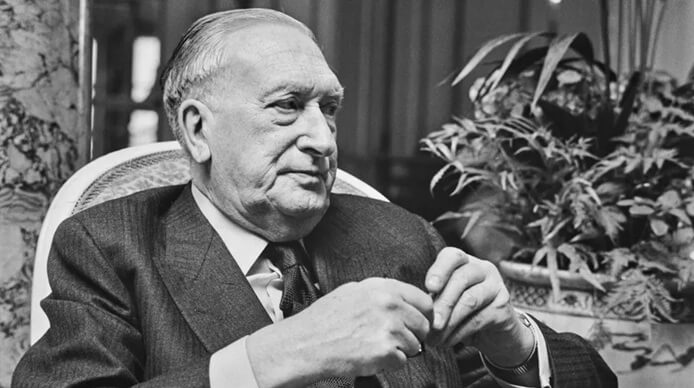
The risk for bridge composers, though, is that they are forever in danger of being overlooked. Being as they are a blend between the old and the new, they can seem as though they have no musical home, no specific style to which our auditory grids can anchor them. The British composer Sir William Walton is one such composer. Known primarily for his viola concerto and first symphony, Walton bridged the gap between Edwardian era in British music, defined by the soaring Romanticism of Edward Elgar and Vaughn Williams, and the twentieth-century genius of Benjamin Britten. Walton was a master composer, one with an impeccable ear and a singular harmonic sensibility, but his status as a bridge composer unfortunately means that he is often passed over.
A new record by the Sinfonia of London, however, aims to change that. Recorded on the Chandos label with John Wilson conducting, the record features three of Walton’s works: the symphonic suite from his opera Troilus & Cressida, the rollicking Portsmouth Point overture, and the violin concerto with Welsh wunderkind Charlie Lovell-Jones on the violin. I will spend a few words on the first two compositions, but the thrust of my remarks—and, I believe, the centerpiece of the album—will focus on the violin concerto.
If Walton is undeservedly neglected, his opera Troilus & Cressida is twice so. This masterpiece, which Walton based on Chaucer’s epic poem by the same name, is a wide-ranging and theatrical work of intense feeling and beauty. One hears flashes of Vaughn Williams-like serenity and Elgar-like power, but they remain flashes; Walton seems eager for more. The second movement, Scherzo, was written for Sir Peter Pears, the same tenor to whom much of Britten’s vocal music would one day be composed for. Sir Peter must have had quite the voice.
The Portsmouth Point overture was inspired by a Thomas Rowlandson print depicting sailors working on the docks in Portsmouth, England. Walton later said he arrived at the idea for the piece while riding the Route 22 bus through London. This is a rambunctious piece, full of angularity and playful energy. I heard some Stravinsky in it, perhaps even a bit of jazz. One could be forgiven for seeing in its jaunty rhythms a precursor to the musical language of Aaron Copland.
Now for the violin concerto. Walton composed it in 1939 on a commission from the great violin virtuoso Jascha Heifetz, who later premiered the work with the Cleveland Orchestra. One can hear in the score the raw pizazz of Heifetz, the almost unbearable brilliance that so often characterized his playing. Lovell-Jones could not have matched Heifetz’s sound, but I found his interpretation convincing nonetheless. His sound has more of a Menuhin-esque sweetness to it, but his interpretive and technical skillsets were more than up to the task. This is particularly important in the first movement of the concerto, which alternates between rage and serenity with (sometimes) alarming alacrity. I’ve highlighted the episodic nature of Walton’s music in these pages before, and I will admit I’ve not always enjoyed it. The cello concerto, for instance, seems as though it is being tossed to and fro between two warring personalities. Yet for some reason I found the episodic nature of the violin concerto less destabilizing.
Is this because I am a violinist and not a cellist? Perhaps, although I’d argue it is because the first movement contains one of the most memorable and beautiful melodic lines in the 20th century repertoire. I thought of Korngold’s violin concerto when I heard this line, so smooth and cinematic were its contours. Indeed, it is tempting to view the two concerti as parallel works. After all, Walton’s concerto was composed in 1939; Korngold’s in 1945. It would not be difficult to imagine they shared—from opposite sides of the pond—certain musical influences and interests that brought their compositions together in ways they could not have imagined.
The second movement, titled Presto Capriccioso, is great fun. Lovell-Jones is comfortable living on the edge, and his courage lends itself well to the daring virtuosity of this movement. Walton seems eager to stretch the stylistic boundaries of the concerto, alternating between an eerie, lilting waltz tune and waves of unhinged violin runs. The middle of the movement is punctuated by a sudden Canzonneta dance (a popular dance form in 16th-century Italy) before returning to the violin fireworks.
Walton’s British predecessors are most apparent in the third and final movement. The first movement’s main theme briefly returns, this time permutated through various new orchestral textures, before the violin launches into a rapturous cadenza that seems almost as if Elgar himself could have written it. Here Walton unleashes the full strength of his genius to weave the many themes of the concerto into the cadenza and bring them together in an emphatic ending.
T.S. Eliot wrote of what he called “the historical sense,” which “compels a man to write not merely with his own generation in his bones, but with a feeling that the whole of . . . Europe from Homer and within it the whole of . . . his own country has a simultaneous existence and composes a simultaneous order.” By this Eliot was referring to the delicate balance between tradition and innovation, past and present, a theme he would later revisit in his immense and beautiful poem Four Quartets. And it is for this reason that Sir William Walton, underappreciated though he may be, is worth our attention. By bridging the gap between Elgar and Britten, Walton is a vital link in the story of English music.


Related Posts