Why the Left Sees Fascism Everywhere
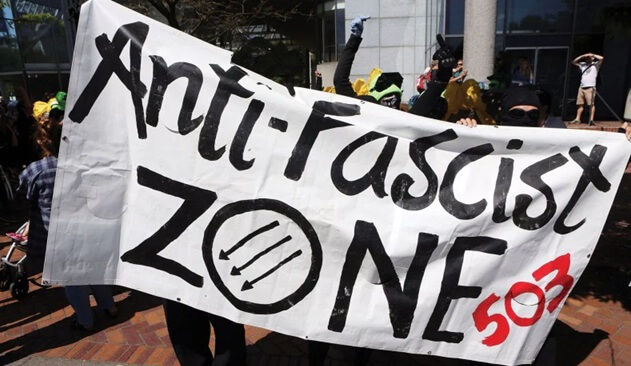
Fascism lost World War II. Communism lost the Cold War. Marxism is winning the historical imagination in the twenty-first century.
One of the pressing problems with political rhetoric is the constant usage of terms and terminology without a reference point, an anchor, to provide understanding. There is also the problem of terminological fundamentalists, those committed to adhering to an unchanging definition even as no one adheres to that old definition. Fascism and Marxism are two examples of this. Fascism is everywhere used to describe anyone even slightly to the right of the far-left and the virtues and values of the generation that defeated fascism in the 1940s would be labeled fascist today: Christian, patriotic, and pro-family. Marxism, too, is bandied about as a pejorative among the cultural and political right, even by some on the left, though it is largely detached from the general philosophy and economic theory of its namesake, Karl Marx.
The problem with terminological fundamentalism is its refusal to accept the reality of language: the ever-changing usage of language by the people who use it. Dictionaries are updated to reflect our language usage, which includes how we understand certain words whose meanings change with our usage. Awful no longer means full of awe, as it originally did, but now means something bad, disgusting, repulsive. Nice used to mean simple, or foolish, to be nice was to be a foolish simpleton. Nice, nowadays, is a synonym with kindness; to be nice is to be kind and generous.
It behooves us to fight the old rhetorical war by wanting to retrieve the original meaning of fascism, the political theory of state corporatism and authoritarianism, where the State, headed by a dictator or strongman acting on behalf of the people, the nation, ruled with a sort of absolute supremacy. Giovanni Gentile, in his The Doctrine of Fascism (co-authored by Mussolini), described fascism very succinctly as the philosophy which would manifest “the century of the State.” The fascist century dreamt by the first generation of fascist theorists and leaders conceived itself as the energetic zeal emanating from the spirit of the people being channeled into the formation of a state which would act as the unitive spirit of newly formed nations. We must not forget, here, that though certain peoples had a long history, their nations had only recently been formed like Italy (1861) and Germany (1871), or only recently gained full independence after the end of World War I like Hungary (1918). No one means fascism to be a political philosophy of state supremacy when used, either self-descriptively or as a pejorative for political opponents. So what happened?
What happened was fascism’s own self-transformation, once in power, and the analysis of it by critics (especially Marxist critics), in the aftermath of the horror of the Second World War. Once in power, fascist governments promoted an aggressive foreign policy of aggrandizement, often with the goal of achieving Living Space, or Lebensraum, as famously adopted by the Nazi Party in Germany. This aggressive foreign policy of aggrandizement mixed with notions of Lebensraum united with the hereditarian biologism of late nineteenth century race-science, ensuring the eventual marriage of state supremacy with racial supremacy: the state is the ultimate actor of the will of the people, but that people the state is the ultimate expression of is a racial people which excludes certain groups of people even if they reside within the nation. Fascism was defeated in World War II by the democratic alliance of the West, led by the United States, and the communist superpower of the Soviet Union.
The defeat of fascism, along with its spectacular rise to power in the decade after the tragedy of World War I, caused Marxist philosophers and intellectuals to reanalyze capitalism, the bourgeoisie, and the new phenomenon that Marx did not live to see: fascism. The East German playwright and philosopher Bertolt Brecht aptly summarized the emergent new Marxist understanding of fascism, “Fascism is a historic phase of capitalism.” Brecht would go on to say, “how can anyone tell the truth about Fascism, unless he is willing to speak out against capitalism, which brings it forth?” To be against fascism, Brecht elaborated, meant one had to be against capitalism. To be against capitalism meant one was fighting against fascism. The Cambridge Five, the infamous ring of British spies working for the Soviet Union, thought the same: Marxism, in the form of the Soviet Union (at the time), was the best political system to fight against fascism.
In the new Marxist historical imagination, capitalism’s disintegration of all social bonds through its relentless industrialization and commercialization, its exploitation of humanity (humanity understand to be labor), and reorganization of human social order through urban capitalization made humans weak and prone to the eventual state authoritarianism of the dictator. Furthermore, fascism’s historic manifestation as a bulwark against revolutionary socialism would attract the support of the bourgeoisie, the patriotic middleclass of any nation who would fear the Revolutionary Other and forsake their democratic, libertarian, and religious traditions to find protection under the fascist dictator. “In Fascist countries capitalism continues to exist, but only in the form of Fascism,” writes Brecht. “Fascism can be combated as capitalism alone, as the nakedest, most shameless, most oppressive, and most treacherous form of capitalism.”
Fascism, therefore, is the final expression of exhausted capitalism. Or, in Neo-Marxist language, fascism is the byproduct of “late capitalism.” Late capitalism, a term first used by Werner Sombart, was popularized by the Marxist economist and philosopher Ernest Mandel. Late Capitalism, Mandel’s magnum opus, attempted to explain what Marx did not witness: the failure of the working-class to inaugurate the proletariat revolution, the 1950s and 1960s economic boom, and the shift of capitalist modes of economics away from industrial work to financialization leading to globalized markets and mass consumption. The exhaustion of late capitalism into a bland consumerism would lead to the reemergence of fascism, which would be the attempt by capitalism to defend itself at the end of its exploitative and oppressive development wherein the racial majority of a capitalist country would also vehemently scapegoat and go to war against the foreign other—the scapegoated other being the image held up by a devolving capitalism to hide the failures of late capitalism in its final descent into disintegration and authoritarian fascism within that process of disintegration.
Suddenly, so much leftwing rhetoric makes sense once understood through the Marxist historical imagination. Living in the age of late capitalism, with the supposed failures of late capitalism becoming apparent, the middle-classes of developed nations in their turn to authoritarian nationalism and scapegoating—the new fascism of the twenty-first century—prove the Marxist historical imagination correct. We are living in the early stages of the new fascism according to the Marxist mind. Marxism, as we can now understand it since 1945, is not the mere economic and political theory of Marx’s social history, but principally a vision of unfolding history within the epoch of capitalism—the end of capitalism and its descent into fascism which proves Marx’s basic point of capitalism correct: exploitative oppressive.
Liberalism, therefore, becomes fascism. Conservatism becomes fascism. Christianity becomes fascism. Every tradition and deep root of culture now destroyed and disintegrated by the destructive exploitation of capitalism ends in fascism, which can be understood as state racialist authoritarianism within a late capitalist economy.
This idea is very pervasive among the Western educated elite and intelligentsia, a core segment of the professoriate at elite universities and state universities (especially those educated at the elite universities who read the many post-war Marxist thinkers), among lawyers and journalists, and now among the new generation of university students who have swallowed, wholesale, this basic vision of understanding history and the world. Yet there remains an awkward humanist impulse within the new Marxist imagination—the desire to prevent another holocaust, the hope to prevent another world war, the want to prevent a global catastrophe. Thus, the oppressed scapegoat is the victim to be saved against fascist oppression and vulgarity. Capitalism must be replaced now before it destroys itself, our planet, and mass swaths of people as it did in the 1940s. A global, eco-socialist, solidarism must be the future. And anyone who opposes this global eco-socialist future is a fascist because of the dialectical binary that Marxist politics is imprisoned in. Capitalism ends in fascism, or fascism is the cruelest and latest form of capitalism—it is all the same to the Marxist imaginary—and therefore you are either on team capitalist-fascism or team socialism. Thus, to the Marxist historical imagination, fascists really are everywhere. Fascists can be you, me, our neighbor, anyone who is not that oppressed and scapegoated group at the end of late capitalism as it devolves into fascism.
Humans are instinctively narrative creatures. We live by stories. Our identities are shaped by the stories and narratives we tell ourselves. Unless a different story can be told in the current world epoch we live in, the Marxist imaginary of late capitalism and its descent into fascism and the emerging danger of fascist catastrophe will be the narrative that dominates our world and the next generation. Ignoring this is perilous.


Related Posts