
Light of the Mind
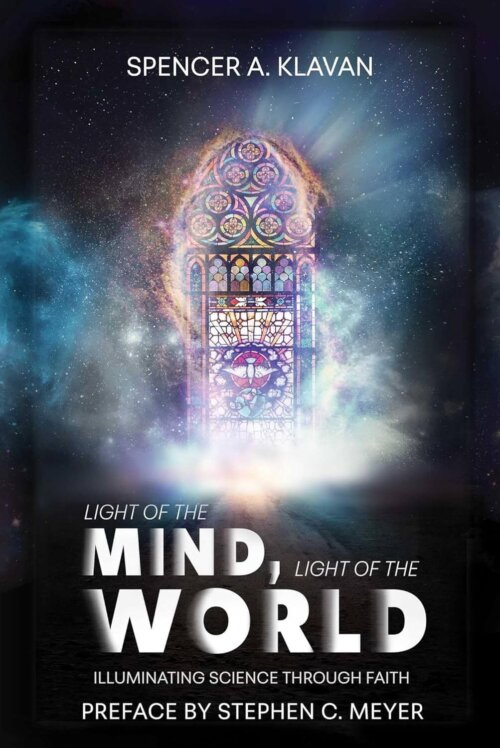
In the modern age, which uncritically enshrines science and technology, Spencer Klavan’s Light of the Mind, Light of the World seeks to retrieve an older wisdom. Klavan intends to dismantle the prevailing cultural zeitgeist which he calls “Scientism — the bone-deep and unreflecting assumption that matter alone can account for all reality, that all of existence is measurable and automatic.” Klavan’s argument is that centuries of scientific inquiry actually point us toward a Creator, toward immaterial realities, and toward the centrality of the human intellect in knowing the world. Unreflecting materialism would reduce all these to nothing, yet it cannot account for our knowledge of the world, nor does scientific inquiry truly drive away the immaterial “ghosts” of the cosmos. As Klavan says, it is time for our era to “shake off spiritual sleep — for night is far spent and the day is at hand … To those with the eyes to see, the world described by science is now looking more and more like the God-ordained universe revealed in our ancient scriptures.” Both faith and scientific inquiry point us beyond science alone.
Klavan’s method of proceeding is to survey the history of natural science. Reading the work as a philosopher and not a natural scientist, I appreciated Klavan’s extensive familiarity with the history of scientists, theories, and experiments. He brings the scientific knowledge to bear and the book features detailed endnotes, yet the text itself is accessible and poetic, not specialized or exacting. He also displays a thorough knowledge of philosophy and provides his own translations of the classical texts.
Following in the spirit of Charles Taylor and C.S. Lewis, Klavan proposes that “Scientism” is just as much a positive religious account of man as any prior sacred framework of imagination. Darwinism itself provides an “attractive new myth of man’s ascent out of primordial chaos.” Once man was nothing but primitive matter, but he has ascended to ever increasing heights of evolutionary superiority, dynamized by evolving technology. Atheistic Marxism, too, foresees a teleological ascent in which communist man can use technology to control all of nature and society for a utopian vision — albeit an immanent, material one rather than a transcendent one. Transhumanism through technology and drugs is an easy step away. But these are positive visions of whither man goes, and they are asserted with the religious confidence of a believer. Klavan astutely points out that the Big Bang Theory is merely the “canonical mythology” of our secular religion – “No story is more sacrosanct.” Despite all the claims that science has displaced faith, the Big Bang sounds a lot like a secular, quantitative account of the inexplicable creatio ex nihilo of Genesis, or even like Aristotle’s prime matter. It turns out that we can’t disenchant the universe as easily as modern science promised: “if the universe had a beginning, what force or power lurked beyond its starting point?” and “who or what set that first process of expansion in motion?”
Similarly, Klavan seeks to show the continuity between the old and new science. He refutes the modernist claims that ancient philosophers and theologians were but superstitious metaphysicians and armchair scientists. Klavan shows that one can supposedly chase out the immaterial “spirits” of the world, yet they will relentlessly sneak back in. Aristotle posited that everything contains both act and potency, and that everything in the world was composed of underlying matter and determining form. Modern scientists may think they have moved beyond these metaphysical speculations, but have we really advanced our understanding? As Klavan demonstrates, modern physics increasingly runs up against immaterial realities like energy. One cannot crack open and dissect “energy” any more than one can get a hold of Aristotle’s immaterial form or potency. There remains the inescapable recourse to aspects of nature which are intelligible, yet simultaneously immaterial: “What we are really doing when we use words like ‘force’ or ‘impetus’ is painting a mental picture of something more than material … We imagine that we have chased the spirits out of the world. [But there] has always been something more in the world to make it move, something more than matter which gives life to otherwise inanimate stuff.” Klavan further expounds:
What you are picturing is not a material object to be touched or seen: it is an immaterial fact about material objects, a property whose effects can be experienced through the senses and their imagery, but whose essence can be known only by the mind. In the days when Aristotle puzzled over why anything moved at all, he imagined powers inherent in the nature of things themselves. Those powers are not vanished, though we call them by other names. The world is no less teeming with invisible motive forces than in the days when angels moved the stars.
From this vantage point, Aristotelian form and matter, act and potency don’t seem quite that “unscientific”. Nor was Aristotle so naïve in positing the philosophical necessity of some unmoved mover, a first cause prior to all. Epistemic humility could restore natural science.
Another problem Klavan plumbs is the quest to get beyond appearances. The oldest Greek scientists, such as Aristotle and Ptolemy, sought to provide scientific accounts that could “save the appearances” by accurately mapping and corresponding with the phenomena witnessed. In time, the Copernican Revolution overcame the older Ptolemaic astronomy and Europe’s Scientific Revolution overcame older theories, partly due to advances in technology and due also to a turn toward investigating the material makeup and motions of bodies — celestial and otherwise. Baconian empiricism was optimistic that science could look beyond appearances into the material natures and properties of things. By this naturalistic thinking, the material components and forces of a thing are what the thing really is. If we could dive “beneath” the appearances and dissect reality, we could get at the genuine account of nature, free from speculative or theological baggage. Klavan gladly points out that many of the greatest Western scientists were devout Christians, but he sees the modern enterprise having led away from faith toward naturalism.
Once again, Klavan probes deeper: has modern science truly managed to get beyond appearances and yield coldly “objective” facts? As Klavan attempts to explain and summarize the confounding discoveries and hypotheses of modern physics (advanced by Einstein and his successors), it becomes increasingly clear that breakthrough advances in physics have not gotten us any more definitive an answer to that same old question of the Pre-Socratics: what is the fundamental nature of reality? Or, as Klavan puts it, “just what, after all, is the world made of?” The advances of modern physics press forward not to greater simplicity and certainty and simplicity, but to greater complexity and less certainty. The cosmos still remains an inexplicably wondrous phenomenon that transcends our limited ability to give an account of it.
If we see the world as nothing but material, man too becomes nothing but matter — atoms amongst other atoms. Biological determinism strips human life, morality, and the mind of any significance. Instead of this reductionism, Klavan wants to reclaim the role of man as subject within an intelligible cosmos. Klavan says that the scientific revolution “had begun in the hope of going beyond appearances” to see matter as it really is apart from how it merely appears to us, but further scientific progress has only made clearer the indispensability of the conscious knower; we cannot separate the knower from the phenomena. “Perhaps it was only when they could be seen by a conscious observer that ‘objects’ made any sense at all.” He argues modern physics supports this recognition.
This is not subjectivism or relativism where reality is merely what we think or wish it to be. As Klavan puts it, “The facts of the physical world are far from arbitrary – we can’t simply wish them to be other than they are. But they are what they are, and how they are, because of what we are: even physical facts are facts about how things look to us.” The modern scientific enterprise has often championed getting at “facts” which are independent of any human experience or subjectivity, yet Klavan rightly reminds us that even “facts” about the universe are nothing other than human observations. This suggests the enduring truth of the scholastic dictum of Boethius (oft cited by Thomas Aquinas) that “everything that’s known is known not according to its ability to be known but rather according to the ability of the knower.” The “facts” of the world are presented to our senses and discerned by our intellect; there is no escaping the role of human as knower, which means there is no escaping the conclusion that science is always representational and cannot be reductively simplified. Klavan’s example of a rainbow is illustrative: a rainbow is fundamentally a perception, but that doesn’t mean it’s totally random, fake, or arbitrary. The world is not mere matter we can rearrange in any possibility, but nor is it a dead object that can be objectively dissected and reduced exhaustively into component material parts. Dissolving things into their component parts, as modern science has sought to do, does not yield comprehensive knowledge of a thing or reality. Recognizing the limits of natural science actually restores significance and meaning to the human intellect.
Klavan speaks of two kinds of light: “the kind that we see, and the kind that makes us able to see. The light of the world, and the light of the mind.” There is an intelligible order in the cosmos, and there is the intellect in the human soul that enables us to see that intelligible order. Both testify to a Creator. As Klavan puts it, “When we see the world, we draw out of it an order that was implicit in its making.” This would not be possible if the world was not ordered, nor if we were just clumps of atoms created incapable of engaging in the world as knowers.
Our ability to know suggests we were put in the cosmos to experience it, almost as if we were the crowning pinnacle of creation, made as knowers in imago Dei. Klavan lands on theism throughout the work, but doesn’t go further, despite his clearly biblical suggestion that God placed man at the centre of creation: “God’s majesty remains in evidence all over the spectacular home he has built for his creatures.” He esoterically alludes to the Incarnation, but his rather unorthodox account isn’t clear about the details. Does he think Christ is the logos of God made flesh or merely an archetype?
Furthermore, Klavan is hopeful to restore theism, teleology, natural order, and a biblical sense of intelligent design, yet this seems troublingly inconsistent with his outspoken identification as a gay man “married” to another man. This element is absent from the book itself, yet the author’s lifestyle sits uneasy with his philosophical aims. Whatever his inconsistencies or shortcomings, Klavan can be lauded for his attempt to dethrone the gods of “Scientism” by questioning the manifold ways in which “science can’t explain itself.” If we would begin to heal a desperate world, we must tell a better story: “That story – ancient but forever new – now stands as the indispensable, the desperately needed alternative to a savage and ultimately irrational new faith, a grim and monstrous new tower of Babel whose silhouette is already rising against the skyline.” We need “the proclamation that in the beginning, God created the heavens and the earth.”
Light of the Mind, Light of the World: Illuminating Science Through Faith
By Spencer Klavan
New York: Regnery, 2024; 272pp


Related Posts