Agency and Moral Responsibility in Virgil’s Aeneid
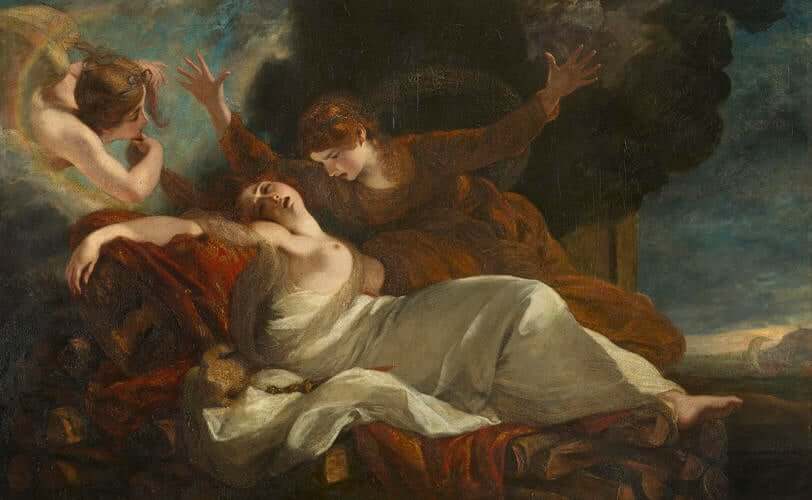
It would be almost impossible to read Books one to four of Virgil’s Aeneid and not stop to consider, at least for a moment, the moral ambiguity of Aeneas and Dido’s tragedy. The more closely one examines Dido’s cathartic speech upon hearing the news of Aeneas’ departure, for instance, or even earlier on during the cave scene where her possible hamartia appears to be established, the more one would begin to grasp even half of the layers of nuance that cloud our ability to judge responsibility, blame and agency throughout the first half of the epic. This, of course, is deliberate, and the frustrating truth about Virgil’s choice to leave questions as pertinent as “who’s to blame?” unanswered reveals that he is less interested in whether our actions are caused than in how we assign responsibility when they are. In this sense, then, it appears that the real question worth asking may instead be one about how people can be morally responsible if their lives are governed by forces beyond their control. This essay, through Virgil’s treatment of the idea of fate, divine influence, culpa and dual causation, will argue that the genius of the Aeneid lies in showing that when objective facts become inaccessible, responsibility depends upon interpretation rather than simply upon actions.
Fate, free will, and the problem of causation
Before we can begin to ask anything about whether Dido or Aeneas should be held responsible for their actions, it is first necessary to establish the world that Virgil has placed them in, and it is here that context, both within and beyond the epic, becomes important for closer reading.
Dido is a Carthaginian. Although seemingly an obvious fact, it quickly becomes an adequate reason in itself for a Roman audience of Virgil’s time to read his work with a clear bias that is in no way in Dido’s favor. In her final speech before ending her life at the end of Book four, she curses Rome and Carthage to be sworn enemies and luridly references Hannibal all in her final emotional (and not very stoic) release before her death. Even the mere concept of a foreign queen leading a proto-Roman leader away from what his “duty” (pietas) suggests he ought to be doing (who later kills herself) seems deliberately reminiscent of Cleopatra, a clear political narrative for comparison.
Despite this context being commonly acknowledged among readers, it is nevertheless important to establish when trying to approach interpretations of responsibility, blame or agency here as it raises the question of whether this would seem an equally difficult challenge to the Romans in the first place – after all, Virgil has deliberately set Dido up to be hated more than sympathized with contextually, and it would therefore seem that his audience has already had a helping hand when it comes to deciding who to defend; evidently, their choice lies between siding with the man who comes to his senses and travels to Italy to found the very city they may find themselves standing in, or the woman from Carthage, Rome’s sworn enemy from the Punic wars, that leads him astray and keeps him on enemy territory while delaying him from fulfilling his fated prophecy from the Gods themselves to found a new race.
But Virgil’s tragedy derives precisely from the fact that this seemingly straightforward moral decision quickly begins to lose its simplicity upon closer reading, despite any contextual prejudices that a Roman audience of the time may have been subjected to in Aeneas’ favor. It becomes quickly apparent that Dido cannot merely be reduced to the role of the foreign Queen who distracts Rome’s founder from his destiny: before her relationship with Aeneas begins, she is already presented as a capable ruler, a faithful widow and a figure worthy of admiration. If Virgil wanted his audience to only ever sympathize with Aeneas and portray Dido as nothing more than an obstacle between him and the founding of Rome, then why go through the trouble of establishing her as such an honorable leader of her people in Book 1? Instead, the tragedy of Book 4 seems to depend upon the reader recognizing that what Aeneas abandons is not solely a personal temptation, or even that this should be interpreted as him “overcoming an obstacle” of sorts, but instead a human being whose claims and suffering are legitimate. The question Virgil raises, then, seems to be much less to do with whether Dido or Aeneas is simply right or wrong, but rather with how responsibility can be judged when both individuals are acting within competing systems of obligation and, importantly, when even their emotions are shaped by forces beyond themselves.
The role of fate and divine intervention here complicates things even further. It is made explicitly clear in Book 1 that Dido does not choose to fall in love with Aeneas (if such a choice were ever to exist); instead, this is imposed upon her by Cupid and, by extension, Aeneas’ mother Venus herself as an act done to ensure that her son is protected from any hostility while he has been washed up on foreign shores. Her love is not entirely self-generated, and her tragedy is implied to originate much less from any “lack of self-control” (contrary to what Virgil’s audience might be initially compelled to believed) and more from the fact that a clear conflict emerges between competing obligations: Dido’s vow of loyalty to her former husband Sychaeus after his death and her responsibility as Queen to lead and guide her people as Carthage was being founded, but also her love for Aeneas and any expectations that have subsequently been imposed upon her by the Fates or other sources of divine intervention.
Much like what may already be intuitive to a modern audience in some respect, to acknowledge divine influence is not necessarily to remove human agency. Throughout Book 4, Virgil repeatedly presents events as possessing multiple simultaneous causes, and the line between fate, divine intervention and human choice becomes increasingly blurred. Take the infamous cave scene as an example: Juno explicitly announces what will happen beforehand in the line speluncam Dido dux et Troianus eandem devenient (“Dido and the Trojan leader will come to the same cave” being one potential translation). The future tense here later changes to a present, deveniunt, strongly reinforcing the idea that Juno seems to be orchestrating the events here, again giving the impression that the characters seem to be moving through a sequence already determined before they act. Virgil’s word order itself also mirrors the action it describes; by positioning speluncam at the beginning of the clause and closing with eandem, the cave appears to enclose Dido and Aeneas syntactically before it does so physically, reinforcing the impression that they are being drawn into circumstances from which escape will prove impossible. Even the word eandem itself has an implication of fate, as Juno seems to be deliberately pointing out that Aeneas and Dido are not separately choosing the same destination, but rather converging upon one point by a force greater than themselves.
It is also here that agency becomes blurred, and this, too, can be seen both linguistically and symbolically. The interesting thing about this line is that dux is in the nominative, but so are both Dido and Troianus, meaning that the common-gender noun dux refuses to privilege either character grammatically. So who is the dux? Dido is a Queen, and Aeneas is a leader – what I am led to believe from this fairly equal status is that neither person is following the other, and no one person is more in control of the situation. Instead, the events that play out in the cave (sex, of course, is implied but never explicitly stated) happen on the grounds that the two have met as equals.
But “Juno causes everything” is still only half of the story. The rest of Book 4 is still spent explaining their conversations, doubts and decisions. Divine causation, at this point, supplements rather than replaces human agency, illustrating the poem’s characteristic tendency to offer multiple simultaneous explanations for the same event.
(It is important to briefly note here that the apparent unfairness of Virgil’s system is unavoidable and needs to be mentioned. If the gods can manipulate human emotions and circumstances, on what basis can individuals still be judged responsible for the consequences? Although justified, this question depends upon an assumption that causation and responsibility are mutually exclusive: that if an action has an external cause, the individual cannot be accountable for it. But Virgil’s world does not operate according to this distinction. Within the logic of epic, divine intervention does not necessarily function as an excuse; instead, it is another layer of explanation within a world where human beings remain morally significant.)
What all of this points at, then, is the complexity of dual causation. Rather than replacing one another, divine and human causation coexist, each bringing to light a different aspect of the same event. Dido falls in love because Cupid intervenes, yes, but she nevertheless experiences said love as her own; Aeneas obeys Mercury’s (and, indirectly, Jupiter’s) command to leave, yet he still struggles and hesitates before ultimately deciding to follow through with the order. The cave scene happens the way it does because of Juno, most definitely, but also because of mutual desire, accident, and narrative necessity. Aeneas himself also says that “it is not by [his] own will that [he] seek[s] Italy,” but he still accepts responsibility for acting. Every significant action is at once psychological, political, emotional and divine, and the more explanations Virgil gives for each event, the harder assigning blame becomes. In this way, practically every narrative in Book 4 becomes overdetermined.
But if it were as straightforward as Virgil making it impossible to assign anyone blame to show the complications of agency for the lives of mortals, then why say that Dido uses the word marriage (coniugium vocat) to hide her culpa (“guilt”)? What should Dido even be guilty of?
Culpa: why guilt still exists in an overdetermined world
Coniugium vocat, hoc praetexit nomine culpam. “She calls it marriage, with this name she hides her guilt.”
What guilt?
At first glance this appears almost contradictory. The poem has just consistently spent hundreds of lines layering multiple causes behind every specific action, and now the sudden introduction of any language around guilt or blame seems strangely out of place. Yet this apparent contradiction proves central to Virgil’s exploration of agency.
Vocat instantly shows that this marriage is an interpretation rather than any kind of objective fact – it was what Dido calls it, not necessarily what it actually is. That said, it is important to note that this does not come from nowhere, and Dido, in the eyes of many, seems to be justified in her interpretation of events. First, within the text itself, marital language appears to be everywhere. Juno is present as pronuba (a close modern equivalent of this perhaps being a bridesmaid), there are wailing nymphs in the background reminiscent of a chorus present at Roman weddings (ulularunt Nymphae), and even “flashing fires” (fulsere ignes) that may be referencing procession torches. The language here all clearly seems to make Dido’s claim justified, but if you were to step back and remove the metaphorical lens, this still might not be sufficient evidence. Juno, regardless of whether or not Virgil says was “present,” would have been invisible to both Aeneas and Dido. Similarly, the nymphs are “wailing,” which, although is technically a sort of singing or chanting, seems much less suitable for a wedding – if we were supposed to so clearly interpret this as a marital metaphor, why doesn’t Virgil just use a word such as cantant? To complicate things even further, as is somewhat unavoidable when analyzing Virgil, another relevant distinction that needs to be made is the one between Roman marriages and modern ones, where the former actually existed on a spectrum. They ranged all the way from a confarreatio, the most formal religious marriage requiring ten witnesses, priestly involvement and elaborate rituals, to usus, marriage through continuous cohabitation. Although the legal details of this are much more complicated, this does show that from a Roman perspective, the bar for what can technically be considered “marriage” may be much lower than that of a modern audience, in turn making Dido’s claim seem to be less of a “reach” and, perhaps, more plausible than it may initially appear, even if Aeneas refuses to recognize it. In fact, as Book 4 continues, Virgil explicitly details Dido “keeping Aeneas warm” throughout the winter: a clear statement of prolonged cohabitation.
Praetexit is equally interesting. It is often translated as “[she] covers” or “veils,” but from whom is Dido hiding her guilt from? The Carthaginians? The reader? Aeneas? The Gods? Why does she feel she has to hide it? Who thinks it’s guilt? There are lots of possibilities here, again made deliberately unclear by Virgil. This, of course, then leads us on to the frustratingly overdetermined question of what exactly Dido’s culpa is in the first place. There are several possibilities at play here: maybe the guilt is having sex in the first place. The problem with that, however, is that Roman attitudes were more complicated than that. Although sexual morality in Rome was deeply connected to ideas of chastity and social order, the issue was not simply sexual activity itself. Rather, elite Roman attitudes placed particular emphasis on pudicitia, fides, and the preservation of family and political structures. Dido’s transgression, therefore, likely lies in the abandonment of the identity she had previously constructed around loyalty to Sychaeus and independence from remarriage.
Or perhaps, very understandably, it’s Dido breaking her vow of loyalty to Sychaeus; after all, Dido’s main initial objection to becoming romantically involved with Aeneas which she voices to her sister Anna is that it would go against her initial oath. A third possibility, however, seems even more likely in this case: Dido’s guilt is mistaking the relationship for marriage when Aeneas didn’t. The tragedy within this is that neither person is necessarily lying or obviously wrong, but that there is a genuine disagreement that seems to remain unaddressed before it’s too late. That, of course, raises a much broader philosophical question analogous to whether someone can meaningfully consent to a relationship if both parties fundamentally disagree about what relationship exists. Perhaps this is Dido’s hamartia.
Hamartia: tragedy without a villain
One of the most striking features of Book 4 is the extent to which Virgil deliberately frames Dido’s story as a Greek tragedy. Throughout the book, tragic allusions accumulate with remarkable consistency; as Dido’s psychological state deteriorates, Virgil compares her to figures such as Pentheus and Orestes, both victims of divine madness whose fates are already sealed. Elsewhere, her increasingly desperate behavior recalls Medea, while the ominous atmosphere surrounding Carthage itself begins to resemble a theatrical stage upon which the audience already knows disaster is inevitable. Rather than merely borrowing isolated references, Virgil constructs Book 4 with the relentless sense of inevitability characteristic of tragedy, encouraging his readers to interpret Dido’s downfall through that literary tradition.
A defining component of Greek is hamartia, which importantly derives from the Greek verb ἁμαρτάνειν meaning “to make a mistake.” It’s best known as the “fatal flaw” (although, as shown, much better understood as simply an error or misjudgment) and it is partially why Greek tragedy is tragic: hamartia can result in something bad happening to a mostly good person as it is not a moral flaw, but rather an honest mistake.
It is easy, I think, to erroneously assume that Dido’s hamartia must have been her passion. Yet unlike many tragic protagonists, the passion that precipitates her downfall is explicitly imposed upon her by the Gods. If love originates outside herself, it becomes difficult to describe said passion as a purely personal failing on her behalf. If Dido possesses hamartia, it seems instead to be acting on an interpretation of events that Virgil deliberately refuses to confirm or deny.
But if Dido’s mistake, as proven in the previous section, is understandable – even justified – why does Virgil frame her as a tragic heroine rather than simply a victim? Why does Virgil even choose to frame this narrative through the lens of a Greek tragedy at all?
The allusions to Pentheus and Orestes in Dido’s final speech are important here because neither character exercises complete control over his actions. Pentheus is driven towards destruction by Dionysus, while Orestes is pursued by the consequences of divine command and inherited guilt. Virgil, by invoking these figures, subtly also places Dido within a tragic tradition in which responsibility remains morally significant despite overwhelming external forces. Interestingly (just to complicate things again), Dido is also subtly compared to Medea: both are foreign queens, women whose passion threatens political power, and yet Virgil still makes Dido far more sympathetic. Again, Virgil is resisting the temptation to simplify her to the destructive stereotype that a character such as Medea often represents.
Virgil himself seems to sympathize with Dido the way a chorus might sympathize with characters in Greek tragedy when he speaks directly to her: apostrophe is often a device used by poets to allude to a strong and positive personal connection to their character. So, after Dido has begged Aeneas to stay and he sails away, Virgil’s infelix Dido, nunc te facta impia tangunt (“miserable Dido, how these cruel deeds touch you”) actively encourages our sympathy. It becomes increasingly difficult to read her as simply a villain when the narrator himself appears emotionally invested in her misfortune.
And then there’s nam quia nec fato, merita nec morte peribat, sed misera ante diem… (“for she was dying neither by fate nor by a death she deserved, but pitiably before her time…” again being one possible translation). Here, we are being explicitly told that Dido did not deserve this death, making it impossible to read Book 4 as the straightforward punishment of a guilt woman. Again, this makes it likely that Dido’s true hamartia is the profoundly human error of acting with certainty in circumstances that, unfortunately, admit no certainty at all.
Gender and moral responsibility
If responsibility in the Aeneid depends upon interpretation, then the question of who is allowed to interpret events becomes crucial. At this point, then, gender now becomes a mechanism through which blame is allocated.
Despite all the nuance, Dido still remains an easy character to blame, and it is here that the gendered values of both Roman epic and wider Roman society come into play.
Firstly, Carthage is largely represented as feminine. The only named male Carthaginian of significance that gets any mention throughout Books 1 to 4 seems to be the bard, with all other characters remaining female: Dido, Anna, Juno (the patron God of Carthage, so to speak). The Trojans and their “patron Gods”, on the other hand, are all men: Aeneas, Ascanius, all of his men, Jupiter and Mercury. For a misogynistic Roman audience of their time, this would therefore seem like a conflict between love and empire, emotion and stoicism (neither of which would have exactly qualified as a difficult decision for the Romans).
With that in mind, let’s examine one of Mercury’s insults to Aeneas: he calls him uxorius, often interpreted to mean “excessively submissive to one’s wife.” In essence, the word suggests that Aeneas is under a woman’s (implicationally negative) influence; one of emotion, passion, and, importantly for the events of the epic, distraction. This is more than just a word encouraging Aeneas to leave, because it implies that if he were to sail away, he would be returning to a world of war, empire, politics, and pietas. These masculine virtues are privileged by Roman epic, and would seemingly seem to dismiss Dido from a political and social narrative.
With that being said, despite operating within a deeply patriarchal literary tradition, Virgil still persistently manages to grant Dido the dignity that resists those conventions, whether that be through her speeches, her narrative sympathy, or her rhetorical power.
Yet Dido is still a more comfortable character when she’s fulfilling traditionally male roles. At the beginning of Book 1, she’s founding a city, judging disputes, leading people, and, by some extension, almost acting like Aeneas. This, of course, is admirable, until the poem becomes about love and Roman values start judging her differently. That is not to say that Virgil necessarily agrees with those values, but instead that he chooses to expose them to some extent. What I am arguing, then, is not that Virgil is objectively misogynistic, but that, as mentioned, he writes within a literary tradition whose assumptions about gender shape the way responsibility is distributed.
Modern relevance
Modern discussions of trauma, coercion, mental illness, ideology or religion often become trapped between two equally unsatisfactory positions: either people are wholly determined and therefore blameless, or wholly free and therefore entirely responsible. Virgil offers neither. Instead, the Aeneid suggests that understanding why someone acts is not the same thing as deciding whether they should be judged. Explanation and responsibility, far from being mutually exclusive, coexist uneasily, just as they do in the lives of Aeneas and Dido. And that is why Virgil repeatedly frustrates the reader’s desire for certainty. The vast majority of this essay has been spent analysing nuance, because the Aeneid does not ask us to make a simple choice between fate and freedom, marriage and affair, guilt and innocence. Instead, it reveals that moral judgement becomes most difficult precisely when objective certainty proves impossible.
The tragedy of Dido is not that she mistakes illusion for reality, but that Virgil constructs a world in which reality itself cannot always be accessed with certainty.


Related Posts