The Power of the Tale
I work on behalf of two Dioceses in Northern Ontario, serving a publicly funded Catholic School Board. In the late 1990s, in an effort to grab the attention of an uninspired class of grade six students, I told a story. It was a dramatic telling of an old tale found in the Brothers Grimm collection, The Devil’s Three Golden Hairs. I had been raised on stories like these, including the dramatic and sometimes horrifying Old Testament tales. My instinct to tell a story was supported by an unexpected ability to tell the story dramatically, with some blackboard art thrown in for good measure. The students were rapt with attention, and I was pleased with myself.
As the school year went on, I continued to tell stories in other classrooms, and the feedback from students and teachers was enthusiastic enough that the nature of my work changed. My work was still centered on animating the school’s Catholic faith, but now I used stories for their mediating and informative powers. Stories bring people together regardless of age, and when people share a story, the motivations, choices and experiences of their characters enrich any conversation around matters of the soul. I suspect this is one reason people join book clubs. A book club is a community with a shared spirit and a common language created by the written word being read and discussed. Typically, literary material that has stood the test of time follows universal human experiences that an English class or a whole society can engage with conversationally or in private meditations, each person taking from the material what they need to hone their understanding of the world and to bring shape to their soul.
Storytelling has become more important in my work than ever before. Our culture is so inundated with digital media and streaming platforms that it is often difficult to find a story that students hold in common. Besides reading less, children today often do not even watch movies, since scrolling and social media are more captivating than a cinematic story that takes an hour and a half to tell. Twenty to thirty years ago, I could refer to Star Wars movies or the Lord of the Rings trilogy and every student in a class could recall details of the stories. Ten to twenty years ago I could refer to the Harry Potter saga, and once again a unitive effect was realized where themes of virtue, the nature of good and evil, the necessity of self-sacrifice for the good, friendship, and courage could be discussed openly. The sense of community formed around shared stories is difficult to realize now.
The list of stories I share has grown from old folk tales like those found in the Brothers Grimm, to tales by Hans Christian Anderson and Oscar Wilde, to my favorite story, The Bottle Imp, by Robert Louis Stevenson. Religious, philosophical, and psychological themes that are sometimes complicated or difficult to explain are made accessible to each student regardless of their intellectual abilities or life experience, because a good story brings everyone along a plane that defies material limitations. Good stories, and the nature of the characters, are familiar to us even before we know how the stories will end.
*
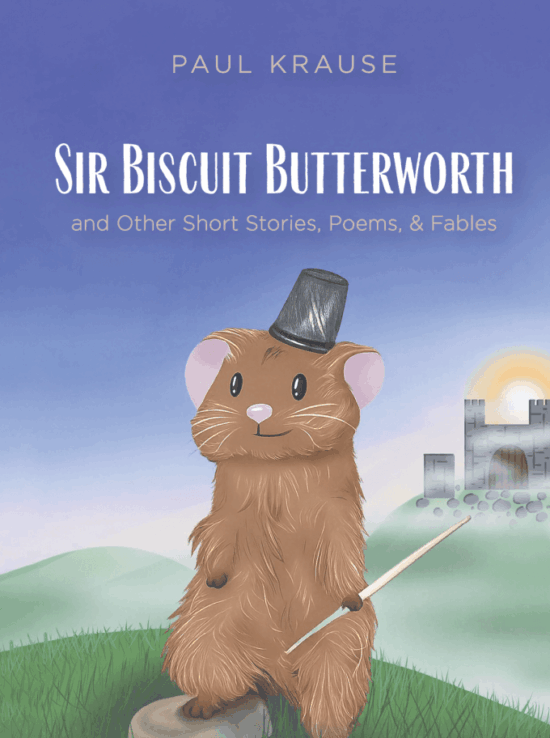
This past spring I read Paul Krause’s book Sir Biscuit Butterworth before handing out copies to grade 6 teachers for their classrooms. In the concluding section of his book, titled The Gift of Stories, Krause touches on this power of stories to carry us beyond the confines of a graceless individuality to a rich life rooted in relationship. While affirming the reader and their own powers as storytellers, he writes, “by reading and listening to stories we enter a truer world than the world outside which stands before our eyes.” This statement jumped from the page, causing me to pause. What did Krause mean by that statement? I sensed what he was suggesting, but I had never put words to it. I realized that I had not reflected deeply enough on what a student experiences when they hear a story told to them.
I considered the stories Krause shared in his book. There were characters who went on adventures together, there were characters confronted by fear who did not want to go on any adventures, and new friendships were formed in almost miraculous fashion, all because adventures had been shared. The wonder and beauty found in community was made clear for the reader through characters who were misunderstood, like potentially violent characters who suffered from loneliness, and how they were welcomed into a circle of friends. There was also a unique world within which the characters lived. Like every story, this world had to be entered with the aid of imagination. If a reader refuses to enter the world of the tale, then reading is reduced to a mechanical enterprise absent of enjoyment and more importantly, soulful experience.
To read carefully is to enter into a spiritual experience, or perhaps more palatable for the modern reader, a transcendent experience, as Eric Voegelin would coin it. Our daily lives are often lived without the mindfulness we crave. We struggle to differentiate ourselves from the calculations and worries of the day that we are embroiled within, and the soulful distractions and corporal temptations that bandy us about draw us away from our true north within an obscured horizon. We regain our bearings when we enter a good story. The reader enters a universe that allows them to brush up against universal truths such as good and evil, the virtues, love, and beauty, as well as the sufferings people endure and the follies they pursue, follies that inevitably lead them away from the good and the true.
In Stories and Poems for Intelligent Children of All Ages, Bloom writes, “the child alone with her or his book is, for me, the true image of potential happiness, of something evermore about to be.” A child with a book is a “mind learning to exercise itself in all its powers.” Children live in a world of constant change, fear, and wonderment. Like any adult, a child can forget that they live in a universe not only ordered for life but ordered spiritually with universal truths such as the humble yet enduring power of the good, and the monstrous, terrifying reality of evil. We stand amidst these powers, humble creatures next to the scale of the universe. Yet good stories remind us that we are eternally present, with the scale of good and evil influenced not only by our actions and words, but even by our thoughts and desires. How do we plan on orienting our soul and our life? Will we allow the self-sacrificial nature of love to guide us, or will we become self-possessed by our own desires and lusts for power, riches, and pleasure? A child can learn about this tension at a very early age, not because of a teacher’s lesson or a parent’s admonitions, but because of the power of the tale. Snow White and her stepmother, Hans Christian Anderson’s emperor and his beloved Nightingale, Samson’s wasted birthright, or Judas’s betrayal for 30 pieces of silver; these stories reveal to a child all the subtleties, pitfalls, and truths of the soul without the use of any technical or abstract terms. Although the question may not be articulated, when a child hears of Judas’ betrayal of Jesus for 30 pieces of silver, there is an innate understanding that the money is long gone while the character and soul of Judas remains in our presence as something real and suffering.
It is in this sense that I understand Krause when he holds up the tale as being truer than the world we are immersed in daily, a world of toil and passing pleasures, and of relationships that are “vulnerable,” as Harold Bloom writes in How to Read and Why. Our relationships, so important to us, are also “so likely to diminish or disappear, overcome by space, time, imperfect sympathies, and all the sorrows of familial and passional life.” Like the gold we horde, if our relationships on this earth are transitory, what then can we ultimately hold onto? The enduring and universal experiences held by the tale direct a person’s search for a good and safe anchorage. The vulnerability of our relationships versus the lasting power of friendship and familial relations reveals a tension best captured in stories, including our personal stories, and is a tension that Krause has captured perfectly in his tale about a character named Geronimo. A young person reading Geronimo’s life story will understand that while our relationships can appear to end as we pursue the adventures the world offers us, there is at the same time something beyond time and physical space which keeps family and friends united.
My favorite story in the Sir Biscuit Butterworth collection of tales is Krause’s final story, What Tucker Saw, a story of a dog and his experience from birth to death. It is a story of hope, and it animates the notion of eternal life in a very natural and subtle way. The story protects a mystery we cannot enter until death while evoking in our hearts a spiritual movement that feels right and true. Our lives are rarely formed by sudden resolutions or experiences of lightening quick duration that have us make a right turn towards something new and richly felt. Rather, we are like clay on the wheel, slowly taking shape. When a child, or a person of any age, reads an account of eternal life as Krause has shared in his tale of a dog, the movements and shadings of the story stay with the reader. The account of eternal life is held by the reader, like a hand holding up a gift, mused upon at a level of being so deep that it sometimes can hardly be acknowledged consciously. Does the experience of eternal life as told to me in the story feel true? If it doesn’t, then it is rejected out of hand. If the story feels right, if it harmonizes with one’s intuition, then something universal and infinite, something awesome, has moved within one’s being. The story informs one’s pilgrimage and illuminates the path so the pilgrimage can continue toward our shared end.
Sir Biscuit Butterworth and Other Short Stories, Poems, and Fables
By Paul Krause
Eugene, OR: Resource Publications, 2026; 66pp


Related Posts