
Coming to Terms with Nature in Thomas Mann’s Black Swan
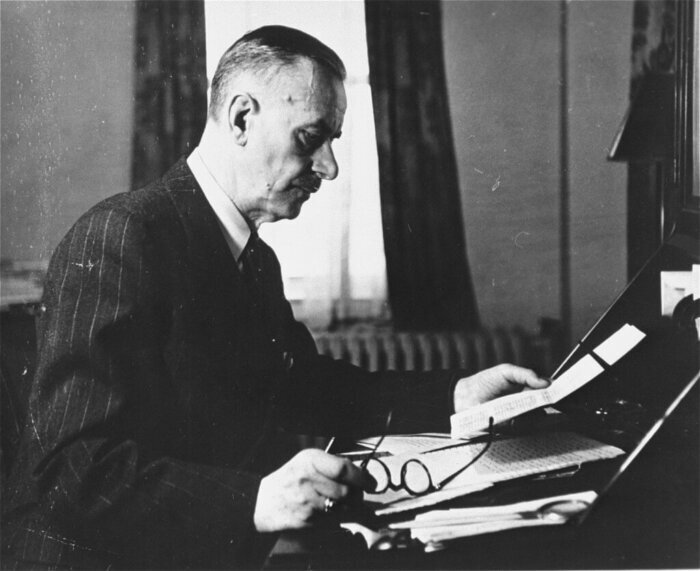
I have found that it is difficult to live in Western New York and not appreciate nature, especially during the late fall and early winter, from the time the leaves begin to change to the days when the first snow begins to fall. And yet there are plenty of reminders here, as there are everywhere, that nature has its harsh and unpleasant side; hissing geese, swarms of gnats on hot, muggy August evenings, and gusts of cold winter wind are all reminders that nature does not exist merely to please us. A healthy relationship with the natural world requires a certain degree of humility. The importance of this humility is perhaps nowhere more beautifully illustrated than in Thomas Mann’s novel Black Swan, a novel about one woman’s relationship to nature. Through this complicated relationship, the novel conveys a powerful message about what living in harmony with nature really entails.
Black Swan is set in the 1920s and consists of a series of incidents in the life of Rosalie von Tümmler, a widow recently turned fifty who becomes attracted to her son’s twenty-four-year-old English tutor, Ken Keaton. Her struggles to decide whether and how to act upon her feelings for him culminate during an excursion to Holterhof Castle when she completely surrenders to temptation and begins vigorously making love to him, a decision with which Ken seems rather pleased. Very early the next morning she becomes ill, and she only lives a few days longer. Throughout the novella, her attempts to understand her attraction to Ken and to decide how she should respond to it are shaped and driven by her sense of her own identity as a child of nature and her relationship to the natural world. In this way, the novella offers an extensive critique of her beliefs about what nature is and how to understand its workings.
One of the first things the reader learns about Rosalie is that she is a “great lover of nature.”1 While her passion is undoubtedly sincere, it gradually reveals itself to be selective, inconsistent, and at times suspiciously self-serving. Her understanding of nature and of her relationship to it is frequently colored by her sentiments and caprices. These same sentiments sometimes drive her to act rather unnaturally toward her children. At other times, her supposed reverence for nature exists in tension with her desire to transcend the limitations it imposes on her youth and virility. Her inability to abide any conception of “nature” that is not consistent with her own impulses and desires ultimately leads her to interpret those impulses and desires as inherently good and natural. And it is this strange faith that motivates her to pursue her hopeless and untenable infatuation with Ken Keaton.
The sentimentalism that underlies her love of nature is apparent on the trip to Holterhof when Ken points out several different species of trees native to different parts of the world, and she is unable to take any interest in them: “Nature, she considered, must be familiar, or it did not speak to the heart.” Her preference for the familiar is also evident in her disdain for modernity and all that she associates with it. This aversion influences her relationship with her children, a relationship often less than maternal. Her son Eduard is far more interested in engineering than in his humanities subjects, and he is eager to finish his studies so he can go to England or to that “El Dorado of technology, the United States.” This difference of interests and inclinations is likely part of the reason Rosalie’s attitude toward him never goes beyond a “cool friendliness.” One of the more interesting inconsistencies in her character is that for all her desire to transcend nature’s limitations she is nonetheless instinctively averse to engineering and technology, two things that can extend lives and make them more comfortable.
She is clearly not opposed to using whatever methods she can to mask the effects of aging upon herself. When her twenty-nine-year-old daughter Anna points out that her desire to dye her graying hair and to apply rouge to her face “will not go too well with [her] deep feeling for nature,” she responds that “it is certainly no sin against Nature to help her out a little in such an accepted fashion.” She is not able, however, to view her son’s interests and intended profession in this light.
Her aversion to aging goes beyond a desire to mask its outward effects. She speaks with great bitterness and envy about the differences between how men and women age and how “fifty comes nowhere near stopping [a man] from playing the lover, and many a man with greying temples still makes conquests even among young girls.” Anna tries to argue that this is not something that should be envied, and that on the contrary, women have it better in many ways: “all civilized peoples have always rendered the most exquisite honours to the matron, have even regarded her as sacred—and we mean to regard you as sacred in the dignity of your dear and charming old age.” Rosalie responds to this by complaining that such a transition is very hard and that, at the moment, “dignity and the honourable estate of a matron” do not particularly appeal to her.
While she has significantly more affection for Anna than she has for Eduard and genuinely (if sometimes begrudgingly) seems to respect Anna’s intellect, one thing she cannot bring herself to like is Anna’s modern, “abstractly symbolical” painting style. So much does it upset her that she decides to interpret Anna’s various health defects as punishment for her “unnatural” way of painting, another instance of how she appeals to nature to sanction her personal tastes and preferences.
Rosalie is always eager to explain away the fact that her daughter does not seem to have been as favored by nature as herself. Anna is club-footed and walks with a limp and is understandably skeptical of her mother’s simplistic view of nature’s beneficence. When Rosalie says, “Let us enjoy [nature] with reverence, for we too are her children,” Anna suggests that her mother should speak for herself in this respect: “She’s not so fond of me, and she gives me this pressure in my temples with her concoction of odours.” When Rosalie suggests that Anna’s pains are a punishment for her painting style, which she does on more than one occasion, Anna does not fail to notice the irony of her mother’s resort to such mental gymnastics: “you scold me for being intellectual, and then propound absolutely unwarrantable intellectual theories yourself!”
One of the scenes in which Rosalie propounds this theory regarding her daughter’s health is followed by a scene in which the two of them are out on one of their nature walks and encounter a horrible stench, which they soon discover emanates from a pile of excrement with flies hovering over it and the body of a dead animal nearby. This strange combination of grotesque objects is an implicit rebuke of Rosalie’s self-serving attitude toward nature and her assumption that the pains Anna experiences must be punishment for some kind of sin. It is a reminder that sometimes nature is just coarse, ugly and unpleasant. Rosalie wants to see only nature’s beauty and doesn’t want to acknowledge its seedier side, and so she cannot make sense of her daughter’s weak constitution or her clubbed-foot except by fallaciously reading them as a justly deserved punishment.
Unfortunately, Rosalie does not appear to take any insights away from this grotesque episode. Her ill-conceived view of nature becomes more, not less, pernicious after this moment, particularly insofar as it allows her to construe as natural whatever is in accordance with her own appetites and to condemn any idea of rejecting or suppressing her desires as a violation of nature. This way of thinking helps her rationalize her ultimately fatal attraction to Ken and her decision to indulge it.
It is not difficult to see what Rosalie finds so enticing about Ken. As Ken appears to be in so many ways Eduard’s opposite, the same impulses and aversions that prevent her from feeling maternal affection for Eduard also inspire her attraction to the young English tutor. Ken, though from America, much prefers Europe and its age to the United States and its newness. He is passionate about history and knows things about German folklore and traditions that the Tümmlers had not even known. In his passion for history and tradition, combined with his “naturalness,” he seems to represent Rosalie’s rejection of everything she considers unpleasant. He is not particularly handsome, but he is strong and youthful and is said to be very successful with women. While her children remind her of change, intellect and modernity, Ken represents not only history and tradition but also youth and virility. These latter qualities clearly appeal to her desire to retain her own youthfulness and virility in spite of her age.
There is a period during which Rosalie feels repulsed by her attraction to Ken and wants to resist it. She even asks herself, “Am I a shameless old woman?” But the thought that he could easily find someone much younger than herself makes her wild with jealousy, and she soon begins rationalizing her newfound infatuation by interpreting it as a miracle of nature, comparing herself to Sarah from the Old Testament. Ken, she insists, “is Nature’s means of working her miracle in my soul.”
Her decision to regard her attraction to Ken as “a miracle of nature” to be respected and revered makes it harder for her to see him as he is. After all, there does not appear to be anything truly admirable or impressive about Ken. He is young, healthy, and amicable, but otherwise there is little to be said for him. Anna finds his face to be “anything but distinguished by intelligence,” and he certainly does not possess any special degree of virtue. He is already having an affair with at least one local woman, and this does not deter him from encouraging and returning Rosalie’s advances once he recognizes them. His general impressiveness and loose sexual morals lend credence to Anna’s suggestion that maybe Rosalie’s love for him is causing her to think he is far better than he actually is. The possibility that her supposed reasons for loving him are mere rationalizations is further reinforced by her desire to be impressed by his honorable discharge from the military, despite Anna pointing out that such is “the routine procedure for everyone who doesn’t actually do something dishonourable.”
Not able to win the argument against Anna, Rosalie angrily rebukes her for suggesting that they ought to get away from Ken by moving to another town or suggesting that Ken do so. She suggests that to try to spurn her attraction to him would be “disloyalty to nature” and a “denial of faith.” So strong is her belief in this idea that she threatens Anna by telling her she will hate her forever if she convinces Ken to go away.
For all her aversion to modernity, Rosalie is perfectly willing to turn around and become an advocate of changing norms and standards when they can be used to justify her coquetry. When Anna suggests that perhaps seeking to marry him would be more reasonable than continuing to flirt with him with no such desire in mind, Rosalie is quick to reject this idea. She insists that “ideas are changing” and accuses Anna of lacking “broad-mindedness” and being “behind the times.” As to what she does hope to achieve by her flirtation, if not marriage, Rosalie is not quite sure. Yet, she is convinced that some undefined good will come of indulging her attraction: “What Nature has granted me is so beautiful that I can only expect something beautiful from it.” Her simplistic understanding of nature and her own relationship to it leaves no room for any other possibility.
In the short term, her decision to stop suppressing her feelings for Ken appears to benefit her, at least on the surface; her appearance changes in such a way that people begin asking her what “fountain of youth” she has been drinking from. However, this changes when Ken finally begins to detect and understand her insinuations and becomes responsive to them. At this point, she suddenly becomes cold towards him again, causing him to wonder, “Is she in love with me or not?” It would seem that his decision to return her advances necessarily brought about her realization that she does not know how to proceed. She has made up her mind that she does not hope to marry him but has significant reservations about the idea of entering into a non-marital relationship with him. It is as if the dream she allowed herself to indulge has suddenly become too real. Anna had warned her if she were to indulge her desire to flirt with him she would be “living in opposition to [her]self.” The realization that she cannot go any further without crossing a line she does not want to cross depresses her, causing her to begin looking and feeling old and tired.
It is during this period of dejection that she decides that they all ought to take a trip to Holterhof Castle, and it is on this trip that the scene from which the novella takes its title occurs. On seeing a group of black swans approaching, Rosalie asks for some bread with which to feed them, but when Ken hands her the bread, finding it “warm from his body,” she begins ravenously consuming it herself. Ken tries to stop her, telling her that the bread is “stale and hard,” but she dismisses his concern, insisting upon the strength of her teeth. It is at this point, however, that a swan begins flapping its wings and menacingly hissing at her, causing her to finally relinquish the bread.
This unnatural indulgence, her impulsive consumption of the bread provoked by its former proximity to her young lover, is a hint at what is to come. Moments later, Ken and Rosalie are exploring the castle alone together. Inside of a dark, dingy secret passageway Rosalie openly declares her feelings for Ken. She now dismisses her prior moral reservations and her aversion to libertinism as mere “sophistries” and begins making love to him. Their lovemaking continues until she becomes disgusted by the dirty passageway and the stench of death all around them and tells him that she will visit him in his room that night.
But this nighttime meeting never materializes, because Rosalie almost immediately becomes very sick with the illness that ultimately kills her. To the very end, her sense of herself and her relation to nature appears unchanged. Her last words to her daughter before passing away are, “Nature—I have always loved her, and she—has been loving to her child.” While there is perhaps something admirable in her acceptance of death, this outcome is unlikely what she had in mind when she insisted that she could expect something beautiful to come of her attraction to Ken. Rosalie and Ken never get to continue the clandestine relationship that began that day at Holterhof Castle, and Rosalie’s deathbed recollection of the hissing swan is suggestive of some, albeit momentary, doubt in these final moments about nature’s attitude toward her recent decisions.
The kind of wishful thinking that makes Rosalie want to believe that her daughter would not have the health problems she has unless she had done something wrong to deserve them is the same kind of thinking that makes her look to nature for a warrant to follow her desires wherever they may lead her. But the lesson of the blow flies hovering over the excrement and of the angry swan is that to truly love and respect nature is to accept it as something separate from ourselves and our own desires and tastes. A wise appreciation of nature allows us to be comfortable with the fact that not everything in nature will be pleasing to us and that not everything that is pleasing to us is natural.
Note:
Quotations in this essay are taken from the 1954 Willard Trask translation published by University of California Press.


Related Posts