Conversations that Matter: On the West Facing Disaster, Confronting an Expansionist Axis, and Preparing for the End of History
In an article of his from last November entitled “The Six New Rules of Communicating,” writer Ted Gioia, creator of The Honest Broker blog, reflected upon the fact that a number of months back his writing style had become more conversational. He notes that when thinking about this development at the time it primarily seemed “that it felt right,” but now he sees that this change placed him among those in the forefront of a new mode of communicating. The mode arose since the world has changed, and communication styles of necessity had to “adapt to the new reality.” He gave his thoughts on why and how this necessitates the style it has largely replaced: “Here’s the reality—rhetorical skills and speech making degraded last decade. This top-down approach works best when it is rigorous, logical, and organized. But in an age of insults, taunts, and denunciations, speechifying starts to feel like browbeating.” This was the mode of public discourse of powerful people in a divided society, but people are finally “burned out on this hot oratory,” no matter if it is friend or foe that delivers it.
This is where the conversational style comes to the rescue, which Gioia claims explains the outburst of conversation friendly media. And so, among others, “Podcasting is thriving because of this approach.” The implication for politics is evidenced by the fact that the successful candidate of the last American presidential election was the one who could ably navigate a three hour podcast. As Gioia humorously summarizes one of the effects on politics: “Leaders will now have more authority when they speak while sitting—not standing.”
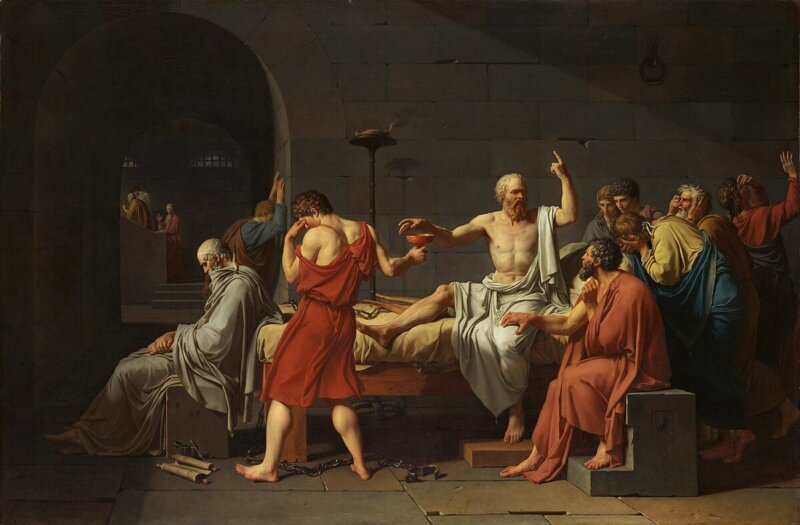
It’s not that the “new” style of communication doesn’t have forerunners. Gioia names The Tonight Show of the 1960s as the progenitor of the conversational tone in the United States. However, its most serious predecessor, he argues, is much further back. After provocatively claiming that in the West culture was primarily based on “one way communication,” where leaders and experts communicate from their own pulpits, he more persuasively insists: “Socrates was the last major thinker to rely solely on conversation.” What is more, “His entire reputation was built on conversation.”
Socrates’ enormously valuable “conversation,” of course, was recorded in writing by those who recognized its genuine contribution to human thought. Currently, significant as well as banal conversation has been recorded through podcasts, among other means. But bearing in mind the nature of “Socratic method”—back and forth dialogue—can we currently look for conversation on highly pertinent and profound matters in podcasts? That is what will be examined now. I will move from the socio-politically pertinent to the more profound questions, along the way examining different forms of conversation, recorded on select video podcasts, with three speakers. These are public intellectuals of different backgrounds discussing particular concerns: the subject matter, first, Ayaan Hirsi Ali on the West facing disaster, next, Niall Ferguson confronting an aruably new axis of power, and finally, Peter Thiel notionally and philosophically preparing us for the end of history.
On 26 November 2024, Ayaan Hirsi Ali delivered the New Culture Forum’s 2024 Smith Lecture to an attentive audience in central London. The New Culture Forum is a British think tank that aims to confront the pathologies of the present. Among their posted aims they claim: “At a time of threat from extremism, the West finds itself besieged from within and without. Too often our enemies and our opinion formers appear to agree that Western culture is indefensible or a source purely of shame.” They chose their speaker for their annual lecture since, as they put it underneath the podcast’s screen, Ali “is one of the bravest and most prominent voices in the defence of The West. In this thought-provoking speech, she explores the multiple threats to our way of life and how to combat them.”
Considering Ali—a member of the Hoover Institute, among others—has consistently brought up civilizational concerns in her writing, the organizers chose well. Her lecture, “The West: Sleepwalking to Disaster,” was later released as a video podcast on YouTube. The lecture she delivered was briefly described as concerned with the problem of the self-denigration of Britain and the West. Thus heroes and achievements are denigrated, and history rewritten. Race and identity politics are fracturing social cohesion. Mass immigration from the Islamic world has led to a rise in illiberal cultural practices and attitudes towards women, girls and others. Moreover, the right of citizens to free speech can no longer be taken for granted.
Her thoughtful speech on these issues was delivered with great clarity in her soft-spoken manner. And it obviously connected with the audience as evidenced by their questions. One could virtually say the speech was an inspirational point of departure for the conversation that followed. Certainly Ali’s manner became more vibrant in the extensive question and answer period, which brought out the serious message in a powerful conversational tone, also dominating the video podcast.
The first person to ask a question responded to her religious suggestions toward the lecture’s conclusion. As a Christian himself he felt fellow believers have retreated from the public sphere and are “divorced from everything around them.” Ali—herself a recent convert to Christianity—responded she senses a spiritual hunger in society, with the young unfortunately often filling it with drugs or pseudo religions. Islam is taking advantage of the plight. She noted churches that are attracted to fads are fading and lying empty; it’s those that still serve the “core message” of Christianity that are filling up. To a complementary follow up question, she added the moral ethos for the West is founded on Christianity, and emphasized that in her opinion the current crisis of unity stems from abandoning these roots. The insistence on diversity is an insistence on moral relativism. She adds that even atheists like Richard Dawkins who emphasize the importance of truth are following the Christian ethos. Worth adding before her conversion for a time Ali was herself a prominent atheist who was friends with Dawkins.
To another question concerning multiculturalism and its iterations she responded that significantly its ideologues resort to what has been called luxury beliefs on social justice that they—quite obviously members of the elite—don’t actually believe themselves: “They have fences around their homes. And they do get married before they have children. (. . .) So for some of these people who profess diversity, it’s simply a luxury good, to make themselves distinct from the rest of us who are poor and unwashed.” She points out there were problems with minorities that have largely been solved; thanks to the civil rights movement in the United States a black woman like herself can move around freely in the country and without restrictions in marrying a white man anywhere within it. Ali obviously supports that a person be judged by the content of their character, that hardly matters for diversity ideologues. She argues multicultural ideologues practice a form of tribalism that takes away resources from the common good for narrow goals. As she stated earlier in the closing remarks to her lecture: “We must opt for the nation over the tribe.”
In a related question Ali replied to the problem of re-immigration that on account of the immigrant problem is now being pondered in Europe and actually practiced in Sweden. She pointed out the country was extremely liberal in its approach to multiculturalism, practicing open borders. Consequently it became the rape capital of Europe, and now is paying immigrants to leave.
Among other matters, Ali responded to questions about leftist anti-Semitism and manufactured accusations of Islamophobia by the mainstream. Worth noting in her essay “Why I am now a Christian,” published in UnHerd online magazine in 2023, Ali raised the following point toward its conclusion. Regarding the civilizational challenge before us she wrote: “We can’t withstand China, Russia and Iran if we can’t explain to our populations why it matters that we do. We can’t fight woke ideology if we can’t defend the civilisation that it is determined to destroy. And we can’t counter Islamism with purely secular tools.” One of the questions she responded to during her lecture concerned the paucity of historical knowledge that the youth of Britain possessed on account of the poor historical education in the schools. Ali agreed that history was not taught well in schools. Moreover, the focus is often on its negative aspects, like colonialism—a point made in a critical manner by a speaker born and raised in a country that had actually been a colony of European empires. She encouraged parents to challenge this overall negative historical narrative. A pertinent point she made was despite the negative effect of social media and the internet, these can be positive resources. I will now turn to the lecture that offered advice on what should be done concerning the challenge of China, Russia and Iran she listed in her essay. And historical knowledge was indeed one of the keys.
Historian Niall Ferguson is the Milbank Family Senior Fellow at the Hoover Institute, Stanford University, and a senior faculty fellow of the Belfer Center for Science and International Affairs at Harvard, where he served for twelve years as a professor of history. Author of numerous books, he is also co-founder of the University of Austin, thus engaged with combating the ideological turn of so many universities in the West, in which surveys indicate a majority of students do not feel free to speak their minds.
Among his many speaking engagements, Ferguson was invited to the Centre for Independent Studies in Australia in October of 2024. A “classical liberal think tank,” as it calls itself, specializing in policy questions. In the subsequent video podcast his speech is introduced under the screen by information of an earlier one on the same question: “John Mearsheimer, speaking at CIS in 2023/24, argued that foolish U.S. policies, such as NATO expansion, has just pushed Russia closer to arch-rival China. In a multipolar world, the U.S. should recognise its limits to power and reorder strategic priorities away from Ukraine and Israel and focus more on Asia to deal with a far more important China threat.” The think tank claims to foster the free exchange of ideas, as the title of the podcast indicates: “Niall Ferguson rebuts John Mearsheimer: Don’t Underestimate the China-Russia-Iran Axis.”
If Gioia writes he has taken to writing as if it were conversation, it could be argued Ferguson gives speeches in the tone of a conversation with the audience, no matter how serious the topic. And the topic is serious: even deadly serious. Nevertheless, he starts with a joke, claiming the music that has introduced him was not to his taste—being Scottish, as those in attendance mostly knew—he would have preferred bagpipes.
Ferguson starts with some historical background on American and Australian relations from a half century ago that has some relevance for the problem of the liberal world order and would obviously be close to such an audience. He adds a humorous touch by comically imitating the voice of Henry Kissinger while quoting some of his exchanges with the Australian prime minister of the time. One might add that like in a John Ford movie, the comic relief that is introduced on occasion overall does not detract from the seriousness of his talk. And, like the filmmaker, the historian is also deeply humanitarian.
Ferguson soon comes to the main question: his approach to dealing with the world order that he implies is realistic—but unlike the same claim by Mearsheimer, he argues is more likely to be successful. He also looks at moral questions, such as the latter’s argument that East Central Europe should have remained under Putin’s control, thus not to have been allowed to join NATO or the EU, despite the collapse of the Warsaw Pact and the desires of its former members. Ferguson makes a similar argument concerning the situation of Israel and the Middle East.
After briefly dealing with Mearsheimer, Ferguson concentrates on his own main argument. He claims in essence he agrees with what Donald Trump noted in an interview with Forbes: that Russia is married with China and it’s a dangerous world. He adds Iran and North Korea to this axis. He further notes Trump is not an isolationist as many claim; the historian understands his approach as precision intervention rather than a broader one, that often enough has involved too many resources and not necessarily avoided failure, like for instance the American involvement in Afghanistan. Ferguson agrees with the familiar argument that Biden’s chaotic withdrawal from that country convinced Putin it was possible to carry out his full scale invasion on Ukraine.
The above is largely why the historian disagrees with prioritizing China over the democracies of East Central Europe and Israel. He claims the real axis of China, Iran and North Korea are supporting the orc Russians—he likes the Tolkien-derived term Ukrainians have come up with. Moreover, the language of true realism emphasizes deterrence over de-escalation, a form of appeasement, which ultimately fails.
And so: “Wars happen when deterrence fails,” Ferguson insists. The disintegration of the Soviet Union is a classic case of imperial decline and fall. The chaos within the societies had parallels with the end of World War II, and ultimately led to “Muscovite fascism” under Putin. The feeble response of the West in 2014 led to Russia appropriating Crimea and parts of eastern Ukraine. The year 2022 witnessed NATO’s failure. For instance, currently German spending on rearmament more or less matches that country’s spending—in terms of the percentage of GDP—during the Weimar years in which international treaties impinged restrictions upon it: now there is no such excuse for such miserly investment in defense. In the Middle East similar havoc with Western responses inspired Islamic terrorists.
Ferguson raises the question of whether or not it can be said at present we are in a Cold war, adding that during such a “war” the gravity of the situation must be understood: effectively it is “a latent world war.” What can be done about it? Toward the end of his speech he recounted a recent visit of his to Ukraine. He dropped into a particular pizza place there that impressed him with a sign above the bar, which in Ukrainian wrote: “If you want peace, prepare for war.” That is history’s oldest lesson, he pointed out. Ferguson then verbally turned to his hosts: “What about you, Australia?”
How seriously can this potential catastrophe be taken? As Ferguson suggests at different points, the historical level gives some suggestions. For instance, I would add, the Polish philosopher Leszek Kołakowski provocatively presented the challenge that Bolshevism and Fascism had posed through their catastrophic incarnations: “The devil . . . invented ideological states, that is to say, states whose legitimacy is grounded in the fact that their owners are owners of the truth.” Thus what must be considered as the devil plays a role in history, currently with far greater means. Without even taking it to the religious level, we can look at this as a metaphor, obviously of evil, or we can raise it higher to the philosophical level of political theology. It is at this level that Peter Thiel largely discusses a parallel problem with an interlocutor from the Hoover Institute in a two part video broadcast.
In the center’s video podcast Uncommon Knowledge hosted by Peter Robinson, entitled “Apocalypse Now? Peter Thiel on Ancient Prophecies and Modern Tech,” Part I premiered on November 18 and Part II on December 6, 2024, “the prominent tech entrepreneur and thinker,” as he is presented at the bottom of the screen,
discusses his views on the end times, technology, and societal progress. Thiel delves into the historical and philosophical context of apocalyptic thinking, referencing biblical texts and the work of René Girard. He argues that modern technological advancements, such as nuclear weapons and AI, have apocalyptic potential and should be taken seriously. He argues history does not really repeat itself, and thus it must have an end.
Although this is not his first participation in the Hoover Institute video podcasts, not to mention other podcasts, for those who are primarily familiar with Thiel as an immensely successful entrepreneur, his activity as a thinker may come as a surprise. Yet during his undergraduate studies at Stanford University, he studied philosophy under eminent French philosopher René Girard. In one of the earlier video podcasts Thiel participated in he discusses Girard’s philosophy and was asked if that philosophy helped in business. He responded that the philosopher’s mimetic theory provides insight into how to deal with conflict, a key problem in business. Resolving areas of conflict in business also contributes to its success. Obviously the problem of conflict is crucial when reflecting upon current apocalyptic potential, yet Thiel delves philosophically much deeper in this serious conversation at the Hoover Institute. As in another earlier video podcast the thinker participated in and discussed some of the same problems, the philosophical framework was political theology. And although the summary that was provided by Uncommon Knowledge does not suggest this, the discussion is closer to political theology than secular in nature: and as Gioia comically noted on the medium of podcasts the interlocutor host and Thiel were seated while they discussed the key issues.
Since it is obvious from the summary of the first part of the podcast that is provided for the viewer that Girard remains important for Thiel to this day, it is worth briefly presenting the philosopher and his work that is most pertinent for the “Apocalypse Now?” podcast. His work focused on human desire, violence, and religion. He was born in Avignon, France and studied in Paris before moving to the United States, where he taught at several universities including Stanford. Actually, in 2009, one of the earlier years Uncommon Knowledge podcasts, an interview with the philosopher was aired. Girard was a believing Christian and his later works, including I See Satan Fall Like Lightning published in 1999, examined Christianity and the Bible through the perspective of his theories. In that book Girard interprets the New Testament as revealing the innocent victim at the heart of the scapegoat mechanism—which countered what the philosopher argued was false in mythology (Thiel points out traditional mythology resembles Campbell’s monomyth) with Jesus as the ultimate scapegoat whose death unveils and begins to undo the cycle of violence. He argues the modern world remains caught between the Christian revelation and its Nietzschean inversion. It is drawn to the concern for victims, but it also seeks to overcome it through a return to pagan values of strength and power. In the podcast Robinson significantly quotes the following from Girard’s book: “The Antichrist boasts of bringing to human beings the peace and tolerance that Christianity failed to deliver.”
As the summary of the first conversation makes clear, Thiel feels, as he notes Christian thought has discerned, history moves in one direction. This comes up partly in the context of discussing the common assumption that civilizations have their cycles. He admits there might be certain parallels, but the end of contemporary civilization brings with it unprecedented dangers, most pertinently the genuine danger of an apocalyptic end to history. The interlocutor quotes Thiel at one point as having earlier written: “our only chance at good globalization is to be critical [of it], to recognize the narrowness of the path.” The thinker explains that globalization in itself is not inherently bad, but this does not mean it is not problematic, and it requires considerable attentiveness from people to deal with it appropriately.
In the second conversation with Thiel, the discussion continues to explore his reflections on ancient prophecies, particularly the concept of the Antichrist as outlined in biblical and literary sources. With the aid from thinkers such as Cardinal Newman and fiction by Vladimir Solovyov and Robert Hugh Benson: with the latter Thiel feels narrative helps in understanding critical matters, and the interlocutor quoted Newman’s sagacious advise: “It is the ‘duty’ of believers ‘ever to be watching for the end of times.” Thiel agrees that it is our grave duty, but generally largely neglected. Thus the conversation explores how apocalyptic ideas are pertinent today, especially considering global challenges like technological risks, nuclear threats, and international governance. Thiel further emphasizes the need for critical thinking, balanced globalization, and the importance of integrating historical and contemporary insights into a coherent framework for action.
At its zenith the conversation examines the tension between fears of Armageddon and the dangers of a one-world government. People have a natural fear of the former, Thiel observes, but he identifies the latter as closer to the Antichrist; implicitly in the Girardian sense—thus the Antichrist can be thought of a type, or as a system. To further illustrate the crucial point of the Antichrist as a system Thiel also draws upon the short film “One World, or None” (1946), that in light of the threat of atomic bombs implicitly hints at the need for world government, which he feels is ultimately illusory, yet as threats grow in scale, will be extremely tempting. Moving to the present Nick Bostrom similarly recommends “effective world government” in light of global problems. Although advanced technology potentially enables such solutions, Thiel sees the potential danger of such a solution, since as Lord Acton wisely puts it: “Power corrupts, absolute power corrupts absolutely.” Such global governance would be “power without check.” He further adds “Enlightenment rationality believes in the rationality of crowds, the Bible believes in the madness of crowds.” Thus a world state is the largest crowd with humanity “closing in on itself,” with the available technology for a gigantic surveillance state. And so the antichrist would “talk about Armageddon all the time. He’ll scare people—and then offer to save them.” Throughout both parts of the video podcast the apocalypse is discussed through the relevant passages of both Hebrew and Christian scriptures.
In these three complementary conversations that matter, both Ayaan Hirsi Ali and Niall Ferguson offer arguments and advice to deal with the problems that they have described, Peter Thiel’s problem is hypothetical, but far less so than in the past: he offers some solace in the existence of human agency that is a necessary prerequisite to work toward a solution. In their manner all three make the implicit point that the “holiday from history” is over, and this has serious implications at a number of levels. Each of the talks was in its own way a wakeup call, a tradition that goes back to Jonah, but doesn’t always succeed.
The final problem Socrates faced was a trial in which he defended himself, admitting “I show myself to be not in the least a clever speaker,” but he told the jurors, “unless indeed they call him a clever speaker who speaks the truth.” The truth was not enough to save his life, and it is hard to say to what extent it will ultimately help us at the existential level at present or at the end of history. But following the truth was Socrates’ key to his permanent place in our civilization and perhaps beyond. That is what we as well can hope for in the extreme dire straits that plausibly awaits us. And although naturally truth is more important than the conversational form itself, through encouraging dialogue the form has great potential as a means of helping us in the quest of its perception. And that in itself raises its significance.


Related Posts