Creating a Nightmare: Henry Fuseli and the “The Nightmare”
Henry Fuseli was born on February 7, 1741, in Zürich, Switzerland. Originally named Johann Heinrich Füssli at birth, Fuseli saw himself engrossed in his father’s artistic endeavors. Johann Caspar Füssli, the father, was an artist and a writer, unintentionally providing Fuseli with an early desire to pursue the arts. Despite Fuseli’s keen interest in the arts, his father forced him to attend Caroline College of Zürich after expressing strong opinions regarding the ministry. In 1761, Fuseli was ordained and began traveling around Europe. Fuseli started in Germany. He then moved to London where he was first influenced by the Enlightenment, ultimately sparking fond memories of his childhood when he watched his father’s artistic skills. Italy was Fuseli’s next stop. He remained in this country for nearly eight years from 1770 through 1778.
Alongside his growing desire for the Enlightenment and its artistic productions, Fuseli met Anna Landolt. Anna Landolt and Fuseli immediately fell in love, yet she could not be wed as she had been set for an arranged marriage. His reason for departing Italy after nearly spending a decade here was in partial hopes of forgetting Anna, whom he loved dearly. Whether Fuseli’s intention was such, much of his pieces in The Royal Academy, after moving from Italy back to London in 1779, insinuated a distress for losing a love/lover. The Royal Academy became a home to hold heavy significance for Fuseli’s grotesque career in Surrealism during the eighteenth century. The Nightmare is one of many perfect examples of Fuseli’s grotesque, eerie, and fearful pieces.
Before we begin, it is necessary to provide historical context to put The Nightmare together by pointing out the importance of the Romantic Movement. Romanticism was a movement that arose in response to the Enlightenment while also, in other ways, being a continuation of some of its themes (like individualism). Romanticism is commonly broken into two branches: literature and art. The literary Romantics skewed Romanticism to emphasize thoughts concerning the imagination, emotional states, industrialism’s negative impact upon the natural world, and the grotesque, which would provide the basis for what scholars call Dark Romanticism; Edgar Allen Poe and William Hawthorne are two excellent examples of Dark Romantic authors, and they both prowl on demonic symbolisms. Romantic art, by contrast, emphasized nature, dominance, violence, and terror—all of which connected to the notion of Sublimity. These four characteristics are extremely similar to literary Romanticism, though Romantic art does not force the audience to use their imagination to determine what the work is like. Romantic art does the work for the audience and physically exemplifies the author’s creative mind. Denis Diderot, philosopher, even said “all that stuns the soul, all that imprints a feeling of terror, leads to the sublime.” Exploring the sublime through Romantic art allows for vulnerability presenting the emotional states of the artist(s). Oftentimes Romantic artists would use the sublime to incorporate various evil creatures in their pieces as a symbol for themselves. Such creatures bewitch the audience’s imagination in creating a whole new meaning. And, as the audience visualizes in The Nightmare, the grotesque is heavily embedded.
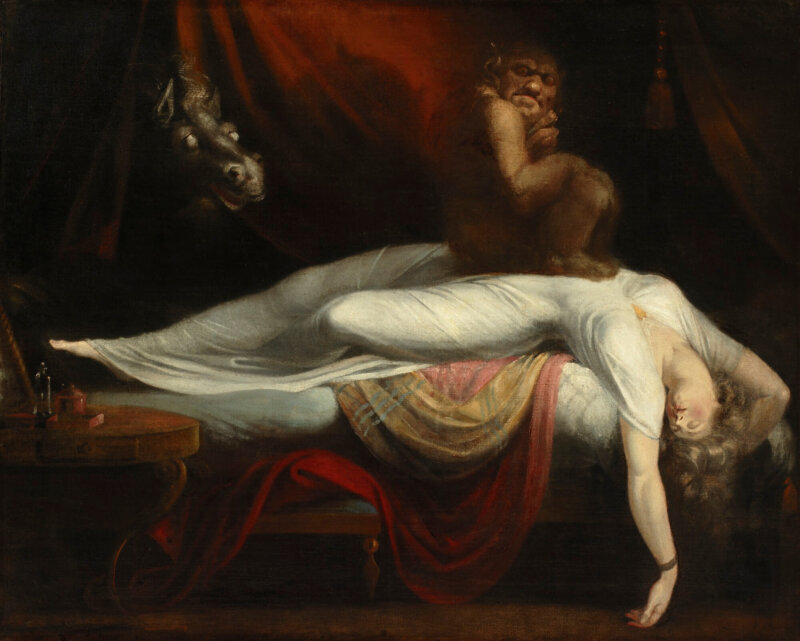
The Nightmare was completed in 1781, and it was made an exhibit at the Royal Academy of Arts in 1782 in London. Looking at the painting immediately instills a spooky and fearful feeling to the audience. Fuseli creates a moody background with deep browns and reds and oranges, but he counteracts this troublesome exterior with a woman in white (and slightly purpling colors) as the focal point. The frail woman has her arms hanging over the bed in complete release from the natural world as if she has given up after a strenuous dilemma. The left arm is totally extended, but the right arm is in another position: it is tucked under the woman’s head and slightly raises it to reveal her blonde, curly locks descend to the floor. Her head is also in the same position, partially due to her body and head hanging over the bed, but it exhibits a lack of consciousness and any feeling with her eyes shut and mouth open and relaxed. Taking these details into account, the woman’s upper extremities are presented by Fuseli with such grace and beauty all the while revealing weakness. Projecting her head’s position and arm’s movements with elegance portrays a sort of loss and defeat. While this position may relate with defense mechanisms or vulnerability with her arms thrown in the air, it is also important to note how her breasts perk upward, in a sort of domineering fashion or sense of arousal. Fuseli’s means in portraying the woman’s mannerisms encourages a transition from the woman’s angelic garb and graceful gestures to the surrounding exterior’s doom and gloom.
Despite the woman’s apparent deep slumber, she is not covered in any sort of linen(s) other than the ankle-length gown. The long linen gown and the woman’s colorless skin collides and magnifies her being as nearly an overpowering source of light within the darkness behind the platform bed. Her placement upon the platform is rather peculiar when taking into account the amount, or lack thereof, of linens on her person, because they seem pushed and tangled at the sides and bottom of the bed. Much like her gown, the bottom sheet radiates a similar color scheme. It is also important to note here that Fuseli uses a fading and blending technique to transition the woman’s white gown into the whitish, gray sheets to the background. Fuseli’s excellent blending skills are counteracted by the “accidental” coloring of the blanket underneath the woman. The blanket shows hints of pink and yellow. Pink can be analyzed as a happy and bright color, while yellow is associated with sickness, disease, and insanity.
Aside from the woman’s angelic complexion and gown, these are not the only sources of light in this piece. If the audience glances a few centimeters upward, they may notice a gremlin/demon-like creature perched on her chest. The faint glimmer of light brushes the creature’s right arm and creates a shadow on the deep orange/red curtain behind.
Additionally, the creature’s face is slightly visible by this mysterious light. Its large and circular nose, pointed ears, motionless eyes, and The Thinker position reveal a sense of domination over the woman, which could not be visible if the light was not cast. Almost as if the creature has been caught doing something naughty, its face is focused on the audience with a degree of vengeance. Because of its location on the woman, it may be the reason why the creature’s body language looks awkward and uncomfortable. The feet are also pointed towards the woman’s face, and, yet again, the creature’s crouched position reveals it may be hiding something in its lap. The creature’s guilty mannerisms connect to imps and incubuses that appear when women are sleeping or dreaming in folklore. Their purpose is to torment the individual by either having sexual intercourse or laying on their chest to make it difficult to breathe. However, the creature’s placement is slightly lower than the woman’s chest, indicating it may have not wanted to apply pressure and uneasiness of dreams, rather conduct intercourse.
The Nightmare’s creature sitting directly above the woman can then exemplify a staunch contrast between light versus darkness and even a dream-like state versus the subconscious. (Sigmund Freud, when living in Vienna, believed The Nightmare tapped into the subconscious, and he eventually put this piece in his home as a reminder of his studies concerning the subconscious.) While the audience may see hints of light on the creature, the woman predominantly holds the majority of the goodness Fuseli intentionally portrays. The woman laying perfectly horizontal seems to allow or suggest the audience draw a hypothetical line between these two worlds, forcing them to ultimately see the drastic change in subjects. On the top is darkness and the subconscious, while the bottom where the woman lays is goodness and a dream-like state. The audience may even say the woman breaks the painting in two since her brightness abruptly cuts the painting in half, with no transition into ombré motions like Fuseli does with the woman’s gown and bottom sheets, between the light and eerie colors.
In a previous note, I mentioned the creature sitting upon the woman’s chest. If the audience were to continue this notion of the lighter bottom portion of The Nightmare being the dream realm, the audience can assume the top portion are nightmares, hence the painting’s nomenclature of The Nightmare. Common folklore in the Romantic Period depicted dark creatures and beings in connection to nightmares. While this may be a reasonable comment, this was not Fuseli’s intention in the slightest despite him strategically using these creatures from nightmare folklore.
Moving to the far left of the painting, tucked behind the curtain, and with some sparkle of light, lurks a dark horse, staring at the woman. While the creature on the torso of the woman is indeed ominous and terrifying, the horse arouses another type of terror that shocks and changes the audience’s attention. The horse is not quite obvious amongst the curtain, but once it is noticed, it is hard to unsee its scary and alluring mannerisms. In Biblical contexts, a dark horse is often associated with death, which could make the audience believe that the woman’s frail appearance and the horse’s positioning behind the curtain could perhaps insinuate her death is inevitable. The horse’s eyes, as it looks upon the woman, appear black and empty but also focused, waiting for the woman to pass away. Aside from the horse’s blank and empty eyes, the horse has one curly piece of hair in between its pointed ears. As an onlooker to The Nightmare, I immediately thought of it depicting a flame. Its waving motion is much like a fire bursting in erratic gestures as the combination of oxygen and combustion produce this wild creation. Perhaps revealing how the woman’s death is predestined and organized with articulation between the underworld and the creature upon her torso, the horse’s lock is controlled and tamed.
There are varying flows of motions between the woman’s bed sheets, the horse’s lock of flame-like hair, and now the curtain behind the horse. Fuseli manages to focus on the woman while simultaneously using the curtain as a background to move the painting closer to the audience as if it is 3D. The dark curtain was meant to truly make the woman the focal point by covering and eliminating, literally, all distractions, but curtains can also mean the ending of one’s life. In theatrical plays, a curtain is used to announce a scene or act has ended. This can be interpreted as the woman’s life is soon ending, especially with its connection to the horse of death that the curtain attempts to hide.
Another interpretation that could remain plausible is when the audience takes into account Anna Landolt, Fuseli’s lover in Italy during the Enlightenment. Anna could not marry Fuseli, because she was destined to be with another man. With this in mind, Fuseli hypothetically places himself in the creature on top of the woman to relay dominance. Considering the woman’s sheets are stripped off her person, this could insinuate Fuseli violated the woman and made her open to his desires she could not relay in reality.
The Nightmare is a spectacular painting that combines all characteristics of Romanism. The woman, the color schemes, the creatures, and the subtle details play their part in contributing to Romanticism and the grotesque many associate with the “dark” side of Romanticism.


Related Posts