Demons, Technology, and the Fall
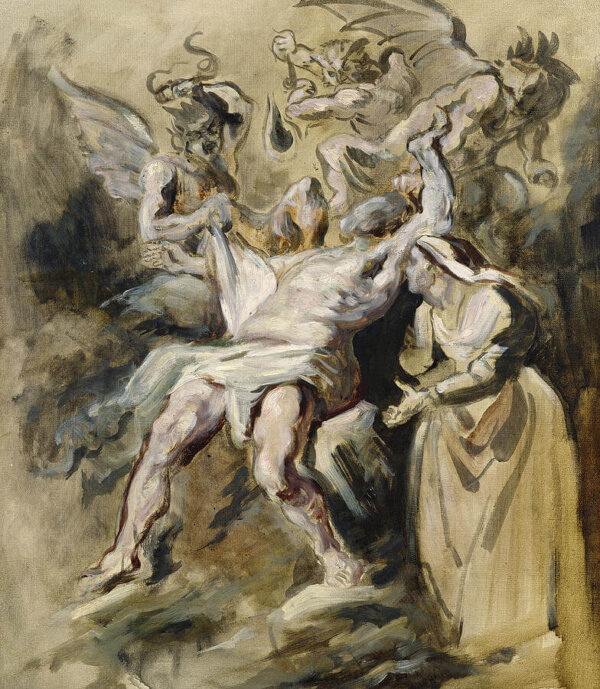
Peter Thiel’s recent obsession with the Antichrist seems uncannily appropriate to our times. The ascription of demonic influence to things and people was once relegated to a religiously naïve past, or, if the demonic did appear in modern times, it was the exclusive concern of your Jesus-loving aunt. However, an increasing number of media and political figures now speak as if there are occult forces that utilize technology and institutions to control our lives. Thiel himself has recently been compared to the Antichrist. A guest on an episode of Tucker Carlson’s podcast spent much of his appearance discussing the relatively obscure philosopher, Nick Land, who believes that the major institutions and systems of the modern age (capitalism, liberalism, AI) are anti-human alien powers whose origin comes from “the Outside.” The New York Times has run an opinion piece discussing the topic of spiritual warfare among Gen-Z. And lest one believe that the category of the demonic is exclusively to the Christian Right, even some Marxists are getting on the action by appropriating the theological language of the “demonic” to describe the ways that capitalist markets have a destructive “desire for infinity”.
The resurgence of concern with the “demonic” that we are seeing today has many potential causes. On the one hand, there is an undeniable tendency to hyperbolize the nefariousness of the forces that govern our lives—a tendency fueled by the internet. There is also the destructive tendency of political provocateurs to use the language of the demonic to dehumanize their opponents. However, I think there is a sense in which the surge in ascriptions of the demonic is more than just a cynical manner of speaking aimed at duping the credulous masses. It is a genuinely interesting fact that even in our “disenchanted” world, it is possible to find the concept of the “demonic” meaningful.
The question is how to make sense of the category of the demonic without regressing into hysterical enthusiasm. I want to propose an account of the demonic that maintains fidelity to the term in its historical signification, and which acknowledges the utility of the term in picking a genuine feature of the modern world. The account I present here does not exhaust every possible meaning of the demonic. I want to provide a coherent account of the aspects of modernity that make the revival of the term “demonic” meaningful.
The idea of the demonic that I offer has its origins in the Genesis myth. A fundamental aspect of Adam’s original innocence is that he knew the names of all the creatures in Paradise:
And out of the ground the LORD God formed every beast of the field, and every fowl of the air; and brought them unto Adam to see what he would call them:and whatsoever Adam called every living creature, that was the name thereof. And Adam gave names to all cattle, and to the fowl of the air, and to every beast of the field… (Genesis 2:19-20)
What is not often appreciated about Adam’s act of naming, but which was familiar to antiquity, is that Adam’s capacity to name each animal meant that he had access to the logon didonai [to name/to give a reason for], which means that creatures presented themselves to him in such a way that they shone forth in the fullness of their essence. The “name” that Adam gave each thing is not at all like the names that we have for things. Rather, the words of the “Adamic language” are best understood as statements conveying direct information about creatures, such that anyone who heard the word spoken would immediately know everything about the being to which it refers. This is similar to the same way that our word “man” connotes the definition “rational animal,” except that Adam’s words disclose their definitions the moment they are spoken.
Adam’s knowledge of the names or essences of things also meant that he had mastery over them:
Then God said, “Let us make mankind in our image, in our likeness, so that they may rule over the fish in the sea and the birds in the sky, over the livestock and all the wild animals, and over all the creatures that move along the ground” (Gen. 1:26).
On one interpretation of this passage, the “image” is the power of intellection that God and man share in their own proper degree, and through which man partakes in the act of ruling over his apportioned piece of God’s kingdom. Adam’s sharing in the divine intellect is what simultaneously gives him access to the names of things and the power to rule over them.
As a result of the Fall, man suddenly finds himself cast out from the stable world of Paradise into a world that now confronts him as an alien land. The Fall made us forget what things are and how they coexisted in the harmonic order of creation, and now those very things assail us on all sides.
The demonic, originally meaning power or fate, is just another name for the unknown external forces that assail us in our state of fallenness. Those things that once made sense and were familiar from the perspective of Adam’s perfect knowledge now appear to us as dark and hostile demons. This relationship between the demonic and unknowing explains why the rulers and authorities of this world invoke demonic forces. What the demon offers is knowledge and control over our fates in the face of this hostile world. It offers to return us to our place of mastery over the earth by becoming its accomplice.
Invoking the demon has the remarkable appearance of being the recovery of a word of the Adamic language. In its epistemic function, the name brings about a recovery of knowledge of the sphere of being that falls under the demon’s purview. This epistemic recovery has its physical correlate in the demon granting us practical mastery over the things that it governs. This mirroring of knowing the name of the demon with physical mastery is explicit in Gnostic soteriology, where knowledge of the name of the archons is necessary for the soul to physically pass through their domains:
men cannot be saved until they have gone through all kinds of experience. An angel, they maintain, attends them in every one of their sinful and abominable actions, and urges them to venture on audacity and incur pollution. Whatever may be the nature of the action, they declare that they do it in the name of the angel, saying, “O you angel, I use your work; O you power, I accomplish your operation!” And they maintain that this is “perfect knowledge,” without shrinking to rush into such actions as it is not lawful even to name (Irenaeus I.31.2).
This Gnostic formula illustrates just how far one can push this identification of knowledge with power, and of oblivion with corruption.
Unsurprisingly, the necessity of knowing the names of the demons in the Gnostic account of salvation contrasts sharply with the orthodox view of man’s state after the Fall. Orthodoxy accepts that man’s original oblivion of the Adamic language is responsible for our current state of unknowing, without therefore concluding that we can regain that original knowledge in this life. Both Judaism and Christianity require that man refamiliarize himself with the things he once knew to become at home in the world once again: “Wise people store up knowledge, But the mouth of the foolish is near destruction” (Prov. 10:14). However, our knowledge of the things of this world must be oriented by the absolute truth that wisdom is nothing without knowledge of God: “The fear of the Lord is the beginning of knowledge, but fools despise wisdom and instruction” (Prov. 1:7). In the Christian era, Christ’s name came to stand in for the truth of things as such, and hence the evocation of his name, and not a demon or the original Adamic word, was sufficient to control the forces of this world:
And these signs shall follow them that believe; In my name shall they cast out devils; they shall speak with new tongues; They shall take up serpents; and if they drink any deadly thing, it shall not hurt them; they shall lay hands on the sick, and they shall recover (Mark 17:17-18).
Modernity made a clean break with the notion of the original oblivion of the Adamic language and the corresponding view of man’s powerlessness in the face of nature. Admittedly, the early Renaissance, with its Hermetic and Kabalistic influences, continued to give this idea life. However, the emergence of modern logic and linguistics was made possible by the complete rejection of the idea that there was an original name corresponding to each object of knowledge. Instead, modern science embraced the nominalist insight that words are arbitrary signs. Nominalism, accompanied by the gradual realization that the inner workings of things could be uncovered by the Baconian imperative to “put nature on the rack,” allowed modern man to shed once and for all the need to posit some underlying truth or essence to things beyond what can be captured in the mathematized systems of natural science. It no longer made sense to think about truth as standing in some essential relation to names, since names were understood to be arbitrary conventions without any authentic antecedent.
Interestingly, this nominalist revolution in science reoccupied the concept of Adamic epistemology through the development of what the philosopher G.W. Leibniz called the “universal characteristic.” The universal characteristic is a hypothetical formal language that expresses mathematical and scientific concepts in such a way that their truths can be easily communicated for use in abstract logical reasoning. The closest analogues to what Leibniz envisioned are formal logic and modern systems of bookkeeping. In the essay in which Leibniz introduces the universal characteristic, he says there are some who “have retained their inherent ability to believe that astonishing things can be discovered through numbers, characters, and through a certain new language that some people call the Adamic language.” Though Leibniz dismissed these “absurdities” as cabalistic hogwash, he did think that there was something to be gained by preserving the formal principle underlying these earlier attempts at discovering the “language of nature.” What Leibniz had in mind was the idea that each thing could be assigned its own characteristic number that always stood in for it. This would allow us to “devise a certain alphabet of human thoughts and that, through the combination of the letters of this alphabet and through the analysis of words produced from them, all things can both be discovered and judged.” This art of discovery and judgement takes place entirely through an artificially constructed language in which all truths stand in a clearly deducible order. This opened the possibility that the nature of each thing could be discovered and ordered in this universal characteristic in such a way that anyone who knew its “number” would be able to know everything about it.
In place of the “natural” Adamic language corresponding to the truths of things, modern philosophers adopted an artificial language, composed entirely of conventional signs that would allow men to once and for all understand the nature of things as disclosed through the mathematical and physical sciences. With this universal language in hand, and with the ability to finally pry open nature to reveal her secrets, modern man finally regained his dominion over the world and the mastery of his fate.
I think that this decoupling of truth from naming is responsible for finally dispelling modern man’s belief in demons. What Max Weber famously called “disenchantment” can, from one perspective, be understood as man’s deliverance from the alienation brought on by unfamiliarity with the world. When philosophers and social scientists remark that people today no longer believe in superstitious entities like demons, what they are really observing is the final success of the natural sciences in understanding and dominating the forces of nature. One no longer needs to posit some kind of active malevolent principle to explain the events of nature, for science itself can provide every possible account of those forces. The final exorcism of the demonic from nature was successful precisely because the physical processes underlying the things in nature can be known with relative ease, even by those who lack a complete mathematical understanding of physical processes. A farmer does not need to know the detailed physics of how changes in the climate occur to no longer believe that a poor harvest is not the work of a slighted god. He just needs to know that such a physical account is available to trusted experts.
Our final deliverance from the demonic was made possible through a paradoxical reoccupation of the Adamic language by modern science. The paradox lies in the fact that modern science identifies the “natural names” that Adam assigned to creatures with the “conventional names” assigned to things by theoretical physics. This paradox resolves itself in the realization that there is no original language of nature; there is just the language that man imposes on things through his own power. There is, in effect, no return to the state of perfect knowing that characterizes Adam’s state in Paradise. There is only the Paradise to be created through the final conquering of nature through technical mastery.
Up until recently, this disenchantment has been completely thoroughgoing in modern life. Even religious believers who have resisted other aspects of modernity accept the naturalistic picture of causality told by science. So why are philosophers, technologists, and popular media personalities reviving talk of the demonic to characterize modern science and technology? What has changed such that the question of the demonic is returning?
In short, I think that we are increasingly finding ourselves incapable of naming, and hence controlling, the technologies that dominate our lives. The issue is not just that we lack the complete language of nature that Leibniz envisioned. Scientific progress has and will always remain a regulative ideal. But even if we have a relatively thorough mechanistic grasp of the physical processes underlying modern technology, there is an important sense in which that knowledge will always be inadequate to capture what is truly uncanny about technology.
One way of thinking about the phenomena of technology, which includes both the technology powering our phones and computers, as well as the more mundane technology, such as toasters and automobiles, is that technology allows us to engage with the world in a way that takes over the act of inquiry. Think about the difference between an electric doorbell, such as Ring cameras, and a pre-electric bell attached to a pulley system. In the latter case, the principle of the bell’s operation is accessible to anyone who pulls on the chord. There is a kind of immediacy to the mechanism that we can observe and describe with varying degrees of precision. While perhaps a visitor inside the house who had never heard the bell ring before might be startled by it, perhaps mistaking it for some kind of ominous beast, their belief is dispelled the moment they behold the mechanism.
The electric doorbell, by contrast, does not reveal itself to us in this way. Its inner operations are hidden, and the mechanism by which it performs its actions is alien to our everyday understanding of the world. Every child knows that when they pull a string, whatever it is attached to will move. It is this background of everyday familiarity that makes the bell on the pulley accessible to us. What could one say about the operations of a Ring doorbell to make them familiar in the same way? One could perhaps compare its camera to an eye, and its circuitry to the nerves of a brain. However, this anatomical description is not only misleading on the whole, but it itself is already divorced from our everyday understanding of the world. The electric device does not invite us to understand it. Rather, it is a sort of unspecifiable entity that we call upon to bring about a result.
In the face of electrified technology like this, there is no longer a process at work that can be made accessible to the average person. Instead, technology confronts us as a foreign power that does not reveal how or why it produces the effects it does.
An electrical engineer could provide the most detailed possible lecture on how an LLM works on both a hardware and software level, and yet even this researcher would admit that he does not adequately grasp what is happening internally within the software for it to generate its results. It thus makes perfect sense that both laymen and tech leaders alike speak about this technology as if it were an active, conscious being with nefarious, anti-human desires. Furthermore, there are many who believe that any sufficiently advanced AI is indistinguishable from magic, as two recent authors put it. The quasi-demonic analogies are very much the result of the fear that we have no idea what this technology is doing at a fundamental level. As such, it is all but natural to feel as if this technology is going to dominate, if not outright kill, us.
Another technology ripe for demonization is CRISPR and other gene editing processes. This technology seems to be the culmination of the Enlightenment dream of finally mastering the limitations imposed upon us by both disease and those pesky inherited traits. It appears to be the last great step in man’s domination of nature. This optimism is not universally shared, however. There are deep ethical concerns about its proposed application to both human beings and animals. It is increasingly apparent that the hubris underlying the possible widespread adoption of this technology might put us on a path towards even greater harm, due to both unforeseen physical responses to the editing of the finally tuned human body and the possible social inequities that such editing could bring about. The fact that we are staring such a technology in the face without the slightest clue about what it can do to us or the world places us in a position where the only responses seem to be either resignation to our fates or total damnation.
We are already living in a world where it seems impossible to expect that there is any one person who can say that they know, in the fullest sense of the word, how the technology we have built operates and what it is doing in the world. Except for an increasingly diminishing group of experts who have been around long enough to have seen the technological world develop from its infancy, our grasp of technology is becoming more and more specialized, and the fundamental processes that underlie it are increasingly being forgotten because of iteration and streamlining usability. Much like the electric doorbell, we use this technology without ever stopping to think about the way it functions and how the relationship between cause and effect works at a fundamental level in it. This means we are increasingly confronting our technological world with a sense of powerlessness and ignorance. If I am correct in claiming that a condition of the demonic is that man feels powerless in the face of forces that lie outside of his knowledge and control, then it appears that modern science and technology have set the stage for the demon’s return. The demonization of technology that we are seeing today is just the start of what is to come.
A defender of modern science could respond to this demonization by pointing out that honest scientists admit the limitations of their field and promote a cautious and ethical approach to research and product development. I fear, however, that this appeal to ethical science misses the point. The technological world in which we live does not admit of such caution. The absolute dominance of science and technology over our lives means that we are thoroughly embedded in a world we do not adequately understand, and which we now know to be harmful to the future well-being of the species. The defender of science even admits that we do not have a full grasp of that which science concerns itself with. This oblivion of the essences of the things we have created can only become worse as we hand over more and more of our intellectual power to AI. Demonization is the result of this fact, and no amount of cautious science will be able to resolve this ontological fact about modern man.
I worry that the rather limited use of the demonizing language that we are seeing today is just the beginning of an even greater cultural shift. We are quickly finding ourselves in the position of the fallen Adam, as one who no longer remembers the names of things. We feel alienated in the world again, but this time it is a world of our own making. It is this simultaneous loss of familiarity and the feeling of being controlled by technology that allows us to relate to the modern world in a way that evokes the specifically demonic worldview of past ages. The disenchantment that accompanied the accomplishments of modern science is quickly losing its hold on our consciousness. The ancient principle of demonology still holds: If you can name it, you can control it. The problem is that those whom we have trusted to be the keepers of the new Key of Solomon seem to have forgotten how to read it. We now stand helpless in the face of a creature that cannot be named, and from which we need to be delivered. We may hope to one day find the name of this demon and regain control over it. Or, perhaps we should reconsider the Christian command to utter the only name that can really deliver us from evil.


Related Posts