Scott Wheeler and Birds of America
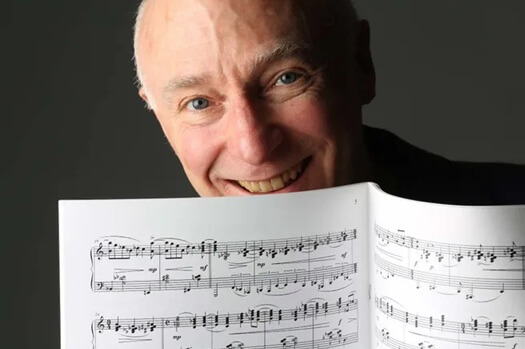
Much of the classical music being composed today is characterized by what I call the Three U’s: Unintelligible, Unstructured, and Un-singable. Alternatively bland and erratic, such music appeals only to the siloed academic whose musical interests are, for the most part, theoretical. To come across a contemporary composer who bucks this trend is therefore a delight. David Conte, whose music I have written about before in these pages, is one such composer. Another is Scott Wheeler, composer-in-residence at Emerson College in Massachusetts, who writes tonal, structured music that is engaging and fresh.
A recent album featuring Wheeler’s violin concerto alongside two others offers an instructive comparison of these two kinds of contemporary compositions. The album, which was released on the Canary Classics label in October 2025, features violinist Gil Shaham playing concerti by Wheeler and Avner Dorman and a piece for violin and orchestra by Bright Sheng titled “Let Fly.”
The album begins with the Wheeler concerto, which is titled “Birds of America.” Query: why do today’s composers give names to their compositions? Brahms was content to let his violin concerto be called a violin concerto; why shouldn’t we? That aside, Wheeler’s concerto is a wonderful achievement. Commissioned by Bard College and written specifically for Shaham, the concerto originated when Wheeler and Shaham encountered a downy woodpecker while walking through Central Park. This “chance encounter,” Wheeler writes, inspired him to start composing.
“Birds of America” is a perfect piece for Shaham, whose wheelhouse is all things light and virtuosic. Indeed, “light” is the best word to describe the concerto as a whole. The orchestration, the textures, the solo line—it all has a sense of buoyancy, a youthful desire to leap and fly that perfectly fits the theme of the work. Wheeler’s musical imagination is also light and buoyant, while also maintaining a strong sense of direction and momentum. “I am about long-breathed melody,” he writes, and it shows.
As a violinist, I was delighted to hear several instances in which Wheeler quotes the violin concerto repertoire. He quotes Vivaldi’s Four Seasons, the rolling tenths from the first movement of Brahms’s violin concerto, and the second movement of Prokofiev’s first violin concerto. I also heard echoes of Copland and Hanson in the restful, reminiscent second movement, which features an evocative flute melody that weaves in and out of the violin solo line. The third movement was the most overtly bird-like of the movements. It begins with a brilliant and humorous woodpecker imitation, which Wheeler accomplishes by having the section violins tap on their instruments while the violas play col legno and the woodwinds insert various high peeping noises. The solo line was also birdlike, featuring numerous trills and virtuosic runs in the highest registers of the instrument. It was also—to coin a word—violinistic, by which I mean that it is written in a way that fits neatly into the violinist’s left hand. Wheeler’s collaboration with Shaham is evident.
I have only one complaint about the Wheeler concerto, and that is the ending. I would have liked the ending to match the energy and virtuosity of the rest of the movement, perhaps ending in a well-paced, percussion-heavy flourish, but Wheeler lets the orchestra fade out after a long high note in the violin. A delicate and fine ending, but not the one I would’ve chosen.
The second and third pieces on the album do not approach Wheeler in technique or effect. The Dorman concerto, which is built on Jewish folk tunes, contains moments of brilliance, particularly when it embraces the dance-like form of its compositional material. I especially liked the energetic dances in the second and fourth movements, which sounded as if they could be excerpts from Fiddler on the Roof. But the rest of the concerto gave the impression of indecision, of having too many ideas and being unable to decide which one to use. I found the third movement particularly frustrating to listen to because it embraced the maddening tendency among modern composers to create “sound atmospheres” rather than actual music. Such scores contain almost no movement at all, just random sighs and moans (usually in the strings) punctuated by random and jarring spurts of noise (usually in the clarinet or oboe) and various unstructured percussion effects (invariably featuring the cymbals). This is a tired trope, and Dorman’s capitulation to it—especially after the delightful energy of the other movements—was disappointing.
The final piece on the album is a 2013 composition for violin and orchestra by Bright Sheng titled “Let Fly.” (Again, why the name? Are those two words supposed to somehow transform our listening experience?). Sheng writes that the piece was inspired by the idea of a violin melody that flies off into thin air. Sadly, that was precisely my impression of the piece: thin air. It was bright and benevolent at times, so I can see why Shaham would be drawn to it. But overall it was a directionless and uninteresting composition, wandering to and fro between various unconvincing melodic fragments and giving the overall impression of being lost. The orchestration was also problematic, seeming at times to contradict the direction of the solo line. Many times the violin rose into an impassioned climax, only to discover that the orchestra was either completely silent or plucking along with apparent indifference to his efforts. This, combined with the piece’s exhausting length (29 minutes!) brought “Let Fly” crashing to the ground.
Taken together, these three contemporary compositions provide a helpful comparison between the two general types of classical music being composed today. On one side we have academic, theoretical “sound” music, defined primarily by its complete lack of definition. And on the other side we have composers like Conte and Wheeler, whose music builds the tonal tradition and the great works of the past into fresh musical material. Audiences have given their verdict in favor of the latter, and if this concerto is any indication, Wheeler has been listening.


Related Posts