Dreaming for Life’s Sake: A Reflection on Literary Archetypes
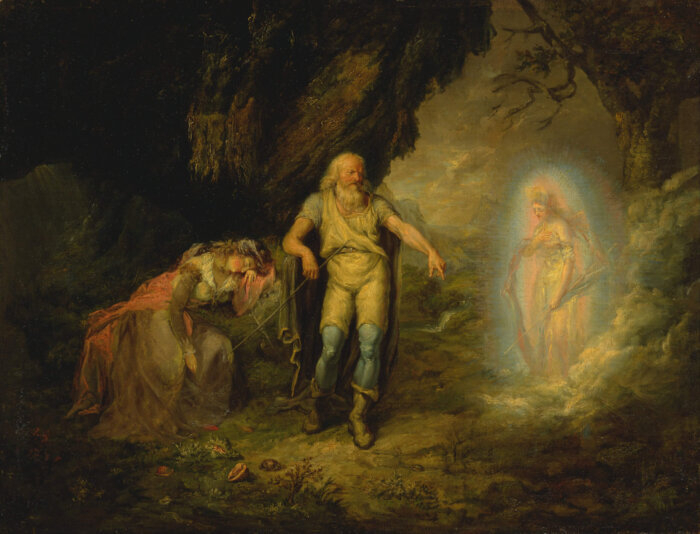
Be not afeard; the isle is full of noises,
Sounds, and sweet airs, that give delight and hurt not.
Sometimes a thousand twangling instruments
Will hum about mine ears; and sometime voices,
That, if I then had waked after long sleep,
Will make me sleep again: and then, in dreaming,
The clouds methought would open, and show riches
Ready to drop upon me; that, when I waked,
I cried to dream again. (Shakespeare, The Tempest, II.2.148-155)
In this ravishing passage of Shakespeare’s enigmatically exquisite swan song The Tempest, the hideous monster Caliban, who is held captive by the magician Prospero on an enchanted island, assures strange visitors to the island that there is nothing to be afraid of. In so doing, he delivers a stunning epiphany about the nature of dreaming. The term has become yet another of our culture’s bleached, disenchanted words since Freud associated it with the mechanical movements of the subconscious and “follow your dreams” has become a withered old monarch of clichés. The “sounds and sweet airs” exalted by Caliban hail from a time when dreams were recognized as the foundation of all that is truly human. It is in our moments of utmost wonderment and highest perception when we notice the world’s “riches ready to drop on us” and we “cry to dream again”—that is, to recapture that wonderment and weave it into the fabric of one’s life. “Dreaming” in this sense does not refer to what goes on when we’re asleep, nor is it some vague platitude about the desire for pleasure and contentment. Rather, it speaks of the holy fire that is kindled in our hearts when we approach the threshold of a waterfall, a cathedral, a lover, or even more quotidian matters such as our beds, our plates, our work, or our front porch on a resplendent morning. These whet our appetites for the City of God to which they point, which is the source and destination of all that is true, good, and beautiful. Such earthly blessings allow us to dream freely since we know, through the greatest gift of faith, that all shall be well.
Yet human nature will always intrude with its maddening, logic-defying complexity and depravity. Since the dawn of recorded civilization, artists have constructed their works upon the archetype of the dreamer and the dream since dreams are the highest and most significant things one can write about. Is there any great literary work that is not ultimately connected to dreams? Shakespeare can compose the sterling lines above because he writes in a tradition that has defined and presented various images of the dreamer through millennia by means of stories. This tradition defines “dream” not only as an ideal that rules our passions and pleasures—a synonym for “aspiration”—but as an epitome of existence, an entity whose distant presence is so intense as to work its way into one’s unconscious life. The impulse of the dreamer is the impulse to internalize the sublime. The dreamer sees an object of immense, terrifying beauty lingering on the horizon of the mundane, and declares that life will not be fully life for him until he has rested in the presence of this object. In other words, the dreamer pours all of his love into the object of his desire. St. Augustine speaks of love as the animating force behind all existence, the reason why we do anything at all. Well-ordered love is the sustenance of angels, the stuff of sainthood, achievable only through a dispensation of grace to our diseased souls. We are Calibans all: deformed and enslaved by sin but released to the presence of the beautiful life through the realization that we inhabit a world of wonders. Disordered love is the consequence of the Fall: a placement of our affections in fleeting, temporal things that should rightly be considered gifts of the Creator and means by which we contemplate and glorify Him, but which we end up idolizing as we make them ends unto themselves. But all love, whether well or poorly-ordered, consists of dreams. To know what it means to love and dream aright, we must immerse ourselves in the images and narratives that have sculpted our world.
The acknowledgment that we are all, by essence, starstruck lovers and vagrant dreamers is so properly basic that the earliest literary characters reflect this in magnified ways. The works of Homer have lasted since the ninth century BC because they depict catastrophically flawed figures who, theoretically, have everything they need for prosperity and fulfillment, thrust into the midst of the most trying, unforgiving circumstances. But they are not satisfied with their power and influence, their fame and renown, their victories and triumphs. Their thirst for something greater has yet to be slaked. They crave qualities that transcend momentary satisfaction—immortal honor among men, the abundance of a prosperous home life, accord with friends and family, peace with the divine, and the hunger for perfection. If Homer had portrayed the fearsome warrior Achilles as simply a war-lusty man of the world with a sadistic streak for vile vengeance, he would not be anything close to an endearing, sympathetic character. But Homer knew his world better than most of the critics who have attempted to analyze him, and Achilles, through some miracle of artistic invention, lives on as a figure that somehow captivates the attention of all who read about him. This is because he comes to the realization that his apathetic sulking by the ships while his comrades spill out their lives on the plains of battle will lead him into the pit of despair. Like Camus’s Sisyphus, he seems to be consigned to the absurdity and futility of existence. But he must project one tortured shout of misery into the void before his flame is snuffed, and the only means he has to do that is his swift-footed strength. He thus resolves to pour out his incendiary fury against the Trojans, his enemies among the Greeks, the madness of injustice, and the very decrees of the gods by taking up his god-forged armor and plunging headlong toward the culmination of his life. He directs his longings toward surpassing his own limitations in order to etch his name into the universe and to “rage, rage against the dying of the light” as Dylan Thomas said it. This is also, ultimately, what makes Achilles a tragic figure even amidst the great spark of redemption in the Iliad‘s finale.
The second half of the Homeric corpus offers us the battle-scarred, ever-wily Odysseus who is set adrift by fate in his attempts to get home after Troy has been conquered. On one hand, he can be seen as someone who craves mere temporal comfort rather than the eternal resonance sought by Achilles and his unhinged, angst-tinged wrath. In Achilles and Odysseus, Homer has set up for us the dichotomy of false and noble dreams which will dominate the Great Conversation: the doomed fist-shaker against the universe who is homeless in this world, and the starry-eyed lover of domestic delights who is continually tossed about and unsettled. Underneath all the heroic qualities of Odysseus lies a perfectly ordinary guy who just wants really badly to get home to his wife and son who he hasn’t seen in 20 years. His goal is not vengeance or any form of glory besides the need to be where he belongs. Achilles, half-mortal that he is, does not know where he belongs, a recognition that fuels his entire crisis. Odysseus knows above all else where he needs to be, but the world is set against him. The spirit of Achilles is found in Shakespeare’s blackest tragedies such as Macbeth and King Lear with their titular figures’ revolts against the cosmos. Ultimately, he devolves into the modern antihero. The spirit of Odysseus is found in what some believe to be the earliest extant piece of English verse (the spelling is modernized here):
O western wind, when wilt thou blow?
The small rain down can rain.
Christ, that my love were in my arms
and I in my bed again.
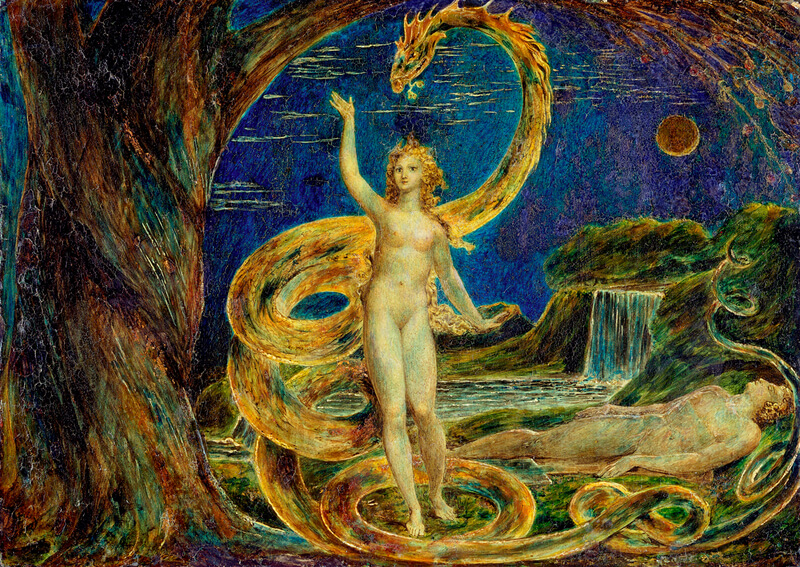
This is not tragic longing, but longing that points to the fulfillment of all dreams that are too good to be true, the consummation of which is in the realm of The Tempest‘s island. Odysseus wants to surround himself with domestic bliss, which is surely one of the highest and truest callings of man. The only problem is that he has to overcome the slight nuisance of immutable divine will in order to get there. But like all symbols, Odysseus’s homecoming takes on cosmic significance. We all have ideals which we view as “home” to us; something which we thrust the engines of our life into overdrive to get to. In both the epics, Homer seems to be saying that true homecoming—that is to say, true dream-fulfillment—is attainable to a certain pitch in this life, but only through a degree of suffering that is so intense so as to transcend the mundane. This must be coupled with a recognition of our ultimately insignificant position in the cosmos and the primacy of divine mysteries. Homer’s pagan framework produces a multitude of hinderances and downfalls to the achievement of a beautiful life, but overall, he is not far from a prefiguration of Judeo-Christian typology, as are all the Greek thinkers and poets. The big difference? Achilles and Odysseus do earn the honor and reverence among men which they strive to secure, even at the cost of life (Achilles) and a great deal of wandering sorrows (Odysseus). The oral tradition that produced Homer carried on the legends of Achilles and Odysseus centuries after they supposedly lived. But in Scripture, everyone who strives to write their name in the heavens of their own accord fails spectacularly, from the disobedience of Adam and Eve onward to the Tower of Babel, Samson, Nebuchadnezzar, and even hubris-afflicted heroes like David and Peter when they fall prey to the weakness of the moment. The Biblical vision tells us that the purest dreams are those in which we take no part in achieving. They can only be won for us by the God who chooses to rescue us from our sorry state. Achilles and Odysseus’s mantras of self-sufficient “infinite striving” are, in fact, the very road to Hell. Which, as we all know, is paved with good intentions.
*
As we progress through the timeline of Western civilization’s output, we see the ideal of the dreamer evolve erratically and hesitatingly. The Roman poet Virgil, writing in honor of Caesar Augustus, reversed the Homeric concept by making Aeneas pius, or faithful, to a divine responsibility that directly contradicted his personal desires. Aeneas, like Achilles and Odysseus, is a dreamer controlled by forces beyond his understanding, but those forces use him as a means to build the great edifice by which all of humanity’s highest dreams may be accomplished—the pinnacle of Augustan Rome. It is no wonder, then, that the medievals universally preferred Virgil to Homer, since Aeneas represents the kind of man they strove to be—one on whom Divine Providence is free to work, and who pushes through suffering and temptation to gain the contentment that can only come from piety. So what if we are Achilles and Odysseus, sacrificing our lives and even our souls to achieve what we want to achieve against the odds determined for us by the gods? Try doing the same thing but in service of something higher than your own desires, in homage to God and History above all else. Get out of your own short-sightedness, and into the will of the Everlasting. This is the highest genius of Virgil’s recasting of Homer.
With the great jewels of medieval literature, we come to a time when European culture was mostly in harmony with a reigning vision—albeit a deeply imperfect one that was inevitably tainted and undermined by shocking outbursts of greed and barbarity. The Greeks and Romans spent their entire existences grappling with the implications of their confusing, often brutal worldviews. Medieval Christianity not only persisted for more than a millennium, but it also fostered a type of thinking in line with that of ancient Israel—one in which dreams were not something to be fought over in blood-drenched battles or pursued across perilous, monster-laden archipelagos. According to this view, man already lives amidst the fulfillment of his greatest dreams, since eternity awaits all believers by means of God’s work in history. The divine light draws our souls toward it, continually challenging and pulling us toward the highest promise of unspeakable love. Thus, in the medieval romance and allegory, the battle and the quest are outward signs of their heroes’ internal stability. This is not to say that these figures do not have flaws, frailties, and misgivings. Beowulf, Chrétien de Troyes’s Arthurian romances, the Song of Roland, and Chaucer’s Knight’s Tale carry piercing elegiac notes since they do indeed examine their heroes’ pitfalls. But the fundamental rightness of their desires is never in question; through sin and stumbling, they fight for what their authors considered to be the City of God and emerge bathed in its light. This same attitude naturally spawned the extravagant, labyrinthine side of medieval art, in which even the most apparently mundane aspects of existence are bathed in qualities of unspeakable grandeur and elevation (think illuminated manuscripts, the Divine Comedy, and the Gothic cathedrals). In sum, medieval literature was less about the persistent archetype of the dreamer devised by Homer and more about perfectly ordinary figures who lived in a world of extravagant wonders and were content to take it as it came. Dante’s cosmic quest for the supreme Light restored, in some ways, the Odyssean model, but it is a metaphysical odyssey toward man’s most natural longings rather than a classical exploration of the kind of inhuman rage (ménin) kindled in Achilles when he faces the horrors of his position, or of the fate-chained Aeneas’s precarious tilt between the fierce saevae (wrath) of Juno and the glimmering promises of Destiny. Disillusionment never wins in medieval literature because, despite all the trials of the world, it is impossible so long as we have divine wisdom and love showered upon us like manna.
If we are to point to one work which re-instilled the classical striving Dreamer into the fabric of our civilization and made it once more the chief concern of all literature since then, we must single out Cervantes’s pioneering novel Don Quixote, that grand fantasy of absurdity. When we first read this hilarious, disturbing work, we look down upon and laugh at the Don as a deluded soul who wants to be a valiant knight in a world that couldn’t care less. But as the story unfurls through endless vistas of frustrated exploits and motley adventures, most readers will come to feel sorry for him as we come to know that he really does believe everything he thinks he is. In the end, the world is simply too much for him. This is the conflict that has paved the way for all literature since then: reality as constructed by the individual, versus reality as it really is. Cervantes seems to be telling us that the desires of the individual direct one to the promise of paradise, only to be constantly thwarted by the indifference and even outright spitefulness of reality. Whether he really believed it or not, Cervantes bifurcated truth from desire, and our culture has never recovered from this. All of the most celebrated tragic literary figures since then are dictated by the gulf that exists between what they want and the limits imposed upon them by their environment. Hamlet, Faust, Madame Bovary, Anna Karenina, Captain Ahab, Gatsby, the casts of Kafka and Beckett’s theater of the absurd—the works that all these characters inhabit are undisputed masterpieces, and they tell us much about the meaning of sin. Some of these authors, such as Tolstoy and of course Shakespeare, use tragedy to illuminate the reality of twisted ambitions, evil, and the curse of our inability to fulfill the Law from a thoroughly Christian perspective. However, in many of these works, even the Homeric/Virgilian hope of potential fulfillment is blotted out because there are no actual conditions that could avert tragedy. Homer and Virgil believe that if the powers that be are aligned in just the right way, if Achilles can discover one little flaw in the gods’ designs, and Odysseus can get one goddess on his side, the dream has a chance of becoming reality. But modernity has abandoned the “superstitious” language of gods, goddesses, and God in favor of a characterization of reality as alienating and terrifying. The universe no longer teems with beautiful mysteries but with ugly terrors. Achilles seems to have glimpsed some version of this earlier than anyone else, but at long last he has had his triumph. The impersonal cannot generate the favorable. If there is no higher intelligence than ourselves, and our own intelligence cannot even bring us happiness, then hope itself is dead, and has been swallowed up by darkness. O life, where is thy victory?
*
What, then, does this mean for the contemporary truth-lover? Has the bumbling Quixote, sorrowing over the repeated failures of his good-hearted quest for virtue and his merciless bullying by society, really had the final word? How do we reconcile the need for happiness with the need for duty? This brings us back to the central question of the Aeneid, and to the medieval resolution, which must be our prime example. Anyone whose supremely joyful dream is not the embrace of eternity has their desires misaligned. The medieval hero starts in such a corrupted position. After all, Dante begins his Comedy lost in a “forest dark,” utterly directionless until none else but Virgil himself shows up to set his priorities straight. Throughout his journey, he is transformed when he allows the intimations of paradise to flood his soul. The key here that modernity has missed is Augustine’s core insight: the distinction between beautiful and destructive desires is that between life and death, between the clouds of the island with riches ready to drop on us and the Inferno of Hades with pure alienation threatening to engulf us. The ill-advised retreat into the stubborn dogmas of one’s warped desires, when unaccompanied by a will to renovate those desires, is the chief criterion of all tragic formulae. Plato’s Socrates said that education consists of teaching pupils to desire the right things. We must not discount the importance of dreams, for they are one of the fundamental glories of being human. We should not be ashamed of the indelible existence of dreams in our souls. However, the art of life consists of taming and subduing those dreams, in elevating them into the realm of purity against the base devices of sin, in realizing that all dreams must be subsumed into the greatest ruling dream of all, which is our heavenly destiny toward perpetual perfection. Prayer and steadfastness are the truest companions toward the achievement of this revolution of the soul.
In reading great literature, poor vagrant dreamers that we are, we find ourselves between the pages. Who knows if Odysseus stares at us with his weary, fiery eyes to convict us of our inward-curved tendencies and to point us home? What if Aeneas and Dante can serve as fuel for our longings, clarifying and elucidating the truths of Scripture and making the beauty of well-cultivated dreams all the more real for us? Perhaps we must even see ourselves in Achilles and the tragic tradition so that we may avert our eyes from self-consuming darkness. And Quixote can certainly remind us of the cruelty of this world, the bleak mockery that our culture makes of the noblest desires and our consistent inability to justify ourselves. Through such literary experiences, we discover the necessity of facing our fallenness and properly ordering our loves toward the Light of Ages. We learn to discern the tragic and embrace the comic.
This is the ultimate promise of a classical education: the formation of the whole person and the direction of the will toward the transcendent through the nourishing streams of the Great Tradition. A quality education can guide us into appreciation of a poem, novel, or play for its aesthetic qualities, yes. But most essentially, it schools us in the art of wonder: in knowing ourselves and our world as we are created to know them. It heightens our longing for the City of God, and transforms wanderers into pilgrims. We return to Shakespeare, who, after bringing his theatergoers through the Valley of the Shadow of Death with Hamlet, Lear, Macbeth, and the crushing misanthropy of several later plays, finishes his career with ethereal visions of an enraptured beatitude that overcomes even the most piercing suffering, and which is perhaps available only to the one who believes in fairy tales. “We are such stuff/ As dreams are made on, and our little life/ Is rounded with a sleep” (IV.1.74). There is no better or more concise summary of our status as humans.


Related Posts