He Would Not Live Long: The Postwar World in W.H. Auden’s “The Shield of Achilles”
While many great thinkers and philosophers have sought to analyze the brutality and sheer devastation of World War II, they can never quite compete with the work of the artists. In the wake of the world wars, countless artists have sought to describe the bleakness of postwar reality—but none of them, perhaps, with the same degree of wit, wisdom, and profound melancholy as can be found in the work of W.H. Auden, a British-American poet who lived through both world wars and died in 1973.
For the most part, Auden’s poetry depicts the unsettling lostness of the postwar world without writing about the world wars directly. Rather than staring straight at the sun, his poetry tends to highlight the complex details of a society forever illuminated by the threat of nuclear war. A student of the classics, Auden was also known for addressing contemporary societal concerns through the lens of classical characters and symbols. In his famous poem “The Shield of Achilles,” Auden subverts a moment from Homer’s Iliad, an ancient Greek epic, in order to shed light on the constancy of war throughout the ages.
The Modern World in an Ancient Story
The plot of the Iliad centers around the rage of one Greek hero, a demigod named Achilles who is snubbed by a Greek king and therefore refuses to fight on behalf of his friends in the Trojan War. Because Achilles is the best of the Greeks, his withdrawal from battle has dire consequences. The Greeks begin to lose ground. Many Greek warriors fall on the battlefield. Achilles’ dearest friend (and probable lover), Patroclus, begs him to rejoin the war—but when his pleas fall on deaf ears, he proposes a different plan. Patroclus will don Achilles’ armor and enter the battle in his stead. At the mere sight of what they believe is the great warrior Achilles, the Trojans will surely flee and the Greeks will be saved.
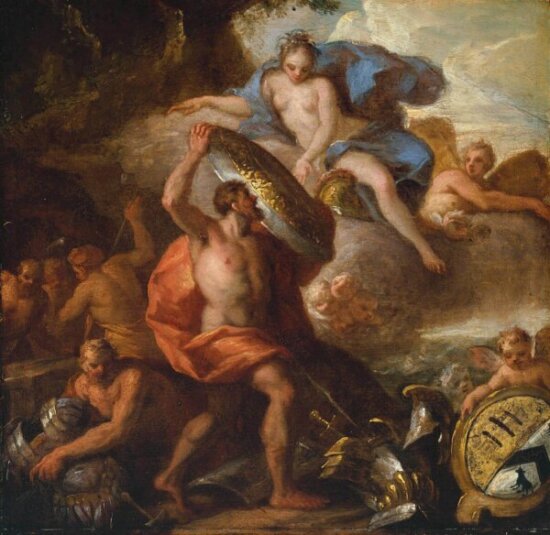
Achilles agrees reluctantly to this plan. Disguised as his friend, Patroclus rides out onto the battlefield. Unfortunately, he is soon killed by Hector, the greatest of the Trojan heroes. When Achilles learns of these events, he is torn apart by rage and anguish. He vows to return to the Trojan War, but this time with one goal in mind: the death of Hector. His divine mother Thetis, however, begs him to wait until she can procure another set of armor for him (since his armor was taken by Hector after the death of Patroclus). Thetis quickly goes to the smith god, Hephaestus, and asks him to make Achilles a set of armor.
Auden’s poem begins immediately after Hephaestus has finished the armor, which includes an intricate engraved shield. In the original epic, Homer describes a series of beautiful images depicted on the shield: the sea, sky, and earth; various constellations; a farmer plowing his field; a vineyard; men and women dancing; sheep roaming on a farm; the ocean. At the beginning of Auden’s poem, Thetis looks over Hephaestus’ shoulder, expecting to see the same images that Homer lists in the Iliad: “vines and olive trees, / marble well-governed cities / and ships upon untamed seas.” She is, however, met with a series of much more disturbing pictures. She sees “an artificial wilderness / and a sky like lead.” She sees “a million eyes, a million boots in line, / without expression, waiting for a sign.” She sees “three pale figures…led forth and bound / to three posts driven upright in the ground.” She sees, in short, a modern world rather than an ancient one. She sees the horror of the world in the wake of World War II—and at the end of the poem, Auden tells us that Thetis
Cried out in dismay
At what the god had wrought
To please her son, the strong
Iron-hearted man-slaying Achilles
Who would not live long.
In some sense, this poem has an interpretation so simple as to be obvious. The Iliad depicts the brutality of war and the consequences of human malevolence; over the years, that brutality and malevolence have not changed or evolved. In Auden’s imagination, the shield of Achilles, though crafted for a Greek warrior roughly three thousand years ago, nevertheless connects the ancient world to the modern across space and time. Thetis sees the aftermath of the modern world wars and weeps for her own son—and perhaps all children caught in the crossfire of war.
There is no reason to doubt this simple reading. Even so, Auden’s use of Homer is arguably much more complicated than the simple reading might lead us to assume. Before we can fully appreciate the hidden depths of Auden’s poem, we must dig deeper into the parallels between the narrative of Homer’s Iliad and the historical events that mark the end of World War II. Within these parallels, we may find that Auden has buried within this simple little poem both the seeds of the world’s destruction and a whisper of its hope.
Pearl Harbor and the Death of Patroclus
On December 7th, 1941, the Imperial Japanese Navy Air Service launched a surprise attack on an American base at Pearl Harbor in Honolulu. The attack was a surprise both because the Japanese gave no warning, as was required by the Hague Convention of 1907, and because the United States was, at that point, a neutral actor in World War II. 2,403 Americans died at Pearl Harbor, sixty-eight of them civilians. A thousand more Americans were injured.
This act of brutality shocked and enraged the American people—and rightfully so. One day after the attack on Pearl Harbor, President Roosevelt gave a now-famous speech that captures the sentiment of anger that had swept through the nation. In his address, Roosevelt pointed out that “the attack was deliberately planned,” that Japan had “deliberately sought to deceive the United States,” and that “very many American lives [had] been lost.” Roosevelt goes so far as to use language that paints the event as an eternal blot on history, stating that December 7th is “a date which will live in infamy” and that “always will our whole nation remember the character of the onslaught against us.” Near the end of his speech, Roosevelt promised that no matter what it took, the Americans would win the war. “With the unbounding determination of our people,” Roosevelt said, “the American people in their righteous might will win through to absolute victory.”
Before the attack on Pearl Harbor, the United States had stayed out of the war, just like Achilles—and just like Achilles, the United States was moved to unimaginable rage when innocent American lives were lost at Pearl Harbor. The Empire of Japan had become a Hector to the American people. By declaring war on Japan, the United States—like Achilles—made a choice that could not be undone. Roosevelt had promised the people “absolute victory,” and absolute victory they would have: no matter the ruin, no matter the cost. Hector had killed Patroclus, and so Hector was now marked for death.
Killing Hector, Killing Achilles
In 1940, the U.S. Army Corps of Engineers kickstarted the top-secret “Manhattan Project,” a program tasked with developing the world’s first atomic bomb. Led by the now-famous J. Robert Oppenheimer, this team of scientists ran their first successful test on July 16th, 1945. On August 6th—less than a month later—the United States dropped an atomic bomb on Hiroshima. When Japan did not immediately surrender, they dropped a second bomb three days later on the city of Nagasaki. On August 15th, Emperor Hirohito announced Japan’s surrender. Celebrations erupted all across the United States. At least 130,000 Japanese civilians had been killed in the blasts.
In Book XX of the Iliad, Achilles re-enters the war, hell-bent on slaughtering Hector, the slayer of his dear friend. Describing the blinding, godlike rage of Achilles as he storms onto the battlefield, Homer writes:
As a fire raging in some mountain glen after long drought—and the dense forest is in a blaze, while the wind carries great tongues of fire in every direction—even so furiously did Achilles rage, wielding his spear as though he were a god, and giving chase to those whom he would slay, till the dark earth ran with blood.
Although words cannot adequately describe the fiery devastation that engulfed Hiroshima and Nagasaki as the bomb ripped matter itself apart, Homer’s metaphor—while originally describing the rage of Achilles—may help to paint the horrifying picture. Flames swallowed the Japanese cities, like a fire incinerating a forest after a drought. The United States came through the sky armed, wielding the bomb as though they were gods, “till the dark earth ran with blood.” Both Achilles and the United States swore to obtain absolute victory—and obtain absolute victory they did. Troy fell. Japan surrendered. Hector died by Achilles’ godlike hand.
Of course, Achilles’ fate is also sealed from the moment he slays Hector. Indeed, Homer tells us in Book XVIII that when Achilles’ mother learns of her son’s violent intentions, she weeps and cries out, “Then, my son, is your end near at hand—for your own death awaits you full soon after that of Hector.” This is the natural consequence of Achilles’ double-fate, his capacity to choose either death and glory or long life and obscurity. However, a fundamental piece of the myth lies in the fact that Achilles cannot choose his own death—and subsequent glory—without raising his own hand to shed blood. By driving his sword into Hector’s heart, Achilles symbolically strikes his own death blow. Incidentally, this is what Thetis means in Auden’s “The Shield of Achilles” when she “crie[s] out in dismay” after seeing the shield that Hephaestus has constructed for her son. In the context of the story, Hephaestus only makes the shield because Achilles has made his final choice to kill Hector and sign his own death warrant. This is why, gazing at the shield, Thetis experiences the pang of anguish over “her son, the strong / iron-hearted man-slaying Achilles / who would not live long.” Achilles’ death is bound up in the death of his victim. He has chosen a resolution carved out by violence, and therefore he will not live long.
Given the imagery of the rest of Auden’s poem, the parallel between Achilles’ fate and the postwar world is clear. Thetis looks for “vines and olive trees,” for “marble well-governed cities / and ships upon untamed seas,” but instead she finds only a devastated wasteland: “an unintelligible multitude,” soldiers marching away “column by column in a cloud of dust,” the shame of men who “died as men before their bodies died.” She sees a lone figure who expresses no surprise at the idea that a girl might be raped, that children might murder one another—all because he had “never heard / of any world where promises were kept, / or one could weep because another wept.” A world without empathy, peace, or natural beauty: this is the postwar world. In Auden’s imagination, perhaps it is even the only world possible after so many innocents have been slaughtered.
It is important that this dark reality is not only the natural consequence of the human condition, but the natural consequence of human choices. Just as Achilles chooses to kill Hector in his rage, thereby bringing about his own destruction, the United States also makes a conscious choice to kill the citizens of Hiroshima and Nagasaki. Whether or not one agrees with the reasoning behind that decision is beside the point. In Auden’s poetic imagination, the world is forever changed—even destroyed—by that single choice. In the world after the bomb, no one is safe from the threat of nuclear war. Some would even argue that an eventual nuclear war is a necessary outcome. Righteous anger may have catapulted both Achilles and the United States into a bloody war, but it is the cold hand of fate that afterward takes control.
Hope and Redemption
Even after Hector’s death, the rage of Achilles is still not satisfied. He mutilates Hector’s body, ties it to the back of his chariot, and drags it around the walls of Troy. In doing so, he denies Hector’s family the opportunity to give his body a proper burial, a ceremony which would permit Hector’s safe passage to the Underworld. This unholy treatment of Hector’s body is an act of supreme evil, even for a warrior like Achilles.
If this were the end of Achilles’ story, then the Iliad would be a tragedy without any hope. But in the final lines of the poem, Homer tells us that the old king Priam, Hector’s father, disguises himself and sneaks inside the Greek camp. He kneels before his enemy, Achilles, and kisses the hand of the man who murdered his son. He begs Achilles to think of his own father, whom he will never see again in the land of the living. Moved to pity by the old king’s entreaties, Achilles begins to weep. There in Achilles’ tent, these two sworn enemies weep together over the violence of a war that neither of them caused or wanted. Achilles returns Hector’s body to Priam and the two men part ways, never to meet again.
In “The Shield of Achilles,” Auden describes the Greek hero as “iron-hearted” and “man-slaying,” and for good reason. After all, he is describing Achilles just before he succumbs to his rage, just before he enters the heat of battle in all of his godlike power. But although he paints Achilles as a killing machine of war, perhaps he also has a different Achilles in mind: the Achilles who softens at the sight of a weeping father, who is moved to tears by the grief of his enemy. Achilles’ rage may have turned him into a monster, but one single moment of humanity somehow succeeds in making him human again.
And if this Achilles, marked by his one act of kindness, occupied any of Auden’s thoughts as he wrote this poem, then perhaps we can find a secret message of hope after all, buried underneath the violence and pessimism. No matter what crimes your ancestors have committed, no matter how dark the future may appear: Be kind to one another. Recognize the humanity in your enemy. Extend mercy to your foes. By doing so, you will not erase the past, but you might still save yourself—and if I may venture such optimism, the world might be saved along with you.


Related Posts