Heir to the Throne: Posthumanism and the Specter of the Totalitarian Titan
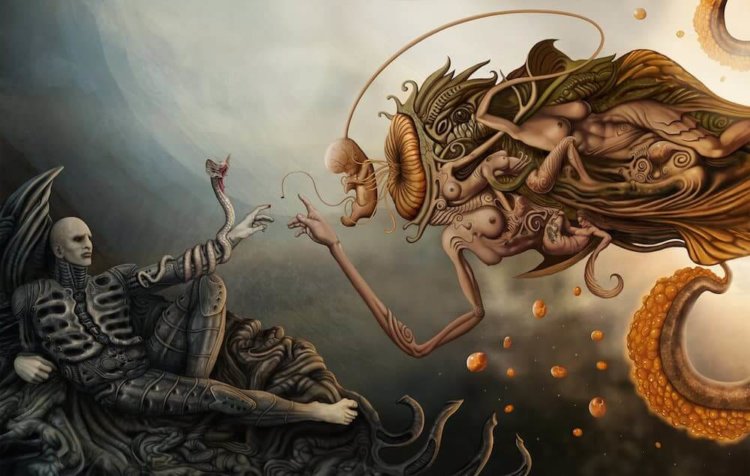
We find ourselves in a moment of time that is as much a mirror of a prior time as its extension, this prior time being the immediate wake of the Second World War. It was within the wake of this second catastrophic war that some of the greatest minds of a generation took stock of what had unfolded from their own homeland, which had left them homeless and estranged from what they had come to know and love. It was in this process of reflecting back that German-Jewish political philosopher Leo Strauss proclaimed within his work On Tyranny that it was the “experience of the present generation” that required and taught the need to read “the great political literature of the past with different eyes and with different expectations.”
For us, our time has now called upon us to undertake this same study, and if the extension we share with the generation of Strauss is mirrored in anyway, its mirrored in that we are looking forward to coming calamities instead of backwards upon them. In looking forward we must review and grapple with not only the great works again with new and clear eyes, but we must fold into that consideration the works of Strauss’s generation to understand our time and what we are truly on the cusp of. It’s within the passage of time and its extension of what our two generations share that the theoretical and technological horizons have expanded, for what was on the edge of the horizon or beyond then is now barring down upon us with an existential gravity of unprecedented proportions.
Twin Pillars and True Origins
In taking account of Strauss’s generation, it’s vital to begin with the fusion of ideas which flowed from the discourse of Strauss’s compatriots, Hannah Arendt and Eric Voegelin. It was Arendt’s 1951 The Origins of Totalitarianism that served as the most recognized work that sought to understand and define what had ruptured Europe so profoundly. What is most notable for our purposes in regard to Arendt’s Origins is the becoming of its 1958 second edition, which included as part of its new conclusion the chapter Ideology and Terror, which first appeared as an article she had priorly published back in July 1953. This additional chapter is essential, for while the initial main body of Origins masterfully details the historical-institutional lead up to and theorization of totalitarianism, it’s both the content and especially the development of Ideology and Terror in relation to Origins final chapters that is of timely relevance to us today.
Analytically, Arendt distilled totalitarianism down as a regime-type composed by two central pillars: terror and ideology. Stemming from the Hobbesian Commonwealths absolutist over-awing of all men, the most fundamental logic of totalitarian regimes is that the full deployment of a totalizing terror is not to eliminate and destroy all opposition, but of the rule of terror itself, as “[T]error… is the very essence of its form of government.” Opposition is only “the last impediment to its full fury” towards the full application of such a totalizing terror, which seizes and captures all of society in its arbitrary clutches, as the means to its ultimate end.
It’s this deployment of total terror through the destruction of all opposition that serves to obtain the domination of all it comes over. This total domination “strives to organize the infinite plurality and differentiation of human beings as if all humanity were just one individual,” where all individual spontaneity is destroyed to form a unitary-collective mass that the state rules over and organizes under the banner of its ideology. It is only through the complete annihilation of all spontaneity, dignity, and the complete control of all aspects of man’s life that this total domination can be cemented and secured, and it’s through the total fury of terror that this process is achieved.
This process of total domination through total terror is the means to the final ends of achieving the second pillar of ideology, which serves as its teleological supersense or the “key to history,” proclaimed by the “law of movement.” This movement, whether it be the Third Reich’s racial attempt to create the Aryan Master race or the USSR’s Hegelian, dialectical goal of global communist victory, is the directing light of totalitarian regimes that its elites and mass citizens are to be indoctrinated and terrorized over for its enactment.
As Arendt notes, both of these movements are underpinned by the Darwinian notion of evolutionary progress found through the survival of the fittest, in this case of the strongest and most righteous ideology and civilization towards the conquest of the world. This evolutionary law of movement is the grand-teleological goal that defines and operates all totalitarian regimes, with it being the ultimate and destined culmination of worldly and human history. Totalitarianism’s goal then is to not only transform human nature itself in pursuit of the grand law of movement, but the complete transformation of the human species “into an active unfailing carrier of a law that human beings would otherwise would only passively and reluctantly be subjected.” The essence-form of totalitarian regimes given this can be delineated as tyrannical ideocracies, driven by total state terrorism towards its ideological-teleological goal, or given this teleological-ends orientation, as a state-terror driven teleocracy.
The ideological grand movement then is the promise of delivering all of humanity unto the final golden epoch of world-evolutionary history, with terror acting as the “realization of the law of movement; its chief aim is to make it possible for the force of nature or history to race freely through mankind, unhindered by spontaneous human action.” Terror serves then as executor of the grand movement towards the “fabrication of mankind,” in which the individual is destroyed for the sake of the species, so that the human condition can be transformed and delivered upon a teleological new world order.
In the wake of World War II, Arendt saw human nature itself as being at stake within these new and deeply troubling forms of governance. But while it is one thing for a single nation to descend into the hell of totalitarianism, Arendt keenly notes that totalitarianism cannot stop within a single nation-state. Totalitarianism must strive towards not only the complete remodeling of humanity, but that doing so requires world domination and subjugation of all the inhabitants of the earth. In achieving this, totalitarian regimes must protect against not just foreign conquest but the alternative realities of rival ideologies, as they must be on constant guard against reversals of their positions and stances of strength both geographically and in the minds of those who fall under their rule. Consequently, offense becomes the best defense for totalitarian regimes against every form of opposition on the world stage.
In switching to its genesis, Ideology and Terror built upon Origins closing chapters and further emerged out of a November 1950 lecture by Arendt at Notre Dame. This was followed by the exchange of letters between Arendt and Voegelin that began in March 1951 after the initial publication of Origins, which culminated in Voegelin’s own review of Origins and Arendt’s reply in January of 1953 in The Review of Politics.
In giving credit to Arendt’s historical approach, Voegelin lays a first and softer critique in pointing out the personal and trauma-based motivations of Arendt’s work, which Voegelin feels “leads to a delimitation of the subject matter,” or an overall lack of analytical, theoretical unity. Arendt responded in kind to this by directly stating the intention of her method was to destroy, not conserve, totalitarianism as a political phenomenon. From this intention her method sought to analyze and discover the basic elements of totalitarianism, limiting this endeavor the relevant historical frames of analysis. Upon this Arendt gives a vital admission in that her work did not “really deal with the ‘origins’ of totalitarianism – as its title unfortunately claims – but gives a historical account of the elements which crystallized into totalitarianism, this account is followed by an analysis of the elemental structures of totalitarian movements and domination itself,” with this elementary structure of totalitarianism and its central concepts being the respective structure and red thread of the book.
This gives a key insight into where Arendt was coming from both in terms of intention and direction, for her historical approach is not only potentially liable to being not extensive enough, but leads to the very admission that a more apt title of her work might have been The Elements of Totalitarianism rather than its true origins, marking the point in which expanded analysis and assessment of the full essence of totalitarianism is placed and can be started upon.
Voegelin presses the matter from here, in that while he finds Arendt’s work to be characterized by profound theoretical insights, he finds her final analysis flawed by the “intellectual confusion” of their age and of political science in general due to the influences of positivism and historicism, which leads to an inconclusive “flatness.” It’s this flatness that derails the full accounting of the consequences of her most profound insights on the true essence and origins of totalitarianism, which is teamed with a fatalism that treats man and his actions as nearly entirely predetermined by situational circumstance.
With this, the crux of Voegelin’s critique rests upon Arendt’s understanding that modern masses have lost faith in the Last Judgement, and with it the worse of humanity have lost their fear of divine punishment and the best have lost their hope of divine jubilation and salvation. Consequently, with the masses unable to live without these fears and hopes, they are “attracted by every effort which seems to promise a manmade fabrication of the paradise they have longed for and of the hell they had feared. Just as the popularized features of Marx’s classless society have a queer resemblance to the Messianic Age, so the reality of the concentration camps resembles nothing so much as mediaeval pictures of hell.”
Voegelin pounces upon this for it strikes at the very modern Gnostic immanentism that his The New Science of Politics details and denounces as the source of the poisonous putrefaction within Western civilization that threatens to destroy the rest of the body of humanity. It’s the social utopianism of Gnostic immanentism which Voegelin held as nothing more than a spiritual disease, ailing the modern masses and all modern ideologies ranging from Liberalism, Communism, and Nazism, with the “man-made paradises and man-made hells” being its ultimate symptom.
Voegelin launches into a full-frontal critique here, permitting the necessity of quoting him in whole:
If the spiritual disease is the decisive feature that distinguishes modern masses from those of earlier centuries, then one would expect the study of totalitarianism not to be delimited by the institutional break down of national societies and the growth of socially superfluous masses, but rather by the genesis of the spiritual disease, especially since the response to the institutional breakdown clearly bears the marks of the disease. Then the origins of totalitarianism would not have to be sought primarily in the fate of the national state and attendant social and economic changes since the eighteenth century, but rather in the rise of immanentist sectarianism since the high Middle Ages; and the totalitarian movements would not be simply revolutionary movements of functionally dislocated people, but immanentist creed movements in which mediaeval heresies have come to their fruition. Dr. Arendt, as we have said, does not draw the theoretical conclusions from her own insights.
Arendt pushed back on this in defending liberalism, positivism, and pragmatism, specifically by noting “liberals are clearly not totalitarians,” even if liberalism and positivism share in essential ideas or “lend themselves to totalitarian thinking,” which itself requires drawing sharper analytical distinctions to define such affinities between liberalism, positivism, and totalitarianism. This matter is beyond Arendt’s scope and method, which is openly focused upon “facts and events” rather than the “intellectual (i.e. philosophical) affinities and influences” underpinning the true nature and origins of totalitarianism, and what those relational origins may have with liberalism.
This then serves as a pivotal point of the debate and understanding, for Arendt concedes here that potentially some of these element’s stem farther back than from where her own analysis begins, and along dimensional lines not captured in her work entirely, that being of philosophical and spiritual origins. Before embarking on that extended study, its greatly worth considering the rest of Arendt’s and Voegelin’s exchange, as it continues to strike at the core of the matter further and in doing so pinpointing the ideas and direction that extended study needs to take.
Much in the flat-derailing manner characteristic of her style, Arendt seeks to disagree and respond on the spiritual disease ailing the modern masses. Arendt brings forth her existential theory of modern mass superfluity, which is central to her wider social theory of totalitarianism, in that the modern masses are distinguished from the masses of prior centuries in that:
[T]hey do not have common interests to bind them together nor any kind of common ‘consent’ which, according to Cicero, constitutes interest, that which is between men, ranging all the way from material to spiritual and other matters. This ‘between’ can be a common ground and it can be a common purpose; it always fulfills the double function of binding men together and separating them in an articulate way. The lack of common interest so characteristic of modern masses is therefore only another sign of their homelessness and rootlessness.
Even with her brief mentioning of spiritual matters being an important source of common interests and purpose, Arendt gives little deeper consideration of this and instead goes on the attack to reject the notion that totalitarian movements ought to be interpreted as substitutes for the loss of prior traditional beliefs. Arendt holds that there is “no substitute for God in the totalitarian ideologies… More than that, the metaphysical place of God has remained empty,” from which she denounces such “semi-theological” arguments of indulging in “strictly blasphemous modern ‘ideas’ about a God who is ‘good for you’- for your mental or other health, for the integration of your personality and God knows what – that is ‘ideas’ which make of God a function of man or society.”
That this latter point is of semi-Platonic, Stoic, and virtue-based origins escapes Arendt, and serves as a provoked example of the very flatness that Voegelin charges of Arendt’s general method of analysis and writing. This is a matter that Arendt would continue to wrestle with, with her chapter expansion Ideology and Terror building from this debate to encapsulate the idea that totalitarian ideologies and their law of movement essentially act as a secular migration of the holy from theology to ideology. In this, a microcosm to macrocosm relationship is formed through the fabrication of the individual towards the end of totalitarian world domination, a notion that directly mirrors Voegelin’s gnostic immanentism:
The rulers themselves do not claim to be just or wise, but only to execute historical or natural laws; they do not apply laws, but execute a movement in accordance with its inherent law. Terror is lawfulness, if law is the law of the movement of some suprahuman force, Nature or History. Terror as the execution of a law of movement whose ultimate goal is not the welfare of men or the interest of one man but the fabrication of mankind, eliminates individuals for the sake of the species, sacrifices the “parts” for the sake of the “whole.” The suprahuman force of Nature or History has its own beginning and its own end, so that it can be hindered only by the new beginning and the individual end which the life of each man actually is.
That such total state terrorism seeks to dominate and fabricate man and mankind for the sake of the whole is a dark inversion of Aristotle’s teleological and organic conception of the whole being prior to its parts, with the whole being the final sacred kingdom that champions itself as the natural evolutionary end of history.
This is an issue that was present in the first edition of Origins and is one that Voegelin has the sharpest and pronounced reactions to, upholding Arendt’s following analysis as some of her most profound yet directionally surprising, quoting her directly that
“What totalitarian ideologies therefore aim at is not the transformation of the outside world or the revolutionizing transmutation of society, but the transformation of human nature itself… Human nature as such is at stake, and even though it seems that these experiments succeed not in changing man but only in destroying him . . . one should bear in mind the necessary limitations to an experiment which requires global control in order to show conclusive results.”
This line of thought is one that Voegelin “could hardly believe” his eyes over in reading, as it smacks against his Aristotelian conception of nature via essences and subsequently human nature, specifically that of a “thing as a thing” and that such natures cannot be changed or transformed, and the attempt to do so is a “contradiction of terms” that only results in the destruction of that thing. As Aristotle says directly in Politics, “All things derive their essential character from their functions and their capacity; and it follows that if they are no longer fit to discharge their function, we ought not to say that they are the same things, but only that, by an ambiguity, they still have the same names.”
To pretend otherwise is to confuse the procedural-means of transformation or alchemical transmutation with the end result-goal itself, which in destroying the original essence of man, creates a new post-essence, not a trans-essence, a vital metaphysica matter that will be returned to in due time.
This issue for Voegelin is the very “essence of totalitarianism as an immanentist creed movement,” as it seeks not to resolve social problems or evils by industrial and social planning, but upon the migration of the holy through creation of a new millennium in an eschatological sense. Upon this the ultimate goal is the “transformation of human nature” upon a dominated planet, perverting the Christian doctrine of transcendental salvation into heaven through the grace of God, into an immanent perfection of man through the acts of man himself.
Voegelin holds this central idea that the nature of man needs changing or transforming as a key symptomatic intellectual breakdown of modern western civilization itself. He then accuses of Arendt in sharing this primary immanent premise that the nature of man can be changed, and that it’s just a matter of a totalitarian regime taking total control of the globe to successfully implement such a radical transformation of the human condition entirely.
Arendt gives a final defense against this in clarifying against a misunderstanding of Voegelin’s, in that she proposes no more possible change or transformation of human nature than what the experiments of totalitarian domination threaten in the prospect of man losing his own soul from it. Consequently, totalitarianism poses the radically novel threat of liquidating “freedom as a political and as a human reality than anything we have ever witnessed before,” and it’s hardly a comforting proposition that either the nature of man is transmutable after all or that freedom isn’t an actual fundamental characteristic of the human condition itself. For Arendt, we only “know of man’s nature insofar as it has existence, and no realm of eternal essences will ever console us if man loses his essential capabilities.”
This is the essential threat of totalitarianism for Arendt, as it serves as the world-historical force that threatens the complete destruction of human nature itself, and with it the extermination of freedom both as an ideal and as socio-political, existential reality. One may wager that these both go hand in hand together, rather than making a distinction between them.
This review brings us towards two analytical points that provides the opportunity to reach for further theoretical inquiries, much as Voegelin sought in tracing “the genesis of the (totalitarian) movements through the course of a civilization that has lasted for a millennium.”
Firstly, Arendt’s method focused upon only a limited investigation of historically relevant facts and events, whose final coalescence crystalized into totalitarianism as a new political phenomenon. Voegelin’s analytical aim given this is to expand the breadth and vision of possible inquiry to grasp the true origins of the problem, and it’s his line of argumentation that these origins stem from a much older philosophical basis through the problematic metaphysics that underpins modern Gnostic Immanentism.
Secondly, Voegelin’s assessment of Arendt’s analysis resulting in a characteristic flat-derailment away from grappling with the consequences of her more profound insights is such an astute characterization that it’s of vital utility for our own analysis. That Arendt perpetuates this quirk in her own reply to Voegelin only reinforces its validity further, and subsequently begs the question of where else within Origins and other writings and lectures of hers that she makes this line of analytical derailment at the expense of full elucidation. Such analytical shortcomings and other gaps entirely omitted or not considered is prime for our own identification and inquiry, towards arriving at the true origins of totalitarianism, which Voegelin sought and has now helped on the most fundamental level in pointing towards.
The first central identifiable gap within Arendt’s theoretical framework is within the notion of the totalitarian transformation or fabrication of human nature upon a dominated planet. It’s through these two closely related potential developments that Arendt provides little insight into the exact technical means and feasibility of this, nor its deeper philosophical origins, both of which are of critical relevance to our contemporary situation and assessment.
While Arendt details that imperialism expanded the military and police powers of the European empires all across the world to protect the exportation and development of global capitalism, and while totalitarianism sought to completely unleash those administrative and economic forces both at home and abroad for total conquest, she not just neglected the technological dimension of this, but also the philosophical-historical core of what has enabled these techno-capital advances to become so monstrously unhinged and set free against the peoples of the earth and of the human condition itself. There is a demon in the machine here that must be put under closer scrutiny.
For our scrutinizing purposes, this neglect provides us with the rich opportunity to dive backwards into the genealogy of western intellectual and scientific-technological thought which Arendt entirely overlooks, from which a thread can be weaved back from the very beginning of modernity through the 20th century and our contemporary moment.
From this a most prominent analytical derailment arises, one being within Arendt’s own tracking of the intellectual history of ideas that underpin totalitarianism. In 1953 Arendt lectured upon this via a potential theoretical argument, which emphasized technology as such a key factor in the rise of totalitarianism, entailing that:
[t]echnology implies mastery over nature, that is a rule by violence. We violate nature and thereby the natural order of things. We do not longer know the natural order of things. This has come about through Plato. Realm of Ideas or God as transcendent yardstick implied negation of the earth, the will of power over the earth. We experience now a kind of revolution of the elements. Dieelemente sind mi tuns verschworen und suf Zerstorung lauft’s hinaus (The elements are conspiring against us, and destruction is inevitable). We fabricate everything and have for felted our earthly existence in the midst of of what was given to us.”
Arendt incurs another derailment by rejecting this technological argument as a fallacious one, instead upholding faith in homo faber – Man the Maker – by opting to argue along Hobbesian lines that without technology or “without fabrication, man cannot live. Technical development is a fact without which we would have the greatest catastrophe. To live in the midst of nature only savages do, and they are not human.” This is most striking, as it’s the very modus operandi of totalitarianism in that it seeks the fabrication of mankind towards its ideological goals. Would technology really not play a central role within this?
Arendt failed here to fully explore the full implications of this line of thought. Ultimately, Arendt’s deferment to the technological imperative of modernity through the mastery of nature is the central gap of her wider thesis, one that both neglects the genealogy of such an idea, and is further represented by the fact that the dimension of technology is entirely absent upon a close review of Origins. Bringing forth the question concerning technology into this gap is vital then in understanding the true origins and essence of totalitarianism, from which we can identify the threat vector that it may re-emerge from in the coming future.
Universal Enslavement and Dominion
In tracing the philosophical origins and genealogy of the idea of the technological mastery of nature for its relevance to the nature of totalitarianism, the gap that Arendt created here is made all the wider by the precarious nature of its origins in relation to Thomas Hobbes, whom Arendt roots her theory of imperialism and international relations upon within Origins. For while the “mastery” of nature was penned by Hobbes’ contemporary Rene Descartes within his Discourses, it was Francis Bacon whom Hobbes was the amanuensis of who first famously envisioned this idea within a scientific, technological context.
Bacon’s orientation was deeply defined by his post-reformation nominalism, humanism, and anti-Aristotelianism, a characteristic central in his realignment and assessment of the proper order of the arts, causes, and ends. For while Aristotle had proclaimed that all arts and techniques were means to the end of the wellbeing of the polis with nothing in excess, Bacon found his root in a defiance against the natural world for an advancement of the artificial, of the man-made, over what is natural, seeking ultimately to tame the very tyranny of nature itself and its environmental forces and laws towards human mechanizations and goals. It’s precisely upon this point that the natural order of things is violated, resulting in the alienation of man from it and the creation of a runaway machine of artificial development, all in a bid to emancipate man from the tyranny of the natural order.
It’s from this that Bacon in his later 1620 master work the New Organum that he proclaimed his mission, in that his new method of obtaining applicable natural knowledge was built towards the “relief of man’s estate,” from which the “enlargement of his power over nature” would be obtained and grown across generations. The new reductive-inductive method of instrumental empiricism that Bacon developed across his oeuvre aimed to join human knowledge with human power through the direct knowledge of efficient natural causes, without which effect cannot be controlled and reliably reproduced towards human ends.
Such a method he elsewhere described colorfully as the “Inquisition of Causes, and the Production of Effects; Speculative and Operative. The one searching into the bowels of nature, the other shaping nature as on an anvil” The operational uniting of human knowledge with human power for the relief of man’s estate within the New Organum falls all upon the gleaming and capturing of nature’s efficient causes, an operation that feigns an initial slavish obedience to nature, which is but a ruse to a decisive will of power over it. Bacon explained so that:
For man is but the servant and interpreter of nature: what he does and what he knows is only what he has observed of nature’s order in fact or in thought; beyond this he knows nothing and can do nothing. For the chain of causes cannot by any force be loosed or broken, nor can nature be commanded except by being obeyed. And so those twin objects, human knowledge and human power, do really meet in one; and it is from ignorance of causes that operation fails.
If followed through to fruition, the new method would place nature under mans “constraint and vexed; that is to say, when the art and hand of man she is forced out of her natural state, and squeezed and moulded,” as the means to ultimately endeavor to create the dominion of man over the natural world.
It’s this pursuit of establishing and extending this dominion that Bacon holds in the highest regard, above the ambitions of those who wish to extend their powers over their own country or that of their country over others, for “if a man endeavor to establish and extend the power and dominion of the human race itself over the universe, his ambition (if ambition if can be called) is without doubt both a more wholesome thing and a more noble than the other two. Now the empire of man over things depends wholly on the arts and sciences. For we cannot command nature except by obeying her.”
This strand of Bacon’s idealistic humanism goes back as far as his 1605 The Advancement of Learning, opening Book IV in declaring that his new method of natural philosophy would not summon man to quarrel, fight, and cut each other down, rather that it would lead to making of “peace between themselves, and turning with united forces against the Nature of Things, to storm and occupy her castles and strongholds, and extend bounds of human empire, as far as God Almighty in his goodness may permit.”
In his 1609 Wisdom of the Ancients, Bacon further utilizes ancient Western myths to better situate natural philosophy towards his overarching program and hopes. Most importantly, he invokes the Greek Sphinx and its deadly riddles as allegory for the unlocking of scientific knowledge and its technological applications, whose successful solving gives power and empire over either two separates by closely related domains, that of nature, and that of man:
All the riddles of Sphinx, therefore, have two conditions annexed, viz : dilaceration to those who do not solve them, and empire to those that do… Sphinx has no more than two kinds of riddles, one relating to the nature of things, the other to the nature of man ; and correspondent to these, the prizes of the solution are two kinds of empire, — the empire over nature, and the empire over man. For the true and ultimate end of natural philosophy is dominion over natural things, natural bodies, remedies, machines, and numberless other particulars… But the riddle proposed to Oedipus, the solution whereof acquired him the Theban kingdom, regarded the nature of man; for he who has thoroughly looked into and examined human nature, may in a manner command his own fortune, and seems born to acquire dominion and rule. Accordingly, Virgil properly makes the arts of government to be the arts of the Romans.
This further demonstrates and expands the gap in Arendt’s analysis. For while she built so closely upon Hobbes, we see here that Bacon within his own philosophical works had delineated a decade in advance of his relationship with Hobbes the nature of political science, towards the establishment of the dominion over men through the understanding of the nature of men, and set it aside against natural philosophy and its scientific knowledge-based dominion over nature. While the line of influence here cannot be drawn, it’s nevertheless clear that the later works of Hobbes were in effect the socio-political extrapolation of Bacon’s mission to dominate the natural world unto the social world of men, to quell the brutish and anarchic state of nature amongst men.
This finally leads to one of Bacon’s earliest and most obscure works, one which serves as the origin point and central essence not only for Bacon’s wider philosophical mission and the technological imperative that he would develop for the rest of his life, but also both for the greatest dreams and catastrophes for modern western civilization that came with it.
Left unpublished till after his death in 1653, this work is Bacon’s unfinished 1603 The Masculine Birth of Time, or THE GREAT INSATURATION OF THE DOMINION OF MAN OVER THE UNVIERSE. In Chapter 1, The Legitimate Mode of Handing on the Torch of Science, Bacon speaks to the audience as a father to a son receiving a great lecture, in which Bacon laments the sad state of European knowledge as being sandwiched between men of poor honor or duty, and of men of poor understanding, both of whom lack any true “art or precepts” in the production of public knowledge.
Bacon sets about to move on from these patterns of error in the giving of humanity a new method as the center of his program, one which radically sought to “come in very truth leading to you Nature with all her children to bind her to your service and to make her your slave… my only earthly wish, namely to stretch the deplorably narrow limits of man’s dominion over the universe to their promised bounds; as I shall hand on to you, with the most loyal faith, out of the profoundest care for the future of which I am capable, after prolonged examination both of the state of nature and the state of the human mind, by the most legitimate method, the instruction I have to convey.”
This binding enslavement of nature and all her children towards the universal dominion of man is the central method and mission of Bacon’s body of work, one that he rhetorically shifted on and toned down in his later works at the expense of later audiences grasping of what he truly was striving towards. This negative action of enslavement was only matched by Descartes more positive mastery of nature, which is reflective directly of Arendt’s adoption of this reconceptualization and her own acceptance of the technological imperative from it.
Fundamentally, this line of thought reflects Bacon’s biblical conception of nature being of a fallen, tyrannical, or even evil order as a consequence of man’s fall and banishment from the Garden of Eden, a state of affairs Bacon’ sought to overturn through the “instauration” (Latin instauratio) of man’s holy dominion over the universe as once was before the Fall.
It’s worth considering that Bacon launches this radical program within Chapter 2 through a complete assault on many of the philosophers preceding him. He begins with an attack on Aristotle, declaring him as the worse of all sophists, who “composed an art or manual of madness and made us slaves of words… it was his bosom that were bred and nurtured those crafty triflers, who turned themselves away from the perambulation of our globe and from the light of nature and history.”
He declared Plato a deluded theologian, whose philosophy “was but scraps of borrowed information polished and strung together… By your vague inductions you took men’s minds off their guard and weakened their mental sinews.”
Bacon continues this assault against those ranging from Galen the physician to Paracelsus the alchemist, to Epicurus for his sacrilegious mixing of the natural with the divine, and to Hippocrates as nothing but a puffer of ancient wisdom, an authority Galen and Paracelsus used to take cover under, an authority that Bacon held to be no more than the shelter of an ass.
These vicious attacks, amongst several more, act as Bacon’s attempt to break with the tradition of the past that he viewed as not just unproductive, but as antagonistic to the advancement of mankind’s knowledge and dominion over nature and the universe. Bacon seeks to avoid these errors and the idle study of ancient literature for the continued preparation of “things useful for the future of the human race,” in which he seeks to derive science from the light of nature, which is absent from the darkness of antiquity, as “our business is to see what can be done.” He wishes to not spend too much effort and time upon the refuting the likes of Aristotle and Plato individually much less the entire Scholastic tradition that followed them, deeming in the most self-ironically Platonic of terms that it would be a sin “on the grand scale against the golden future of the human race, to sacrifice its promise of dominion by turning aside to attack transitory shadows. The need is to set up in the midst one bright and radiant light of truth, shedding its beams in all directions and dispelling all errors in a moment.”
Bacon concludes this unfinished manuscript with a profoundly utopian yet modern vision as the grand goal of his philosophy, one brimming with the nascent idealist hope of establishing a universal society of humanity. It’s this grand telos in which his program and method is meant to unite humanity “with things themselves in a chaste, holy, and legal wedlock; and from this association you will secure an increase beyond all the hopes and prayers of ordinary marriages, to wit, a blessed race of Heroes or Supermen who will overcome the immeasurable helplessness and poverty of the human race, which will cause it more destruction than all giants, monsters, or tyrants, and will make your peaceful, happy, prosperous, and secure.”
This universal vision of Bacon not only radically breaks with the classical cyclic view of history via a scientific-technological progressivism, but it embodies within in it the very symbols and ideas of history Voegelin identified as characterizing the philosophy of Joachim of Fiore. We see within Bacon not only the prophet of a new age, but that this new age would lead to a final realm of human civilization built upon the “brotherhood of autonomous persons,” freed from the gnostic tyranny of nature that Bacon identified as stemming from man’s fall from the Garden of Eden. And much as Joachin built upon the Chistian notion of the transcendental immanentization of meaning the towards a state of perfection at the “end of history,” Bacon secularized and immanentized this progressive idea into the direct domain of Augustinian “profane” worldly history, having done so a century earlier than Voegelin himself identified the commonality of such an idea in the 18th century.
The issue with the immanent progressivism of Bacon though is a matter of the demon in the machine that’s mobilized by the technological imperative. This demon is exposed by Bacon’s choice words in that his methods expansion of the dominion of man over the universe is one that would enslave nature and all of its children for its obtainment. Having been uttered within a limited biblical-creationist horizon, such rhetoric within a post-Darwin evolutionary context quickly lends itself to the logical consequence that man himself may come under the machines domineering sway, as it slips off the tracks of control towards a new horizon of runaway autonomous techno-capital development.
Given this, that all the forces of the natural world must be enslaved for the theoretical obtainment of the society of the Superman brings to light the folly of Arendt’s deferment to the technological imperative. It’s Bacon’s program that sought a respective proto-Nietzschean and Heideggerian Will to Power and Enframing over the natural world that was quickly expanded by Hobbes onto the social domain of men. Weimar and Third Reich legal theorist Carl Schmitt brilliantly observed in his works on Hobbes that it was his Leviathan as the great artificial man that served as the first machine of the modern-technological age, in that
“[t]he state that arose and succeeded on the European continent in the seventeenth century was a product of man and was distinct from all earlier forms of the political unit. The state can be viewed as the first product of the technical age, as the first modern mechanism on a large scale, or in the apt formulation of Hugo Fischer, as the ‘machina machinarum.’ With its development there emerged the essentially intellectual or sociological precondition for the technical-industrial age that was to ensue. By then it had become apparent that the state itself was the typical or even the prototypical work of the new age.”
We see from here that it’s Bacon’s technological imperative as founded upon the enslavement of the natural world that imperial economic and political expansion would be driven towards the ends of the world, while totalitarian state power would be unleashed in a total ideological terrorism upon all individuals under its influence. Ultimately, totalitarianism was the gnostic turning against humanity of the technological and now ideological imperative, which had already triumphed over the natural world and all its forces, flora, and fauna.
What Arendt flatly took for granted then is the true genesis point of the pure power and historical technological progressivism that enabled in the first place the rise of totalitarianism, which itself serves as the logical yet hidden telos of modernity. Without the quest to enslave nature for the supposed wellbeing of mankind, there is no obtaining of a final great ideological end in which secular man is satisfied one way or another at the end of history. The tragedy arises from this in that the very thing that was meant to emancipate man from the tyranny of nature only enslaved and tyrannized him further. It’s from this sad state of affairs that the great war of the Soviet and German ideological empires occurred, as their machina machinarum were unleashed unto a totalitarianism rampage that massacred millions last century. But even in their military defeats and eventual exhaustion against the united front of western imperialism in the Cold War, the stage was laid and the seeds for the next generation of totalitarianism were planted within it.
The Final Revolution and War Upon the Coming Titan
Where the logic of Bacon’s program of enslavement and dominion begins to fully shine is within the joint works of Carl Schmitt and Leo Strauss. It’s within Schmitt’s most well-regarded work The Concept of the Political via its 1929 expansion The Age of Neutralizations and Depoliticizations that Schmitt lays his critique against the depolitization of the state by the “technicity” of technology, a matter he saw as having defined the threat posed by the Soviet Union on the rest of Europe, and as of having engrossed the intellectual milieu of the time under the “irresistible” yet soulless mechanization of technology.
It was the hopeful Baconian belief of the time that Schmitt identified in that technology would provide the final neutral domain to put aside conflict and strife towards un-political (i.e., no tension and war spawned by friend-enemy distinctions) technical progress, which by the 19th century and Schmitt’s time had advanced towards an
“astonishing rate, even as did social and economic situations as a consequence, that all moral, political, social, and economic situations were affected. Given the overpowering suggestion of ever new and surprising inventions and achievements, there arose a religion of technical progress which promised all other problems would be solved by technological progress. This belief was self-evident to the great masses of the industrialized countries. They skipped all intermediary stages typical of the thinking of intellectual vanguards and turned the belief in miracles and an afterlife—a religion without intermediary stages—into a religion of technical miracles, human achievements, and the domination of nature. A magical religiosity became an equally magical technicity. The twentieth century began as the age not only of technology but of a religious belief in technology.”
The centrality of technology is found upon the notion that all other problems may be resolved through technical means, making all other matters secondary under the march of the technological imperative of modernity that had enveloped Europe by this time. It’s the recession of all other domains and issues of life towards technological progress that Schmitt aims to critique here, and it’s upon the augmented Baconian notion of the domination of nature deployed here that the false faith of technicity is animated.
For while technology is the seemingly final neutral domain of modernity, Schmitt keenly pinpoints that the political impact of technological advancement can never be fully anticipated, for not only is technology available towards the deliverance of both war and peace and their intensification, different epochs of technical advance produce far different socio-political outcomes. Where the advances of the 15th and 16th centuries produced liberating and rebellious developments, the advances of Schmitt’s time produced the means towards the large-scale mass domination of the masses.
Consequently, Schmitt deems it that the neutral stance of technology between the potential of liberation and domination entails central political questions and answers cannot be properly drawn from a technologically centered perspective. Schmitt climaxes upon this matter in that the century of technology that he (and for that matter, us) inhabited will be understood and defined by “which type of politics is strong enough to master the new technology and which type of genuine friend-enemy groupings can develop on this new ground.”
Schmitt concludes by encapsulating the essence of the technological drive of modernity that he denoted by the term technicity, and by doing so giving a full re-construction of the philosophical mission first found within the works of Bacon, a mission that in the end turns on man:
The spirit of technicity, which has led to the mass belief in an anti-religious activism, is still spirit; perhaps an evil and demonic spirit, but not one which can be dismissed as mechanistic and attributed to technology. It is perhaps something gruesome, but not itself technical and mechanical. It is the belief in an activistic metaphysics—the belief in unlimited power and the domination of man over nature, even over human nature; the belief in the unlimited “receding of natural boundaries,” in the unlimited possibilities for change and prosperity. Such a belief can be called fantastic and satanic, but not simply dead, spiritless, or mechanized soullessness.
Schmitt here breaks down the artificial distinction Bacon made between nature and man, in that the Baconian will to power for the enslaving domination of nature cannot and will not stop at the gates of humanity. If this drive to domination is truly unlimited, the potential forces and powers locked away within the very essence of man must be broken down and enslaved themselves.
It’s here that Strauss finally enters the equation, as Strauss had read and given notes on The Concept of the Political, which Schmitt in turned used to generate its later editions. Subsequently, Strauss elaborated upon this issue and tweaked the rhetoric in his later works for decades to come, having first built upon Schmitt in his 1948 On Tyranny. Within it, Strauss established the contradistinction between natural-classical and unnatural-modern tyranny (i.e., totalitarianism), the latter of which being characterized by ideology and technology, which is empowered by a modern conception of science predicated upon “the conquest of nature.” Strauss builds upon this tweaked echo of Schmitt towards a full referential parallel, from which Strauss gleams the crisis of our time, in that “[w]e are now brought face to face with a tyranny which holds out the threat of becoming, thanks to the ‘conquest of nature’ and particular human nature, what no earlier tyranny ever became: perpetual and universal.”
It was Strauss’s aim within On Tyranny to establish a study of the classical notion of tyranny as a means to better understand its modern iteration, a study he didn’t limit to this single work. It was within his most well-known 1953 work Natural Right and History that Strauss builds upon On Tyranny in establishing what separated classical tyranny from its modern iteration.
Strauss advances this matter as part of his attack upon historicism, in which he uses the historical-theoretical horizons of Aristotle as an example. For while it was possible for Aristotle to conceive of the injustice of slavery, the conception of a world state was not possible due the classical conception of science as both purely theoretical and morally-politically controlled and limited to final moral-virtuous ends. The reason that the potentiality of a world state wasn’t conceivable to Aristotle was that he understood that such a potentiality would require a new science unhinged from such classical theoretical limits and ethical controls, and it’s precisely the new science of Bacon and the Enlightenment that radically rejected such limitations and controls, a rejection that lowered the goal of final ends for the actual obtainment of a universal dominion of affluence through the enslaving-conquest of nature.
In reiterating his paralleling echo of Schmitt, Strauss held that this world state required a new epoch of technological development, one based upon a new science devoted towards “the ‘conquest of nature’ and that technology be emancipated from any moral and political supervision.” This emancipation of science and technology from pure theoretics and moral-political control Strauss concluded “would lead to disastrous consequences: the fusion of science and the arts together with the unlimited or uncontrolled progress of technology has made universal and perpetual tyranny a serious possibility.”
It’s this striking theorization that Strauss leveraged against Alexandre Kojeve’s response to On Tyranny via his essay Tyranny and Wisdom, in that Kojeve’s Hobbesian-Hegelian universal homogenous state would enable the rise of an unwise, totalitarian Final Tyrant, whom would bring an end to philosophy itself as a means to protect against philosophical cunning and revolution. Strauss finishes his response to Kojeve in elaborating on this in that:
From the Universal Tyrant however there is no escape. Thanks to the conquest of nature and to the completely unabashed substitution of suspicion and terror for law, the Universal and Final Tyrant has at his disposal practically unlimited means for ferreting out, and for extinguishing, the most modest efforts in the direction of thought. Kojève would seem to be right although for the wrong reason: the coming of the universal and homogeneous state will be the end of philosophy on earth.
Strauss details here the fundamental domain in which the totalitarian machina machinarum of his generations time sought to enslave, dominate, and conquer the social nature of man through ideologically driven, socio-political terrorism. This process is but the second generational iteration of Bacon’s technological imperative to enslave the natural world for foolhardy reasons, the most brutal manifestation of the solved riddle of the Sphinx towards establishing the empire over men in the wake of the establishment of the empire over nature.
Strauss didn’t finish his exploration of this matter within Natural Right and History, for he opened the first pages of his 1963 City and Man with a meditation that strikes at the taproot of both the crisis of the modern West and the origins of totalitarianism. It’s here that Strauss identifies that the crisis of the West lays in it becoming uncertain in its purpose, reflecting a bewildering loss of faith in the vision of the “modern project” obtainment of “its future as the future of mankind” upon a universal society and state. It was this vision in which the modern West supplanted the prideful and contemplative nature of classical political philosophy with one that is charitable and active, an activity animated by and towards the Baconian “service of the relief of man’s estate; it was to be cultivated for the sake of human power; it was to enable man to become the master and owner of nature through the intellectual conquest of nature.”
It was this striving towards a universal human society of free and equal individuals that the West embarked upon as the modern project, a goal that was shared between the Western capitalist movement and that of Communism. But for what they shared in common, their differentiation over degree and means broke the back of the higher vision itself, for the totalitarian tendency of Communism arose from its pursuit of “the common good for the human race,” a goal which as the “most sacred thing, justifies any means; whatever contributes to the achievement of the most sacred end partakes of its sacredness and is therefore itself sacred; whatever hinders the achievement of that end is devilish.” This difference over degree and means was one which concerned ethics, and as a consequence pitted the Western capitalist movement against that of Communism, a contradictory antagonism that created the central loss of faith and crisis of the West, for it nullified the goal of the universal society thanks to its maintenance of self-preserving particular societies, while sullying the hope that man may rationally leave behind his malice and the need for societal coercion.
The fragmentation of this great civilizational quest between its Western capitalist and Communist branches however is underpinned by its greatest danger, one rooted within the activist Baconian method and mission. The modern project sought first and foremost to satisfy the natural needs of men, in which “nature was to be conquered for the sake of man who himself was supposed to possess a nature, an unchangeable nature… After some time it appeared that the conquest of nature requires the conquest of human nature hence in the first place the questioning of the unchangeability of human nature: an unchangeable human nature might set absolute limits to progress.”
Strauss warned from this that modern science, in radically expanding the powers of man, could still not teach virtue and wisdom thanks to the fact-value distinction at the center of positivism, a problem that those still faithful to technicity foolishly believe would be resolved once social sciences and psychology caught up to the natural sciences. Such a development though would not close the gaps between facts and values, instead it would merely “bring about a still further increase of man’s power; they will enable men to manipulate man still better than ever before; they will as little teach man how to use his power over man or non-man as physics and chemistry do.”
This marks fully within the thought of Strauss the turning point in which the very thing meant to emancipate man turns against man, for the conquest of nature and the technological imperative it fuels is a naturally unlimited universal conquest, one that must and will attempt to besiege the supposed limits that the nature of man places upon it. For how could it not, especially when theoretical and ethic restraints have been thrown off? Human nature by its very nature is an extension of nature. Our evolutionary forebearers were born within it and molded by the natural forces of evolution, with every part of our bodies, brains, and nervous systems still defined by these ancient origins. The classical telos of the flourishment of human excellence through virtue and justice is ruptured and replaced by the necessity of the technological imperative, which will strip humanity down to its bare bones, neurons, and genetic code, towards a new form and resultant telos that the assumed unchangeable nature of man is but an impediment to. If the tyranny of nature is to be fully overcome given this, its residues with human nature naturally must be scrubbed off and a new being formed.
The term “transhumanism” maliciously confuses this matter, as it conflates the process with the end result itself, as not only is the process of transformation one which destroys the initial essence, but it’s one that serves to enslave the new essence under the regime of technicity rather than to emancipate it from the supposed tyranny of nature. Transhumanism fundamentally has within it a deep-seated misanthropy that it disguises with a false appeal to a final liberation upon a final act of man himself. Given the actuality of this posthuman worldview and metaphysic, humanity itself may become the ultimate thing in the way of the obtainment of the unified world state.
Strauss began this meditation upon this matter and the wider loss of faith in the modern project with a critique of Oswald Spengler’s thesis regarding the decline of the West, for any such decline is conflicted by the potentially infinite drive of the scientific-technological imperative:
We may therefore say that Spengler’s analysis and prediction is wrong: our highest authority, natural science, considers itself susceptible of infinite progress, and this claim does not make sense, it seems, if the fundamental riddles are solved. If science is susceptible of infinite progress, there cannot be a meaningful end or completion of history; there can only be a brutal stopping of man’s onward march through natural forces acting by themselves or directed by human brains and hands.
This point brings us to the final crisis of modernity and form of totalitarianism, upon the ideological auspices of posthumanism. For while Strauss gleamed the essence of first-generation totalitarianism, and that advances within the social sciences and psychology would enable further unparalleled totalitarian social domination, scientific advancement since his time has opened the door to both to the abolition of human nature itself from within and without, and totalitarian world domination upon and through it.
It’s from the endogenous within via biotechnology and genetic engineering that the prospect of neo-eugenics has arisen, entailing that the next step in biological evolution itself can be engineered and pushed forward this century by the augmentation of intelligence, strength, and physicality. Such a realizable potential elevates the stakes of what is unfolding before us, as it brings forth the next great evolutionary struggle within the billion year-long story of life on earth. It was Francis Fukuyama’s fear of this within his 2001 Posthuman Future that the liberal end of history would be supplanted by such a revolution in both genetic engineering and knowledge of the brains neuro-architecture and behavioral correlates, which would enable the creation of a new global caste system, and with it the potential of catastrophic social strife and war.
Such technologies under a posthuman totalitarian regime would have the means to triumph on the most fundamental level where its predecessors lacked and failed, and in doing so would achieve the destruction of the essence of humanity that Voegelin balked at within his retort to Arendt’s central claim, in that the transformational-fabrication of humanity itself is the ultimate aim of totalitarianism. In fact, within such a radically evolutionary context, the essence of humanity itself is the final great road block between the techno-eschatology of posthumanism and its new telos at the sacred true end of history. Any and all means would be justified in the annihilation of this supposedly obsolete obstacle in the way of the obtainment and immanentization of a posthuman-totalitarian world imperium.
This applies just as much to the matter of posthuman totalitarianism from the exogenous without, in which entirely non-human technical artifices themselves become a new autonomous form of being within our world. The most immediately obvious vector of this comes from Artificial Intelligence, in which the entire future of the global economy and international competition rest upon currently. While the looming specter of mass AI economic automation comes closer and closer, the prospect that it’ll also be tightly integrated into national and global governance-military systems and institutions entails that the machina machinarum of the Leviathan itself would become animated by a Luciferian, even satanic spirit, which would preemptively surveil and dominate all under its sovereignty and pseudo-Godly judgement. Such an inspiriting will be intertwined with advances within robotics, with embodied AI within humanoid robots entailing the coming of the Maschinenmensch, representing the final physical eclipse and usurpation of the human form and the natural spirit that endows us all.
This augmented inspiriting of the Hobbesian Leviathan demands for it a new name, one it’s most deserving of: Titan.
Even with the potentially disastrous implications of either these two revolutionary routes, the greatest threat lies in the merging of that which is within and without. From which, a symbiosis would be struck between the biological and artificial, enabling the arrival of entirely synthetic life and the creation of a positive feedback loop out of their respective strengths and powers. Such a nexus between domains would be the final revolution in world affairs, resulting in a titanic new world order that would quickly seek to conquer and triumph over the rest of the planet from where it finds its initial strongholds within.
It’s incredibly hard to foresee what room, if any, there is for humanity in these three revolutionary routes. Each of which threaten the very essence of our humanity through its direct enslavement. It’s this factor that the greatest act of mass dehumanization looms, a factor that Martin Heidegger captured perfectly within his seminal essay The Question Concerning Technology: “The threat to man does not come in the first instance from the potentially lethal machines and apparatus of technology. The actual threat has already affected man in his essence. The rule of Enframing threatens man with the possibility that it could be denied to him to enter into a more original revealing and hence to experience the call of a more primal truth.”
Short of an omnicidal extermination of the human race at the hands of any of these revolutionary routes, the greatest tragedy from all this would be that man would be denied a greater, more authentic understanding of himself as a result of the very technicity built up to emancipate him and reveal to him the wider workings of his world. The quest of philosophy would result then in a final, profound cosmic terror. Perhaps extinction would be preferable.
Whatever fate may be destined for us, there is an element to the thought of Schmitt that gives us theoretical agency in the trials ahead of us all, in a manner he couldn’t have possibly foreseen. It’s from his insight that technology is not of a truly politically neutral domain that a new politics would be needed in mastering its onwards march, which naturally entails the founding of a new and genuine friend-enemy distinction to fuel and drive the resultant political struggle.
A great irony arises from this in that Schmitt brought forth as a criticism of humanitarianism and pacifism the idiom expressed by Proudhon in that “whoever invokes humanity wants to cheat,” for traditionally those who deemed themselves to be carrying the banner of humanity deemed those to be their enemies to be anti-human, worthy of the most savage and repressive acts of warfare. It’s given this that Schmitt exposed the absurdity of what used to lay at the center of those who proclaimed humanity for themselves, in that the very “concept of humanity excludes the concept of the enemy, because the enemy does not cease to be a human being—and hence there is no specific differentiation in that concept.” Because of this, Schmitt divined that “Humanity as such cannot wage war because it has no enemy, at least not on this planet.” Short of an alien invasion, the concept of humanity has been a politically vacuous concept of political authenticity and true activism – that is, until now.
What’s been genealogically studied here is that posthumanism is not only the true ideological heir to totalitarianism, but that it serves as a final evisceration of technic political neutrality. Consequently, if the Titan begins to crown and rear its head upon the earth, it will provoke the ultimate friend-enemy distinction and a resultant final global war between it and humanity. The question that concerns us most is if a new politics and related movement can be founded to prevent such an emergence event, and if not, what if any human political order will remain in the wake of the final revolution and the war to end all wars. These matters represent the quintessential challenge and purpose of our generation.


Related Posts