Chekhov and the Literature of Possibility
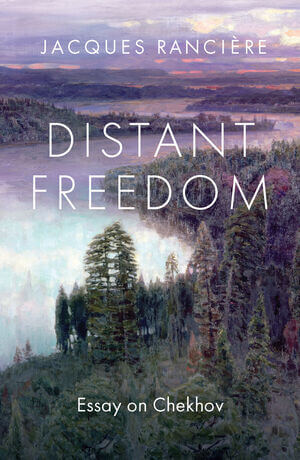
Jacques Rancière needs little introduction to those in the world of philosophy, art, and aesthetics. Neither does Anton Chekhov, the great Russian writer famous for his short stories. France’s leading philosophical thinker embraces Chekhov in this extended essay examining a “politics of literature” through the open-ended endings that characterize Chekhov’s many stories. What does this “politics of literature” entail? The possibility of freedom from the “suspended ending” type-scenes that conclude many of Chekhov’s brilliant stories.
Examining the oeuvre of Chekhov seems daunting, so Rancière limits himself to the short stories and short novels of one of Russia’s greatest artist-writers. In particular, stories like “My Life,” “The Kiss,” “The Cherry Orchard,” “Dreams,” “Three Years,” and “The Student” factor prominently in Rancière’s assessment, Dreams and My Life especially. To begin, what is the task of the writer and the story according to Rancière? “Giving body to this freedom is the task the story will devote itself to by introducing new fiction within the fiction.” What does this mean? As the reader goes on to realize, through the apt and suddenly straightforward analysis of Rancière, it is to articulate a new freedom for the individual and world. Yet, within this freedom that stories present and offer, there remains the burden and paradox of servility.
What makes Chekhov a penultimate and enduring writer, unlike the ideologues who followed after him, is that he presents the tension of domestic servility within the very stories and often within the very characters who also aspire to, or come into conflict with, the possibility of a new freedom and new world. To illustrate this, Rancière begins with “Dreams,” one of Chekhov’s iconic short stories, where the protagonist is embarking on a journey to Siberia surrounded by two constables of the law. The dream of freedom clashes with the reality of servility and submission to the law, the existing norm that constrains individual hope and aspiration, “The reality of [the] dream competes with the reality that the constables serve.”
Establishing this unitive tension as the norm of existence, rather than a neatly defined dichotomy of either/or, Rancière engages in a brilliant critical and hermeneutical discourse how the dream of possibilities, namely freedom for the self and a new world, clashes with “submission to the repetition of the same” in Chekhov’s works. Chekhov’s heroes and heroines are tasked with a choice, where their freedom immediately enters a liminal space of choosing, to submit to the mundane and repetitive or to set out on the journey for the possible. The real stands in contrast to the imagined, the possible, the hopeful, but Rancière makes clear that it is the imagined, the possible, the hopeful that drives stories, characters, and the best of artistic storytelling. But what equally makes Chekhov so worthwhile to engage with is the fact that some of the happiest, and tragic, most emotionally evocative characters are also those who choose that “submission to the repetition of the same.”
Here enters the brilliance of the “suspended ending” or the non-closure conclusion – what we might also call the ambiguous ending. As a teacher of Literature, I have remarked to students that I enjoy ambiguous endings. Why? We learn a lot about ourselves as readers based on how we “close” the ending. Do we accept the conclusion as the “submission to the repetition of the same,” here being the closed conclusion of finality: the story is over and this is how it ends? Or do we imagine other possibilities and continue the journey and “give freedom” to the story and its characters?
Rancière asserts that Chekhov’s brilliance is how he invites us into the reality of the tension of possibility emerging from the route, the mundane, and the normative. The writer, the characters, and the reader form a dance in the symphony of the world—the world of the story and the world we ourselves live in which often mirror the stories and the world and characters they populate. Some heroes fail. Some heroes retreat into the “repetition of the same” (yet declare themselves happy). Some heroes press on into the horizon of the new world and new dawn, but we don’t know what happens.
For Rancière, there is ultimately “no dialectical overcoming.” Instead, “There is a choice, always the same: a threshold that you cross or do not cross to break the ordinariness of the pact of servitude.” This is the freedom that all have which, ironically, thrusts one back into the unfreedom of the same or the continual choosing “to break the ordinariness of the pact of servitude.” The dream of freedom is found in the continual choosing to break free of the rote, the mundane, the same.
As a work of literary criticism, giving insight into the various works of Chekhov, this little book, really an extended essay by one of France’s leading public and academic intellectuals, is a remarkable gift to the world. It is exciting to read and easy to follow. As a work of political criticism through analyzing art and literature, it offers a plethora of insightful moments with which to wrestle. Do we dream of freedom and possibilities? Or do we retreat into the servility of the same? It’s ultimately our choice. And that’s what is frightening, just as Rancière notes is the experiential reality of many of Chekhov’s characters.
Distant Freedom
By Jacques Rancière, Translated by Steven Corcooran
Hoboken, NJ: Polity Press, 2026; 120pp


Related Posts