Heraclitus and the Notion of the Philosopher
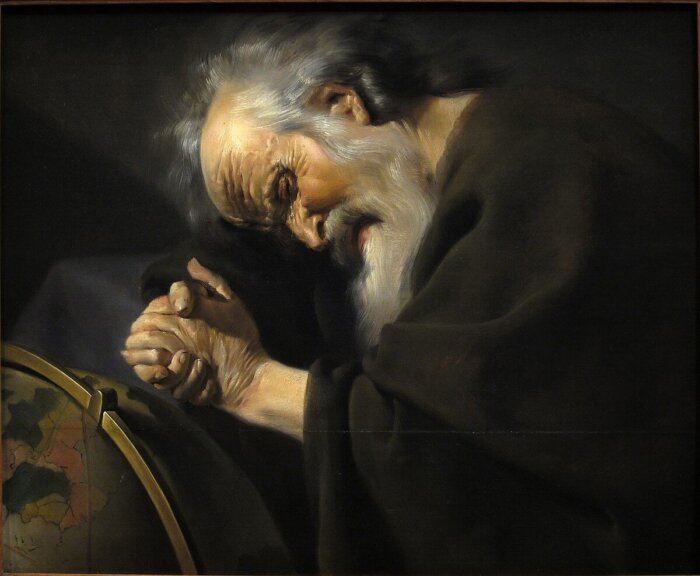
If Pythagoras (6th–5th century BC) was the one who inaugurated the use of the term “philosophy” (i.e., “love, friendship for wisdom”), then Heraclitus (6th century BC) was the earliest Greek thinker said to have used for the first time the term “philosopher.” In fact, the recording of such important terms does not mark their first use, but only their first written attestation. Their first oral use in the living language of the ancient Greeks will remain forever unknown to us. Without insisting, then, on the historical origin of the term “philosopher,” I will propose an interpretation of it inspired by the fragments attributed to Heraclitus.
I should specify from the outset that what you are about to read is in no way an essay or a study in the history of philosophy. Convinced that it is impossible, in the absence of the author himself or at least texts of secure authorship, to establish the meaning of fragments that are but the distant echo of his thoughts, what I will propose is merely the interpretation that seems most probable. Despite this uncertainty, the issue at stake is no less important. For the goal of this interpretation is part of a broader project: to offer the necessary keys for a correct understanding—based on ancient Greek sources—of the notions of “philosophy” and “philosopher.”[1]
In the translation of Kathleen Freeman, fragment 35 of Heraclitus—transmitted to us by the famous Christian exegete Clement of Alexandria (c.150–c.215 AD)—reads as follows, “Men who love wisdom must be inquirers into very many things indeed.”[2]
At first glance, the fragment seems to refer to a kind of superficial or horizontal erudition, similar to the historical knowledge of various peoples and customs described by Herodotus, or, closer to our time, to encyclopedia articles. Yet this very extended knowledge—called “polymathy”—as a defining trait of the philosopher, is reproved in another fragment attributed to the same Heraclitus, transmitted by Diogenes Laertius, “Much learning does not teach understanding.”[3]
The Greek term translated as “learning” or “erudition” is therefore polymathia. Although very brief, the Greek text tells us that much knowledge does not give you “mind”—hence an equally good translation as that of R.D. Hicks would be “Polymathy does not give you mind.” How then can it be that fragment 35 from Diels’ collection seems to say that the philosopher is one who investigates many things, only for us later to learn that much knowledge does not make one a philosopher? Are these statements attributed to Heraclitus not flagrantly contradictory?
Here is an enigma that can be resolved by appealing to another teaching of the Greek thinker, transmitted through the same doxographer, Diogenes Laertius, “That which is wise is one: to understand the purpose which steers all things through all things.”[4] Hicks’ translation differs slightly from Freeman’s, “This one thing is wisdom, to understand thought, as that which guides all the world everywhere.”[5]
Gradually, things begin to clarify. The philosopher, the one who seeks wisdom, must find everywhere that “something” which directs and guides all that exists. Therefore, not the plurality of empirical, i.e. sensorial knowledge, but the unifying substratum of that plurality. And what else could that unifying “something” be if not the supreme Logos—that guides all things?
You have surely noticed that in the previous question I have suggested more than the cited texts strictly allow. This is why I will propose a few other quotations containing a doctrine of great importance attributed to Heraclitus, a doctrine that lies at the foundation of my interpretation.
A fragment transmitted through Sextus Empiricus (Adversus Mathematicos, VII, 133) slightly lifts the veil from the previous quotation, “it is necessary to follow the common; but although the Logos is common the many live as though they had a private understanding.”[6]
Here, that unifying substratum of all that can be known is explicitly named for the first time: Logos. As is well known, there is hardly another notion with as rich and significant a history as this crucial term—both for pagan Greek thought and, even more, for Christian thought. Following the idea that seems to arise from the above fragments, I believe we can say that for Heraclitus the philosopher is the one capable of perceiving the unique Logos—the common and profound substratum of all that exists. In another, much longer fragment, also transmitted through Sextus Empiricus, we read:
Of the Logos which is as I describe it men always prove to be uncomprehending, both before they have heard it and when once they have heard it. For although all things happen according to this Logos men are like people of no experience, even when they experience such words and deeds as I explain, when I distinguish each thing according to its constitution and declare how it is; but the rest of men fail to notice what they do after they wake up just as they forget what they do when asleep.[7]
Here Heraclitus laments universal ignorance. Echoing Pindar’s verse that “man is the dream of a shadow,”[8] he describes the state of ordinary humans as similar to the forgetfulness of dreams during the waking state—a forgetfulness that, we might say, turns people into mere moving shadows upon the stage of the world.
In another fragment, transmitted through Hippolytus (Refutatio Omnium Haeresium, IX, 9, 1), we encounter the Pythagorean humility of one who refuses to claim the title and rank of teacher, expressed together with the distinctive feature of Wisdom: the ability to perceive the unity of creation, “Listening not to me but to the Logos it is wise to agree that all things are one.”[9]
The translation proposed by Daniel W. Graham adds further clarity by emphasizing the relationship between acquiring Wisdom and knowing the Logos, “Having harkened not to me but to the Word, you should agree that wisdom is knowing that all things are one.”[10]
Belonging to the line of Plato as a representative of Middle Platonism, Plutarch (c. AD 40–120) seems to identify Heraclitus’ Logos with the Divine Intellect from the Timaeus when he speaks, in Moralia, of “the Intelligence ‘by which the Universe is guided,’ as Heracleitus has it.”[11]
If I were to affirm that the influence of Heraclitus’ vision is truly remarkable, I would only be repeating what countless historians of philosophy have already demonstrated. Practically no significant Greek thinker missed the opportunity to mention him. Probably the hymn of Cleanthes of Assos (c.330–c.230 BC) is the most conclusive proof of this:
“Thou dost direct
The Universal Reason which, commixt
With all the greater and the lesser lights,
Moves thro’ the Universe.”[12]
In his commentary on these verses, the translator Frank Cole Babbitt explicitly mentions Heraclitus’ influence, “According to Cleanthes the ‘Logos’ was eternal, and so it was conceived by Heraclitus himself; ‘it’ was without beginning or end, piloting all things through all, like a wary steersman.”[13]
In exactly the same vein is the more substantial commentary by professors Kirk and Raven, who also highlight that particular aspect of the relation between Wisdom and Logos that is of special interest here:
Wisdom—and therefore, it might be inferred, satisfactory living—consists in understanding the Logos, the analogous structure or common element of arrangement in things, embodying the μέτρον or measure which ensures that change does not produce disconnected, chaotic plurality. Absolute understanding here can only be achieved by god, who in some respects, therefore (but not of course in anthropomorphism and in the demand for cult), resembles the Zeus of the conventional religion. God, with his synoptic view, is thus ‘the only thing that is (completely) wise.[14]
On the basis of everything shown so far, I will summarize the main ideas that together delineate Heraclitus’ contribution to understanding the notion of the “philosopher.”
Thus, after observing first that he seems to affirm that the philosopher is one who knows many things, we have presented several fragments that suggest quite the opposite: not a broad, horizontal knowledge, but rather a deep knowledge—one capable of perceiving the unity of all things. Then, supported by the most striking quotations among the fragments transmitted by various commentators, we have seen that this unity of all that exists results from the substratum which is the unique, divine Logos. Plutarch does not hesitate to speak, in Platonic terms, of the supreme Intelligence governing all things. In this sense, professors Kirk and Raven also comment on the Heraclitean fragments, emphasizing that Wisdom can belong only to the one capable of perfectly knowing all things simultaneously. Obviously, this can only be God—thus indeed, Pythagoras was right: truly Wise can be only the Deity.
If this is the case, what remains for the lover of Wisdom—the philosopher—to do? Only one thing: to seek, humbly, to harmonize his own intellect with that of God. This, of course, implies a form of life and meditation capable of helping us to perceive the Wisdom with which all things are governed. For, as Heraclitus reminds us in the fragment transmitted through Sextus Empiricus, “all things happen according to this Logos.” A true anticipation of the Christian doctrine of Divine Providence, this teaching emphasizes the ontological unity of creation through the divine intellect—a unity that represents the ultimate goal of knowledge for the one who aspires to the title of “philosopher.”
NOTES:
[1] For those who wish to familiarize themselves with my project, I suggest reading the following articles published on my Substack, Kmita’s Library: “What is True Philosophy? It is NOT Sophisticated Talk, nor an Endless Discussion About Concepts”; “What Philosophy Is: Part I – Philological Investigations;” “What Philosophy Is: Part II (A) – Historical Investigations”; “What Philosophy Is: Part II (B) – Historical Investigations”.
[2] Ancilla to the Pre-Socratic Philosophers. A complete translation of the Fragments in Diels, Fragmente der Vorsokratiker by Kathleen Freeman, Cambridge: Harvard University Press, 1948, p. 27.
[3] Diogenes Laertius, Lives of Eminent Philosophers, With an English Translation by R.D. Hicks, in Two Volumes, II, Cambridge, Massachusetts: Harvard University Press; London: William Heinemann, 1925, p. 409.
[4] Ancilla to the Pre-Socratic Philosophers. A complete translation of the Fragments in Diels, Fragmente der Vorsokratiker by Kathleen Freeman, ed.cit., p. 27.
[5] Diogenes Laertius, Lives of Eminent Philosophers, ed.cit., p. 409.
[6] The Presocratic Philosophers. A Critical History With a Selection of Texts, by G.S. Kirk & J.E. Raven, Cambridge at the University Press, 1957, p. 188.
[7] The Presocratic Philosophers. A Critical History With a Selection of Texts, by G.S. Kirk & J.E. Raven, ed.cit., p. 187.
[8] Pindar, Pythian Odes, 8: “What is someone? What is no one? A dream of a shadow is man.”
[9] The Presocratic Philosophers. A Critical History With a Selection of Texts, by G.S. Kirk & J.E. Raven, ed.cit., p. 188.
[10] The Texts of Early Greek Philosophy. The Complete Fragments and Selected Testimonies of the Major Presocratics, Part I, Translated and Edited by Daniel W. Graham, Cambridge University Press, 2010, p. 149.
[11] Plutarch, Moralia, Volume V, With an English Translation by Frank Cole Babbitt, Harvard University Press, 2003, Harvard University Press, 2003 (8th edition), p. 181.
[12] The Hymn of Cleanthes, Greek Text Translated into English with brief Introduction and Notes by E.H. Blakeney, London-New York: The Macmillan Company, 1921, p.8.
[13] The Hymn of Cleanthes, ed. cit., p. 13.
[14] The Presocratic Philosophers. A Critical History With a Selection of Texts, by G.S. Kirk & J.E. Raven, ed.cit., p. 205.


Related Posts