How to Look
When a man truly perceiveth and considereth himself, … he doth not grieve over his sufferings, for they are right in his eyes, and he hath nothing to say against them.
—Theologica Germanica
The Good
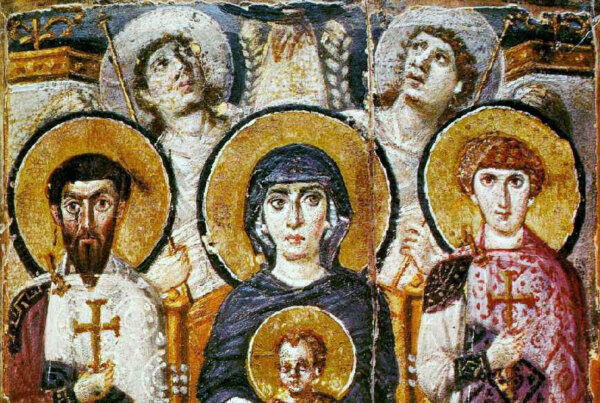
In Tbilisi are icons that masters
worked for centuries, meditating hours
before daring the least change, though days staggered
famine to fire, disaster to disaster.
Some preferred a likeness made without hands,
a lime wood board shaped and smoothed by adz
that touched the Mandylion and effortlessly
became a perfectly copied perfect Man—
as if a man could be made without blood
by painters who have not witnessed human pain,
who have not turned light against the shadows’
hideous strength to find gold flecks in the mud.
Do not avert your eyes; perhaps you will
learn how to see. Look with love: the image
may refashion you. Gaze on living
faces and hear Sinai: “Thou shalt not kill.”
The Bad
A collector hides his Virgin behind curtains:
at dawn he draws them slowly to reveal
his Mary. He adores her, kisses her, veils
her again for the next command performance.
A Byzantine empress holds the Baby Jesus,
cooing and caressing as the empire
falls. This is a child, she whispers, I have
borne without pain, whose love never ceases.
For reasons like these, the murals in Shakespeare’s
school were limewashed over. The wash could be
removed, should icons return to favor, but eyes
were scraped off to warn the old believers.
The Ugly
I don’t see the divine in my shaving mirror,
but still pray to be filled with love, to see Him
in the homeless man who drops by once a week
to take a shower, leave his laundry, and share
his grief. His brother’s dead. He’s disinvited
from the funeral. “You’ve brought this on yourself,”
they say, “dead-beat old druggie.” They don’t see
his pain; they have gouged him out of their eyes.


Related Posts