On the Genealogy of “Vibes” Politics
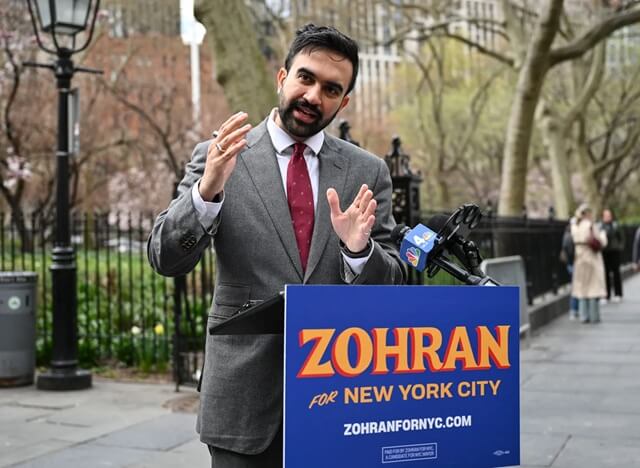
The mayoral triumph of Zohran Mamdani has sent shockwaves throughout the American political mainstream. Just as the meteoric rise of President Donald Trump in 2016 destabilized the political status quo, Mamdani’s election as mayor of America’s greatest city signals that the hollowing out of America’s political center is occurring at an alarming rate. Indeed, Mamdani’s election has seen political pundits out in full force, diagnosing his victory as evidence of a new rise in ‘hipster’ politics.
Yet, contrary to the emerging consensus among the pundit class, Mamdani’s rise will not usher in a new kind of politics. The reason for this is that Mamdani is simply a left-wing iteration of Donald Trump. Where Trump promises to make America great again, Mamdani promises a New York built by and for immigrants. Mamdani’s ascent, glorified within digital progressive circles and anxiously scrutinized elsewhere, now serves as a bellwether of the American Left’s present moral psychology.
To be sure, when Donald Trump came riding down the great golden escalator in 2016, he introduced an unmistakable rupture into American politics. Gone were the days when Americans chose their political candidates on the basis of substance. Whether we like it or not, President Trump dragged us into the era of ‘vibes-based’ politics and both the American Left and Right have fallen prey to this same malaise of substituting moral psychology for political thought.
This essay argues that the apparent opposition between figures like Trump and Mamdani dissolves once we analyze the moral psychologies and governmentality that drive their appeal. On the Right, voters seek transcendence through politics. On the Left, ressentiment inverts traditional moral categories in an unending quest to purge the untidy complexity of human life. Irrespective of their differences, both paths converge on the shared end of a biopolitical domination that manages life itself, resulting in a world where politics is reduced to the art of conducting the conduct of others.
The ascendence of vibes-based politics has guaranteed that instead of reasoned debate over policy positions, Americans now select their favored candidate on the basis of who can come up with the most captivating soundbite. One need look no further than the 2016 debate between Trump and Hillary. The only thing that people in 2025 remember from that fateful night was Trump’s (in)famous promise riposte to Hillary that he would put her in jail.
Almost a decade on and things have only gotten worse. The 2024 election saw both President Trump and Democrat-nominee Kamala Harris duel it out on the podcast circuit. The highlights from that race include President Trump pumping his fist in the air after surviving an assassination attempt, working at McDonald’s, driving a dump truck, and appearing on Joe Rogan’s podcast. The fundamental question of whether President Trump could actually deliver on his MAGA 2.0 platform was cast aside by voters in favor of the ‘vibes’ he gave off and the many promises he was willing to make.
The American mind which had up until that point been hooked on a steady diet of TikTok reels and memes from Instagram and X, was briefly jolted out of its dopamine-induced stupor by the policy-heavy Vance-Waltz debate. However, such a reprieve from the opiate of the masses—political memes and clips—proved all too short.
For, in 2025, the radical wing of the political Left found its Trumpian foil in Zohran Mamdani and foisted him upon us all. Where President Trump gained political notoriety among those on the disaffected Right through his politically incorrect zingers, Mamdani spoke the language of compassion which appealed to his Left-wing base. As with Trump, so too with Mamdani. The mayor-elect has made promises galore and the masses have simply lapped them up. After all, going into the practicalities of implementing these policies is far too tedious a task for those with little patience for such foibles—that is, those who are instead content to congratulate themselves for the virtuousness of their intentions.
To understand the deeper moral impulses animating both movements, we can turn to Nietzsche for the necessary frame. As he observed, the death of God does not, for the masses, result in an affirmation of life. Instead, perhaps having been confined within the frame of Christian asceticism for too long, man attempts in vain to reconstruct the Christian quest for transcendence through secular means.
This is precisely the moral psychology we see plaguing the vibes-based American Right. For the Right-winger, the death of God does not signify a need to return to life but rather results in him doubling down on his pursuit of eternity. Since eternity can no longer be attained on the metaphysical plane, he instead seeks it out through politics.
Unlike religious asceticism, however, its Right-wing variant does not demand that its adherents to yearn for salvation in the hereafter. Rather, this new-fangled asceticism grounds its vision of an idyllic future in metaphors of a resplendent past. Take influential radical Right pundit, Tucker Carlson, for instance. For him, the MAGA movement hasn’t gone far enough as it remains tethered to a democratic system of governance which is worlds away from the feudalism of old which he edifies. In Right-wing asceticism, we thus bear witness to what Camus termed “nostalgia”, a wistful longing for a transcendent state of affairs that “provides modern anguish the means of calming itself.”
To be sure, Right-wing asceticism is more insidious than its religious forbear. The past was inhabited by living, breathing humans. Its invocation is thus intoxicating in a way that religious asceticism could never be. Where religious adherents of the past had to paint murals to imagine the beatitude of a divine existence, Right-wing asceticism promises its devotees that such beatitude is attainable if only we turn back the clock.
In this sense, Right-wing asceticism is life-denying as it counsels against embracing life as it is and enjoins its disciples to paradoxically seek out a triumphant future by returning to a glorious past. As Nietzsche diagnosed it, such asceticism constitutes “the very incarnation of the desire for an existence of another kind.”
The same life-denialism is no less rampant on the vibes-based American Left. This time, however, its animating principle is not asceticism. The Left is, by contrast, stirred by the spirit of ressentiment. Nietzsche termed the particular ethos of the resentful “slave morality”. These malefactors shriek ‘no!’ ab initio to anything different from themselves.
For them, achievement, strength, and vitality become natural objects of their malice. The resentful, Nietzsche warned, seek to inflict their “ultimate, most subtle, most sublime triumph of revenge” by “forcing their own misery, in fact, all misery, into the consciousness of the happy, so that the latter begin one day to be ashamed of their happiness, and perhaps say to themselves when they meet, ‘It is a shame to be happy; there is too much misery!’”
By this, Nietzsche meant that the resentful aim to invert moral categories so as to convince those who embrace life into self-flagellation. Thus, the resentful congregate in herds to cow life-affirmers into penitence. The malignant rhetoric of Congresswoman Alexandria Ocasio-Cortez offers a case in point. She consistently inveighs against America’s “original sin” of white supremacy which “exists on a larger scale beyond just the infected” but “also lays dormant.” The implication is clear. Regardless of whether or not one disavows white supremacy, its grasp is so totalizing that even the sincerest egalitarian is tainted by it.
Left-wing ressentiment, then, is enamored by its own conceited sense of virtue. As Nietzsche observed, such individuals puff themselves up and declare: “We, the good, we are the righteous”. What they demand “they call not revenge but ‘the triumph of righteousness.’”
This is the self-same life denialism as before, though this time clothed in robes of compassion. Nietzsche was right to describe such an ethos malignant. This is because, like tumors, it metastasizes and has an unquenchable thirst for uncovering new shibboleths, new quests for cosmic justice which will only be satiated when every single life-affirmer kneels in contrition.
Of course, utopianism is not a new phenomenon on either the political Left or Right. What is new, however, is the intellectual paucity of the vibes-based utopianism of today’s body politic. The inclination among modern voters on both sides of the aisle to place a premium on how a political candidate makes them feel—how successfully political candidates manage to quell their sense of existential dread—over the substance of their policies.
Consequently, the political center has begun to erode, with level-headed political figures finding the ground beneath their feet rapidly shrinking. Given the modern voter’s want for achieving transcendence through politics, it is no wonder that the political middle has become as unsexy as it is.
Take this pair of quotes from President Ronald Reagan and President Bill Clinton, respectively. In 1981, the former stated, “government is not the solution to our problem; government is the problem.” Likewise, in 1996, the latter was quoted as saying, “We know big government does not have all the answers. We know there’s not a program for every problem.” Now juxtapose this with Zohran Mamdani’s recent proclamation that his New York City government “will prove that there is no problem too large for government to solve and no concern too small for it to care about.”
Though President Reagan and Clinton obviously held disparate moral perspectives on social issues, both understood that most of these issues weren’t a government’s to fix. Under the new political asceticism, however, this small government mentality is decidedly outmoded. No longer do devotees need to wait patiently to be redeemed in the afterlife, our new political priestly class guarantees that redemption is now possible within one’s lifetime, although the exact date for this redemption is left conspicuously undisclosed.
While Nietzsche diagnosed the moral psychology that has led to the politics of life-denial on both the Left and Right, Foucault’s thought unmasks the administrative techniques which such a politics generates. In this regard, the new Left-and Right-wing asceticism necessitates political domination.
Consider, for instance, the popular Left-wing proposal that has once again gained traction through Mamdani’s successful campaign to freeze rents. While it is clear to see why such vibes-based policies prove popular amongst a voting base that cares more about the optics of compassion than property rights, such a policy institutes what Foucault termed a “dividing practice” which splits society into the exploited renter class and the predatory landlords. The institution of such a practice, in turn, justifies exercising political power to infringe the property rights of the latter group as an act of revenge carried out on behalf of the former group.
Policies such as rent freezing form part of an apparatus of power Foucault called “biopower”. It serves to “conduct the conduct of others”. By this, Foucault was referring to the state’s exercise of power to intervene and manipulate social conditions in the name of improving ‘population health’ or ‘security’. As we saw the example of rent freezing, the effect of biopower is “to fragment, to create caesuras within the biological continuum addressed by biopower” as it divides between the victimized lower classes and the corrupt capitalist class.
The tendency towards biopolitical domination drove the late Foucault to scorn all forms of socialism and Marxism. Indeed, towards the end of the 1970s, Foucault had open animus towards socialism, condemning even its most benign manifestations as necessitating the creation of a bureaucratic apparatus to administer “a technology … which tries to control the series of random events that can occur in a living mass” to ensure that every semblance of free trade is effectively suppressed. These pastoral impulses which lead to biopolitical domination are the precise hallmarks of modern Left-wing asceticism.
Right-wing asceticism also manifests biopower, albeit in a different form. For example, President Trump’s current strong stance on immigration started as a campaign against rampant illegal immigration has now mutated into a crusade to limit all forms of immigration. What began as law and order policies that exemplify Foucauldian “disciplinary power” deployed to impose “meticulous control” over individual bodies has now morphed into a biopolitical struggle to achieve purity within the populace.
Indeed, Foucault sharply observed that the use of biopower ineluctably leads to a rise in racism. As he emphasized, “racism makes it possible to establish between my life and the death of the other that is not a military or war-like relationship of confrontation, but a biological-type relationship.” In effect, those who wield biopower proclaim that “[t]he more inferior species die out, the more abnormal individuals are eliminated, the fewer degenerates there will be in the species as a whole, and the more I—as species rather than individual—can live, the stronger I will be, the more vigorous I will be. I will be able to proliferate.”
For Right-wingers, the biopolitical turn of the present Trump administration has almost certainly engendered the rise of antisemitism and even the scorning of interracial marriage that is now par for the course in online Right-wing circles. This is manifest from how New Right influencers such as Nick Fuentes openly flirt with neo-fascist iconography and attack Vice-President J.D. Vance for being in an interracial marriage with Second Lady, Usha Vance. In Fuentes and his acolytes, Nietzsche’s ascetic ideal is consummated in biopolitical form.
To be sure, the modern ascetic Left also partakes in biopolitical racism. Consider Zohran Mamdani’s proposal to shift property tax burdens from New York City’s outer boroughs to “Whiter” neighborhoods to fix “the inequitable” property tax system. Irrespective of the fact that Mamdani framed the issue as one of restoring equity, it remains a textbook dividing practice which moralizes a demographic category and designates it as the proper object of state intervention. In Foucauldian terms, that is biopolitics on a racial register. Though not the crude and vicious racism of Jim Crow, it is nevertheless a softer, managerial racism which hierarchizes along biological lines.
What unites Left-and Right-wing governmentality is thus not ideology but the techniques of domination that they seek to institute. Each strives to redeem life by administering it, thereby transmogrifying politics into a machinery of moral hygiene. It is here that the “new-old” biopolitics reveals itself. These modern managerial techniques of governance are no different from the pastoral power that Foucault once saw as typifying theocracy and socialism. Our vibes-based politics thus marks a resurgence of this old governmentality under the respective guises of compassion and nostalgia for a bygone past.
To tame the excesses of the present epoch of vibes-based politics, we should take a page out of Foucault’s book. Instead of attempting to eliminate power entirely, we should aim to civilize it. In this sense, we ought to “give [ourselves] the rules of law, the techniques of management, and also the ethics that will allow these games of power to be played with a minimum of domination.” The imperative nature of this task was grasped by James Madison in his own idiom: “Ambition must be made to counteract ambition.” In effect, the task for centrists is to neuter the ability of both sides to carry out their radical proposals.


Related Posts