Piper Alpha
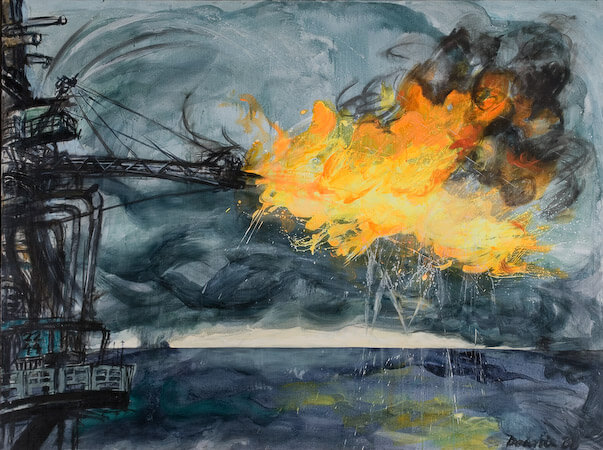
In honour of the 167 who died in the Occidental (Oxy) Piper Alpha oil platform disaster in the North Sea, 6th – 7th July 1988, British, American, French and others. The writer had worked on an adjacent platform, Claymore.
1
‘How long ya thinkin’ of keepin’ yer hands
In yer pockets, pal?’ That would be
Kotton’s slow, soft voice. ‘Ya’ll better
Be getting to work now’. But he was
The boss, toolpusher, on another rig. Here
It was Mike Neff, extravagantly moustached,
In Colorado accents, ‘Don’ you ever
Turn your back on the drill-floor, son –
Never look away from pipe in the ramp’:
My roustabout pusher when I began,
He cursed when he heard I was new.
And ‘You’re gonna have to get
Closer’n to it, chum’. A photograph
I found online has a man I don’t recognise
Standing by a ramp I knew so well.
It was the place of my beginning, where –
Naïve, anxious, unskilled, a roustabout –
We were bundling or unbundling drill-pipe
With the crane. ‘You’re gonna need to put out’:
He wanted exertion, always wanted to see it.
‘Put out’ were the words he used most.
And ‘My little sister could do better’n that!’ –
That was his call to the roughnecks. And they
Could curse. Long, unrolling oaths, syllable
After syllable, beginning ‘God-damn…’
Then Boris – his nickname – ending every
Amusing obscenity that came to mind
With a soft mock- reverence, ‘Robbie Burns’.
So many voices calling out to be heard. But
Where you were photographed so casually,
The ramp, the drill-floor, are completely dead.
2
You’re standing in front of Rig 40 or 41 –
One of the two that Bawden Drilling
Had on Claymore – 41 was mine.
You’re standing on – what was it called? –
The jetty-like pathway of steel, that ran
The length of the pipe deck, to the ramp
Up to the drill-floor. We shifted it
With the crane, section by section,
When the rig was jacked to a new hole.
And you could be any of the men – riggers,
Technicians of one sort or another –
Who peopled the rest of the platform.
You’re not from the drilling crew:
Wear your overalls open, loose, like that,
And you’ll get caught in something
And trapped. But your hard hat – dirty
White or yellowish – your overalls –
Worn, oily – brown supply-store boots –
I recognise these, almost know you in them.
From where you stand we looked
Across a mile of so of water
To Piper Alpha – where the flare
Blazed day and night. It never went out.
3
Bawden had the drilling rig on Piper too.
So there’d be another Mike Neff, Gerry Friend,
Gary Bowman, roustabouts, roughnecks,
Night and day shifts, derrickmen, tool-pushers,
Sparkies, the motorman, mechanic, welder,
Rig clerk – the rest of a drilling crew –
And all the others – engineers, stewards,
Contractors, the men like you, on lower decks
Carrying gear, others in the galley
Queuing with trays. Crane operators,
I remember, were drilling crew too.
One night, when few were around, I rode
Seated on the cold, hard ball of the crane,
Holding to the u-bolts, the wire rope,
Swung high over the platform, over
The heli-deck, to land on the heaving stern
Of a supply ship, where the waves
Splashed and swept among the ropes,
Running between stanchions, swirling
At the corners of cargo, skips, containers,
And raised again, knew mind, feeling,
Body alive as never before or since,
In a multitude of thrilling excitement.
The experience was mine, but the feeling –
All feeling – belongs equally to you,
And this I compose is not about me,
But about you – you, now – and those
Across the usual grey of the sea
On Piper – the dark, shadowy, shape
Under a blowing globe of light, the flare:
That constant, companionable flame
Overtaken by others – growing larger,
More furious, violent, implacable –
Until only a fire remained.
Then that was extinguished too.
4
I said this is not about me, but about you:
And it is and it isn’t about either of us, but
About the dead of Piper and the surviving,
Perhaps too your dead and mine,
For we stand now, out of time,
Beyond ourselves, both anonymous
And wholly identifiable – and the words, ‘he’, ‘you’,
And ‘I’, or ‘she’, are without separation here,
As neither are we separate from those
Burned, drowned then in the North Sea.
I say ‘I’, say ‘you’, as there’s no other means,
No other place to stand, to tell. But the division
Is not true. The photographed man
May be alive, may be dead, is me, is you,
Those I remember, the you I address.
Though you never set foot on an oil platform,
He did, I have – and thus you have too:
In every falsehood, there’s truth –
In all honesty, a lie. In each of us,
Equal in fact and falsification,
All others live too. You and I
Are involved in each other,
In this one man, in the 167 who died,
The 61 who survived. We are
Parts of their community – the dead
And the living – not completely
Subsumed, nor completely separate,
At least – or so it seems – until we die.
5
We know nothing of the dead. We know
What we thought or felt of them living:
Thoughts, feelings, that light and sink
Within us – flare of their own accord
And end – and memory is as false as imagining.
Yet from these unrealities, or in their use,
Their combination, we seek some truth.
My process, my inquiry, is not as others
Have been – the cold accommodation block
And its cargo of the dead, lifted, dripping
Seawater into daylight, its paintwork burst
And bubbled, the papers dried, sifted –
Witnesses, the survivors, interviewed.
My purpose is to paint those who died
And who survived, with others too –
The living that were, the dead that are –
From Claymore, giant Ninian
On its pedestal, red Montrose,
Brent Charlie, Dunbar, Argyll,
All the other overlooked names –
To paint them in their own type and colour,
Which is my own and yours. Our purpose,
Mine and yours, is surely to know
Ourselves before – because – we die.
6
All answers in the abstract – the reasons,
Sequences – are known. The burnt remainder –
Its blackened, twisted stalks of steel –
Has long been cleared. The surface
Of the sea has no obstruction now.
The waves that beat against Piper’s frames,
Bursting their dense, green and white foam
In shards of spray through platform legs,
The close-packed risers of the wells,
Hanging ropes, hoses (we used to stand,
For fun, remember, on the low, narrow,
Grilled walkways of the so-called spider deck,
Our sodden gloves clinging to the railings,
Bent into the soaking shreds of spume) –
The waves break now in their own rise
And fall. No rigid shadows float
In place on the always moving water,
No great flare blazing in its brilliant
Red and yellow reflection. And the men –
Jovial, reserved, thwarted, proud –
All that can be described of people –
Their accents, of England, Ireland,
Scotland from Grampian to the Western Isles,
The Southern States of the US, France,
Wherever else – all this remains in others.
There is no end of human description:
No end to the abstract. But the human,
The individual, ends when the person dies.
7
We are, and yet we are not, one another.
I must share almost every attribute
Of mine with you, with countless others –
The remainder is mere detail:
And on this detail I build, believe in,
My own self. But none of this interrupts,
Repairs, the fact of any death.
With every death, this fragment,
This detail of the whole, passes
Out of the world. Some distinct,
Irreplaceable paring of life – the man
Or woman – the particular quality
That made them no other – this
Is no more. Our world must be poorer then,
And every loss a loss to all of us.
8
Death – death – death – his, hers, theirs –
We live with death – in the air, on the water,
Underground – deaths like these –
Sudden, rending, never thought. And we
Will and add still other deaths – planted, worn,
Driven – in the market, by the queue,
Among school desks. There is no end
Of death, planned, manufactured, carried,
Caused, willed, unwilled. There is no end
To the work of death. We are agents of it here –
Victims over there – running towards,
Preparing, urging, hastening death. We are
Busy every minute with the fact –
The avoidance or the pull – of death.
What demands we make of it.
And death, what does it demand of us?
Sorrow in one – joy in another for some.
We give ourselves to death – deliver
All possible emotion, expend
Such human capital, in the cause of death.
And death itself says nothing, gives
Nothing back. And these deaths?
What measure, what value do they have?
We weigh up, reckon among,
Different endings – purposed, earned,
Fortunate, courageous, peaceful, quick,
Accidental. They’re all one to death.
9
All one to death, but not to us. We judge
Our will in death. Blame, forgive, reason –
Say it happened because of some wrong –
Point to oversight, mistake, necessity,
Something done, something else not.
And all this work – deliberate, wise –
All the explication, supposition –
All these are barriers, fences,
Erected between us and death: no different
From the railings I see behind you now,
And these, I know, are lightweight things.
Hit by a bundle of drill pipe spinning
In a gale – the roustabouts running
From their loose rope tag-lines – they’ll break
From their fixings and fall four or five metres
Clattering on the deck below. I was dragged
Half over another handrail once, above the sea –
At night, a leg caught in metal tape
Trailing in rubbish spilling from a skip –
As I waved the load away, invisible
To the crane. It was only the chance
Of someone like you – yes, someone
Like you – pictured here, reading now, alive
Or dead – coming along with a radio
That stopped me falling to my own death.
10
I’ve felt that moment, at will, ever since,
As it you may have too in other situations,
And we share it again here and now:
One in which time distorts and freezes.
But what is time? On Piper, time is fixed –
9.55, 10.04, 10.20, 10,50, 11.20, 11.50 – explosion
After explosion, as they were timed.
But for those on the platform, those
On nearby ships, the neighbouring rigs,
For ourselves now, there was
And is no such time. It has, it had,
Ballooned in a burning whole –
All clocks meaningless – consuming all,
Then diminishing to nothing:
To a gap in the world.
No, we don’t live in time.
We conceive of eternity and we
Keep some moments alive for decades.
Time is born in us and, like us, dies.
11
Our fabric, our edifice, of time is raised
Just as the elaborate frame and structure
Of Piper Alpha, in the scale, the presence,
It had when it stood above the water.
And there, night and day, morning and night –
The day shift first, the graveyard next,
Two weeks on, two weeks off,
In the working trip or tour as it was called –
Time was measured out, as it’s measured
For me, for you, for all of us. We wake
To time – the time around and within us –
As into Piper’s continual workings,
Into its lights, its sounds – a constant noise –
Banging drill-pipe, the staccato of radios,
Generators, grinders, acetylene torches,
Whistling pipe-work, the deep gas turbines.
We wake to this as from an ocean
Of the unknown, the unformed,
Where time and place, life and
Death, you and I, do not belong,
Where these must be mere artifice.
Is this the world of feeling? Perhaps feeling
And only feeling lasts. In this, we are,
We can be, stretched beyond ourselves:
Made whole seemingly with all existence, alive
Where all contraries, impossibilities,
Realities combine – held wholly
Within and yet beyond the world.
Surely feeling transcends death.
12
And yet it can’t. Feeling alters nothing,
Remains housed, contained
Within ourselves. It has no reach
Beyond expression. Funeral after
Funeral there have been – there are –
Voices, tears, faces dissolved in grief
Or fixed in its restraint – and all
This anguish reaches just to the point
Of death, a point we cannot reason
Without reasoning dying as continuity,
As having some value in or for our lives.
With this reason, this belief in something
Beyond living, dying – beyond the fact
Of both – death may accomplish something
Whole, may not be an end. But this truly
Is beyond feeling, beyond reason,
For in these we reach to the limits
Of ourselves, the limits of the physical,
Where what is dies. And these thoughts too
Change nothing – they are mere beating
Against the fact of things: waves
Running, breaking into platform legs,
As at the fact we follow all the dead.
13
Neither my death, nor yours, will be as it was
For these, nor, likely, as it was urged,
When I first arrived offshore, in Mike’s scribble
On a safety induction form, under the heading
Any Special Instructions Given: ‘Live fast,
Love hard, die young’. I have lived beyond
His encouragement, avoided the chances
Of Piper, others of my own. My death,
Like yours, will be as it comes. And we will
Merge our fragments of the whole
Into some truth beyond time – beyond
All capabilities of reason, feeling.
Mere words, it’s true, but what
Do we have but words to use, to fix –
Attempt to fix, to join – the whole within
And beyond us? For there is this whole,
In which we live, in which these others lived,
In which they died and we die with them.
14
So I see you now – no-one I know or
Remember – in a photograph found online,
Standing where I first handled drill-pipe
On the catwalk – that’s what it’s called –
Where we landed swinging bundles of pipe
From the crane, releasing them,
Measuring each length, winding the chain
Of the tugger tight around their heads
For hauling to the drill-floor – a sudden thrust
And no stopping. Stand in the wrong place
When a load comes in and it’s spinning,
And there’s nowhere to run. At the end of a well,
And at periods in its weeks of drilling,
The same thirty-foot lengths – greased
With mud and diesel – come at you fast,
Back down the ramp, moments apart.
And this is where you stand – you, the unknown
Photographed man – you, the reader now –
You, in my self-projection – your back
To a loosed bundle of pipe on the ramp –
In obvious ease. For here, your cares are
Workable, and time is no more
Than the blocks rising and falling
In the derrick, the roughnecks in their
Practised throw and tightening of the tongs –
Making, unmaking stands of pipe –
While night or daylight dies. The connections,
Length of pipe to length of pipe,
Are to be made up or broken –
Drilling or pulling out of the hole –
In almost easy regularity, day
And night, amid the lights
Of accompanying flares – those
On the booms of this platform,
That of Piper Alpha bright over there –
And it’s never quite expected,
The end of your tour when it comes:
The loud chopper that lands to take
You back to the world of the dying.


Related Posts