Plato, Umberto Eco and the Daimon of Writing
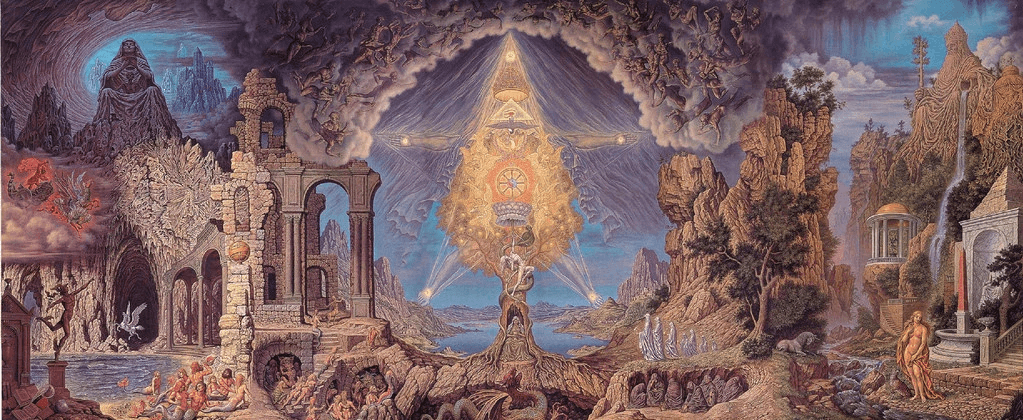
In a lecture delivered in 1996 by Umberto Eco at The Italian Academy for Advanced Studies in America, the author of the novel Il Nome del Rosa sought to extend Socratic irony even to the Athenian philosopher: “Plato’s text is ironical, naturally. Plato was writing his argument against writing.” Eco was wrong. Uninterested in the paths of Eternal Wisdom, as any self-respecting agnostic (or even atheist) author tends to be, Eco tried to charm his audience with his own irony—perhaps a fascinating yet ultimately flawed discourse. The pretext for his commentary was one of the most intriguing passages from Plato’s Phaedrus (274c to 277a). This is where the dialogue between the Egyptian King Thamus and the daimon Theuth is recounted. As I will show below, the reason the Athenian master criticized writing through writing had nothing to do with irony.
For those who do not have fresh in mind this memorable encounter between Thamus and Theuth, let me recall that the daimon offered the king an unexpected gift: letters. Persuasive like Goethe’s Mephistopheles, he argued that what he was offering the king was nothing less than the remedy for forgetfulness:
This invention, O king, will make the Egyptians wiser and will improve their memories; for it is an elixir of memory and wisdom that I have discovered (Phaidros 274e).[1]
Somewhat surprisingly, but not unwisely, King Thamus refused the gift. For he understood that what the cunning daimon was proposing was not, in fact, a remedy against forgetfulness, but rather its drug. The essential idea of Plato’s story refers to the superiority of spoken word over written word. In his view, only the former can be united with true knowledge of a contemplative-mystical nature. Metaphorically speaking, the written text is a kind of “writing on water”—fleeting and inconsistent. In contrast, the spoken word of the master, memorized by the disciple, is a true “writing in the soul”—the only one that can be considered a seed that may bear fruit at the right time. But how could this happen if the word is not planted in the “soil” (i.e., the intellect) of the one aspiring to Eternal Wisdom?
For someone who does not correctly understand the perspective Plato takes when expressing such an attitude, his statements might seem downright scandalous. Or at least contradictory and ironic, as they did to Umberto Eco, who mocked Plato’s critique of writing by pointing out that it was paradoxically carried out in writing.
What Eco fails to consider is the role of the philosophical text in the context of the Old Academy. As I have already shown in an article published last year on VoegelinView, “Philosophy Beyond the Text: Rethinking the Way We Approach Plato’s Dialogues,”[2] in the context of the philosophical community, the written text “was the ‘libretto’ offering the disciple the opportunity to interiorize the memories (hypomnemata) written down in the dialogues, followed by the anamnesis supervised by he-who-knows.” That is why in the absence of a master the text loses its value. The philosophical text was by no means intended, as it is today, for mass publication and popularization. Actually, it does not (and cannot) contain the knowledge it aims for. The philosophical text is not the Kingdom of Wisdom itself, but only a map that shows—to those who know how to interpret it—the path to that eternal, intelligible world.
What is difficult for us modern readers to understand is that Plato’s dialogues were not meant for wide circulation, but for the members of the philosophical community gathered around the master. The fact that they reached us after traversing millennia, allowing us to read them today in the solitude of our offices or private libraries, is rather an accident, a whim of history—or perhaps, who knows?, the fruit of a mysterious plan of Divine Providence.
Here it is absolutely necessary to distance oneself from any “esoteric” interpretation: I do not want in any way to suggest that Plato’s philosophy is a mystery-doctrine meant for a gnostic elite that alone knows the “Truth.” Far from me such a thought. What I do want to say is that wisdom (i.e., Divine Wisdom) cannot be conveyed through written texts. Whoever truly sees the unseen world in mystical experiences remains silent. He cannot write. Eventually, he is able to offer, through his writings, some clues that can guide those who are already on the path to illumination.
When Saint Thomas Aquinas had, in the year (1273) before his death, the famous mystical vision during Mass, he immediately ceased—to the astonishment of his disciples—working on the Summa Theologica. The plenitude of a mystical experience is beyond the capacity of our words to describe. At the same time, it gives the one who had it the certainty that writing cannot offer the fruits of an experience that goes beyond anything we could imagine. What he can do instead of writing is guide those who love Wisdom through the labyrinthine path to the highest form of contemplation. Only he is capable of planting the seeds of such a future experience—in the souls of those who listen—through his illuminative spoken word. The motivation behind such a vision is entirely mystical and religious in nature.
Given the spatial limitations of a simple essay such as this one, I will limit myself to saying that Plato’s essential concern was with that “something” called—following Homer—“the image and likeness of God” (Republic 501b):[3] the intellect (νοῦς). Located in the core of the human soul, where the creature may encounter the “hyper-uranian place” (ὑπερουράνιος τόπος) described in Phaedrus (247c), it is the only spiritual organ that can know the divine. To reach this knowledge, however, the intellect must be “ignited” or “turned” from the “world of becoming” toward the “world of being.” Noetic (i.e., intellectual) illumination—this would be the essential goal of Platonic philosophy, which stems from the central aim of his entire epistemology: the Demiurge, as presented in the Timaeus dialogue. The fact that we are dealing with a mystical and religious, even interpersonal demand becomes evident from one of the most debated passages in the Timaeus, 28c, where Plato states:
Now to discover the Maker and Father of this Universe were a task indeed; and having discovered Him, to declare Him unto all men were a thing impossible.[4]
In the above quote, we again encounter a serious reservation toward the possibility of speaking—or sharing with others—the truth about the Demiurge. Its meaning is revealed by correlating this passage with another, from the Seventh Letter (341c–d), where Plato states:
As a result of continued application to the subject itself and communion therewith, it is brought to birth in the soul on a sudden, as light that is kindled by a leaping spark, and thereafter it nourishes itself.[5]
As one can understand from reading Timaeus 28c, the “thing” Plato refers to is the Demiurge himself, who, once found, is impossible to express in words. Considering the eminently mystical and religious goal—the knowledge of the supreme God—of Platonic philosophy, what Plato proposed to his disciples was not so much a doctrine as, as scholars like Pierre Hadot and Karl Albert have shown, a way of life based on certain spiritual exercises of meditation/contemplation meant to lead souls to activate that principle within them referred to as “the image and likeness of God.”
Founded on the living transmission of Truth through speech from master to disciple, it becomes clear why philosophy cannot in any way be transferred to writing: for the simple reason that it necessarily presupposes the presence of an intellect illuminated by Divine Wisdom. But books have never had, do not have, and never will have a mind. Only writers and readers do. While most authors who adopted and extended the interpretations of Friedrich Schleiermacher (1768–1834) claimed, despite the glaring contradictions in their “text-based” readings, that the manuscripts contain the entirety of Platonic philosophy, interpreters such as Konrad Geiser (1929-1988), Karl Albert (1921-2008), and Giovanni Reale (1931-2014) consider the unwritten philosophical tradition as essential. This tradition can offer access to the “otherworld” targeted by Plato. The exegetes of the Tübingen School took seriously the continuity between Plato and Neoplatonism, thus restoring the legitimacy of a reading that went beyond the “idolatrization” of the written texts and words.
Returning to Plato’s critique of writing, I will now revisit the agricultural metaphor he used to indicate the evolution of philosophical knowledge based on the master-disciple relationship:
When one employs the dialectic method and plants and sows in a fitting soul intelligent words which are able to help themselves and him who planted them, which are not fruitless, but yield seed from which there spring up in other minds other words capable of continuing the process for ever, and which make their possessor happy, to the farthest possible limit of human happiness (276e–277a).[6]
What is described here is the inner dynamic of the evolution of a soul consecrated to the love of wisdom, a soul which, after memorizing the axioms (i.e., principles) transmitted by the master, deepens them through the practice of “spiritual exercises”—among which the art of dialectics holds a place of honor. But what is dialectics? In the Philebus dialogue, Plato states that it is:
a gift of gods to men (…) tossed down from some divine source through the agency of a Prometheus together with a gleaming fire (16c).[7]
The art of dialectics is the instrument that enables the practice of those methods of intellectual purification which bring about the disciple’s inner growth. But this inner growth is only possible under the illuminating influence of one who knows. This is the deepest reason why Plato warns us, through the myth of the god Theuth, about the danger of replacing anamnesis with hypomnesis. What happens when true knowledge is written down and stored in books—or, more recently, on digital media—is the disappearance of “inner perception,” a phrase by which I designate the interiority of the human being, represented by the immortal and intelligible soul, whose central organ is the intellect: the “image and likeness of the divine” in man. The loss of oneself in the things and pleasures of the external world is always accompanied by the weakening—and even the loss—of the inner capacities for knowledge.
On the other hand, written philosophical texts can create an illusory form of knowledge based on imagination rather than on a concrete experience of illumination. Someone may imagine that he knows, without actually truly understanding what he claims to know. This is the greatest temptation of “theologians” who speak about God without having the real experience of dialogue with Him. That is why Pierre Hadot could say that he had met many professors of philosophy, but no philosopher.[8] This was not clear to Umberto Eco. What he overlooked, because of his own agnosticism, was the deeper mystical motivation behind the critique of writing in the Phaedrus dialogue. It was by no means ironic, but on the contrary, entirely serious. It seems that the daimon Theuth, who failed to deceive the classical King Thamus, managed to fool the postmodern Eco.
NOTES:
[1] Translation by Harold N. Fowler, in Plato in Twelve Volumes, Vol. 9, Cambridge: Harvard University Press; London: William Heinemann Ltd., 1925.
[2] “Philosophy Beyond the Text: Rethinking the Way We Approach Plato’s Dialogues:” https://voegelinview.com/philosophy-beyond-the-text-rethinking-the-way-we-approach-platos-dialogues/ [Accessed: 27 July 2025].
[3] Translation by Paul Shorey, in Plato in Twelve Volumes, Vols. 5 & 6 Cambridge: Harvard University Press; London: William Heinemann Ltd., 1969.
[4] Translation by W.R.M. Lamb, in Plato in Twelve Volumes, Vol. 9, Cambridge: Harvard University Press; London: William Heinemann Ltd., 1925.
[5] Translation by R.G. Bury, in Plato in Twelve Volumes, Vol. 7, Cambridge: Harvard University Press; London: William Heinemann Ltd., 1966.
[6] Translation by Harold N. Fowler, in Plato in Twelve Volumes, Vol. 9, Cambridge: Harvard University Press; London: William Heinemann Ltd., 1925.
[7] Translation by Harold N. Fowler, in Plato in Twelve Volumes, Vol. 9, Cambridge: Harvard University Press, London: William Heinemann Ltd., 1925.
[8] Pierre Hadot, “There Are Nowadays Professors of Philosophy, but not Philosopher,” in The Journal of Speculative Philosophy, New Series, Vol. 19, No. 3 (2005), pp. 229-237.


Related Posts