Politics, Children, and a “Culture of Life”
In L.M. Montogomery’s beloved children’s book series Anne of Green Gables, the spritely Anne eventually marries and settles down with Gilbert Blythe. They purchase a house and begin their family in the fifth book of the series, Anne’s House of Dreams. In the chapter after Anne delivers her son James, several of the Blythes’ neighbors visit the Blythes to discuss the general election. Anne laughs at the partisan statements of one of her neighbors and friends, Captain Jim, after whom her son is named. Montgomery presents Anne as a rather disinterested observer of her country’s politics:
“I never heard you make such a bitter partisan speech before, Captain Jim. I didn’t think you had so much political venom in you,” laughed Anne, who was not much excited over the tidings. Little Jem had said “Wow-ga” that morning. What were principalities and powers, the rise and fall of dynasties, the overthrow of Grit or Tory, compared with that miraculous occurrence?
Naturally, Anne finds the near-and-dear reality of her son and his development much more noteworthy than the victors of the general election. Though Anne and her husband do align with the conservative party, the Blythes have enough in common with their neighbors that they are able to maintain friendships and carry conversation with people of different political convictions. The characters of Anne’s House of Dreams share a sense of community that transcends politics. Their friendship flows from their common place, common interests, and common Christian faith, and their various political beliefs do not threaten such friendship.
Anne in particular recognizes that which, to her mind, sits far above concerns of “principalities and powers” – Anne recognizes the beauty and wonder of a singular human life. Bearing and caring for a child is, in the world of Anne Blythe, an apolitical and even supra-political action. Bearing a child has no import in questions of politics, for it, like the friendship of Anne’s community, transcends political questions.
L.M. Montogomery wrote during the early twentieth century – Anne’s House of Dreams was originally published in 1917. Much of what is true for the Blythes and their community is no longer true today, at least not in America: our communities rarely hold a common faith or common interests, and the relevance of sharing a common place has largely lost its weight, thanks to the innovations of modern transportation and technology. The possibility of genuine connection across party lines has grown scanter and scanter as differences in worldview grow greater and greater between our parties.
But, even more than this, what is true for Montgomery’s Anne in her childbearing is no longer true for our society: while bearing a child was, in Anne’s day, a decidedly apolitical action, it has today become (whether for good or for ill) an expressly political one, for fertility and childbearing have been made public questions that have to do with political problems.
Our culture has long since destroyed the boundaries between public and private life: what was once personal or communal has become a matter of public and political discussion. Wendell Berry’s long 1993 essay “Sex, Economy, Freedom, and Community” explores this reality well. But in our day, the internet and social media particularly exemplify this blurring between public and private spheres. Such blurring, however, dates back to days before the internet. The twentieth-century sexual revolution particularly blurred public and private spheres by bringing the bedroom into the public sphere, and, via the concomitant spread of contraception, presenting childbearing as a matter of choice, not circumstance.
In the years since the sexual revolution, the logic of the abortion movement has furthered the logic of contraception, falsely pitting a child against his mother and his mother’s freedom and rendering children’s lives and deaths a matter not only of public discussion but of public policy. Whether children are to be born or to be killed in utero has become a matter of politics. Life and death have been made a matter to be debated and voted upon. Abortion not only takes innocent lives; the broader issue of abortion also makes the most vulnerable of human beings – children in the womb – political pawns.
But it is not only contraception and abortion that have made children a matter of public discussion and spectacle. Childbearing is also inextricably political in our day because our day is a day of birth dearth. As many writers and social scientists have noted, America is at its all-time fertility low. In 2023, women had, on average, 1.62 children, according to data from the CDC. Because 1.62 is a number well below the replacement rate, many politicians and cultural critics voice concern over the looming decline of our nation. For the future of any nation relies on new citizens – a feat which cannot solely be accomplished by immigration but must also be accomplished by reproduction. As Emma Waters wrote for First Things, “Our economy, Social Security, military readiness, eldercare, education, and more depend on new generations of children. On an individual level, this decline reflects a much darker reality. Happy, hopeful people have babies. If we are not having babies, what does that say about the health of our nation?”
This is the reality behind VP candidate J.D. Vance’s now-viral statement that the U.S. is being run by “childless cat ladies who are miserable at their own lives and the choices that they’ve made.” Despite the lack of tact in Vance’s statement, it contains truth: our country is increasingly becoming a childless one, and widespread childlessness suggests unhappiness. For the so-called “baby bust” is in fact a human bust: healthy human communities are fruitful communities. Our culture, conversely, produces fewer and fewer fruitful communities as it becomes more and more “family unfriendly,” to borrow the words of author Timothy P. Carney.
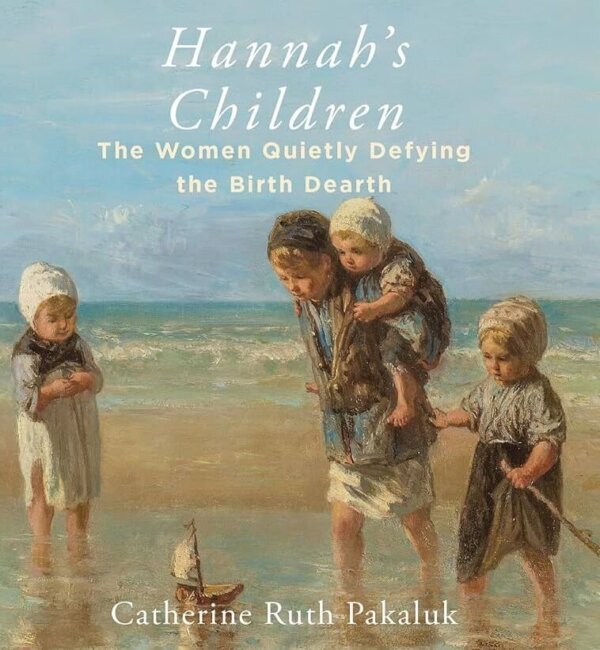
But what is the solution to these grim realities? How ought we to live in a world in which even childbearing has become political? Progressives and conservatives alike propose political and economic solutions to low fertility, such as increasing the tax credit that accompanies having children or expanding parental leave policies. Others, such as Catharine Pakaluk in her recent book Hannah’s Children, pose religion and increased religious freedom as a solution to our nation’s birth dearth.
Many proposed solutions to the crisis of fertility are promising. But whatever the large-scale response ought to be, there must also be an appropriate small-scale response. In other words, we must respond individually to our day’s crisis of fertility and the politicization of life, and we will respond, whether or not we realize it. Either we will respond by ignoring our nation’s declining fertility and shrugging our shoulders at our culture’s treatment of life, or we will respond by, among other things, seeking to revive in our own corners of the world what Pope John Paul II called a “culture of life” – a culture that supports families and children in everyday things.
In order to make headway towards enriching a culture of life in our communities, we ought to allow the truth of the Psalmist’s statement “behold, children are a heritage from the Lord, the fruit of the womb is a reward” to resonate in our own views and attitudes toward children. We ought to, like Montgomery’s Anne, recognize the beauty and wonder of particular human children. We ought to boldly put into practice the Christian conviction that all humans bear the image of God, and that God designed the family as a good institution to reflect him. We ought to welcome and encourage healthy marriages, new lives, and institutions, ranging from churches to pregnancy resource centers, that support a culture of life.
As Kevin D. Roberts, President of the Heritage Foundation, recently wrote, “This culture of life may seem small right now, almost invisible to those who don’t want to see it. But it’s already growing. A pregnancy resource center here. A clinic there. A wedding here. A little brother or sister there. Before you know it, dinner tables will get a little louder, and the pews a little fuller.” These small things are steps in the right direction.
As my husband and I prepare, like Anne and Gilbert, to welcome a baby around the time of the election, our hope and prayer is that our child will grow up in a community that treasures his existence as a “miraculous occurrence” and treats him as such, even if our broader culture does not.


Related Posts