Pope Benedict XVI and the End Times
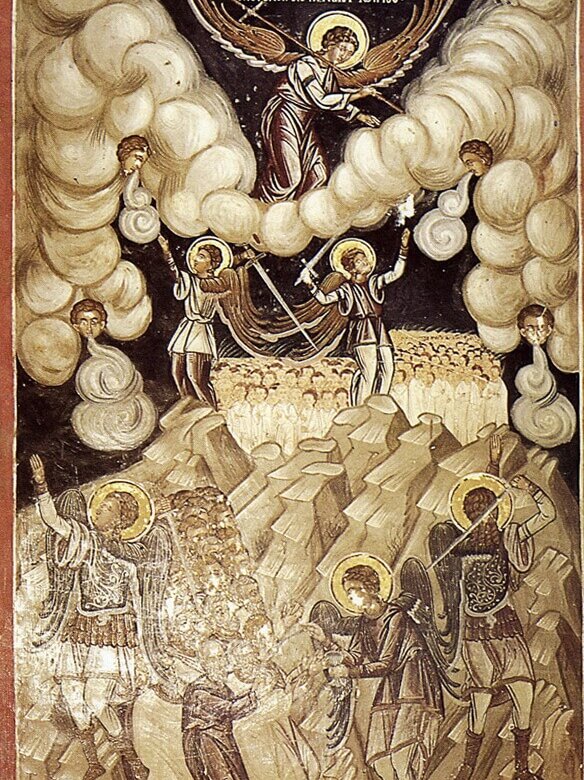
In an article entitled “The Pope and the Antichrist,”[1] Peter Thiel and Sam Wolfe demonstrated, through carefully chosen quotations, the validity of their main thesis announced from the very outset, “Benedict believed he was living in the end times.”
Indeed, Pope Benedict XVI’s persistent interest in eschatology can be easily demonstrated from his writings. The two authors missed no detail, from the young Ratzinger’s post-doctoral dissertation on Saint Bonaventure’s theology of history, to the citation of Vladimir Solovyov’s The Story of the Antichrist in a famous Erasmus Lecture delivered in 1988 in New York and the comments in the margin of a Lenten meditation (2007) by Cardinal Giacomo Biffi. While this is clear to anyone familiar with his works, what is less obvious are the reasons why he avoided speaking forcefully and explicitly about such crucial subjects as the end of history.
The first hypothesis proposed by Thiel and Wolfe concerns his academic formation. If you are a respected scholar and begin speaking about the Antichrist and the signs of the end, you are almost certain to jeopardize your career—even at a Catholic university. The Apocalypse is no longer fashionable in academic curricula, any more than mystical theology, passive contemplation or demonology are. You might discuss such matters historically—like the brilliant professor Bernard McGinn—but not by asking whether the Antichrist can be (or not) present in the world.
To take such subjects seriously today is rather like being a historian of ancient Greece who seriously accepts Plato’s claim in the Timaeus (26e) that Atlantis was real history not a myth, or a historian of the medieval world who believes—like Aristotle and Saint Thomas Aquinas—that monarchy is the best political form of government. It is acceptable to discuss—endlessly—the existence of Atlantis in the abstract, but actually setting out to look for it is suicidal in academic circles. As for philosophy scholars who are university professors and who believe—and publicly state—that Aristotle and Saint Thomas were right about the superiority of monarchy, there simply aren’t any.
Closely monitored by the “politically correct” guardians of the new ideologies, securing a tenured university position today often demands qualities that would have made Machiavelli himself blush. Consequently, it is far safer to discuss St. Bonaventure’s theories concerning the number of the Beast and the heretical Aristotelianism of his own age than to give the slightest indication, as a contemporary Catholic theologian or philosopher, that you might actually be inclined to take the Seraphic Doctor’s interpretations seriously.
The second hypothesis proposed by Thiel and Wolfe concerns the moral and spiritual dangers inherent in making pronouncements about such matters, “More generously, Benedict may have believed that his apocalyptic predictions would be self-fulfilling prophecies, deranging his flock and driving them away from the Church.”
Throughout the history of the Christian era, the number of those who have deceived themselves into believing they could discern the signs of the imminent end has been large enough. If we also take into account the considerable number of Protestant and neo-Protestant groups that have made ingenious—but ultimately fruitless—efforts to prove that one pope, or indeed all popes, are “the Antichrist(s),” we can understand why one can never be too cautious when speaking about the end of the world.
Even some of the saints of the Catholic Church, reflecting on the crises of their own times, believed that the Second Coming of our Lord Jesus Christ was near. This is why the Catholic author who devoted to the Antichrist the most important treatise ever written—contained in his monumental Disputationes de Controversiis Christianae Fidei adversus huius temporis Haereticos (Disputations on the Controversies of the Christian Faith against the Heretics of This Time)—St. Robert Bellarmine (1542–1621), made every effort to soften their error by arguing that they were merely warning the world of such a possibility. Yet I can assure you that some of them were indeed mistaken. Like the Franciscans discussed by Joseph Ratzinger in his brilliant postdoctoral dissertation, The Theology of History in St. Bonaventure, they genuinely believed that the end was very near to their own age.
In any case, if someone—especially someone possessing a certain authority among his fellow believers—“prophesies” one or another of the signs of the end while involuntary deceiving himself and misleading others, the consequences can be truly catastrophic. This is one compelling reason why Pope Benedict XVI refrained from speaking boldly about such matters. Yet, arising from all this, there are two even more serious reasons. It is these that I shall discuss before returning to his contribution to eschatology.
The Magisterium of the Church and the Apocalypse
On 19 December 1516, during the eleventh session of the Fifth Lateran Council (1512–1517), Pope Leo X promulgated the bull Supernae maiestatis praesidio, “On How to Preach.” As its subtitle makes clear, in the troubled years of the Protestant Reformation, the problems surrounding public preaching had become exceedingly serious. Of particular concern to the ecclesiastical authorities was the widespread dissemination of errors by itinerant and self-appointed preachers. Among these errors, none proved more troubling than discussions of the Apocalypse—especially the identification of the papacy with the Antichrist (which, by the way, was not a Protestant invention[2]).
As is well known, the most comprehensive and important treatise ever written on these subjects – Disputationes de Controversiis Christianae Fidei (Book II, Section III) —was the direct result of St. Robert Bellarmine’s controversies with the Calvinists. Although Bellarmine’s treatise remains to this day the indispensable point of departure for any substantial discussion of the end of history and the Antichrist, no less significant is the statement found in the acts of the Eleventh Session of the Fifth Lateran Council:
“They are in no way to presume to preach or declare a fixed time for future evils, the coming of antichrist or the precise day of judgment; for Truth says, ‘it is not for us to know times or seasons which the Father has fixed by his own authority.’ Let it be known that those who have hitherto dared to declare such things are liars, and that because of them not a little authority has been taken away from those who preach the truth. We are placing a restriction on each and all of the said clerics, secular and regular and others, of whatever status, rank or order, who undertake this task. In their public sermons they are not to keep on predicting some future events as based on the sacred writings, nor presume to declare that they know them from the holy Spirit or from divine revelation, nor that strange and empty predictions are matters which must be firmly asserted or held in some other way. Rather, at the command of the divine word, let them expound and proclaim the gospel to every creature, rejecting vices and commending virtues.”[3]
It is worth emphasizing that the conciliar statement does not merely prohibit public preaching from the pulpit about the Antichrist. It also casts doubt upon the very possibility of identifying with certainty any historical event (or person) that might herald the end of history. Here the immense figure of the most influential Doctor of the Church in Christian history, Saint Augustine, is more evident than ever. For it was Augustine who sought to discourage speculation about the Antichrist and the end of history on an essentially theological—and strictly biblical—ground. This very argument is the one invoked by the Fifth Lateran Council in support of its prohibition.
God Himself, our Lord Jesus Christ, declared unequivocally that no human being can know the moment of His Second Coming. This teaching is expressed explicitly in two of the Synoptic Gospels:
“But of that day and hour no one knoweth, not the angels of heaven, but the Father alone” (“De die autem illa et hora nemo scit, neque angeli caelorum, nisi solus Pater”—Matthew 24:36).
“But of that day or hour no man knoweth, neither the angels in heaven, nor the Son, but the Father” (“De die autem illo vel hora nemo scit, neque angeli in caelo, neque Filius, nisi Pater”—Mark 13:32).
Well known within the Christian tradition, these two verses appear to echo another, far less frequently cited, passage from the prophet Zechariah:
“And there shall be one day, which is known to the Lord, not day nor night: but at evening time there shall be light” (“Et erit dies una quae nota est Domino, non dies neque nox: et in tempore vesperi erit lux”—Zechariah 14:7).
Taken together, these texts affirm that knowledge of the final moment of history and of the Second Coming of God the Son belongs exclusively to God Himself. On the basis of these passages, Saint Augustine rejected, in a lengthy letter (199) addressed to Hesychius, Bishop of Salona, every claim that it is possible to know, even approximately, the date of the Second Coming. In so doing, Augustine opposed the position of his correspondent, who, while admitting that the precise moment could never be known, nevertheless maintained that the signs announcing its approach could indeed be discerned, “We see from events that have occurred that some signs of His coming have been realized.”[4]
Such assertions were by no means unique to Hesychius. A considerable number of Church Fathers and Doctors discussed, sometimes in great detail, the signs heralding the end of the world. Augustine represents the minority hermeneutical tradition that excludes even the hypothetical possibility of attaining such certainty.
What, then, does all this have to do with the Antichrist? Quite simply this: if the Antichrist is to appear—and to be destroyed (2 Thessalonians 2: 8)—shortly before the end of the world at the manifestation of the Supreme Judge, then any claim to recognize the Antichrist’s appearance in history necessarily implies some knowledge, however indirect, of the timing of the Second Coming of God the Son. Such a claim appears difficult to reconcile with the categorical declarations of Matthew and Mark that “of that day or hour no man knoweth.” It was for precisely this reason that St. Augustine rejected all of Hesychius’ arguments, a position that was later echoed in the documents of the Fifth Lateran Council.
The statements of the Eleventh Session are crystal clear. Priests and religious are not merely forbidden to make public pronouncements concerning the manifestation of the Antichrist or the end of the world; those who presume to do so are explicitly called liars. Moreover, the Council observes that irresponsible speculation on such subjects undermines the authority of those Saints and Doctors who might genuinely have something meaningful to contribute to these difficult questions.
From what has been said thus far, one might conclude that the position of the Catholic Church concerning these major themes of Sacred Scripture—eschatology, the Antichrist, and the Second Coming of Christ—is perfectly clear. Yet, somewhat surprisingly, matters prove to be considerably more complex. For another official document of the Church appears to affirm, on the contrary, that it is indeed possible to discern the manifestation of the Antichrist and, by implication, the nearness of the Second Coming of our Lord Jesus Christ. This document is none other than the Roman Catechism, published in 1566 under the direction of the great Saint Charles Borromeo (1538–1584) following the conclusion of the Council of Trent (1545–1563).
Here, in a post-conciliar document of the highest authority, the Church appears to follow the line of certain Fathers who differed from Augustine, such as Saint Cyril of Jerusalem and the medieval Benedictine abbot Adso of Montier-en-Der (c.910/920–992). The Roman Catechism states with remarkable clarity:
“Speaking of the last day, our Lord and Saviour declares that a general judgment will one day take place, and He describes the signs of its approach, that seeing them, we may know that the end of the world is at hand” (Matthew 24:9).[5]
The reference is to the so-called “Little Apocalypse,” namely Matthew 24, where Christ Himself sets forth the signs preceding the end of history. According to the Roman Catechism, He revealed these signs precisely so that, by recognizing them, we might know that “the end of the world is at hand.” Does this statement contradict the decree of the Fifth Lateran Council forbidding public discussion of such matters? At first sight, it would seem so. In reality, however, it does not.
Rather, these texts suggest that the position of Bishop Hesychius was here reconsidered—and perhaps even tacitly adopted—while that of St. Augustine receded into the background. Indeed, quite apart from the theological arguments exchanged between the two bishops, the strongest argument in favor of the Roman Catechism’s position is simply the existence of the signs themselves. Why would our Lord, Jesus Christ, have enumerated such clues if no one were capable of recognizing or interpreting them?
At the same time, however, these two sixteenth-century documents convey warnings that deserve our careful attention. The first, inspired by Augustine, concerns the sin of gratuitous intellectual curiosity. The mere desire to pry into such mysteries out of vain curiosity is spiritually dangerous. Hesychius himself combats this temptation by insisting that the true desire of Christians is not idle speculation but rather the longing to encounter God the Son—a meeting that will occur only at the end of history. Consequently, it is not vain curiosity but love of God that ought to animate every authentic eschatological inquiry.
Yet the most profound problem, discreetly but consistently emphasized throughout Sacred Scripture, was developed above all by the great Greek Fathers—especially Athanasius, Gregory of Nazianzus, Gregory of Nyssa, and Maximus the Confessor—and later by such Latin authors as John Scottus Eriugena, Bonaventure, and, most especially, Albertus Magnus. This problem belongs to the domain of philosophical epistemology—that is, the doctrine of human knowledge, whose powers were gravely impaired by the Fall through original sin. Without a thorough examination of this question, we cannot properly understand either the apparent tension between these two ecclesiastical documents or the ambiguities discernible in the writings of Cardinal Ratzinger and, later, in certain teachings of Pope Benedict XVI that shaped Thiel’s and Wolfe’s interpretation. It is to this question that we must now turn.
Saint Albert the Great and the Mystical Key of Prophetic Knowledge
The most important editions of the works of Saint Albert the Great (c.1200–1280), such as that prepared by Jammy (published in twenty-one volumes at Lyon in 1651) and the edition of the Borgnet brothers (published in thirty-eight volumes in Paris between 1890 and 1899), include a work entitled In Apocalypsim B. Joannis Apostoli Enarratio (Commentary on the Apocalypse of the Blessed Apostle John). Setting aside the debate among modern historians, who generally attribute the text to another author from the Dominican milieu,[6] our concern here is not its authorship but the fundamental challenge posed by the interpretation of the final book of the New Testament canon, written by the one traditionally known as the “Eagle of Patmos.”
A detailed examination of this commentary and its various interpretations must be reserved for a separate article. Here I wish to focus only on Saint Albert’s doctrine of knowledge, which sheds light on the profound difficulties involved in any attempt to identify the signs of the end times, and especially the figure of the Antichrist.
Rooted in the epistemology of the great Greek Fathers and of one of the most influential authors of the entire Christian tradition, Dionysius the Areopagite, the commentary begins by emphasizing the unique condition in which the Apostle John found himself when he received the revelations recorded in the Apocalypse. As we learn from three different passages—“I was in the Spirit” (Revelation 4:2), “He carried me away in the Spirit into the wilderness” (Revelation 17:3), and “He carried me away in the Spirit to a great and high mountain” (Revelation 21:10)—John contemplated these mysteries while in a state of ecstasy, made possible by the will of God, who had sent an angel to guide him (Revelation 1:1).
According to Saint Albert, the form of knowledge granted to the Apostle John was therefore extraordinary, comparable to the knowledge possessed by Adam and Eve before the Fall. It corresponds to what some theologians have called “infused science.” Without entering into the details, from the subjective perspective of the one who receives it, this knowledge of invisible realities is accessible only through God’s direct intervention and the operation of divine grace, communicated—as John himself tells us—through an angel.
Entirely unlike our postlapsarian mode of knowing, infused science differs from ordinary human cognition as light differs from darkness. It is immediate and intuitive, enabling the recipient to perceive the “invisible, unseen world” in which spiritual beings (God, angels, and demons) act decisively upon the visible order—the only realm currently accessible to human experience. Subjectively, then, such a sort of knowledge is a grace mediated by an angel that makes such extraordinary visions possible; objectively, it is directed toward the invisible world of spirits and the supernatural beings engaged in the great cosmic conflict so vividly depicted throughout the apocalyptic visions.
The realities contemplated by the Apostle—including the three principal evil figures, namely the Devil, the Antichrist, and the False Prophet (Revelation, chapter 13)—are presented in the form of an allegorical tableau. This symbolic vision can be correctly understood only by those who receive a grace of knowledge analogous to that bestowed upon Saint John himself. According to the classical metaphysics embraced by theologians such as Albert the Great, Thomas Aquinas, and Bonaventure, this form of knowledge grants access to our visible world “from above”—that is, from the standpoint of the intelligible “essences” or “forms” that constitute the foundation of everything existing in the world “below.”[7]
The central difficulty in interpreting the Apocalypse, therefore, arises from the fact that we ourselves remain confined to discursive reasoning, a mode of cognition incapable of directly intuiting the invisible order. For “fallen” human beings, everything appears intermingled. The reality that surrounds us comprises both the “substantial forms” created directly by God and the “accidental forms” produced by human beings, together with the “accidents” that determine their concrete manifestation/actualization.
What we perceive in our world are merely shadows of the beings and realities that exist on the spiritual level of eternity. Their correspondence, to borrow the expression used by Cardinal Joseph Ratzinger in his interpretation of the Secret of Fatima, is by no means “photographic.” There is no one-to-one precision that would enable us to identify without difficulty the realities described in the Apocalypse. The Antichrist, for example—portrayed as “a beast rising out of the sea, with ten horns and seven heads, with ten diadems upon its horns and blasphemous names upon its heads” (Revelation 13:1)—cannot be straightforwardly identified with any concrete historical figure or institution. This explains the extraordinary diversity of interpretations proposed throughout Christian history, ranging from the notorious Roman emperors Nero (AD 54–68) and Domitian (AD 81–96) to the modern hypothesis of a collective Antichrist uniting and ruling all those who have surrendered themselves to demonic evil.
To gain genuine access to the meaning of the Apocalypse and to establish a proper correspondence between its allegorical figures and the actors of our fallen history, one must first acquire that form of mystical, intuitive knowledge that is possible only through grace—a gift that, needless to say, is exceedingly rare. Mysticism is not democratic. On the contrary, its highest expressions—including ecstasy itself—have always been granted to only a very small number of individuals. Even among the saints, visionary mystics such as Symeon the New Theologian, John of the Cross, and Teresa of Ávila are exceptional.
The same was true in the Old Testament, where prophets capable of speaking with God and penetrating the mysteries of history—figures such as Jeremiah, Ezekiel and Daniel—were equally rare. Yet, then as now, the interpretation of prophetic and apocalyptic texts ultimately depends upon the testimony of such individuals. It is precisely in this light that Pope Benedict XVI’s profound interest in the end of history and the Apocalypse should be understood, for he pointed us, with remarkable discernment, toward one such extraordinary witness.
The Secret Knower of the Apocalypse
To the arguments advanced by Thiel and Wolfe in support of Pope Benedict XVI’s interest in the “signs of the end times,” I would add what I consider to be his most significant contribution in this regard: the official recognition of the “Sibyl of the Rhine,” Hildegard of Bingen (c.1098–1179), not only as a saint (10 May 2012), but also as a Doctor of the Church (7 October 2012).
Author of a truly extraordinary body of work, she left us a series of visions concerning the whole of history, a significant portion of which is devoted to the end of history and the Antichrist. These are found in two writings already translated into English: Liber Divinorum Operum (Book of Divine Works) and Sci vias Domini (Know the Ways of the Lord) — better known as Scivias.
The principal characteristic of these writings, which clearly sets their author apart from all other interpreters of the Apocalypse, lies in the fact that they are the fruit of a grace of altogether exceptional knowledge, similar to that received by the holy Apostle John. Although I have begun a detailed analysis of these visions in other articles, here I wish only to recall the most significant episode. It concerns a speech delivered by Pope Benedict XVI on 20 December 2010 to the Roman Curia.[8]
Struggling to address the scandals of sexual abuse committed by some priests, the Holy Father cited a vision described by Saint Hildegard in a letter to Werner von Kirchheim and his priestly community — a vision he explicitly connected to the present state of the Church:
“In the vision of Saint Hildegard, the face of the Church is stained with dust, and this is how we have seen it. Her garment is torn—by the sins of priests. The way she saw and expressed it is the way we have experienced it this year.”
Although he does not explicitly affirm anything quite so sensational as “the vision of Saint Hildegard has now been fulfilled,” the mere mention of one of her visions in direct connection with the sexual sins of certain contemporary clerics is highly significant. This is all the more true because the vision of the Church—described by Hildegard as a majestic, gigantic woman whose face is stained with dust and part of whose garments are soiled—refers directly to the vision found in Scivias. Very concretely, then, we are dealing with the invocation of a prophetic episode—a genuine mystical vision—placed in direct association with a terrible situation in our own time.
Might it not be that, through such a connection, Pope Benedict XVI wished to convey to us something more than a simple papal judgment on a case of grave immorality? Very probably, yes. If Saint Pope Pius X explicitly reflected, in his first encyclical E Supremi (1903), on the possible presence of the Antichrist in history at the beginning of the 20th century, then Pope Benedict XVI, a century later, was far more entitled to meditate on such a possibility. All that remains for us is to follow his suggestion and read, with genuine intellectual humility, the prophetic writings of Saint Hildegard of Bingen, evaluating their content in a context that can justly be described as one of the greatest crises in the history of the world and of the Church.
NOTES:
[1] Peter Thiel and Sam Wolfe, “The Pope and the Antichrist,” July 15, 2026, First Things: https://firstthings.com/the-pope-and-the-antichrist/ [Accessed: 16 July 2026].
[2] The first written attestations of the identification of the Pope with the antichrist date back to the 10th century, when certain bishops and even Cardinals attacked Popes John XV and Gregory VII in this way. For details, the study of Bernard McGinn “Angel Pope and Papal Antichrist,” in Church History, Vol. 47, No. 2 (Jun., 1978), pp. 155-173 is highly recommended.
[3] Decrees of the ecumenical councils, Tanner, Norman P.(Editor), London: Sheed & Ward; Washington, DC: Georgetown University Press; 1990, p. 637. The original Latin text can be read at the same page: “Tempus quoque praefixum futurorum malorum vel antichristi adventum aut certum diem iudicii praedicare vel asserere nequaquam praesumant cum veritas dicat non esse nostrum nosse tempora vel momenta quae pater posuit in sua potestate ipsos que qui hactenus similia asserere ausi sunt mentitos ac eorum causa reliquorum etiam recte praedicantium auctoritati non modicum detractum fuisse constet inhibentes omnibus et singulis clericis saecularibus vel regularibus praefatis ceteris que cuiuscumque status gradus et ordinis existant qui hoc onus assument ne de cetero in sermonibus suis publicis alia quaeque futura ex literis sacris constanter praedicere nec illa a spiritu sancto vel divina revelatione se habuisse affirmare et alienas inanes que divinationis asseveranda aut alio quocumque modo tractanda assumant sed ex divinae vocis praecepto evangelium omni creaturae cum vitiorum detestatione et virtutum commendatione enucleent et declarent et pacem ac dilectionem mutuam a redemptore nostro tantopere commendatam ubique foventes non scindant vestem inconsutilem christi sed ab episcoporum et praelatorum ac aliorum superiorum eorum que status scandalosa detractione quos coram vulgo et laicis non modo incaute sed etiam intemperanter reprehendunt et mordent et ab eis male gestorum expressis quandoque nominibus aperta et manifesta redargutione abstineant.”
[4] The Works of Saint Augustine, Letters 156-210 (Epistulae), Vol. II/3, Translation and Notes by Roland Teske, S.J., Editor Boniface Ramsey, New York: New City Press, 2004, Letter 197, pp. 320-322 și Letter 199, pp. 327-354. Citatul din epistola lui Hesychius se găsește la pagina 325.
[5] Catechism of the Council of Trent for Parish Priests, Translated by John McHugh O.P. and Charles J. Callan O.P., New York, 1923, p. 83. The original Latin text can be read in Ex Decreto Concilii Tridentini ad Parochos, Editio Stereotypa Quinta, Lipsiae, Ex Officina Bernhardi Tauchnitz, MDCCCLVI (1856), Quaestio IV, p. 67: “Quare Dominus et Salvator noster, quum de extremo die loqueretur, declaravit futurum aliquando generale iudicium, signaque adventantis eius temporis descripsit, ut, quum illa viderimus, finem saeculi prope esse intelligamus.”
[6] The most plausible and often mentioned candidate is Pierre de Tarentaise, who became pope under the name Innocent V (c.1225–1276).
[7] I use quotation marks here to suggest that such spatial terms have a strictly symbolic meaning.
[8] The speech delivered by Pope Benedict XVI can be read online here: https://www.vatican.va/content/benedict-xvi/en/speeches/2010/december/documents/hf_ben-xvi_spe_20101220_curia-auguri.html [Accessed: 20 July 2026].


Related Posts