Retrieving The Handmaid’s Tale Back From the Propagandists
W.E.B. Du Bois once wrote that “all art is propaganda and ever must be, despite the wailing of the purists.” Fortunately, I think most people disagree with him.
Most agree that there is a meaningful distinction between art and propaganda, and that the intelligent person can easily discern between the two. Unlike propaganda, art refuses to be subordinated to a political ideology. The artist, if she is a true servant of the Muses, is obligated to create art that is as nuanced and complex as the reality she is trying to depict. The propagandist, in contrast, feels no obligation to verisimilitude, and is content with flattening caricature and lies.
This is not to say that art must be completely apolitical. A work of art can have expressly political themes. But those themes must be emergent; themes emerge spontaneously and organically when an artist reports honestly on her experience of being-in-the-world. The propagandist knows what he wants to say in advance— this is his slogan— and the propagandist loads the dice in such a way that every aspect of his project points, in an obvious and heavy-handed way, at the premeditated slogan. (I will call it a slogan because whereas art has themes propaganda has slogans.) The propagandist is Procrustes, and stretches or saws off the limbs of life and experience and Being to fit the iron bed of his ideology. In art, something may not be literally or historically true, and yet we get the sense that it is honest— true in some deeper sense. In propaganda, we sense that every detail is a contrivance. If propaganda portrays everything in the stark primary colors of the Party, art depicts life in shades or shadows and forgotten hues.
Du Bois’ preoccupation with propaganda may explain why hardly anyone nowadays reads (or has even heard of) his several novels. Of his novels, Dark Princess: A Romance (1928) was Du Bois’ personal favorite, but today the book is only of historical interest.
Ray Bradbury’s justly famous Fahrenheit 451 is an explicitly political novel, but Bradbury’s novel is much more subtle and artful. Bradbury knew the difference between art and propaganda. He puts these words into the mouth of a character:
Do you know why books such as this are so important? Because they have quality. And what does the word quality mean? To me it means texture. This book has pores. It has features. This book can go under the microscope. You’d find life under the glass, streaming past in infinite profusion. The more pores, the more truthfully recorded details of life per square inch you can get on a sheet of paper, the more `literary’ you are. That’s my definition, anyway. Telling detail. Fresh detail. The good writers touch life often. The mediocre ones run a quick hand over her. The bad ones rape her and leave her for the flies.
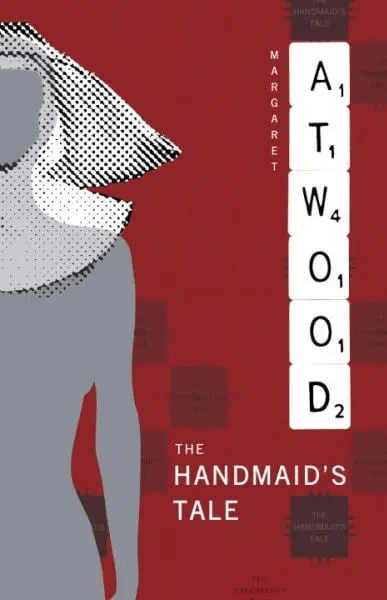
Margaret Atwood’s 1985 masterpiece The Handmaid’s Tale — a futuristic dystopian novel in which fertile women are ritually raped to produce children for an elite, ostensibly Christian theocratic elite — is art, though the propagandists are trying their damnedest to make it their own.
Since the election of Donald Trump, and especially post-Roe, The Handmaid’s Tale has been used by liberals as a proof text, which is to say as propaganda— seeing the “fulfillment” of the novel at every turn. Atwood herself has accepted the mantel of prophetess, tweeting a photo in which she holds a mug that proclaims, “I told you so,” and penning a somewhat “embarrassing” article in The Atlantic titled “I Invented Gilead. The Supreme Court Is Making It Real.”
Since it is art rather than propaganda, The Handmaid’s Tale cannot be so easily conscripted into the service of an ideology. The text is much more complex, much more insightful, and much more interesting than that. I’ve taught the novel at the high school level for several years, and it is increasingly apparent to me that the novel is much more frequently invoked than read.
For this reason, I thought it would be instructive to enumerate examples in the novel that cut against the progressive orthodoxy of today, in order to show that the novel cannot be so easily pigeonholed.
The political left has adopted the red robes and white-winged bonnets of the handmaids as their unofficial protest uniform, and silent handmaids have been present at pro-choice rallies across the globe. It seems that in the minds of many, The Handmaid’s Tale is about abortion. Hardly. In fact, abortion plays a relatively small role in the novel. Indeed, abortion is almost unthinkable in Gilead because an environmental crisis has rendered most of the population infertile: “No woman in her right mind, these days, would seek to prevent a birth, should she be so lucky as to conceive,” the narrator says.
When Atwood does describe the unborn, she emphasizes their humanity. The narrator describes her pregnancy this way: “Lying in bed, with Luke, his hand on my rounded belly. The three of us, in bed, she kicking, turning over within me. Thunderstorm outside the window, that’s why she’s awake, they can hear, they sleep, they can be startled, even there in the soothing of the heart, like waves on the shore around them.” This is the kind of pro-life language likely to send a red-robed, bonneted protester into paroxysms.
It might be more accurate to say that the novel is more about the exploitative practice of surrogacy than it is about abortion. In the novel, fertile women are kidnapped and ritually raped so they might serve as unwilling surrogates to an elite class of infertile couples. In Gilead, this practice is justified by appeal to the precedent of concubinage in the Hebrew Bible (see Genesis 30:1-3). Today, surrogacy is similarly justified by religious-theological logic, but now the theology is neither Jewish nor Christian. As Mary Harrington has shown in her fabulous recent book Feminism Against Progress, a trinity of closely related secular ‘theologies’ underwrite the modern surrogacy industry: “progress theology,” “cyborg theology,” and “Meat Lego Gnosticism.” All of these theologies are closely tied to political progressivism.
According to Harrington, modern progressivism is founded on the belief that true freedom, true “personhood”, can only be accomplished by technological liberation from any and all biological constraints— including, of course, those most burdensome constraints of biological femaleness and pregnancy/reproduction. Biolibertarianism ultimately promises to liberate one’s true self from the “meat prison” of the body. This resentment of the body-as-prison, and the idea that the body can be remade according to one’s will, or even transcended entirely, Harrington memorably names “Meat Lego Gnosticism” because she sees in this contemporary trend a resuscitation of that ancient Christian heresy. Bio-libertarianism is related to, or perhaps terminates in, what Harrington calls “cyborg theology” — the idea that because our human bodies are no more than gross, disposable impediments to self-actualization and freedom, progress demands men and women cease being men and women to instead become disembodied “selves” — a consciousness uploaded to a computer, say — or hybrid creatures, more machine than human.
The upshot of all of this, of course, is that the work of pregnancy/reproduction must inevitably be outsourced, subcontracted, and delegated to those women at the bottom of the economic and cultural ladder so that “freedom,” “independence” and “progress” might be purchased by an elite few. So, both Kim Kardashian and Grimes (wife of Elon Musk) have used their considerable capital to circumvent the inconveniences of pregnancy by outsourcing the reproductive “labor” to anonymous women certainly belonging to a lower economic class than themselves.
The red-robed handmaids showed up to protest the nomination of Justice Brett Kavanaugh because of allegations he had sexually assaulted Christine Blasey Ford. But The Handmaid’s Tale contradicts the accepted #Metoo wisdom that it is necessary to “believe [all] women” and it raises the possibility that rape accusations could be weaponized against political rivals. In the novel, a low-ranking Gilead official working as a double-agent for May Day, a covert resistance group aimed at destabilizing the totalitarian Gilead, is falsely accused of rape by Gilead officials and is then publicly, violently executed. “Don’t be stupid. He wasn’t a rapist at all, he was a political. He was one of ours,” a handmaid in the know explains to the narrator.
In the novel, the totalitarian regime of Gilead kidnaps the children of “unfit” parents and adopts them out to loyal party members. Last year, California passed a bill with the power to strip parents of custody if parents didn’t hold correct views about gender-identity. The bill was vetoed by Governor Gavin Newsom.
None of this is to suggest that The Handmaid’s Tale is “actually” a conservative or right-wing novel. I have no interest in propagandizing the novel in the opposite direction, or in flattening it along a different axis. It is only my desire to wrest the novel back from the propagandists, and to encourage everyone to actually read it.
To quote Bradbury again, “You don’t have to burn books to destroy a culture. Just get people to stop reading them.” It strikes me that the quote might be revised and updated somewhat, to this effect: “You don’t have to burn a book. Just get people to believe the book is a simple, propagandistic parable. Then no one will read it, but everyone will feel they know what it means anyhow.”


Related Posts