The Cartesian Universe and the End of Common Sense
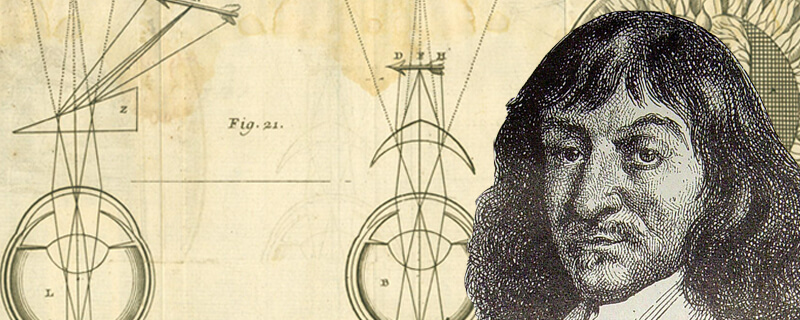
“I realized that it was necessary … to demolish everything completely,” Rene Descartes asserts in his 1641 Meditations on First Philosophy “… and start again right from the foundations.” Ultimately, Descartes affirms the certainty of his own mind against the ephemera of nature and his own body. He trusts his thinking mind, but doubts his senses. We can doubt what we think, but we cannot doubt that we think. Cogito ergo sum—“I think therefore I am.”
Descartes’ phrase is amongst the most revolutionary phrases of the last half millenium. Like most such phrases, his proclamation actually reflects larger historical processes already in play.
Descartes lived in a time of great social, political and philosophical ferment. Europe was in the midst of great religious conflict and the transcendent authority of religion was being challenged on two fronts: Individuals were affirming a capacity for their own personal relationship with God unmediated by priestly authority and an emergent modern science was challenging Church explanations of the physical nature of the universe. Descartes inspired a kind of resolution to the great conflicts of his time, or at least a way forward.
Descartes divided the world into its inner and outer aspects. The inner spirit of the individual mind would be granted respect, while the outer material world would be the realm of science and reason. Descartes separated the immaterial human mind from the material universe. “This is the magnificent, the decisive discovery of Descartes,” argues Spanish philosopher Jose Ortega y Gasset in his What is Philosophy? And this discovery, “… like a great wall of China, divides the history of philosophy into two great halves: the ancients and the men of the medieval world are on one side, the whole of modernity on the other.”
Reading Descartes provides a kind of preview or coming attractions for the spectacle of the modern world. His insights would spark the Enlightenment, fuel the great democratic movements and sanction the free inquiry of science. The subject/object division virtually defines the modern word and everything we think of as progress. Descartes set us on the road to becoming subjective beings in an objectifiable universe.
The Cartesian Project
The Enlightenment Project is the Cartesian Project. What we call “progress” involves the promise of individual liberation with evermore knowledge of and control over nature. “We are born free,” proclaimed Jean Jacques Rousseau in 1762, “but everywhere in chains.” The Cartesian Project will systematically remove our chains.
Descartes’ ruthless doubt reveals the pure thinking mind to be the one certain fact of human reality. Beyond the human mind there exists an ambiguous world apparently only knowable by strict adherence to reason and what would become scientific methodologies. Like other philosophers of his age, Descartes determines reality to be essentially a kind of machine, an object which can be known by being taken apart. It will be systematically broken down and transformed into what we have come to call facts or information.
The liberation of the individual and the conquest of nature are two aspects of one project. Science renders reality into information which can be manipulated by human ideas. We tend to think of the emergence of modern science as the definitive trait of the modern world, but scientific facts are in themselves meaningless without understanding their relationship to the emergent authority of the human mind. “The world is my idea,” thus begins Arthur Schopenhauer’s 1818 World as Will and Idea. This phrase is emblematic of the whole Cartesian Project. As idea making individuals, we can remake an objectified reality more or less as we please. Riding the wave of the Industrial Revolution, the Cartesian Project becomes increasingly politicized and we enter the Age of Ideology. The world will be our idea.
The word “ideology” was invented in France in 1796 during the height of the French Revolution. It reflects the notion that human reason can determine our human social order. Competing ideologies are competing idea systems on what to do with the objectifying, wealth generating forces. Broadly, what we call “Right” ideologies emphasize the free reign of these forces, and what we call “Left” emphasize more social control over the forces.
In the 19th century Left and Right ideologies began to conflict, but generally the wealth and technology generating forces were harnessed by existing regimes who fortified and expanded their empires. However, at the same time these very forces were eroding their own civilizational foundations. By the early 20th century much of the world found itself in a “war to end all wars.” The great monarchies collapsed and the world fell into chaos. Out of the rubble emerged total ideologies, radical attempts to remake reality by one wholly dominant, pure and even utopian idea.
The great totalitarian ideologies turned out to be what Ortega called “false dawns.” They brought destruction, poverty and death. By the middle of the 20th century they were widely discredited. However, few questioned the essential logic of progress. These catastrophes were not necessarily perceived as the inevitable consequences of the Cartesian Project, rather, they were seen as misinterpretations of the Cartesian Project. Although they brought unprecedented suffering, they did, after all, promise liberation and prosperity. What was required moving forward was better ideas—more information, more technologies, more wealth, more liberation, more progress.
Progress is a promise that material prosperity and individual liberation are preferable to the limited world of tradition. In the second half of the 20th century, the Cartesian Project continued the displacement of traditional forms of authority and knowledge. Instead of responsibilities and obligations we as individuals are granted an ever proliferating set of “rights.”
However, many traditional systems and conventions have not vanished, rather, they have simply been neutered, relativized and themselves reduced to individual rights. Religion has become “varieties of religious experience” and art, traditionally the human imagination’s capacity to know reality, has become ghettoized as aesthetics or self expression. In the Cartesian Universe, cultural traditions, what people once fought and died for, have been largely defanged and drained of political and existential power. Liberated from all that prejudice and narrowmindedness, we can embrace and celebrate culture as so many forms of entertainment and subjective preferences.
By the end of the 20th Century the Cartesian Universe had only gotten more Cartesian. The more successfully science, reason and bureaucratic systems objectify reality the more we experience ourselves as liberated subjective powers. The Cartesian Project appeared to reach its apogee: Wealth generating institutions reached an identity of interests with wealth regulating institutions; the Corporation and the State harmonized; Right and Left ideologies fused. The integrity of every individual was affirmed and everyone was determined to have a right to the fruits of progress. The whole world seemed to be finally accepting that we are all subjective beings in an objectifiable reality. Exalting the inevitability and justice of the Cartesian Project, Francis Fukuyama declared the End of History.
But history did not end.
The Information Aristocracy
Descartes unleashed a radical skepticism which has come to characterize the modern world. But this skepticism hasn’t so much discovered true foundations as it has demolished all foundations. All conventions, traditions and hierarchies are subject to ruthless doubt. Descartes was certain that his mind knew God; today we are just as certain that our minds know no such thing. The ruthless quest for pure certainty ends in a kind of pure uncertainty. Cartesian doubt is an acid which dissolves all forms. We may have lost meaning but we do have power. And some have more power than others.
In the name of liberation and prosperity the Cartesian Project challenges and dismantles traditional forms of authority and hierarchies of power only to recreate them on a level never before seen in history. Joel Kotkin describes this emergent system as a form of Neo-Feudalism, a vast global hierarchical system overseen and guided, not only by the great entrepreneurs, but by a “clerisy” who generates and controls information. The world turned into information empowers a managerial class of experts, bureaucrats and technocrats, a veritable Information Aristocracy. This great institutionalized class of objectifiers is the inevitable product of the latter stages of the Cartesian Project. They promise to make the world safe, prosperous and just for all us subjective beings. What we call “education”—especially “higher” education—has become little more than a certifying process for induction into the Cartesian vision of the aristocratic classes. For our new masters the world is their idea.
Jonathan Rausch’s recent The Constitution of Knowledge is a revealing apologia for the rule of the Information Aristocracy. Rausch calls this class the “reality-based community.” They constitute “an elite consensus” of “professionals and institutions”—scientists, academics, journalists, jurists, intelligence services, fact checkers, disinformation experts, Wikipedia editors etc. By faithfully adhering to the proper “method for establishing facts,” this class embodies a kind of self correcting, self validating knowledge constituting machine. Unfortunately many of us yet live in what Rausch calls “bias confirming communities” so it behooves us to recognize the authority of this new secular priesthood who curate what qualifies as real knowledge.
They say to a hammer the whole world looks like a nail. To the objectifying mind the whole world looks like information. A great irony of the Cartesian Universe is that as the world is turned into an object, even we liberated individuals are turned into objects. Descartes famously looked out his window onto a busy street and saw, not fellow human beings, but so many “automatons.” As Descartes’ heirs, our Information Aristocracy of beneficent managers and controllers look out their windows and see the rest of us as consisting of so much information, so many predefined categories to be managed and controlled for our own good. And with the ascension of digital reality the whole universe is now transformed into its most manageable form—data. As individuals adapted into digital reality we may be granted all kinds of rights, but at the same time we require perpetual monitoring, surveillance, censorship and protection from misinformation.
One of the defining traits of our Information Aristocracy is its obliviousness. They clearly see a world of pieces but are blind to the whole. Living high up on the Cartesian food chain our new aristocrats bask in a perpetual sunshine of their own beneficence wholly disconnected from the consequences of their incessant tinkering. They are constitutionally incapable of understanding (let alone respecting) those on the low end of the Cartesian food chain, those who most bear the brunt of a world turned into information, those “bias confirming communities” who remain reliant upon a world of traditional knowledge and relationships. Our Information Aristocracy has forgotten that most fundamental obligation of rule: maintain the trust of the ruled. So the people are revolting? Well then, let them eat facts.
The Cartesian Project does generate unprecedented material wealth but it simultaneously destroys meaning. And as the Cartesian Project grinds the world down into information it continuously generates a toxic by-product: alienation.
Among the great poster boys for this alienation is Fyodor Dostoevsky’s anonymous “Underground Man.” He speaks for generations of those who resent their dehumanization by those who control the objectifying powers of progress. The Underground Man’s warning to all would be objectifiers resonates to this day:
Shower upon him every earthly blessing, drown him in a sea of happiness, so that nothing but bubbles of bliss can be seen on the surface; give him economic prosperity, such that he should have nothing to do but sleep, eat cakes and busy himself with the continuation of his species, and even then, out of sheer ingratitude, sheer spite, man would play you some nasty trick.
The Underground Man understands quite clearly the full implications of the Cartesian Project: The abolition of suffering is the abolition of man. He concludes his narration with this prophetic observation:
It’s a burden to us even to be human beings—men with our own real body and blood; we are ashamed of it … We are stillborn, and for generations past have not been begotten by living fathers, and that suits us better and better. We are developing a taste for it. Soon we shall contrive to be born somehow of an idea.
The great and enduring significance of the Underground Man is not that he points out the failures of the Cartesian Project; quite the contrary, he rejects the very success of the Cartesian Project.
Res Cogitans
In his Second Meditation Descartes refers to himself as res cogitans, “a thing that thinks.” Everything else is res extensa, “extended thing,” everything else is the material universe. This division appears to have only intensified over the centuries: The more successfully we objectify reality the more we experience ourselves as subjective beings. We assume that human ideas make reality and that every individual can be liberated as a thing-that-thinks. Our minds are one thing, nature is something else—even our bodies are something else.
Descartes identified his thinking mind as a logical product of the mind of God. But, with the death of God we now determine this thing-that-thinks to have somehow emerged, like everything else in nature, from the random play of material forces. Having successfully transformed nature and the human body into information, science now directs its objectifying powers toward one of its great and final frontiers: the human mind itself. Science will now put this so-called thing-that-thinks on the proverbial wrack. Objective information will be extracted from subjective experience. Neuroscientists call this “the hard problem of consciousness.”
Armed with clever esoteric theories and incredibly precise technologies, science explores the wilderness of the human mind. A few sightings of “consciousness in itself” have been reported—a suggestive neuroimage, intriguing brain wave corelations—but no hard evidence, no convincing evidence. Perhaps we need better theories, more precise measurements, more funding ..? But at what point might we begin to question the viability of the whole quest? Are we witnessing the limits of scientific methodologies? Is the dualistic Cartesian Universe being devoured by its own logic? Is it a snake swallowing its own tail? Is consciousness in itself the Holy Grail of science or is it the Bigfoot of science?
The world is whole, we divide it with language and concepts. Over time we tend to take what began as poetic interpretations as real, even as elemental truths. Alfred North Whitehead called this the “fallacy of misplaced concreteness.” The-thing-that-thinks is a concept peculiar to the Cartesian Universe. But how can there be a mind disconnected from a reality beyond itself? Which is to say, how can there be a mind without a body, without sense experience? What content could it possibly have? And how did consciousness in itself evolve out of an unconscious universe? How could res cogitans arise out of res extensa? Is the very idea of a thing-that-thinks, or, indeed, the whole subject/object divide, merely one more misplaced concretization of categories generated by a certain kind of human mind at a certain time in history?
Descartes determined his mind to be the one certain truth of the universe. The universe flows from res cogitans. The world is the mind’s object. We have been guided for several centuries by a “philosophy” Ortega describes as “ … moving upstream and against the life current … philosophy becomes the world in reverse, a magnificent, anti-natural doctrine of the initiate, a secret wisdom, an esoteric creed. Thought has swallowed up the world: things have turned into ideas.”
No other civilization had ever assumed such authority for the human mind. Up until the modern world no civilization ever presumed reality could be essentially determined by human ideas. All previous civilizations were outer directed; they acknowledged and defined themselves by their relationship to powers outside themselves. Ortega continues:
… the ancient world knew only one manner of being, which consisted in exteriorizing itself, hence in opening itself up, in displaying itself, in directing itself to the outside. It follows that the revelation of being (this the truth) they would call ‘discovery, … manifestation, denuding.’
Historically humans mostly experienced thinking, not as a thing in itself, but as a process, an experience of encountering forces outside of themselves. Human language itself arises from sense experience, or, more precisely, from the common sense experiences of some group of humans existing together over time. Common experience, transformed by the human imagination into stories, images, conventions etc., historically forms the basis for all social organization. The Cartesian Project inevitably dismisses the processes by which humans for millennia determined what constituted knowledge and how people related to each other and to the world beyond themselves.
No doubt premodern societies were prone to their own fallacies of misplaced concreteness, but for them there was no world of disembodied information and there was no isolated thing-that-thinks. Scholars have long noted the general lack of self consciousness in ancient literature. For those whose lives, whose very survival, consisted of engagement with living forces outside of themselves, self consciousness was a luxury they could rarely afford. Hubris is what the Greeks called the failure to acknowledge the authority of greater powers.
Descartes appears to be motivated by a need for certainty and he claimed to have found it, not in the world, but in his own thinking self. Ortega wonders about the consequences of this insight:
To discover so strange a reality of the conscious—does this not imply turning one’s back on life, is it not taking an attitude which is completely opposed to that which is natural to us in living? Is it not natural to live outwardly, directed to the world about us, to believe in its reality..? Descartes … cuts the cables which unite us and mix us with the world—with bodies, with other men; he makes of each mind a private precinct.
Our Cartesian minds are evermore adapted into a Cartesian Universe. More than ever, we are subjective beings enveloped by an objectified reality. The subject/object divide, simmering through the centuries, vaporizes traditional knowledge and ultimately renders itself down into a world of egoists and experts. And as information becomes data, modern media further extends our awareness into worlds of which we can have ideas about, but of which we have no direct experience. We have become quite comfortable in a reality where everybody oozes opinions, but nobody embodies wisdom.
Today we see the Cartesian Project culminate with millions and millions of liberated/disconnected “I’s” floating through an unending universe of billions and billions of “bits” of data. Each isolated “I” is entitled to fashion their own personal reality, while nature and society are managed and shaped by whomever or whatever manages and controls data. For the liberated thing-that-thinks, we as individuals do not become who we are by participating in reality, rather, we get to choose who we are—even our own bodies are so much raw material. I am my idea. From the Ancients to Aquinas, it was our “souls” which united our minds to our bodies and our bodies to the universe. In today’s divided Cartesian Universe we no longer have souls, but we do have identities.
Descartes is known as one of the great founders of the Enlightenment and a champion of reason and science. But the ultimate significance of Descartes is not simply his radical division of mind from body, subject from object, but the denigration of our human capacity to engage and transform sense experience. Descartes’ doubt is the doubting of experience itself. We only function cohesively as social beings to the extent that our common ideas of reality are grounded in a common experience of reality. We live by generating meaning, not facts. And human beings deprived of meaning are prone to nasty tricks.
We seem to be experiencing the Cartesian Project in both its fulfillment and its descent into incoherence. It does not end in some grand unification but in social and psychological fragmentation; not in an ever more precise knowledge of reality, but in kinds of thinking increasingly dissociated from common sense experience. We are among the most sophisticated and informed people in world history yet we are scarcely capable of distinguishing sense from nonsense.
Civilizational Madness
Reading Descartes I find myself beguiled by his crystalline and unrelenting logic. Yet, simultaneously, I am annoyed by his promiscuous skepticism of sense experience. I wonder, how might somebody whose knowledge of the world is necessarily grounded in common sense experience find Descartes? How might a philosophically minded farmer or fisherman or even new mother react, for example, to this passage from his Meditations: “I shall think that the sky, the air, the earth, colors, shapes, sounds and all external things are merely the delusions of dreams … I shall consider myself as not having hands or eyes, or flesh, or blood or senses but as falsely believing that I have all these things.”
What kind of human being would describe himself as “a thing that thinks?” What kind are comfortable in a world of ideas with no necessary connection to experiential reality? George Orwell famously noted modern intellectuals’ propensity to believe absurdities contrary to
common sense. And indeed many of the totalitarian brutalities of the last century were perpetrated by human beings with ideas in their heads with little or no relation to reality. Like Orwell, the psychiatrist/philosopher Iain McGhilchrist questions our modern infatuation with abstractions and our disregard of common sense experience. In The Master and His Emissary he specifically addresses the relationship between Descartes’ “philosophical enterprise” and a common form of clinical insanity:
Affective non-engagement could be said to be the hallmark of schizophrenia. The sense that the world is merely a representation … is very common, part of the inability to trust one’s senses, enhanced by feelings of unreality that non-engagement brings in its wake—nothing is what it seems. Such an inability to accept the self evident nature of sense experience leads to an emptying out of meaning. There is a characteristic combination of omnipotence and impotence, of being all there is and yet nothing at all, which again follows from the lack of betweenness with what is, with the world of common experience.
Rene Descartes divided the world in two. The Enlightenment encouraged us to step back from and observe reality. This has brought us all kinds of wealth and progress. But over the centuries we have been standing back for so long that we seem to have forgotten what it means to be connected. We have forgotten what it means to be united and guided by common sense experience. As the Cartesian divide expands does it continue to signify unending progress, or is it beginning to look more like a kind of civilizational madness?


Related Posts