The Crucifixion of the Desk: Thomism and Virtue in a Canticle for Leibowitz
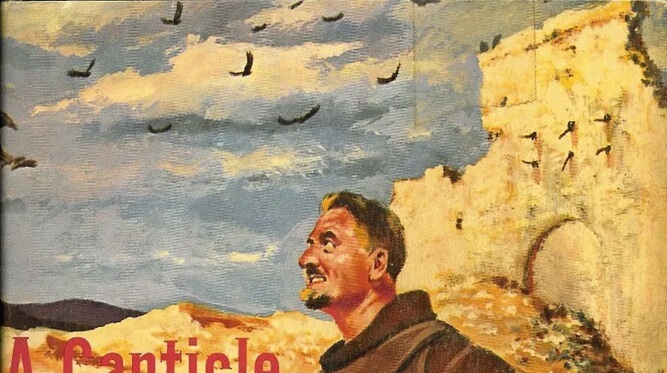
In the first century B.C., crucifixion used to be violent, bloody, and perpetrated with wood and nails; throughout the centuries, many have questioned and continue to question the purpose of the most famous crucifixion in history. While the bloody form of this no longer occurs per se, many contemporary individuals still question the purpose and end of an alternate crucifixion available to most everyone, still involving wood, nails, and a violent struggle, that is, the crucifixion of the desk. In the great chasm that lies between the individual seated before a textbook and the moment that the same individual begins to study, many have found new appreciation for the perennial questions: “why am I even here?” “what’s the point of this?” and my personal favorite, “what if I dropped out tomorrow?” The novel, A Canticle for Leibowitz by Walter Miller asks each of these questions through the practical and messy realities of monastic life in a progressing society, providing some answers, or at least a hermeneutic by which to determine the purpose and proper relationship between study and other goods. Reading the Canticle for Leibowitz (CL) through the Thomistic lens of virtue and study helps us judge the actions of the characters. Seeing these traits lived out in the tension of practical reality, albeit a fantastical one, gives us concrete referent from which to analyze and see these same tensions, virtues, and vices in our own lives and choices.
CL tells the story of a monastery set in a post-apocalyptic world governed by a society that has essentially been returned to the Dark Ages via nuclear fallout. In this clime, knowledge is abhorred and knowledgeable people are persecuted as causing the demise of humanity, but the mission of the monks is to secretly protect and keep any scraps of knowledge that they can find. When we are first introduced to the monastery, it is several years since the founders have passed and the monks no longer possess any context for the information that they now steward, simply preserving and copying important texts. By torchlight, they chant, pray, and illuminate various scraps of preserved information. The book follows the monastery through different eras, later jumping to a renaissance and finally to a postmodern era. Thus, Miller describes the story of the monastery itself as it attempts to remain consistent while experiencing both interior and exterior influences.
The first section, set in the Dark Ages, proposes the question of whether knowledge is worth pursuing at all, even and especially when the knowledge cannot be gainfully employed by those who steward it. In fact, we see this typified in the first character we meet, Brother Francis, who is the quintessential postulant: hopelessly daft and scrupulously obedient. After final vows he holds fast to the charism of the monks through his role as a copyist, reproducing important texts as well as beginning a project of illuminating a circuitry blueprint. He cannot understand the blueprint whatsoever, which is highlighted by his foolish characterization. This is further emphasized by his confrere, Brother Jeris, who makes it painstakingly obvious that Francis can do nothing more than parrot what little he can read off of the blueprint. Though unkind, Jeris is not entirely wrong in his cynicism. No current monk has the ability to comprehend the underlying principles of the ‘science’ they preserve as the diagrams are lacking all context. In a world completely devoid of context, this frustration is fundamentally human, which St. Thomas’s description of studiositas helps explain. He describes Studiositas as a subvirtue of temperance because the desire for knowledge is fundamentally appetitive, that is, baked into our human desires. A complete refusal to enter into any learning would thus be vicious and unfulfilling. For the monks, then, the circumstantial lack of ability to learn rightly causes frustration. Unfortunately, what Br. Jeris lacks is a fulsome understanding of the context of his monastery; while he personally cannot benefit from the preservation of knowledge, the monks do not exist in a vacuum, which the others recognize. Because knowledge is an end in itself, their current role is actually worthwhile both for themselves and for the corporate body of humanity.
While fantastical, the experience of the slow maturation of knowledge should resonate with the experience of every academic, on both a macro and micro level. First, this is simply an accurate depiction of how knowledge develops; the maturation is and has always been slow. The current knowledge possessed by contemporary man is only made possible by the consistent but slow efforts of man throughout the centuries. Though the sciences are in different stages of their progressive unfolding, the beginning is just as important as the end. Thus, the entry into and continued dialogue within the realm of academia must always feel some of the frustration that Br. Jeris rightly hates. The humility of this process, however, consists in the recognition that a contribution by any one individual to a field cannot be exhaustive, as it may take centuries for another mind to pick up an insight and see it to fruition, which the monks also mention. Yet, the time does not negate the importance of each step, and the beginning, especially, can be a place of great potential for virtue. Br. Francis understands this and lives with the patient endurance and obedience that his confrere lacks. Despite the monotony, by his actions he acknowledges the intrinsic value of study and perseveres despite setbacks.
Moreover, this reality plays out in the microcosm of the individual studier, and Br. Francis’ example is incredibly edifying. The great chasm that lies between sitting and entering into study is predicated upon patient endurance, as oftentimes the fruits of study take a long time to flourish and thus the beginner can feel much of the aridity that Br. Jeris describes. Yet, despairing as Br. Jeris does because of a seeming lack of progress stems from a lack of fortitude. Interestingly, Br. Francis’ preoccupations implicitly give us a possible antidote to negligence. Because he was so radically incapacitated in understanding, his only option was to enter into the aspect of beauty present in the blueprint and his illumination thereof, and he does this with a quasi-obsession. However, this makes sense, as this is the most life-giving option available to him in a dark scriptorium. For the student, a true appreciation for a topic always makes it much easier to study with fortitude. Entering into the beauty, like Francis, is one of the easiest ways to enjoy the subject, because as Thomas describes, appreciating beauty does not consist entirely of a cognitive act. Even if concrete truths remain obscure, the claritas itself still can resonate with the heart. This is true for Br. Francis with his manuscripts as well as for the individual who begins to study a foreign language, poetry, or calculus for the first time. Thus, Br. Francis provides us with a helpful pedagogy: if at first we cannot grasp truth, we must at least find repose in beauty.
Additionally, in St. Thomas’ treatment of virtues, he often gives us the opposing vices of excess and defect. Similarly, the monastery encounters the opposing vice of excess in the new renaissance era. In fact, Br. Jeris presciently commented that if the monks ever found an ‘electron,’ they might just put it on the altar. Later, the monastery encounters this vice of curiositas and struggles to understand the proper subordination of study to other goods. In CL as in real life, most characters have complex motivations, muddling competing desires and intentions throughout the process. The first inter-monastery difficulty occurs when a brother recreates an electric light, but the only suitable place to hang said light is in the place of a crucifix. Clearly, the replacement of Christ by technology, literal and symbolic, creates unease for some monks. However, its monastic proponents argue for the change from the reasons of the goodness of technology and how it affords them a greater ease of study in the dark library. They even have a blessing ceremony to ordain the light for this purpose. Essentially, their ends are goods in themselves as well. Here, it clearly portrays how the monks have come to appreciate and live well in a reality where they can finally learn and grow in knowledge; the seeds that Br. Francis planted have finally borne fruit. The monks begin to see how the effects of knowledge often come with other ramifications, in other words, we see the principle of double effect play out. Because the primary intention of the monks is to subordinate their charism to Christ and prayer, they eventually remove the light, which they determine has disproportionally shifted their focus.
The tension is further complicated by the introduction of our first secular scholar, Thon Taddeo. He introduces a host of issues as his character is mostly representative of the state, but his actions are tempered by genuine intelligence and a desire to learn. Thus, when Thon Taddeo later learns of the lamp, he becomes angry, and it seems to come from more than simply pride. Thon then and in later dialogues reveals that an aspect of his motivation for study is for further control of nature. His patron, an emperor, continues to act as a benefactor because the emperor also seeks to use his discoveries for greater control of other empires, and Thon will lose his patronage if he does not act in accord with him. This causes friction with the monastery, as Thon clearly knows the secondary effects of his research, but his desire to continue causes him to be willfully ignorant, which is drawn out in several awkward dinners and speeches. Thon and his patron have thus vitiated the object by making it a means, rather than an end in itself. Instead of the monks, who can see the change that the electric light brings, the state has leaned into this orientation to knowledge for the sake of control. In fact, Miller’s world will again be destroyed by nuclear fallout. Dramatically, Miller draws out questions surrounding the morality intentions and of research, as this cannot exist in a vacuum.
Though less dramatic, the microcosm of the individual feels this tension also, and the reader can learn from Millers’ questioning. Often, the very act of study can be aimed only at the goal of graduation, or success, or pride, or another competing end. While these malformed intentions most likely will not end in nuclear fallout, both the Aristotelian and the Thomist will find it worthwhile to analyze their competing goals. Often, like the monks perceived, there are secondary effects that may aid or shift the original purpose. Desiring to graduate is not a bad end in itself. However, if it subsumes the orientation to study as its own end, or makes study simply a means, it can vitiate both actions. Like the monks, course correction over time may be necessary.
While these tensions are not exhaustive, seeing the competing desires play out in concrete circumstances with real and sometimes dire consequences serves to magnify and draw out the nuances of the often less spectacular tensions of everyday life. Miller teaches us, by example, that entering into study is difficult, but the consistent application of the mind to a topic will cause true growth in virtue. To do this, the student must tread the middle way between negligence and curiositas. In the end, each choice is important and can lead to a different sort of death by study, for which nuclear fallout may well experientially register as an apt analogy for the student. They can fail and die as Thon and Br. Jeris do, or they can lean into the purification, allowing their disordered passions to be tempered, crucified, and nailed to the wood of the desk, and through this slow purification, cultivate growth in both the intellectual and moral virtues.


Related Posts