It’s the Economy, Stupid
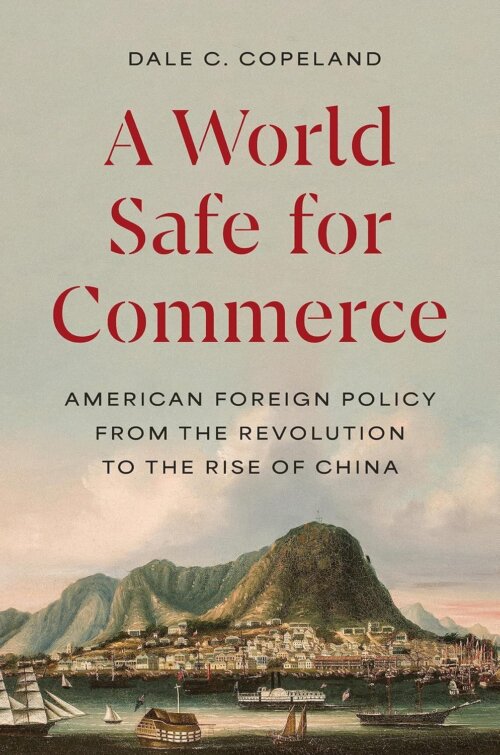
During the 1992 American presidential campaign, Democratic strategist, James Carville hung a sign in Governor William Jefferson Clinton’s campaign headquarters with three phrases, including the now famous “The economy, stupid.” The expression was meant to emphasize that, despite the patriotic fervor surrounding George H.W. Bush’s rapid fire victory during the Gulf War, what Americans really cared out was the price of groceries and their gross annual income. Carville was very well aware that the history of America was a religious, cultural, military, and sociological history, but it was also an economic history. In his recent work, A World Safe for Commerce: American Foreign Policy, the University of Virginia professor of international affairs, Dale Copeland, argues that the history of America-especially American foreign policy—is an economic history.
Copeland sees the American Revolution as providing the blueprint for economics as the driving force of American foreign policy. Copeland notes that there are two fundamental scholarly views of the American Revolution. The first sees the revolution as being driven by the rise of commercial capitalism, while the second, famously held by Gordon Wood, sees the revolution as being driven by Enlightenment ideas of liberty. Copeland adds to these arguments with his dynamic realism, rooted in economics and power politics. Copeland views the cause of the American Revolution as being rooted in conflicting perspectives of how British mercantilism should work. One side attempted to harvest money from goods produced throughout the British Empire in places such as America. The other camp believed that Britain should expand its empire in order to expand its markets. Interestingly, this second expansionist vision would become one of the driving visions of the United States. Nonetheless, Copeland sees the American Revolution as being an expression of the tension between the British desire to control its commercial power over the United States, and the American fear that this control would diminish the wealth and power of Americans. This desire for control of markets and expansion territory and population as means of maintaining and extending markets is, for Copeland, the driving force of American foreign policy from the revolution to the twenty-first century.
The US entry into World War I seems to be an exception to Copeland’s thesis. Indeed, as Copeland states, America was prospering economically by staying out of the First World War. Even the sinking of American commercial ships was not, according to Copeland, the primary catalyst for American entry into World War I. Copeland admits that Woodrow Wilson seems to be an exception to Copeland’s thesis, for Wilson was strongly driven by intellectual principles. At the same time, Copeland argues that Wilson and his advisors Colonel Edward House and Robert Lansing held that state must defend its economic interest in order to maintain its political power. Wilson also was willing to use force to bring about order when confronted with German-influenced chaos in Mexico. Copeland interestingly points out that, at this time, America saw not only Germany, but even Britain as an economic and thus political rival. America ultimately entered the war to defend her economic interest against Germany.
The Cold War was likewise an intellectual as well as economic struggle, and Copeland emphasizes the economic pas à deux between America and Russia. The first key (and oft forgotten) struggle of the Cold War was over Iran, which would provide much needed oil and natural gas for Russia. As oil and gas in the Middle East provided a key role in World War II, so too did it shape the Cold War (and the subsequent War on Terror). Copeland further argues that Russia’s involvement in the Korean War was largely in (economic) self-defense. As Copeland documents throughout his book, East Asia played a key economic role in American trade, and despite the intellectual desire to keep Communism out of East Asia and prevent the “domino effect,” there were strong economic factors behind not only the Korean, but Vietnam War.
Copeland’s argument crescendos in his final chapter, “Economic Interdependence and the Future of U.S.-China Relations.” Copeland sees China’s rise to the status of superpower or “superpower to be” as being the most important geopolitical trend in the past thirty years. In 1991 China’s economy was only 10 or 15 percent of the American economy, yet it has become nearly 80 percent of the US economy by the 2020s. Copeland interestingly notes that Russia, despite its tremendous presence in the contemporary news cycle, is not nearly the economic powerhouse China is and has an economy roughly equivalent to that of Italy. Copeland records that contemporary American views on China range from hostile hawkism to economic integration and cooperation. The hawks or pessimists see America in decline and an expansionist China that will gain a dominant hold on the world in the next decade. In contrast, optimists doubt whether China can overtake the United States and take not of America’s steps to limit and curtail China’s power.
Copeland’s dynamic realism acknowledges that China, like all great powers, will naturally expand. Copeland further notes that China is notoriously secretive about its internal workings, and Sino-analysts—whether pessimist or optimist—may be responding to China’s misleading self-projection as opposed to the real internal workings of the country. A lot of the future of China depends on Xi Jingping’s ambitions and whether he is an “irrational actor” like Adolf Hitler or a calmer and more patient ruler like Joseph Stalin (Copeland, for his part, proposes and then rejects the Hitler comparison). The future of China and Sino-US relations also depends on China’s ability to maintain economic expansion. Like Britain, America, and Germany before it, China must continue to expand its markets to maintain its growth. There is, of course, the underlying question of whether or not China would have to use military force, like America before it, to protect and increase economic expansion.
In his 1979 book, The Postmodern Condition, French philosopher Jean-François Lyotard argues that the postmodern condition entails, among other things, the collapse of grand narratives. While major intellectual structures such as Christianity, nationalism, science, or evolution had shaped Western civilization, such structures had, allegedly, collapsed, leaving a pronounced intellectual and moral hole. In the twenty-first century, we have entered into what has been called a “post-ironic,” “post-postmodern” phase in which narratives are reasserting themselves, and, in the United States, there are many new narratives circulating. The New Right has asserted the cultural and religious narrative that America is an Anglo-Celtic Protestant nation. The left has asserted the narrative that America is an ever-evolving radical force for progress and change. These narratives are not entirely wrong. However, as Dale Copeland details, at least on one level, the narrative of America has always been, for better or worse, a fundamentally economic narrative.
A World Safe for Commerce: American Foreign Policy from the Revolution the Rise of China
By Dale C. Copeland
Princeton: Princeton University Press, 2024; 479pp


Related Posts