
The New Right’s Hollow Gospel: Rediscovering the Common Good
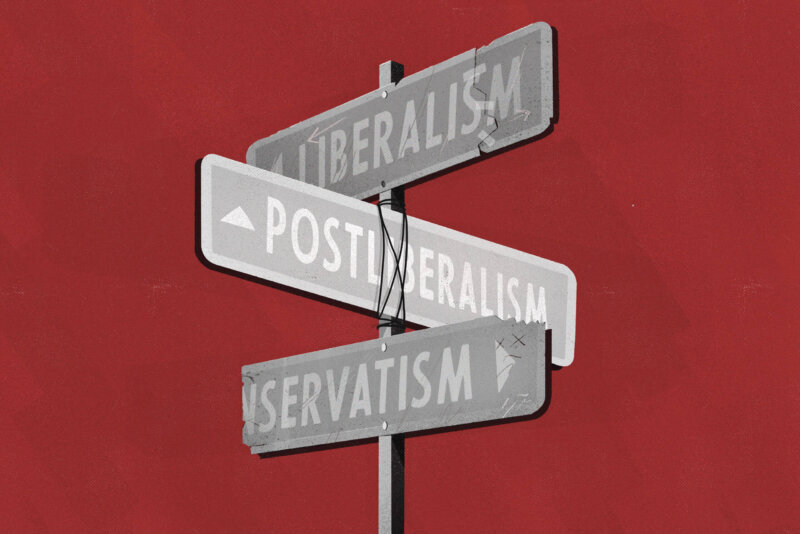
Neoliberalism is visibly decaying. The promise of effortless prosperity that once sustained a belief in the mythos of the American Dream now feels like a cruel joke. Its single-minded focus on the primacy of material gain has denuded Middle America and Britain’s countryside, induced a generation of young women to degrade themselves on Onlyfans for profit, and caused the public square to atrophy into a vapid marketplace for mindless consumption masquerading as freedom.
In this climate, the catechism of freer markets and freer speech preached by conservative mainstays like Ben Shapiro lands with a thud. Shapiro’s dogged defense of classical liberalism is, for all his good intentions, ill-suited for an age where liberalism’s own fruits are utterly noxious. Even his economic advice betrays the deeper rot. Shapiro’s insistence that people shouldn’t retire in their sixties is particularly tone-deaf. While such fiscal conservativism may be technically correct, the remark still lands poorly. This is because his hyper-fixation on economic minutiae and actuarial arithmetic blinds him to the moral truth that forcing people to work into decrepitude to preserve a crumbling system is fundamentally undignified.
This heedlessness to the intrinsic worth of human life serves as a microcosm of the deeper rot that afflicts the other aspects of Shapiro’s worldview. And it is precisely this neoliberal moral barrenness that has driven those on the Right away from Shapiro’s arid conservatism toward darker, more explicitly theocratic substitutes for meaning.
Those on the Right, in their search for a politics of meaning, are increasingly abandoning the desolate morality of materialism peddled by mainstream conservative influencers. The collapse of neoliberal conservatism has created an opening for the theocratic ethno-nationalism preached by Nick Fuentes. Fuentes proudly proclaims himself a devout Catholic, yet his constant stream of slurs and epithets betrays a different creed altogether.
Beyond his theatrics, Fuentes’ primary accomplishment has been the creation of the ‘Groyper’ movement. Its animating creed is the restoration of Western nations to their White, Christian roots, premised on the claim that “white people have a special heritage ….” The project spearheaded by Fuentes hence positions itself in opposition to liberalism, one nostalgically oriented towards “Catholic monarchy, and just war, and crusades, and inquisitions”.
But like its figurehead, the movement is inherently unserious as a political program. While its growing online influence is undeniable, its animating philosophy falters under scrutiny. Its worldview is an incoherent miscellany of hardline Catholic doctrine fused in an unholy alliance with racial sectarianism. Taken seriously, Groyper ideology leads to biopolitical racism aimed at fragmenting and creating “caesuras within the biological continuum”.
One need not believe all cultures are equal to see the mistake, the movement ties culture explicitly to racial membership, treating racial plurality as a hierarchy of “inferior species” to be eliminated for the vitality and proliferation of the White race.
Such biopolitics cannot be reconciled with Catholicism’s axiomatic belief in the equal dignity of all persons. But therein lies the rub. The Groypers preach about the virtues of traditional morality from one side of their mouths while simultaneously howling for the glory of realizing a Fourth Reich through the other. At higher level of abstraction, the problem is obvious: Catholicism is universalistic with its doctrines addressed to all mankind. Groyperism is, by contrast, overtly particularistic, convinced that the only path to salvation is supremacy.
For all its contradictions, Groyperism at least gestures towards foundationalist project. It attempts, however grotesquely, to construct a renewed vision of the Right from the ground up. By contrast, others on the reactionary Right have abandoned even the pretense of building a positive vision, devoting themselves instead to charting the supposed machinations of power through elite theory.
Consider Neema Parvini, better known by his online moniker, ‘Academic Agent’. Parvini worships at the temple of elite theory propagated by such thinkers as Mosca, Pareto, and Michels. For him, a Nietzschean will to power is everything, and its instrument is institutional capture. As he writes in the Populist Delusion, “one could gain institutional control simply by capturing the directorship” after which change would flow top-down as against “the disorganized majority.”
But as with Yarvin, so too with Parvini. Both thinkers demonstrate a blissful ignorance of how organizations actually function. To seize a company’s board of directors, one must first control a majority of the shares. The absolute number of minority shareholders is entirely irrelevant; what is salient is the concentration of voting rights, not headcount.
Beyond the corporate confusion, Parvini’s beloved “iron law of oligarchy” explains far too much and therefore very little. If the Right sees the Left’s success as the fruits of a decades-long ‘Long March’ through the institutions, the Left offers an identical narrative in reverse. Jack Balkin, for example, laments that pro-life activists, lawyers nurtured by the Federalist Society, and conservative Supreme Court Justices mounted their own ‘capture’ of the judiciary culminating in the overturning of Roe v. Wade through Dobbs v. Jackson Women’s Health Organization. That elite theory can be weaponized with equal conviction by the Right’s mortal enemies should give Right-wingers pause before embracing Parvini’s worldview. After all, a schema that reduces every political outcome to oligarchic manipulation is not a theory of power but an interpretive reflex.
If elite theory already collapses under the crushing weight of its over-explanitoriness, recent political events succeed in demolishing what little remains of its predictive value. Since the 2024 elections, Republicans have controlled the Congress, the executive branch, and ostensibly the Supreme Court. Yet the Party’s signature promises remain conspicuously unfulfilled. It is nowhere close to ending birthright citizenship or instituting ideological screenings for prospective immigrants. The same can be said across the Atlantic, where, prior to Keir Starmer’s current Labour government, the British Tory Party held a majority for the past decade.
The iron law of oligarchy ought to dictate that unified Republican and Tory control translates into seamless policy victories. That reality has diverged so drastically has driven Parvini to grasp at conspiracy rather than concede his theory predicts nothing. He now alleges—without evidence—that MAGA itself has been compromised by Zionist influence. This same conspiracism is applied to the Tories who, according to Parvini, have been infected by the corrupting influence of an unnamed and unidentifiable cabal of elites he crudely terms “Globohomo”.
But even setting his theory’s failures aside, it’s unclear what basis Parvini has to bemoan the Republican inaction. Without a positive vision for the Right, he lacks any normative footing to say whether the MAGA agenda was ever desirable to begin with. For all we know, the platform was completely wrongheaded from the start and its failure a blessing in disguise.
The Right’s intellectual disarray has led constitutional theorist, Adrian Vermeule, to return to the classical natural law tradition of St. Thomas Aquinas, out of which he fashions his theory of ‘Common Good Constitutionalism’ (CGC). He begins with the truism that public authorities exist to promote the common good. For him, the common good consists in securing “the classical triptych of justice, peace, and abundance” extrapolated into modernity as health, safety, and economic security. Crucially, Vermeule leaves vast space for legislative discretion—determinatio in his terminology—as CGC’s “enterprise is to … specify the major ends of constitutionalism that serve the flourishing of the political community [and thus] initiate a project that will unfold over time in a community of interpreters who share that framework orientation”.
Despite insisting otherwise, Vermeule plainly “specif[ies] desirable first-order policies”. Take abortion, he declares that the Supreme Court’s claim in Planned Parenthood v. Casey that each individual may define their own concept of existence must be rejected and “stamped as abominable … forever after.” However admirable the sentiment, nothing in his self-admittedly skeletal framework is capable of mustering a moral assertion of such magnitude. The inescapable conclusion is that Vermeule is smuggling in what his theory is too hollow to supply.
This pattern recurs when we consider his insistence that constitutional law must articulate expansive state authority to protect public health “even when doing so requires overriding the selfish claims of individuals”. Once again, he never explains how such sweeping powers were derived from his meager theory of the common good. This tension sharpens when he simultaneously denies even a rudimentary constitutional claim to healthcare, leaving the very people he insists the state is dutybound to protect at the private market’s mercy. Vermeule thereby grants the state the prerogatives of a paterfamilias without the corresponding responsibilities.
CGC’s problems grow even more insidious when we turn to his account of determinatio. Vermeule’s theory is scant on details of how legislators are to know what the common good concretely requires. Of course, we might grant that arbitrariness is inherent at certain points of the legislative process which can only be settled by the exercise of legislative determinatio—for instance, whether public bus fares should be $3.99 or $4.00 can only be settled by legislative fiat.
But Vermeule is far too quick to dismiss the possibility that legislators’ expansive powers of determinatio might be misused. He insists that “robust governance for the common good prevents or cures abuses” as though power immunizes itself against the common good. This is viciously circular: those empowered by CGC to wield broad powers of determinatio will not misuse those powers because CGC has so empowered them. Vermeule thus adopts a Herculean image of rulers—precisely the sort of political anthropology Aquinas counseled against—which denies that rulers remain susceptible to the temptations of their fallen nature.
Sensing the inadequacy, Vermeule changes tact. He claims that “there can be no talk of ‘abuse of power’” without first specifying an account of government’s ends. This rejoinder is similarly baffling. One need not craft a fully-fleshed theory of the common good to recognize that a public official legalizing the Purge has self-evidently abused his authority.
At this point, CGC resembles little more than natural law wallpaper crudely pasted over an essentially positivist structure. Once the duty to obey becomes indefeasible, positive law becomes unshackled from natural law chains. This suspicion is reinforced by Vermeule’s departure from the classical natural law tradition. He claims that “deeply unjust laws contrary to the natural law” do not warrant moral disobedience on the part of subjects.
Vermeule has thus strayed quite far afield from the Augustinian maxim lex iniusta non est lex—a law that is unjust is no law. Classical natural lawyers never denied the procedural legality of unjust laws; they denied the moral obligation to obey them. The tradition’s insistence that legal obligations are morally defeasible demonstrates that Vermeule’s attempt to treat any concern for abuses of power as liberal neurosis is little more than a strawman.
Given that Vermeule’s version of natural law theory placed us on the precipice of rediscovering the common good, it follows that we must take the plunge and immerse ourselves in a richer, more faithful account of classical natural law than the one he offers. In this regard, the most promising guide for the intellectual Right is the neo-classical natural law philosophy of John Finnis.
Finnis grounds political authority in eight basic human goods whose pursuit is intrinsically valuable: life, knowledge, play, aesthetic experience, friendship, marriage, practical reasonableness, and religion. Their pursuit is structured by practical reasonableness, that is, the moral discipline that forbids treating any good as expendable when pursuing another. Finnis lays out certain substantive requirements for practical reasonableness which distinguishes it from a utilitarian calculus or thin proceduralism.
For starters, practical reasonableness forbids us from arbitrarily devaluing or mutilating one good in pursuit of another. Thus, a state that demands subjects sacrifice friendship or conscience to enforce ideological purity violates the very goods which the system of governance was dutybound to protect. Most importantly, practical reasonableness absolutely bars the intentional violation of a basic good. For example, practical reasonableness circumscribes public officials’ legitimate authority to cull the infected during a pandemic to safeguard the healthy, for such an edict would violate the good of life.
Finnis readily acknowledges that human pursuits are manifold, but he insists that all worthwhile pursuits are structured by the basic goods. It is therefore the role of the political community to secure the conditions that allow individuals and families to pursue these goods in common. The common good is thus not a monolithic end imposed from above. More concretely, the common good requires that laws be put in place to allow for distributive justice to ensure that individuals may have adequate opportunity to pursue the good and commutative justice to correct interpersonal wrongs.
In this regard, the Finnisian legislator, much like the Vermeulean legislator, must ultimately engage in determinatio to specify the law’s content. However, unlike Vermeule’s legislator, the Finnisian legislator’s determinatio is disciplined by the substantive requirements of practical reasonableness. And unlike Vermeule, Finnis openly concedes the possibility that legislators may, on occasion, enact grotesquely unjust laws. For Finnis, laws “made for partisan advantage, or … in excess of legally defined authority, or imposing inequitable burdens on their subjects, or directing the doing of things that should never be done, simply fail, of themselves, to create any moral obligation whatever.”
Finnis’ theory is not, however, limited to abstractions about the requirements of the common good. He also extends his theory of basic goods to the realm of practical politics. For starters, Finnis begins where any natural law account must by championing the intrinsic value of human life from the conception to natural death and through all stages of development and potential impairment in between.
Modern conservatism often pays lip service to life at its beginning while quietly endorsing policies that cheapen it at its end—euthanasia, medical assistance in dying, and all manner of other euphemisms for the desecration of human life. Consider, for instance, the fact that the Tory Party did not have an official, unified party line on the issue. The disarray that has destabilized traditional conservative support for life at all stages finds its apotheosis in the current Tory leader Kemi Badenoch’s concession that she is “personally … not against the idea of assisted suicide, in fact I’ve been very much for it” and only rejects legalization for contingent reasons concerning the implementation of such a policy.
Finnis, however, rejects the sort of vogueish sentimentalism around end-of-life issues which modern conservatives have embraced. Indeed, Finnis distinguishes himself from traditional liberal conceptions of the person by repudiating their chic dualism dividing ‘mind’ from ‘body’, contending instead that persons are “unitary subjects” such that “[e]ach of us has a human life …; when it is flourishing that life includes all one’s vital functions including speech, deliberation, and choice; when gravely impaired it lacks some of those functions without ceasing to be the life of the person so impaired.” This yields a consistent ethic of life that does not require Vermeule’s thunderous rhetoric to justify itself.
On property and redistribution, Finnis breaks decisively from the neoliberal dogmas evangelized by free market conservatives. Though he believes that “[t]he point, in justice, of private property is to give owners first use and enjoyment of their thing and its fruits”, there will come a point where “what was commonly available but was justly made private, for the common good, becomes again, in justice, part of the common stock”.
Unlike traditional Left-wing redistributive schemes, Finnis’ is not animated by a spirit of ressentiment. Rather, large disparities in wealth are problematic for Finnis as “that portion of wealth … could be better used by others for the realization of basic values in their own lives.” Thus, for Finnis, redistribution means that the well-off should forgo superfluous material comforts so that “more people can be preserved from (non-self-inflicted) illness, educated to the point where genuine self-direction becomes possible for them, [and] defended against the enemies of justice”.
Finnis distances himself further from the economistic Right by treating aesthetic experience and beauty as a basic good. From this, he can give principled support for environmental stewardship without lapsing into the climate-apocalypse hysterics we see on the Left. For Finnis, defending the natural world against the degradation wrought by private actors is necessary to safeguard the good of beauty and community.
Finnis likewise defends heterosexual marriage as the form uniquely capable of allowing married couples to experience the twin goods of permanence and generation. Unlike the theocratic Right, he draws a line between public norms and private conduct: the state may prohibit homosexual marriage and thereby uphold the marital ideal in the public square but is prohibited from policing bedrooms. We should not mistake this distinction for libertarian permissiveness. Finnis maintains that commercial pornography, prostitution, and drug markets remain public wrongs because they commodify persons and degrades shared goods so as to perpetuate the instrumentalization of oneself and others.
Finally, on the matter of immigration, Finnis avoids the absolutism of populists and the biopolitical racism of Groypers. Finnis acknowledges that a just political community owes limited duties of hospitality to refugees and immigrants, but not at the cost of civic peace or cultural coherence. This calibrated approach also exposes the contradictions of contemporary European conservatism.
In this respect, the recent experience of Italy’s Giorgia Meloni is illustrative. Despite campaigning with fiery rhetoric on a fortress-Europe approach to defending Italy’s borders, her vision has repeatedly collided with the governing realities of European Union law, regional diplomatic pressures, and the persistent strength of the Italian business lobby. Her willingness to tacitly accommodate migration flows when politically expedient shows how easily reactionary posturing collapses into pragmatic compromise.
The tension between Meloni’s campaign and the uncompromising practicalities of governance underscores the very point Finnis insists upon: immigration policy cannot rest on theatrical populism or blood-and-soil biopolitics. It must ultimately be grounded in a coherent moral architecture premised upon the common good of a political community.
It is only within such a rich tapestry of the common good that civic peace, cultural integrity and the limited duties of hospitality can be meaningfully balanced. As Finnis writes, a political community “need not unconditionally accept the risks presented by aliens. That is, the presence in the community of an alien who, individually considered, can fairly be said to present some genuine risk, even relatively slight, to the rights of others, or to national security, public safety, the prevention of crime, the protection of health or morals or the maintenance of [social order] …, need not be accepted.”
The post-liberal Right has spent the last decade stumbling in the dark in search of a politics of meaning only to find window dressing. From racial esoterica to managerial eschatology to baroque theories of power, none of it has amounted to a serious program. Finnis provision of a moral architecture sturdy enough to build on is, by contrast, something dangerously unfashionable. Though his vision won’t titillate doom-scrollers, it has the virtues of sanity and coherence. If the Right is to ever rebuild something worth conserving, it will do no good to lie in wait for Caesar or an algorithmic priestly class. Instead, the Right must undertake the hard, unglamorous retrieval of the common good.


Related Posts