The Princess and the Easter Lily
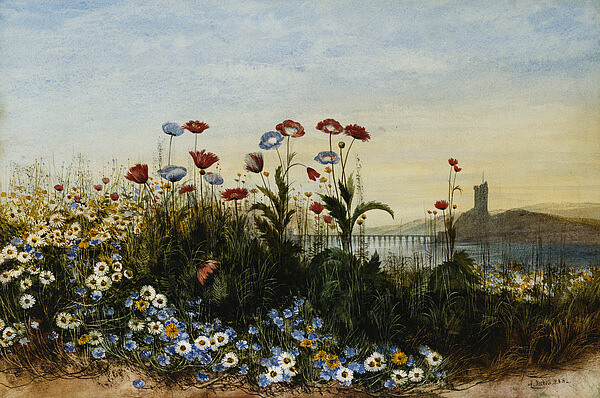
Once upon a time there was a princess called Zarazarinda who lived in a grand castle. The castle was surrounded by a beautiful garden. Zarazarinda liked to walk in the garden, for all through the year it had the greatest show of flowers imaginable. The year was long and warm and sunny in Zarazarinda’s land so that from the earliest snowdrops to the latest chrysanthemums the garden was always in bloom. The gardeners saw to that.
It was understood that when Zarazarinda chose to walk in the garden, the gardeners would disappear from sight. She liked to have the place to herself, to stop to admire the flowers, and to walk on as she chose.
One day Zarazarinda was walking in the garden when she saw one of the gardeners still rooting in the earth in one of the flower beds.
Zarazarinda went up to him and said, “Good man, you must not know you are not to be here when I walk in the garden. Be off at once.”
This gardener, short and dark, with a serious face, paid no attention to her and kept rooting in the ground.
Zarazarinda became angry. “Stop at once,” she cried, “or I will call the guard!”
The man continued to dig around the bed, paying her no attention. In a bag he had a plant he was intending to put into the earth.
Zarazarinda cried out loudly for the guard. Four soldiers came running quickly and seized the man, who grabbed his bag.
“Throw him over the garden wall,” commanded Zarazarinda.
As the soldiers grabbed him, the gardener said to Zarazarinda, “You may throw me over the wall, but I will tell you this. From now on, all your flowers will look away from you until you find a flower that won’t.”
At this the soldiers tumbled the man over the wall.
Zarazarinda finished her walk thinking about what an insolent man that had been. None of the flowers turned away from her. “Stuff and nonsense,” she declared. She was quite a Victorian miss.
The next day, however, she went for her walk and all the flowers immediately turned their faces right around from her. The tulips bent right flat on the ground to avoid her gaze.
The same thing happened day after day. Zarazarinda was very angry at first, and then very sad. All the flowers bent over backwards, or forwards, or sideways to escape her gaze.
After a week or so, Zarazarinda began to hear the whispers of the servants, although they stopped when she came near. Word about her predicament was getting around.
Zarazarinda stopped going into the garden but found the castle, even though it was big, very close and oppressive. All the servants had a small shine in their eye or faint twist to their mouth when she dealt with them.
Zarazarinda decided to go on a cruise. There were no flowers on the ocean and no servants to mock her. She ordered her carriage and set off the next day, as early as possible.
Zarazarinda’s castle was quite far from the sea. To reach the coast, she had to go through a large dark forest. Only one road led through this forest. It was not considered safe to travel through at night.
The servants had not started preparations for the trip as quickly as Zarazarinda had wanted, and so they were not able to leave the castle until late in the morning. It was already well past noon and they had not travelled very far through the woods when suddenly the horses reared upright and began to run wildly. The carriage swayed to and fro, rocking violently. The two coachmen were pulled forward onto the horses which broke away from the carriage and went thundering off. The carriage tipped over and skidded down into a ditch.
Zarazarinda was thrown about but was not hurt. She poked her head up out of the carriage which now lay on its side. She climbed out and sat on it. She wondered when the coachmen would return.
It was beginning to get dark when she realized they were not coming back. Zarazarinda walked down the road. She did not know what to do, except that she imagined she would have to spend the night in the carriage, huddled up in a corner. She began to select words she would use to address the coachmen when they returned.
As she walked on the road, Zarazarinda saw a narrow path leading away into the woods. She might as well follow it. She went down the path and came to a clearing in the middle of which stood a cottage. Much encouraged, Zarazarinda went up and knocked forcefully in the door.
A little old lady answered it. “None today,” she said, and slammed the door in Zarazarinda’s face.
Zarazarinda was stunned, then very angry. She began to bang on the door with both her fists. She banged and banged and banged. She even tried the door, but it was locked.
After a considerable time, the door suddenly opened again.
“What is it?” asked the little old lady.
“I’ll have you know I am the princess Zarazarinda,” she began to say, but once again the little old lady quickly said, “None today,” and slammed the door.
By this time it was getting quite dark. Zarazarinda thought she heard some growling in the nearby bushes.
Once again she knocked on the door, saying “Oh please, oh please.” The door opened and the little old lady said, “What is it you want?”
“I’m stranded here in the forest. Will you give me shelter for the night?”
“I can do that,” said the little old lady (whose name was Elvira), “but you will have to earn your keep.”
Zarazarinda was put to work sweeping the cottage floor while Elvira made the dinner. Every time Zarazarinda thought the sweeping was finished she looked around and saw that it had become quite dusty again. Finally Elvira told her to stop when the dinner was ready. Afterwards Zarazarinda fell into bed, exhausted.
The next day, Zarazarinda went out to the road but no one came by. She returned to the cottage.
“You had better do your day’s work,” said Elvira, “or there’ll be no supper.”
“Do you know who I am?” Zarazarinda asked.
“I don’t much care,” said Elvira. “Go and get your broom.”
Day after day Zarazarinda had to work for Elvira. It was not always sweeping, because Elvira taught her how to cook, to sew, and to work in the vegetable garden. After one bad day, however, Elvira did not let her near her flowers.
Zarazarinda did not enjoy her time. Each day she went out to the road, but no matter when she went, no one was ever travelling by. She also kept hearing growling and faint rustling in the nearby bushes.
After almost a year, it was coming back to spring time. By this time, Zarazarinda had also found to her amazement that Elvira knew a lot of songs and was willing to teach her how to sing them. Zarazarinda had, of course, had the best music teacher in the land, but she only liked to show off the songs the music teacher managed to teach her. When Elvira sang, however, she showed Zarazarinda a new world. Or at least Zarazarinda felt she was transported somewhere beyond this cottage with its perpetually dirty floors.
One morning, instead of going out to the road, Zarazarinda thought she would follow another path behind the cottage that went deeper into the woods. It looked somehow inviting. The air was fresh with a new scent of spring. She felt like singing just for the sake of singing. As she went along this path, she thought she saw through the woods a figure digging in the clearing just beyond where she was walking. She hastened to reach the clearing, but just as she arrived, the figure slipped off into the woods carrying a bag.
“Come back, come back,” called Zarazarinda, but the man disappeared.
Zarazarinda then looked down at the ground where the man had been kneeling. The man had been planting something.
Zarazarinda went over to it. It was a kind of lily, with many white flower trumpets facing every way. As one turned away, another one came to face Zarazarinda. This flower could not turn its face away from her. It faced her constantly.
Zarazarinda reached down to the lily. Conveniently it was planted in a clay pot, so she picked it up out of the earth and ran back to show it to Elvira.
“Elvira, Elvira!” she called. “Look what I’ve found!”
“The flower found you, my dear. Now get dressed, you have to go back to the castle.”
Elvira was Zarazarinda’s godmother who had taken on a trying and tiresome responsibility. Still, she wanted the best for the child. They went out to the road and there the coach was waiting. Holding the lily firmly in her lap, Zarazarinda rode back to the castle and went to her garden to plant the lily herself. She planted it in the ground where the man had been digging, because she knew it was the right place for it.


Related Posts