The Problem of Power and the Hope of Transformative Love
What do Saint Augustine and Shakespeare’s King Lear have in common? Not much at first glance. One is a historic North African saint, the other a fictional character who is the protagonist of an Elizabethan drama. However, a closer examination of the powerful themes and wisdom of Augustine’s Confessions and Shakespeare’s King Lear reveal a lot about problems of power, male-female relationships, parenthood, and whether power dynamics and prejudices can be overcome and therefore remain transformative reads for us in the twenty-first century.
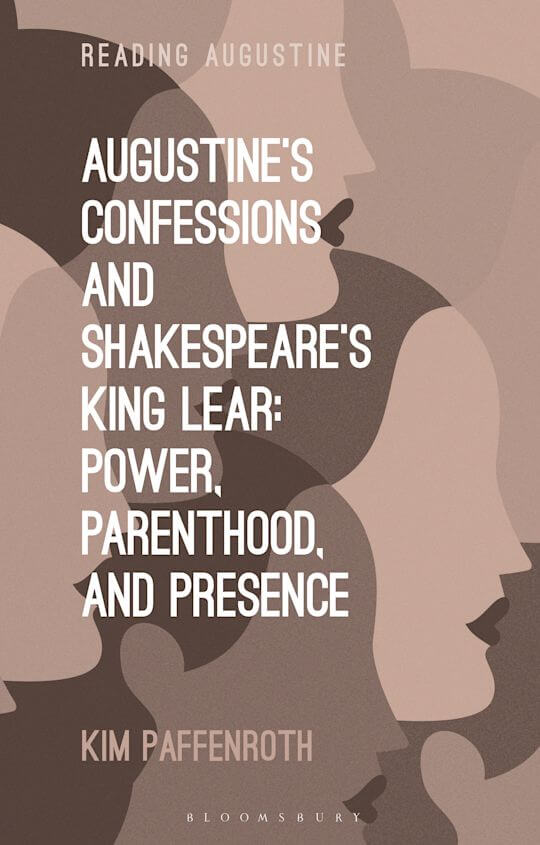
Kim Paffenroth, a professor at Iona University and longtime editor of a series on Augustine for Lexington Books, gives us another important little tome in Augustine’s Confessions and Shakespeare’s King Lear: Power, Parenthood, and Presence. In a world that is now conscious of power and its negative application and effects, Augustine and Lear serve as excellent case studies of both the bad and the good that comes with power. First, as Paffenroth reminds us, Augustine’s Confessions stands out in world literature (and especially ancient literature) which often focused on “military exploits or political rule—like, for example, Odysseus or Beowulf” because of its focus on “personal growth or change or development.” Heroes like Odysseus or even Beowulf are not conscious of the negative consequences of their power (especially Odysseus), but in Augustine, despite all his numerous flaws (both stated and unstated in his text), he shows signs of being very cognizant of the harm he has done in his life.
I intend to focus on the problem of power within Paffenroth’s book because recognizing the limitations and the harm of power is, frankly, important.
One of the great contributions that Paffenroth gives us is his treatment of friendship in Augustine’s autobiographical elements of the Confessions. This is a theme that I also cover when teaching the Confessions, and like Paffenroth, a central episode is the death of Augustine’s unnamed friend early in the narrative. Still a Manichee, Augustine brutally mocks the baptism of his friend who was dying and baptized while unconscious. This mockery of his friend’s faith earns him a stern rebuke. Shocked by his callousness, the future bishop of Hippo leaves and his friend relapses and dies when Augustine is away. Augustine, who seemingly was a good and faithful friend staying by remaining with the bedridden, dying friend, was not there at the moment of death and did harm this friend in mocking his faith as he lay dying.
Paffenroth reminds us of what Augustine is everywhere saying about the nature of relationships: they are often grounded and governed by the lust to dominate. This is true of Augustine who wanted the relationship not for virtue and equality between selves, or even love of God, but to flex superiority and be lauded by this unnamed friend as intelligent and wise. Yet it was not Augustine who was intelligent and wise but the unnamed friend. The “urge to dominate and exert arbitrary power over another person is not confined (unfortunately) to tyrants, serial killers, and a handful of villainous and powerful people. It is manifested daily in the actions…of our interactions.”
Why do we seek friendship? Let’s be honest. It is often to feel a sense of pride, superiority, recognition from another. Look at me, see how great I am! Tell me how amazing I am at sports or academics or video games, so on and so forth. Even acts of outward charity can have the inward lust to dominate and be recognized as superior to another. Paffenroth, through his careful scrutiny of Augustine’s episodic passages, notes, “Augustine realizes with numbing horror that only grows the more he dwells on it, that the emphasis on ‘my friend,’ not ‘my friend’—that the love was not for the friend, but for the possessing and commanding (even manipulating or dominating) him; and he was loved not for himself, but for how he could make Augustine feel, how he could bolster his self-esteem and self-importance—a trophy friend, if you will.” Anyone who says their friendships have never devolved into this dynamic of power assertion is lying.
Paffenroth turns to see how power dynamics play itself out in Augustine’s relationships with women, especially his mother and Una (his concubine). Here, Kate Cooper’s work Queens of a Fallen World, which is cited, is a great contemporary read on the same subject.[1] As such, I want to move to a brief comment on Paffenroth’s treatment of Lear who he positions in contrast to and in dialogue with Augustine.
Our judicious author highlights how Lear is replete in displays, physically and linguistically, with domineering male power over his daughters. Examining three key scenes, Act 1, scene 4; Act 2, scene 4; and Act 4, scene 6, Paffenroth shows the extent of Lear’s cruel and malicious misogyny, rightly labeled, and how it changes. As Lear’s own power is threatened, his violent outbursts and his language devolves to be hurtful in every possible way. It gets worse and worse and worse until, of course, Lear has his brief moment of reconciliation at the end before dying.
Reconciliation is where Paffenroth concludes his incredible short tome. Reconciliation permits the sharing and participation of power and, as it especially relates to Augustine (and to a lesser extent Lear), the sharing and participation in the wisdom of the other, the other that was neglected, abused, and cast aside. Therefore, reconciliation necessarily entails the reduction of the prideful power of the “sinner” and the elevation of the disempowered, the disenfranchised, the cast away. This is the culminating moment for both Augustine and Lear, Augustine with his mother, Saint Monica, and Lear with his daughter, Cordelia.
What makes these final moments so powerful, so memorable, so “literally breathtaking” to quote Paffenroth? It is, in part, because of how bad Augustine and Lear have been to Monica and Cordelia respectively. It is, in part, because we have seen the darker side of their power and the pride. Despite those problems, they do change – Augustine most significantly of the two. “Both Confessions and King Lear present us with a love that goes beyond the particulars of the hero and his beloved, beyond the limitations of their social, biological, and gender roles, and draws us in to participation in, or at least contemplate, what such transformative love would be.”
Paffenroth does an excellent job reminding us as readers the more the faults of the hero the more the transformative beauty is when such works end on that note. We don’t want, and we don’t need, perfect heroes. Why? Because we ourselves are imperfect. And if the imperfect hero, indeed, the sometimes cruel and despicable “hero” changes, that means there is hope in the world after all.
Augustine’s Confessions and Shakespeare’s King Lear: Power, Parenthood, and Presence
By Kim Paffenroth
New York: Bloomsbury Press, 2026; 136pp
NOTE:
[1] I reviewed Cooper’s work at The University Bookman, “Saint Una and the Women Who Made Saint Augustine,” February 11, 2024.


Related Posts