The Wisdom of Ibn Khaldun
The current state of civilization across much of the modern world shows one symptom: death. I hesitate to use the term suicide, which is also popular, since suicide does denote a choice. But death is inevitable. Death is guaranteed.
All civilizations rise and fall. This was the general revelatory insight of Ibn Khaldun, Oswald Spengler, and Arnold Toynbee. Toynbee is instrumental here because he shows how a meta-civilization spawns more refined civilizations rooted in the generative seed. Toynbee’s generative seed for what we might call Western civilization is Minoan civilization. This Minoan civilization that was the first seed of Western civilization, so-called, died; and it died long ago. But that germ passed on into Hellenic and Syriac civilizations which, like the Minoan civilization before it, died; and they died long ago too and are not coming back.
But, if you permit this in a genetic sense, the germ of Minoa and the germ of classical civilizations passed on into Christian civilization through the rise of Christendom. Now this Christian civilizational church of Toynbee, which is Faustian or Western civilization in Spengler, is also dead and gave birth to modern “Western civilization” but it’s hard to see what the inherited germ has been today as we busily embrace an antinomian craze to do away with all that has been inherited as something evil and oppressive. Thus, the new antinomian civilization that characterizes contemporary Western civilization is something altogether foreign from the Hegelian-Darwinian germ inheritance from Minoa to the Enlightenment. Our Western civilization is in the throes of transmutation into an antinomian civilization. It is a civilization burdened by laws to tell us that we have no laws to follow. There is no moral order to follow. There are no natural boundaries to respect. The individual has total control to do as he or she pleases under the first principle of non-harm (to others). And in this elimination of all the germs and customs, laws, and norms of previous civilizations the new civilization is wholly new—it is a return to the state of nature dreamt up by the modern philosophers of the Enlightenment. And like the blank slate epistemology, this empty civilization is universal and applicable across the four corners of the earth which is why international law circumvents traditional and national laws.
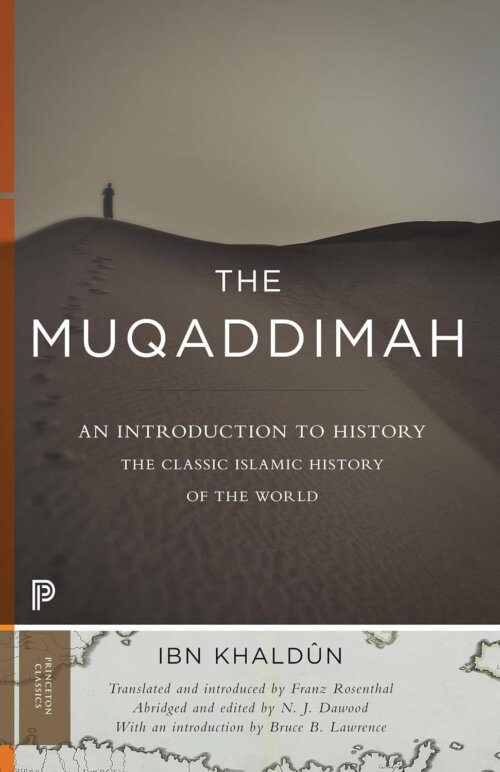
The characteristics of terminal decline were already observed by Ibn Khaldun in Al Muqaddimah, so I am now pivoting to him for my reflections on the coming death of the West as it is supplanted by this antinomian civilization imminently approaching. Ibn Khaldun explained the rise of civilizations through group solidarity, primarily originating in blood relationships—kin and kith—to overcome the harsh environments and realities of the world, “Respect for blood ties is something natural among men, with the rarest exceptions. It leads to affection for one’s relations and blood relatives, the feeling that no harm ought to befall them nor any destruction upon them.” This ethos of group solidarity, his version of esprit de corps, leads to self-sacrifice, the common good, and the city rooted in love for others which manifests itself in the individual’s willingness to sacrifice for others. Since, however, I have already outlined the origins of the first city I will not do so again from the lens of Ibn Khaldun. Rather, I shall reflect on the undeniable truths Ibn Khaldun reflected on concerning terminal decline in civilizations once they have left behind asabiyyah.
While there is a strong thread of geopolitical thought that undergirds Al Muqaddimah, Ibn Khaldun’s sociology of decline predates Oswald Spengler by five centuries. Ibn Khaldun claimed that every civilization has a four-generation lifespan. The importance of four is well-attested to in ancient literature but one should not get hung up on the specificity of four literal generations. Rather, what is clear from Ibn Khaldun, as is the four stages of civilization in Hesiod, Daniel, or Hindu mysticism, is what the four “generations” (or stages) represent.
The first stage of civilization is the growth stage where group solidarity and sacrifice reigns supreme. The second stage is the apogee, or consolidation, where a people succeed in establishing their earthly presence and begin to reap the fruits of their reward. The third stage is the decadent but luxurious stage where people, having now largely migrated to urban centers, see a significant divergence between urban and rural, commercial and agrarian, rich and poor. Ibn Khaldun does see a cultural and economic dialectic of conflict forming in this stage—but the culture and economic origins of this conflictual dialectic are tied together. The rural, agrarian, and poor part of a civilization are still the most closely attached to the founding principles of civilization: group solidarity. It is the rural people who, being the most traditional and still patriotic, so to speak, who feel alienated and betrayed by their leaders as the power-base has shifted from the rural periphery where civilization arises to the urban and decadent metropolitan centers which have arisen due to the success of civilizational struggle and growth. In this third stage the life of luxury leads to the dissolution of group bonds and atomization sinks in and a people become increasingly individualistic, hedonistic, and decadent. As stages advance the new stage becomes progressively detached from the preceding generation. In the fourth and final stage of civilization, the final generations are so detached from their ancestors that they come to despise everything their forefathers stood for. Shunning their heritage and history, the final stage of civilizational life—as it rushes to blindly to death—is characterized by fighting, squabbling, and self-centeredness to the point that all the ties to group solidarity have ceased.
Concerning the generations that Ibn Khaldun speaks of is properly to be understood as the stages of civilization life-cycles, “The builder of the family’s glory knows what it cost him to do the work, and he keeps the qualities that created his glory and made it last. The son who comes after him had a personal contact with his father and thus learned those things from him. However, he is inferior to him in this respect, inasmuch as a person who learns things through study is inferior to person who knows them from practical application.” The builder of the family is the first generation, the first stage, that most important and harsh stage when the struggle for life is a struggle with death itself. But the builder of the civilization, and his son, or the second stage, are closest in bonds and attachments to what allowed life to flourish in the first place—group solidarity. Though inferior, these two generations—these two stages of civilizational life—represent the birth and growth phase.
Moving onto the final generation, the final stage of life, “The fourth generation, then, is inferior to the preceding ones in every respect. Its member has lost the qualities that preserved the edifice of its glory. He despises those qualities. He imagines that the edifice was not built through application and effort. He thinks that it was something due his people from the very beginning by virtue of the mere fact of their descent, and not something that resulted from group effort and individual qualities.” Moreover, “It should be known that at the beginning of a dynasty, taxation yields a large revenue from small assessments. At the end of the dynasty, taxation yields a small revenue from large assessments.” One of the quintessential characteristics of the terminal decline phase of civilizational life is the rule of money over everyone; but it is also marked by increased debt, financial irresponsibility, bribery, economic corruption, and high tax rates to try and preserve the comfortable, hedonistic, and luxurious way of life that the now decadent civilization has found itself occupying.
The reason for the corruption, economic mismanagement, increase in tax rates—though a general depreciation in yield accompanies it—is because of what the internal logic of liberalism, and Marxism, demand. That hedonistic, self-centered, pleasurable life of as minimal harm as possible, and since bodily pleasure is the highest standard of well-being, is incapable of making sacrifices for the common good. So self-absorbed has the civilization become, it is now weak due to its own success.
Part of the poetic and political beauty of Ibn Khaldun is the irony he reveals about the political. The very success of politics, the success of civilization, contains in it the seeds of its own demise. Material prosperity, which is, according to Ibn Khaldun, one of the central reasons for political community, inevitably loosens the bonds of traditional group solidarity and filialism as atomization and hedonistic individualism sets in.
In its stage of termination, a civilization falls in two ways. One, the civilization suffers from internal conflict, civil wars, and spouts of tyrannical rule which is, according to Ibn Khaldun, founded on self-centeredness and favoritism to preserve the luxurious way of life for some over others, and in this self-cannibalization the civilization disintegrates and dies and from the carcass a new birth begins. Or, the civilization—weak and impotent as it is in its final movement to termination—is overwhelmed by external invasion and is incapable of staving off the invader which seizes it, like a deadly virus latching onto its host, and colonizes the host body whereby the host civilization dies but the foreign germ gives birth to a new civilization out of the rotted carcass of the body which had been seized. Both ways seem poignantly applicable to the current state of modern civilization which, as I’ve already said, is on the verge of death and transmigration into something new—the question remains whether that newly born civilization will have any of the germs of inheritance from its root parentage or whether that which replaces it will be something altogether foreign and unrecognizable.
Without the generative principle of the family, rooted in fatherhood and motherhood, which manifests the spirit of protectiveness and asabiyyah, as Ibn Khaldun calls it, the civilizational inheritance comes to an end. And why shouldn’t it, since the final generation of the life of a civilization so despises its ancestors it wishes, through all possible means, to dissociate from its past heritage to the point of severing the most basic inheritance all lifeforms require in order to be born in the first place? Despite the pessimism, new civilizations do arise in the place of the old and the cycle continues. There is, ironically, something hopeful in that.
The Muqaddimah
By Ibn Khaldun, trans. Franz Rosenthal
Princeton: Princeton University Press; 512pp


Related Posts