
A Persisting Lesson in Hard Work, Friendship, and Leadership
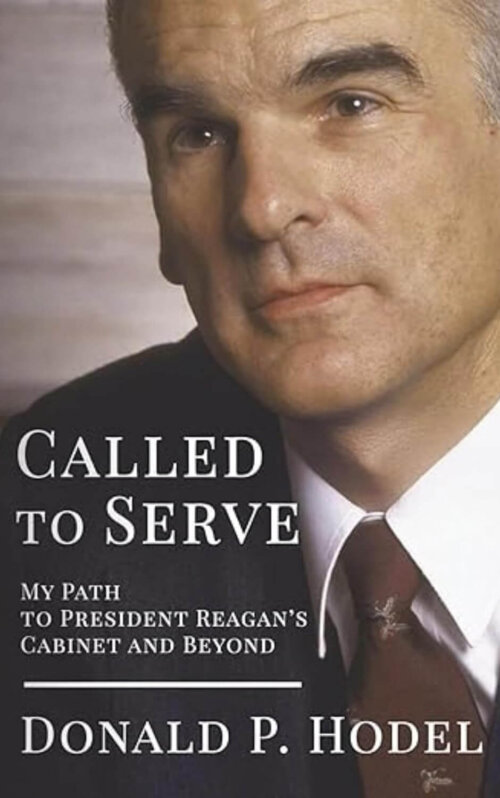
Donald Hodel was the fourth United States Secretary of Energy and the 45th Secretary of the Interior, serving in those two cabinet posts during the Reagan Administration. The son of Canadian immigrants, Hodel’s tale from public school in Portland, Oregon to the halls of American power during the height of the Cold War teach us an enduring lesson on persistence: persistence does matter and is still a valuable message in the twenty-first century in our age of instant gratification and short cuts. From the friendships he forged in high school, to Harvard, to state party chairman, Hodel’s persistence led to his rise from obscurity to importance in a transformative epoch of American culture and history.
What is the influence that fathers have on their sons? That’s a question that Hodel begins his autobiography addressing. From his grandfather to his father, Hodel starts his story by going back into his family’s story—a story of immigrants from Europe who settled as farmers in central Canada before eventually resettling in the western United States (Oregon). There is an irony in Hodel’s family history: from a farming lineage to serving in a cabinet post for an industrial superpower, the story seems too impossible to be true. Yet it is, and Hodel insists that it was his family’s spirit of hard work that made it possible.
Hodel’s father would tell him stories about how “he was the top student in his high school class,” and how these stories of success led to a spirit of emulation in the young future cabinet secretary. Throughout Called to Serve, Hodel emphasizes a willingness to seize the opportunities of life as they present themselves to an individual, “This story always appealed to me because it illustrated the importance of being prepared when an opportunity arrived.” This spirit of seizing opportunities is what defines Hodel’s autobiography: from Harvard to marriage to the Reagan Administration.
Such opportunities are not merely job or work related. Hodel dwells on the importance of friendships and how those friendships helped create opportunities. A couple of his close friends at Harvard were also from his high school and the hard work they embodied at Harvard to prove the elite wrong that public school boys were just as capable ensured that future opportunities would arrive after graduation as those friendships became beneficial for later success. In our own society which prioritizes utilitarian relationships, Hodel’s story of friendship serves as a good antidote—for it reminds us that friendships are more than just utility even if friendships do carry with them opportunities for life successes down the road. Hodel’s reflections on how life-long friendships benefitted him, but how he maintained the personal relationships at all costs, shows another generation how we should conduct ourselves in friendships. This importance of maintaining personal relationships while acknowledging the debt of opportunities is what propelled Hodel into politics. His philosophy can be summed up in his own words, “to do the right thing and to help others.”
How did Hodel’s persistence pay off?
In Oregon, Hodel amuses readers by reminding us of how poor the Republican Party organization in the state was even in the 1950s and 1960s. This did not dissuade his spirit to get involve and make things better, even as things were terrible and often getting worse. Starting off as a Goldwater Republican, and Goldwater got trounced badly in 1964, he persisted in state politics, becoming party chairman. As chairman, he oversaw reform and eventual success. The job was not for the weak or faint of heart as Hodel shows.
This spirit of persistence is also seen in his personal life. After the suicide of his oldest son, he and his wife, Barbara, turn their grief into redemptive strength. They become evangelical Christians and engaged in anti-suicide activities, hoping to “help others” through their own experience. Rather than let tragedy defeat them, the Hodels turned tragedy into hope and good work, assisting others during their own journey of healing and understanding.
Hodel’s persisting spirit led him to campaign for Ronald Reagan in 1968. He was a pro-Reagan delegate in Oregon, one of the few states that participated in direct primary voting in 1968. His meeting of Reagan would lead to another friendship that would bring him to the halls of power in 1981.
How did Hodel go from Undersecretary of the Interior to Secretary of Energy (and later, Secretary of the Interior)? For nearly a decade he worked at the Bonneville Power Administration. His nearly decade of work at BPA is reflected on in a brilliant chapter dealing with hardship, reform, victory, and defeat. While working at BPA, his friendship with the wise, longtime employee, Henry “Russ” Richmond gives insight into that persisting spirit of hard work and learning from others to become better oneself. “Every morning,” Hodel writes, “the first thing I did was o into Russ[’s] office. He spent thirty minutes or so imparting his experience and wisdom to me regarding management techniques, electric utility issues…[to] how to live my life.” Hodel’s work at BPA set him up for his eventual candidacy as a Reagan Administration cabinet secretary, a result of that friendship and political commitment forged with Reagan back in 1968 before he began working at BPA.
Hodel’s autobiography, which goes into great detail during his work in the Reagan Administration, continues on with the themes of friendship and persistence. As such, Called to Serve is an enduring reminder that hard work, persistence, and the value of friendship can lead to the most remarkable and unexpected of outcomes in life. In a world that is now skeptical of the “rags-to-riches” story, Hodel’s own “rags-to-riches” reveals what true richness is: friendship. The attainment of power, the important work as a cabinet secretary, his involvement in federal reform, none would have been possible if not for the spirit of persistence and the magnanimity of friendship that Called to Serve deals with.
Called to Serve: My Path to President Reagan’s Cabinet and Beyond
By Donald P. Hodel
Colorado Springs, CO: Peak Press, 2026; 412pp


Related Posts