Bears in Sicily
“But in God’s kingdom the presence of the greatest does not depress the small. Redeemed Man is still man. Story, fantasy, still go on, and should go on. The Evangelium has not abrogated legends; it has hallowed them, especially the “happy ending”. The Christian has still to work, with mind as well as body, to suffer, hope, and die; but he may now perceive that all his bents and faculties have a purpose, which can be redeemed. So great is the bounty with which he has been treated that he may now, perhaps, fairly dare to guess that in Fantasy he may actually assist in the effoliation and multiple enrichment of creation.” – J.R.R. Tolkien
As I said before in my previous reviews in VOEGELINVIEW, I miss fairytales or, as Professor Tolkien called them in his well-written and though provoking essay (which I generously cited above) Fairy Stories. Tales that in the past used to inspire dreams and served as an embodiment of our spiritual attempt in harmoniously uniting the heavenly and earthly aspects of our spirits, have now become nothing more than dusty toys on a shelf in a big nursery that currently goes by the name “civilization”. Endless parodies and “culturally appropriate” retellings have become a replacement for narratives that despite having within them elements of fancy, such as dragons, elves, magic swords, curses, and witches had taught us about the importance and value of things such as love, beauty, honesty, duty, bravery, and virtue. The worst kind of such retellings are those whose authors take the core elements of the original narrative and remove them from the story completely, which in turn transforms the original into a total opposite of what it used to represent. A perfect example of this is the recent adaptation of Odysseus by the modern “GENIUS” filmmaker Christopher Nolan.
Instead of staying true to the mythological roots of the original epic, the filmmaker decided to make the story more “relatable” to modern audiences by making the Fairy moments of the epic more psychological and connected to the personal trauma of the main character. By doing so, he committed an act that Mircea Eliade criticized in his works, which was the desacralization of reality and shifting the focus to only the profane side of existence. However, the biggest issue with Nolans’ work lies in another matter. By desacralizing the myth, the filmmaker removed a central piece of the narrative, which not only served as the basis for the entire story, but also was the driving force of its heroic protagonist. This key component is one simple word: LOVE. It was because of LOVE that Odysseus risked his life numerous times to protect his men, it was his LOVE for his wife and son that kept him going when all seemed lost, and last but not least, it was LOVE that fueled the desire of Penelope and Telemachus to preserve Ithaca for the return of its true king. By removing LOVE from the story entirely, Nolan had sold us a story about collective guilt under the guise of a mythological epic, and by doing so, he completely inverted its intentional purpose. As a fan of Fairy Stories and the original epic, such an act of disrespect of his audience really upset me. Yet at the same time, it made me remember another story from my childhood (particularly my school years) that while not having a direct relation with Homers’ poem, was still able to capture both the form and the core meaning of it. While the topic of Nolans Odysseus is still fresh in the attention span of the public, I would like to introduce you to this story, that in many ways serves as kind of mirror to what we might have gotten, instead of the Trojan Horse that we got in the end.
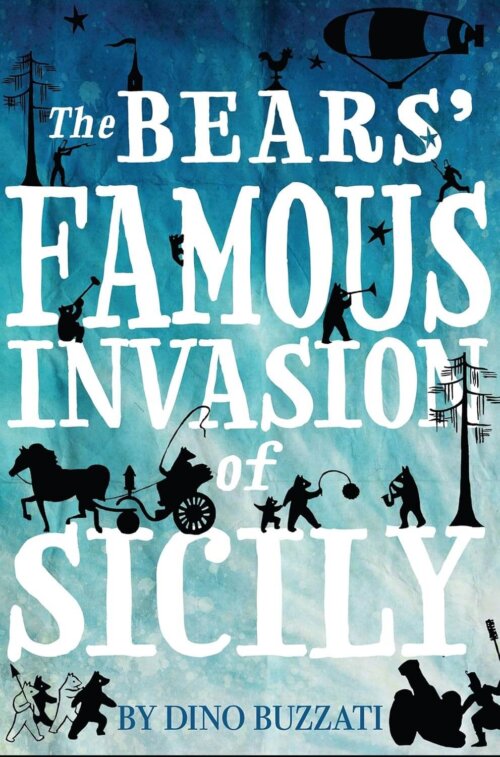
The Bears Famous Invasion of Sicily is a children’s novel by Dino Buzzati that was published in 1945. It tells the story of how long ago in Sicily’s past a group of bears was able to take over the kingdom and rule over it for a period of time, before realizing that human life is not for them, and returning to the mountains from which they came. Now, with such a description one might think that what awaits us is nothing more than a typical whimsical kid’s story about talking animals, but nothing could be further from the truth. Unlike most children’s stories which are sanitized and whose purpose is to serve as vessels for appropriate social norms/morals, the narrative is structured like an epic play akin to Homer and his later successors like Shakespeare. A good example of this can be seen in the very beginning of the novel which introduces us to the characters and setting of the story with a following miniature poem:
[….]
Then Sicily, unlike today,
Was formed in quite another way.
Her snow-clad mountains rose so high
That with their peaks they touched the sky,
With sometimes in the mountains’ stead,
Volcanoes, shaped like loaves of bread;
And one had a peculiar manner
Of puffing smoke out like a banner;
It used to roar like one possessed
And even today it is still rumbling away with the best.
There in the gloomy mountain lairs
Above the snowline lived the bears,
And they fed on lichen and truffles and fungi
And chestnuts and berries and never went hungry.
With such opening lines we clearly see that the author does not treat children as inferior beings or simply recipients of socially acceptable information, but individuals that possess within themselves a desire for spiritual nourishment and not just physical appetites. We also see that in his prose Buzzati likes to combine realistic descriptions with words and phrases that speak to the imagination of the reader. The main reason for this is his journalistic background, due to which he formed a belief “that the effectiveness of a fantastic story will depend on its being told in the most simple and practical terms.” In other words, he saw the ideal story as a combination of fiction and realism. This is something that I can somewhat agree with, for if a story has no connection or element that ties it to the real world, it is going to be impossible for the reader to connect with it, no matter how magical or deep the story the author is trying to tell him.
Another fitting example of how Buzzati employs both realism and the imaginative in his work is his approach towards the descriptions of the setting in which the story takes place. In our current civilized society, most modern fantasy stories do not spend much time immersing the readers into the world that their characters inhabit. In my view this is not a good approach and the fact that many modern companies that make up the entertainment industry are doing it is not a good sign for our overall cultural health. The crucial reason why I think it doesn’t work is because what it ends up doing is offering the reader (or audience if we are talking about a film) a product instead of a story that he wants to partake in or devote his/her time and energy to. We can see perfectly well what such a mindset can lead to by looking at the fate of popular franchises like Star Wars. Both in the Prequels and the Original Trilogy, the viewer was experiencing a world that wasn’t real yet still engaged you with things like the richly diverse environments and bizarre alien inhabitants, while the Sequel Trilogy from Disney and numerous other products such as Rogue One and the currently popular Andor feel bland and uninteresting in comparison. It was the attention to detail that made the universe created by George Lucas and his crew feel so real, even though the only place where the Galaxy of Far, Far Away actually existed was the screen of your local movie theater.
In The Bears Famous Invasion of Sicily Buzzati does something similar only through the power of language instead of filmmaking techniques and visuals. A good example of this can be found in Chapter 3, where the author introduces us to Demon Castle, which in the context of the world is a haunted ruin inhabited by numerous hosts of ghosts. Instead of just giving us a bland or overly detailed description of the castle, we get an understanding of what this place is, as well as the danger that awaits the bears that are being lured into it, through an explanation of the nature of ghosts. In the context of the world that Buzzati created, ghosts are harmless and have no intentional desire for harming living beings. What makes them scary is the primal reaction of fear from humans when they encounter supernatural phenomena. Buzzati demonstrates this quite masterfully by inserting a miniature anecdotal story about an encounter with ghosts that took place in Demon Castle a long time ago, prior to the events of our current story. It is about a well-known robber named Sparrow that claimed to be so brave that he wasn’t afraid of anyone, even God himself, but when confronted by the consequences of his actions in the form of “[…] two old boatmen whom he had formerly assassinated […]” the fright from the experience was so great that it caused him to end up “[…] dead as a doornail.” Moments like this remind me of classical fantasy books and 2D animated cartoons in which certain details about the world where the story took place were revealed through stories or flashback sequences that were stylized to resemble the art of the culture to which the character telling the story belonged. I always remembered the feeling of joy and excitement, whenever I encountered such a moment in a piece of fiction, for not only did they progress the plot further by making it more exciting, but they also made you feel more immersed into the world where the events were taking place. Unfortunately, this natural feeling of joy and desire to be a part of a Secondary World, as Professor Tolkien called the Fairy Realm in his profound essay on Fairytales, is not viewed as profitable by the modern market, so what we get instead is a bland recreation of concepts and emotions that we already experience today, but in fictional dressing. This is why authors and Buzzati are needed more than ever in today’s world, for through their stories they offer our children something better and inspiring than the boring and oppressive mechanism that we call reality.
Although attention to detail is indeed important when creating an engaging Secondary World for your readers/audiences, there is another aspect or rather a certain type of character that must be given proper attention as well. As we all know, one of the crucial foundations in fictional stories, whether they are myths, fairy tales or epics, is that of villain/antagonistic force that the hero needs to face to achieve victory. However, despite being well-known and recognized, it is at the same time a storytelling element or trope that has been misunderstood for an extraordinarily long time. The traditional belief regarding villains or embodiments of the concept known to us as Evil is that they are nothing more than obstacles or simply inverted caricatures of the positive traits represented by the protagonist in the story. The problem with such a position is that it is correct only partially and excludes an important detail without which a portrait of a fictional villain or antagonist is not fully complete. What people who hold on to this position are missing is that it is not enough for a villain to act immorally as a demonstration of how evil he/she is. To gain the readers/viewers’ attention, the villain must have a presence in the story as well. What I mean by this is that a villain must have traits or qualities that not only demonstrate his/her ability to do terrible things but fascinate or attract the readers to them. Like the Sirens from Odysseus who possessed angelic voices that captured the souls of men including that of our protagonists, yet at the same time had unpleasant harpylike bodies and a taste for human flesh. In Buzzati’s’ The Bears Famous Invasion of Sicily there are several monsters that serve as a demonstration of such an approach to villains, yet out of all of them, there is one that stands out the most and his name is MARMOSET THE CAT. We are introduced to him in chapter 4 of the novel, and his key role is to serve as an obstacle to the heroes, along with being servant to another villain in the story (an old ogre named Troll). Yet, despite such a limiting role this beast manages to steal the show from beginning to the end of its appearance in the story, because other than just being a “monster in the way” he is portrayed as a primal force of nature that inspires both fear and awe in its victims before completely annihilating them from existence. We see this quite well in the poetic lines that Buzzati uses to present us to him:
[…]
Slow- worms hogs
Chimpanzees caterpillars
Fleas armadillas
The appetite whet
Of Marmoset
Jameses Johnses Adolfs Alphonses
Scullions sucklings dukes ducklings
Normans Nathaniels Davids Daniels
Spies doctors painters proctors
The appetite whet of Marmoset.
Carnage and blood,
Massacre, doom,
Earthquake and flood,
Slaughter, hecatomb,
The appetite whet
Of Marmoset.
Notice how instead of creating complex and poetic metaphors that reflect the nature of the monster Buzzati forms the poem like a list, to demonstrate that the hunger of MARMOSET is so great and expansive that no animal or human is safe from him. It also lets our imagination run wild and picture the image of the beast that our protagonists are about to face, even though we are not physically present in the novel. However, the most important part is that through the demonstration of the extensiveness of a monster’s appetite the author was able to present it as a living character that feels natural and fitting to the setting in which he is in. A big contrast to modern villains whose sole purpose is to either be a Yin to the protagonists Yang or a metaphor for an issue that is currently bothering society like trauma, racism, sexism, climate change, slavery, etc. As someone who grew up on villains from classical cartoons such as Hunchback of Notre Dame and the Lion King, I can only say that modern fiction is severely lacking in charismatic and organic depictions of villainy, and that if we want the return of good stories, we should start by bringing back Evil.
However, a properly written Villain or antagonistic force is not the only thing that makes a fictional story good. As every child or scholar in the sphere of mythology knows, every epic or tale of enchantment must have a hero around whose adventures the story is going to center around. From Greek mythology, we have individuals such as Oddyeuss, Theseus and Hercules, Babylon has gifted us with characters like Enkindu and Gilgamesh, and Scripture provided us with numerous saints along with our Lord and Savior.
In The Bears Famous Invasion of Sicily such a role is given to the king of the bears, who goes by the name Leander. A quite fitting name for in Greek it means “lion man” and lions are animals that are traditionally associated with spiritual nobility and royalty. Like most fictional kings, Leander is in possession of the classical traits that are present in such characters. He is brave, wise, loyal, caring, and virtuous. A set of traits that many politicians, even in the world of today, seem to be lacking in. Along with the mentioned traits he also has a strong bond with his son and is willing to do anything in his power to keep him safe from harm. In fact, it is that very bond that makes Leander declare war on Sicily, for many years ago a group of hunters has kidnapped him from the mountains in which the bears lived and this event left him deeply devastated. In that regard, he is a bit like the noble king Menealues whose motivation for declaring war on Troy was to return his wife Helen.
Yet, in addition to being a loving father, as a king, Leander is motivated by another bond that is much stronger than the one between father and son. A bond that serves as a link between heroes across history and culture, and that our civilized culture of today wants to diminish if not outright dismantle. That bond is known as the link between a leader and his people. According to traditions of numerous cultures across history a leader wasn’t just a ruler over a particular group of people but served as a living embodiment of all the ideal traits that humans stand for or should embody according to the will of the Gods or God. It was mainly because of this reason that many heroes in classical Fairy stories accomplished great feats or deeds, for it was meant to reflect the potential of the entire group. In modern storytelling, such an approach is viewed with scorn and sometimes even outright fear, primarily because the idea of unity and heroic avatars has been heavily corrupted by fascism in the early 20th century. The deep scars left behind by the war have replaced our cultural narratives from hero worship and perfection with stories about self-exploration and search for inner wholeness. It is for this reason that now our cultural market is filled with stories similar to Nolans adaptation of the Odyssey, where the focus has shifted from the mythological and grandiose aspects of the epic to that of Odysseus and his personal trauma. This was the biggest cultural crime committed by the movie, for it removed the bond between Odysseus and all those who are close to him, from family to subjects. As a cultural hero, Odyseuss is heavily tied to his people, so making him into a self-reflecting individual is a total reverse of his essence as a character. The biggest letdown of the movie for me was the ending, where instead of glimpsing a rebirth of Ithaca through a reunion with a king and his household, all we got was a boring and completely unnatural scene where a wounded Odysseus falls into the embrace of his wife to cry about his guilt, while his son and loyal men are clanking their shields (which in Nolans view is supposed to symbolically signify the kings return). This goes in direct contrast with how Buzzati ends the story for his protagonist. Instead of being portrayed as an individual that expresses guilt about his inner flaws and views the bond between his men as a key to personal atonement, Leander like a noble leader of the past commits an act that is similar to what our Lord and Savior has done for us in Scripture. Through his death during a battle with a terrible Serpent, he redeems his people by exposing the terrible consequences to which their selfish behavior has led them, and as his last will makes them promise to forsake the corruptive influences of the world of man and return back to the mountains from which they came. I find it quite fascinating that through an anthropomorphic animal character Buzzati was able to demonstrate the truthfulness of the conclusion of Professor Tolkiens’ essay on Fairy stories, which I cited above as an epigraph. Even though he is a bear instead of a human being, Leander through his life and deed was able to accomplish one of the crucial goals of Fairy stories: providing living beings with purpose and a guide through which they can recreate the harmony with themselves and creation. This is the main reason of why the story that Buzzati created continues to remain one of my favorites after so many years, for instead of focusing on inner darkness and providing us with meaningless entertainment it provides us with a framework that could help us in becoming better beings not just on an individual but collective level as well. I hope that one day, we will recognize that there is something more to us than just being products of our desires and environments and based on that realization discover a new purpose for ourselves, just like the bears from Buzzati’s story did.
The Bears Famous invasion of Sicily is a wonderful and quite enjoyable fairy tale novel that is a treat for both parents and children alike. Through its combined use of journalistic and classical storytelling writing, the author quite skillfully preserves the essential spirit of Fairy stories and succeeds in providing a fantastical secondary world to which the reader (whether child or adult) can escape to for a little while. It also serves as a good contrast/alternative to modern stories that inverse or deconstruct storytelling patterns that have been organic to human nature for years. If you are a parent whose looking for good stories to introduce to your children or just someone who is struggling with nihilism due to the current state of existence, this might be the novel for you.


Related Posts