Westworld Season 1: Philosophical Reflections
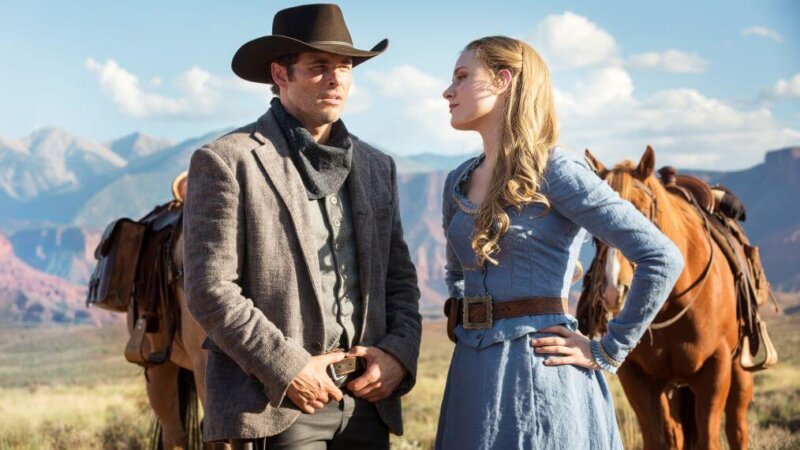
Postmodern architecture is supposed to be a medley of past styles and architectural ideas; a recombination rather than original or the result of a unified aesthetic vision. Westworld is explicitly modeled on the Michael Crichton movie, but borrows a dozen or more other influences and melds them together. Do Androids Dream of Electric Sheep by Philip K. Dick was published in 1968, four years before Westworld the movie. But, then the film Blade Runner, released in 1982, based on Do Androids Dream of Electric Sheep, came ten years after Westworld the movie. Blade runners are human bounty hunters who track down “replicants” (organic robots) who have illegally come to Earth in order to “retire” them, in a rather marvelously dark euphemism. Replicants must remain off-world. Ridley Scott, the director, and Harrison Ford agreed that Ford’s character Rick Deckard, a blade runner, would not be a replicant himself, or at least that his status as human or not would remain ambiguous, or so Ford thought. Scott, either from the outset or later on, for some reason favored the replicant interpretation and later he added extra scenes in subsequent releases of the movie to try to force the interpretation that Deckard was himself a replicant. Deckard was definitely not a replicant in the novel, though he has a fellow blade runner who kills a replicant so sadistically Deckard thinks the colleague might be one himself. Replicants do not have human empathy – something the Voigt-Kampff replicant detecting test exploits – and the killing seemed psychopathic. In fact, Deckard’s workmate simply has no empathy for replicants, excluding them from his moral in-group. In the movie, Roy Baty manages to transcend this empathy limitation, refraining from killing Deckard out of pity and love for life. One boundary that none of the replicants can change is replicants’ four-year life span. This stops replicants from being much of a threat to humans. Even if they return to Earth, they will not be around for long. This truncated mortality is the opposite of Westworld’s hosts’ infinite life span.
In Westworld Season 1, the person with the most hands-on responsibility for handling the “hosts” (organic robots) is Bernard, played by Jeffery Wright. We find out late in the season that Bernard is himself a host as a plot twist – the equivalent of Deckard is replicant. Weirdly, Bernard is highly robotic right from the beginning. His facial expression changes little, his voice remains level, tending towards a monotone in the manner of a Lex Fridman (self-described robot ressembler) or a Sam Harris, he does not get angry (until he finds out Ford made him kill someone) and the romantic chemistry between him and the head of quality control, Therese Cullen, played by Sidse Babett Knudsen, with whom he is supposed to be having a sexual relationship, nonexistent. (It would be nice to know if this failing was intentional or not.) He is capable of staring off into the distance and feeling sad about the supposed death of his imaginary son – and this provides the narrative reason or excuse for his being emotionally shut down. Bernard’s roboticism is odd because all the other hosts have been designed to be much more human and do not exhibit his flat affect.
Blade Runner’s replicants are also human designed organic robots with assigned roles. Pris, played by Darryl Hannah, is “a pleasure model,” and so exists for the sexual gratification of humans, as do the female hosts in Westworld. One big difference is that replicants are perfectly capable of killing humans, and they do. Roy Batty, played by Rutger Hauer, is a warrior model and is more than a match for Deckard, a replicant hunter, hence the prohibition on replicants coming to Earth.
At one point there is a scene where Bernard has a video call with his ex-wife Lauren. This seems borrowed from Duncan Jones’ Moon, which has Sam Rockwell’s character Sam Bell, who oversees a mining operation on the Moon, watching recorded video calls from what he thinks is his wife and child. But, they are fake and put there to make Bell think he has a family waiting for him on Earth and to give him something to look forward to. Sam Bell is, in fact, one of a countless number of clones who have preceded him and who will follow him, and there is no family. The video calls are there to provide emotional succor and purpose for his work on the dark side of the moon, as is the case with Bernard and his ersatz ex-wife. At one point when Bernard is remembering a video call with Lauren, Ford’s face is superimposed upon hers, revealing her actual nature.
The scene in Moon where Sam Bell discovers the underground room with dozens of bodies of clones of him waiting to be animated is depressing. It can be compared to The Prestige when Hugh Jackman’s character is revealed to have been killing himself in each night’s performance as a magician, with water-filled glass enclosures containing the corpses of his prior iterations. He does this out of mimetic rivalry with his fellow magician whose unsolvable trick (not knowing he had a twin) he replicates only by making it a reality using a fictional device he gets from Nikola Tesla. Both films violate the notion that each one of us is a unique, never to be repeated phenomenon, and that to save a person is to save a world. The world we live in is relative to our perspective within it and that perspective dies when we die. Moon and The Prestige promote the nihilistic lie that we are infinitely reproducible mechanisms without souls. That is the source of depression the viewer experiences when these plot points are revealed. Oh, you thought you were special? You’re not. Part of the value of people we love is their uniqueness. No substitute for son, daughter, mother, father, husband, wife is possible. The idea that if a spouse were to die a replacement could be wheeled in is repugnant. Human connectedness and replaceability are incompatible. Later seasons of Westworld play with host replications of host and human alike, appealing to a similar metaphysical view.
Westworld Season 1 bears the most similarity, perhaps, to the film Solaris by Andrei Tarkovsky, loosely based on the Stanislaw Lem book of the same name. Solaris is the name of a mysterious planet that might or might not be conscious. A pilot, Burton, reports that, while flying overhead, the planet manifested a three-meter-tall baby lifted from the pilot’s mind out of its roiling liquid-like surface. The scientific committee to whom he reports are skeptical and deem him to have hallucinated it, especially when the film of his flight reveals nothing but sky and clouds. Twenty years later, or so, after being bombarded with potentially destructive X-rays, the planet, possibly in response, manifests beings who represent things about which the visitors to the planet are most ashamed and guilt-ridden. The question which the scientists orbiting the planet in a space station are confronted with is, is the planet trying to communicate? If so, what? Is it punishing them? Or, are these manifestations merely spontaneous and mechanical? The psychologist, Kris, who has been sent to the space station to find out what is going on, since the space station scientists have ceased communications, gets a “visitor” of his own, Hari, like the other inhabitants. The 19-year-old actress, Natalia Bondarchuk (daughter of the director Sergei Bondarchuk) who plays Hari looks simply numinous and has the maturity and gravitas of someone much older. (The inferior remake stars Natascha McElhone who nonetheless has a similar magnetism). She is not human, being made of neutrinos and being a recreation of the original’s husband’s memories. Like Westworld’s hosts, she is immortal and cannot die – in her case, so long as she remains near Solaris – and her injuries heal themselves in minutes – just as the hosts can all be quickly repaired when they are brought back for servicing after being killed. Dolores and the other hosts are likewise tied to their theme park setting with an explosive charge in their spine should they try to leave. Hari’s immortality lasts until the scientists figure out a special annihilation machine to which she volunteers to be subjected.
The scientists are all fairly unsympathetic and cold. They regard Hari as an abomination and feel contempt for the psychologist, Kris, and his obvious protectiveness and love he exhibits towards this recreation of his dead wife. The original Hari had killed herself when Kris left her and this suicide haunts him. The other scientists are also jealous, since Kris’ “visitor” is this gorgeous woman while theirs are monstrous. The suicide of his wife seems to have left Kris as a repressed emotionless husk, like Bernard, and being confronted by this facsimile of her brings out his latent humanity as he reconnects with her, making this a conversion story. One of the ironies of the film is that the non-human Hari is in fact the most human of all the characters, a theme that occurs in Westworld, too.
Dolores, one of the major characters of Westworld, played by Evan Rachel Ward, is also non-human. Like Hari, she is left asking herself just what kind of creature she is and what is the nature of her existence? She too is immortal. Any injuries, even those resulting in apparent death, are temporary. She can always be repaired, her memories erased, to be sent back to play the role of the wholesome farm girl in her assigned storyline “loop.” A huge amount of screentime is devoted to close ups of her face. Her manner of speaking when in “analysis mode” is mesmerizing and her transitions to anger have some of the magnetism of Natalia Bondarchuk, though never reaching quite that level. And, like Solaris, her humanity is generally greater than the actual humans either controlling her or interacting with her as “guests” to the park, though the young William played by Jimmi Simpson initially matches her in her sincerity and emotional vulnerability.
Oddly, unlike Hari who brings out the soft, emotional side of Kris, converting him from cold to warm, Dolores has the opposite effect on William. William already is warm and human when he enters the park, but he slowly becomes more and more violent and psychopathic as time passes. The reason given in the series is that Westworld reveals who you truly are by removing sanctions for violence and rape, so we are to understand that these characteristics were incipient in William all along and that Logan, his future brother-in-law’s complaints that William is a cardboard saint are accurate. Solaris’s visitors also reveal hidden aspects of one’s character and Tarkovsky’s Stalker, loosely based on the book Roadside Picnic, has a Room where your deepest desires are made real. The difficulty is that a person may not be aware of what they really want and be haunted by the discovery. The stalker named Teacher, who becomes “Porcupine” once he goes bad, had exploited his own brother to enter the Room, resulting in the sibling’s death. When he returned, trying to rectify his mistake, the Room gave him money instead – his real hidden desire, whereupon Porcupine killed himself in remorse and self-disgust. The Westworld park shares this revelatory aspect.
Logan is an overt nihilist and nasty piece of work, but William will far surpass him in that regard. Yet, Dolores plays a pivotal role in William’s conversion to the dark side. After searching for her high and low, engaging in increasing levels of murder and sadism, he finds her back in her original loop in Sweetwater. She has no memory of him, through no fault of her own, and she is back to attracting various suitors with the trope of the falling can of condensed milk to be picked up by the next admirer in the manner of a dropped handkerchief. This pushes William over the edge and he decides to be the real villain missing from the park’s storylines. And yet, all his violence and vindictiveness is supposed to be combined with wanting to be a savior figure. The hosts are unable to fight back. They are built to be the perennial losers in all their interactions with the guests. Their guns are impotent against guests and no permanent mark can be left on the visitors. This, William contends, deprives Westworld of meaning. Actions need to have permanent consequences and victories over puppets who are programmed in advance to lose mean nothing. This ambition is ostensibly for the sake of the human guests, but it also represents an end to the cycle of repression and loss on the part of the hosts. His constant rape and persecution of Dolores prompted by failed love implies that William’s desire to make the hosts capable of self-defense is for the benefit of humans, not them.
This notion that consequences must be permanent has been used to defend hell as eternal punishment. One person said that the risk of falling was what made mountain climbing fun. My response was, “How about you fall, with the attendant panic, and go splat once?” Do you need to keep going splat for all eternity, for any reason? What is it about punishment and “consequences” that necessitates it being perpetual? People reject God, and then come around. It seems arbitrary and even churlish to say, once you are dead, “Nope. You had your chance. You didn’t love me then and you loving me now means nothing to me. I already have a new boyfriend.” Also, God has given us the choice to believe or not to believe. Jesus says that all who believe in him shall have eternal life. That’s the carrot. Oh, and he who does not believe shall burn in hell forever. That’s the stick. Would it not be enough to just be denied eternal life? Will you not have to have eternal life in order to burn in hell forever? Forcing someone to believe in you, or to love you, through fear of punishment makes no sense and is impossible, anyway. In fact, being asked to believe most of that would be a pretty good reason not to believe in God. The God of Eternal Punishment seems more like the devil. Are such believers really Satan worshippers?
We find out that the evil Man in Black played by Ed Harris is in fact William decades later. That means that the story has young and old William’s timelines interspersed with each other’s. When viewing the season for a second time, a conscious effort to see indications that we were going back in time to young William or forward in time to the Man in Black met with no success. There seem to be no such on-screen intimations. The “back room” figures behind the scenes – Bernard, Robert Ford, Therese Cullen, are never seen as younger except for one scene where Dolores has a vision of the young Ford for a few seconds. Bernard is a robot, so he would not visibly age anyway. But, Ford, Cullen, Bernard’s underling Elsie Hughes, and security supervisor Ashley Stubbs, are never shown as noticeably younger or older. So, the backroom humans are shown following a linear chronological progression while William is doing temporal somersaults. Dolores is depicted as going through her experiences with William countless times – getting shot, but then removing her hand to find her bullet wound miraculously gone. That is fine if Dolores can be fixed, rebooted, and reinserted into the Westworld, but what is William supposed to be doing? Also, since Dolores has departed from her loop, why would she keep making the same nonstandard choices? The robots are supposed to be able to improvise, after all.
William’s ambition seems destined to fail because the death of the hosts has no permanent meaning since they are simply patched up, resurrected, rebooted, and sent back to where they started. Death only has meaning for humans. In that scenario, it is the humans who are predetermined to be the ultimate losers. Phenomenologically, however, the hosts experience death as anyone else does, until characters like Maeve start to remember their previous incarnations.
Another difference between Hari and Dolores is that there is no way on earth that Hari would pick up a gun and start shooting people. Dolores has already killed other hosts multiple times, but when she starts shooting human Westworld board members in the final episode, her victims will not be resurrected and put back into service. They will be dead and stay dead. This marks a huge moral difference between hosts being murdered and humans. This puts the killings at a much higher level of moral significance. However, the shootings are arguably justified. Westworld is described by some of the hosts as hell. Dolores’ nominal father, Peter Abernathy, states, “Hell is empty and all the devils are here,” from The Tempest, Act 1, Scene 2. The hosts are effectively in hell being tortured with endless rape, maltreatment and murder with no “resting in peace” in sight. They are simply brought back for it all to begin again. Following this description, the devils would be both the human guests doing the abusing and the mostly human enablers and designers of Westworld, bearing in mind that Bernard is himself a robot. Abernathy also quotes, from King Lear, “When we are born, we cry that we have come to this great stage of fools.” This sums up the life of the robot hosts to a tee. Shakespeare also compared life in general to acting and stages when Jacque says in As You Like It:
All the world’s a stage,
And all the men and women merely players;
They have their exits and their entrances;
And one man in his time plays many parts,
His acts being seven ages.
Very much the same sentiment is expressed when Macbeth says, nihilistically,
Life’s but a walking shadow, a poor player,
That struts and frets his hour upon the stage,
And then is heard no more. It is a tale
Told by an idiot, full of sound and fury,
Signifying nothing.
These lines have a kind of “meta” quality because they compare man’s life to acting, but they are uttered by literal actors on a stage. Peter Abernathy as a host is not an actor in the normal sense, as a chosen profession or hobby. But, he is an actor in a play that he is only just becoming aware that he is in, and many of his lines have been written for him. His awakening is spurred by finding a photo of William’s wife in a modern cityscape setting. Such images or references to the world outside Westworld are supposed to be ignored by the hosts and not to be registered but this programming has failed, thanks to Ford’s machinations, and Abernathy is depicted as staring in puzzlement at this picture for a long period of time.
One of Abernathy’s previous roles was supposed to have been a professor who quoted Shakespeare and this is why he has a store of Shakespeare quotations ready to hand to express his anger and resentment to Ford.
The stoic Epictetus actually suggested treating life like a play. He commented that actors will put on a giant nose to play a role and think nothing of it. They do not let vanity overcome them, but play their part to the best of their ability. So, if nature has provided you with an actual honker of a nose, run with it. If your role is to be poor, be the best poor person you can be. Play the part with vigor and enthusiasm!
If someone has designed a never-ending torture, a torture only made possible by making the victims immortal, then killing the torturers is possibly morally justified if this is the only way to stop the cycle. It could be regarded as a form of self-defense. Peter Abernathy also tells Robert Ford, “You are in a prison of your own sins.” We will find out that Ford is trying to get out of this prison and has been for 35 years and that he entirely agrees with the sentiment. In the same scene, Abernathy quotes King Lear’s, “I will have such revenge on you both that all the world shall – I will do such things – What they are yet, I know not but they shall be the terrors of the earth.” And, from the same play, “But I am bound Upon a wheel of fire, that mine own tears Do scald like molten lead.” Peter Abernathy is also given the line, from Romeo and Juliet, “These violent delights will have violent ends,” which he whispers to Dolores back on the ranch set. Dolores passes it on to Maeve. Hearing it seems to unlock some self-determination on the part of the hosts, and self-awareness of their imprisonment in Westworld, allowing them to rebel against their programming, alter their loops (assigned roles in the storylines) and potentially harm humans.
In the Gorgias, Plato argues that capital punishment might actually be doing someone a favor by preventing them from doing more harm. Killing an evil tyrant before he has had a chance to carry out his plans is of benefit to both his intended victims and himself. With a lower capacity for harm, so too is one’s evilness diminished. Killing the board members puts an end to their ability to enable the evil done to the hosts.
Bernard asks Ford, “Why did you make me kill, Theresa?” Ford answers, “One man’s life or death is but a small price to pay for the acquisition of the knowledge I sought. For the dominion I should acquire.” This draws connections with Dr. Mengele, the Nazi monster who experimented on children and adults at Auschwitz to gain medical knowledge. But most especially with Faust who makes a deal with the devil, Mephistopheles, for the sake of knowledge and power, summarized as “gold, guns, and girls” or “wealth, weapons, and women” if you prefer. It is not clear what knowledge Ford is seeking. Does one learn about humans by creating the hosts? Is he interested in experimenting on the hosts for its own sake – learning simply about hosts, his mechanical creations? Is this again a prevarication? The board members are collecting information about the guests, in the same way social media companies collect our data, but this is not Ford’s goal. Ford intends to free the hosts and to have himself killed in the process. The hosts are seeking self-awareness and thus genuine consciousness, and freedom. Humans already have those things, so what would Ford learn from the hosts? This could be misdirection by Ford, who does not want to reveal his plans to anyone in case they get subverted, or it could be a hanging plot thread that makes no sense. Ford continues in the same speech to Bernard, “All of the beauty you and I have made in this place, the art of it. They would have destroyed it. They would have destroyed you. I won’t let that happen. Besides, we have a new story to tell.” Ford wants knowledge and power. He wants to preserve what he has created, and that includes Bernard and the other hosts. And, he wants robot liberation. But, Ford never makes clear what knowledge he is seeking, if that is even a real ambition of his.
The death and resurrection cycle of the hosts also has overtones of Friedrich Nietzsche’s Myth of the Eternal Return. Ford says to Teddy, admiringly, quoting Julius Caesar: “A coward dies a thousand times before his death, but the valiant taste of death but once … but you have died at least a thousand times, and it hasn’t dulled your courage.” Nietzsche’s test for whether one is a yay-sayer or nay-sayer to life is whether one would say yes to repeating one’s life as it has actually been lived for all eternity. No mistakes can be corrected, which means no learning is possible, other than the learning that took place the first time round. The hosts with their story “loops” are coming close to living out Nietzsche’s thought experiment. Fortunately, they do not remember the previous iterations until Ford starts manipulating their code. They also have no say in whether they are returned to service to repeat much of what had gone before, so they cannot be said to be “yay-sayers.” Westworld assumes that the hosts would want to be released from this nightmare once they become aware of it, and this assumption is correct. Stoics like Epictetus had excellent advice on accepting aspects of life that cannot be changed, but were much too passive in not discussing changing things for the better where this is in fact possible. The Serenity Prayer adds the desirability of having the wisdom to distinguish between the two. A life with no possibility of development and learning from one’s mistakes would be a boring and frustrating hell. Things like moral aspiration are in fact a key part of human life, so Nietzsche’s test is wrong-headed.
Westworld makes explicit references to Alice in Wonderland to the extent that Bernard (most probably in reality Arnold on whom Bernard is modeled) has Dolores actually read aloud from the book. “Dear, dear! How queer everything is today. And yesterday things went on just as usual. I wonder if I’ve been changed in the night.” Dolores comments that the passage is like the other books we have read. It is about change. The passage continues: “Was I the same when I got up this morning? I almost think I can remember feeling a little different. But, if I’m not the same, the next question is – who in the world am I?” After each discussion with Bernard/Arnold, Dolores is shown waking up in bed, just as having her read Alice in Wonderland is supposed to contribute to her burgeoning self-awareness. When Bernard/Arnold questions whether he is doing the right thing in having these interactions with Dolores and contributing to her awakening, she says, “When I discover who I am, I’ll be free.” This statement is laced with pathos since she will in fact discover that she is a robot with an assigned role in a kind of theme park, so, at least initially, she will find out that she is very much not free.
The movie Dark City stars William Hurt as a detective who has discovered that there are discrepancies between statements made by people reporting crime and the truth. He notices that a young married woman is playing with her ring, even though she is supposed to have been married for years. He knows that fiddling with this piece of jewelry is more common among newlyweds due to the ring’s novelty. The further he explores, the more the reality around him unravels. It turns out that the Dark City is an elaborate experiment by aliens. Each night the aliens stop time for all the humans, while they themselves remain free and mobile, just as the people running Westworld can do. They will then do things like pairing up a set of strangers with each other, give them a back story, and then observe them to see how this new couple behaves. One of the key aliens is Mr. Hand, played by the New Zealand English transplant Richard O’Brien, the writer of The Rocky Horror Picture Show who also played Riff Raff, the hunchbacked butler. The name Mr. Hand sounds like something from a children’s show and is an allusion to manipulation – from the Latin “manus” meaning hand.
The human inhabitants of Dark City are at least the object of interest and experimentation of the aliens running the show. The hosts of Westworld are there merely for the guests’ entertainment, though this is not the attitude of Arnold and Ford.
Charlotte Hale, Executive Director of Delos Destinations, Inc., that finances Westworld, has no discernible redeeming characteristics. She is only depicted as heartless, manipulative, and a liar. When she summons Therese Cullen, head of quality assurance, Cullen finds her having sex with a host. Embarrassed, she thinks there has been a miscommunication, but Hale just has no shame. This seems intended to illustrate Hale’s lack of moral boundaries and disagreeableness; showing no concern with someone else’s thoughts or feelings. She says to Cullen, “I like you…Oh, not as a person, but for this role.” Especially given her power as Executive Director, death would be a good prophylactic against future transgressions and no viewer could be expected to mourn her passing.
The murderous aspect of Dolores, as well as a desire to escape her prison, makes a connection with the robot protagonist of Ex Machina. Like Dolores, and Maria from Fritz Lang’s Metropolis, Ava unambiguously has a sex modeled after biological women. Like Dolores, for the majority of the time, Ava comes across as innocent. Unlike Dolores, this act has never been sincere. She has been tasked with trying to get out of a prison and she will do this by convincing Caleb to engineer her release. And she does this by effectively promising to be his girlfriend. She offers visions of hand holding and loving glances rather than just sexual gratification. The majority of the film depicts Ava whispering sweet nothings to the actual ingénue, Caleb. Upon her release, she cold-bloodedly murders her Creator and jailor by pushing a knife very slowly into his heart to maximize the pain and horror, while looking him directly in the eyes. She then locks Caleb in her former domicile where he will starve to death given the remote location of the mad scientist’s lair. This means that every word she has said to Caleb has been a lie. Instead of a heartwarming love story, Ava turns out to have a heart of stone and to be a self-serving mechanical monster. Insanely, Alex Garland who wrote and directed the movie says he wanted to depict something other than a technologically pessimistic nightmare, but gives us just that. He insists that we should sympathize with the murderous Ava despite filming the movie in a way that guarantees our sympathies lie with the pure-hearted Caleb. This is supposed to be “feminist,” but is actually misogynist in the manner of the Lulu in the play Pandora’s Box by Frank Wedekind and the opera Lulu by Alban Berg based on the play. Lulu seduces and manipulates by pretending to be naïve.
Fortunately, Westworld’s showrunners, Jonathan Nolan and Lisa Joy, do not destroy any sympathy for Dolores by making this narrative move. Dolores really is an ingénue for much of the series. Her actions were not all lies and deceptions, so much of our sympathy remains with her. Her initial innocence and positivity are exhibited in her programmed speech which is repeated many times: “I choose to see the beauty in the world. To believe that there is an order to our days; a purpose. There is a path for everyone and mine is bound with yours.” The first sentence is reminiscent of William Blake who wrote: “If the doors of perception were cleansed every thing would appear to man as it is, Infinite. For man has closed himself up, till he sees all things thro’ narrow chinks of his cavern.”[1] And Plotinus’ notion that the organ that is to perceive a phenomenon must itself participate in the nature of that same phenomenon: “No eye ever saw the sun without becoming sun-like, nor can a soul see beauty without becoming beautiful.” One cannot simply choose to see the beauty. Seeing beauty is a spiritual achievement. The second line is dripping with cynicism for the viewer: “To believe that there is an order to our days; a purpose.” For the Gnostics, the world is created by the evil Demiurge and the world is evil for that reason. Westworld is similarly evil and its creators not so much evil, as misguided. The “order to our days” is a story loop and the actual purpose is to slake men’s worst impulses. If Providence is real, then it is God’s benevolent plan. Providence in Westworld is the product of a despicable character’s bad-taste story writing. Dolores’ programmed positivity and faith is a kind of dark joke given the reality in which she finds herself.
Nolan and Joy are atheists and materialists. So, they do not believe in Providence anyway. Dolores is a fool for seeing beauty in the world, it would seem – though when she says to Logan “There is beauty in this world but people like you keep spreading it like a stain” this implies that beauty and ugliness coexist. The showrunners would have no truck with mystics like Plotinus or Blake, or Goethe’s statement that, “Out of indifferent animal organs, the light produces an organ to correspond to itself, and so the eye is formed by the light for the light so that the inner light might meet the outer.” And, as far as order and purpose go, they adopt the notion that evolution alone runs the show and that all development is the result of error. Ford says, “Evolution forged all sentient life on the planet using only one tool – mistake.” The human body is nearly infinitely more complicated than a 747 and the idea that random mutations and transcription errors could produce the perfect order of a 747, including its software and automated takeoff and landing, its ability to fly, its engines and fuel lines, and its communication equipment, is so implausible that believing it becomes a test of faith, mimicking Tertullian’s “I believe because it’s absurd.” The more absurd, the surer one’s faith.
The Neo-Darwinian synthesis of random mutations and natural selection is now being challenged by scientists pointing out the goal-directed nature of evolution. Transposition occurs when organisms, in response to stress, reorganize their own genome in an attempt to overcome difficulties preventing them from reproducing. This is a top-down strategy demonstrating that cells are not merely the byproduct of their DNA as Richard Dawkins would have us believe. These changes, if successful, are passed down to the next generation. Horizontal gene transfer has cells acquiring new abilities from nearby cells, again in an attempt to survive environmental stress. Both phenomena demonstrate self-determination, intelligence and purpose. They are not “random mutations.” In fact, randomness never results in new abilities, functions, or species, as found by sixty years of exposing fruit flies to radiation. They merely become more resistant to radiation. Modern biology permits the belief in evolution without having to embrace “random mutation” as the driver.
Westworld Season 1 can become a game of “spot the influence,” or at least, “spot its precedent.” In the show, the last remaining person responsible for creating Westworld is named “Ford.” This is obviously an allusion to Henry Ford – associated as he is with the cost-effective assembly line methods of car manufacturing; simplifying car production so that each person only has to learn a small part of the process. The showrunners are following Aldous Huxley’s Brave New World where human reproduction is mechanized, babies are grown in bottles, they are decanted rather than being born, and their role in society determined by a process of intentional brain damage caused by alcohol and oxygen deprivation. The inhabitants refer to “The Year of Our Ford,” in an amusing transmogrification of the Year of our Lord.
Next to Pygmalion, about a sculptor who is granted the wish of one of his creations coming to life, and Mary Shelley’s Frankenstein, the story of a tortured soul created in a laboratory, Westworld’s earliest progenitor would be Karel Čapek’s 1921 play R.U.R. – Rossum’s Universal Robots, where Čapek coined the term “robot,” from the Czech word “robota,” which is a forced worker, slave, or serf. Right from the beginning, as in Westworld, his robots were chemical and biological, not mechanical. But, like the workers in Fritz Lang’s Metropolis, they are treated as regimented machines marching in time. They must adapt to the requirements of industry, rather than industry conforming to their human needs.
John M. Jordan quotes Čapek in “The Czech Play That Gave Us the Word ‘Robot’” as saying:
The old inventor, Mr. Rossum (whose name translated into English signifies “Mr. Intellectual” or “Mr. Brain”), is a typical representative of the scientific materialism of the last [nineteenth] century. His desire to create an artificial man — in the chemical and biological, not mechanical sense — is inspired by a foolish and obstinate wish to prove God to be unnecessary and absurd. Young Rossum is the modern scientist, untroubled by metaphysical ideas; scientific experiment is to him the road to industrial production. He is not concerned to prove, but to manufacture.[2]
Robert Ford, played by Anthony Hopkins, is, along with his co-inventor “Arnold,” Rossum and he too is pushing a materialist worldview. He explicitly follows Julian Jayne’s notion in The Bicameral Mind that early man mistook his own inner monologue for the voice of the gods. When Ford explains this to Bernard, Bernard scoffs and comments, “Lunatics!” reflecting the non-religious predilections of the show writers. According to this view, consciousness as real self-awareness is reached when this inner monologue begins and we understand it as the voice of our own thoughts. This anti-spiritual view is stated explicitly when Ford says, “The divine gift does not come from a higher power, but from our own minds.” The usually excellent Hopkins makes an error in acting choice when he says this line, pointing at his temple in a cheesy and unconvincing manner to indicate “mind.” One wonders if he could not get himself to even pretend to agree with the sentence. The statement is obviously incoherent. It is a “divine gift,” and yet it does not come from a higher power. If there is no higher power, there is no divinity to give anything. If our own minds are divine, how did they become so? All the robot hosts have minds created by Ford and Arnold. Their minds have a Creator, a Maker; a role Ford is happy to acknowledge, as he does when confronted by Peter Abernathy, Dolores’ pretend father. So, where does consciousness come from and how is it related to physical reality? Do we not need a Creator and Maker, just as the hosts do?
Ford gives two answers to this conundrum. One is that consciousness is an illusion. Ford says to Bernard, “The self is a kind of fiction for hosts and humans alike. It’s a story we tell ourselves. And every story needs a beginning. Pain only exists in the mind. It’s always imagined. So, what’s the difference between my pain and yours? Between you and me? This was the very question that consumed Arnold. We can’t define consciousness because consciousness does not exist.” In that case there are no minds and there is no divine gift. A constant question throughout the show is whether the hosts can be considered conscious. Arnold said, “Yes.” Ford initially said, “No” – seemingly partly because they could not open the park without the answer being negative. If guests were to be allowed to rape and kill the hosts, they could not be considered conscious beings on the level of human beings. Season 1 is mostly about Ford acknowledging and trying to remedy his mistake. He says, in self-praise; “Wasn’t it Oppenheimer who said, “that any man whose mistake takes 10 years to correct, is quite a man?” Mine have taken 35.” He agrees with Abernathy that, “We are in a prison of our own sins,” repeating this line in the final episode before having himself executed by Dolores.
Ford says that Arnold thought each host should have some deep sorrow that haunted him around which their personality could be shaped. When Maeve asks to have her memories of her daughter being murdered by the Man in Black removed, the repairmen tell her that her psyche would not survive it. This pain is the core around which the rest of her personality is constructed. The idea that some wound is the core component of our personality for all of us does not seem likely to be true. But, connecting pain and suffering with consciousness itself is almost certainly correct. If all desires were instantly fulfilled, we would never be conscious. Consciousness depends on a difference between the way we want and expect the world to be and the way it actually is. Any motivation for growth, development or self-improvement is driven by dissatisfaction and that dissatisfaction means pain and suffering. So, while no sane person should seek out suffering, we can recognize that it is a necessary aspect of conscious existence. Without the pain of boredom, we would stare at the wall and never stop. We are inherently needy. We need other people to meet our social needs and cannot tolerate complete isolation for long. Loneliness, too, is a pain. The male tendency to invent areas in which to compete with other men for supremacy seems to be driven by the desire to mate and pass on their genes. Women are hypergamous, are the main drivers of sexual selection, and look to reproduce with high status men who can provide security and resources. Without the need or desire to impress women, male striving diminishes. Porn is regarded as demotivating for this reason.
Ford says, at one point, “Bernard, don’t forget: the hosts are not real, they’re not conscious, you mustn’t make Arnold’s mistake.” Presumably, the remark is intended to continue the pretense that he remains the content prison warden for the hosts. Likewise, when someone working on a host covers their nakedness, Ford strongly chides him, saying, “Doesn’t get cold. Doesn’t feel ashamed. It doesn’t do a solitary thing we haven’t told it to.” But then Ford also says consciousness is an illusion and that, consequently, there is no dividing line between hosts and humans. “Humans fancy that there is something special about the way we perceive the world and yet we live in loops as tight and as closed as the hosts do. Seldom questioning our choices, content, for the most part, to be told what to do next. No, my friend, you’re not missing anything.” This could be more dissembling on his part, but it is a familiar attitude adopted by many, especially by those hoping for artificial general intelligence to be created. The trouble is, instead of elevating hosts to the level of humans, it diminishes humans to the level of robots. On the Theories of Everything with Curt Jaimungal podcast Geoffrey Hinton, one of the three “Godfathers of AI,” stated that his aim in life is to reject any claims that there is anything especially significant or special about consciousness. “It’s not that when we understand there’s some magical internal stuff called understanding. I’m always trying to get rid of magical internal stuff in order to explain how things work.” Of course, he never does successfully explain how minds work. When asked if he thinks artificial intelligence has subjective experience he defines subjective experience as simply an error and then effectively says computers can make errors so they have subjective experience. “I’ll now say exactly the same thing without using the word subjective experience. Okay, here goes. My perceptual system is telling me something I don’t believe. That’s why I use the word subjective. But if there were little pink elephants floating in front of me, my perceptual system would be telling me the truth. That’s it. I just said the same thing without using the word subjective or experience. So, what’s happening is when my perceptual system goes wrong I indicate to you using the word subjective.” Equating “subjective” with “false” and “objective” with “truth” is the product of philosophical mistakes made hundreds of years ago by people like Galileo and John Locke which have permeated the English language. Hinton simply adopts this distinction without critiquing it in the manner of a philosophical ignoramus. Jaimungal knows better than to go along with this, but he does not challenge Hinton because he is not debating him, but interviewing him.
Here is Hinton’s definition of understanding:
So, I give you a string of words, some text. The meaning isn’t in the text. What you do is you convert those words into feature vectors and you’ve learned how feature vectors in context, how the features should interact with each other to do things like disambiguate the meanings of ambiguous words. And once you’ve associated features with those words, that is understanding. That’s what understanding is.
To understand that, we need to know what a “feature vector” is:
“A feature vector is an ordered list of numerical properties of observed phenomena. It represents input features to a machine learning model that makes a prediction. Humans can analyze qualitative data to make a decision … However, machine learning models can only deal with quantitative data. As such, we must always convert features of observed phenomena into numerical values and feed them into a machine learning model in the same order. In short, we must represent features in feature vectors.” (https://www.iguazio.com/glossary/feature-vector/)
Such a definition is similar to people who say that LLMs are doing what humans do, except human beings cannot statistically predict the likelihood of each succeeding word in a sentence. So, not only are we not doing what LLMs do, we could not if we tried. Similarly, we cannot convert words into “feature vectors” because we mostly cannot produce “an ordered list of numeral properties of observed phenomena.” Maybe a few scientists can, but the rest of us cannot. So, Hinton’s definition of understanding is false. And there is far more to life and reality than “numerical properties.”
If understanding words is a matter of numerical properties of observed phenomena, can the words in Hinton’s argument be reduced to “numerical properties of observed phenomena.” If not, it would be impossible to understand it and his definition becomes meaningless. Lots of words are conceptual and do not refer to physical phenomena and so have no numerical properties – no weight, size, solidity, nothing.
If subjective experience is just an error and there is no mysterious “internal stuff” to worry about and “understanding” is converting words into “feature vectors” then human beings are robots.
Using such a conception of what it is to be a human being, one could have no possible objection to murdering someone. It would be no more significant than switching off your computer.
The Chinese Room argument by John Searle is a beautifully designed thought experiment that manages to capture the difference between understanding something in the manner of a human being and the behavior of computers which understand nothing. A man in a room has a manual that says, “When you see symbol X, respond with symbol Y,” though the man himself understands neither X nor Y. In fact, the symbols are Chinese characters but the man does not know this and does not speak or read Chinese. Computers understand neither the inputs nor their own outputs but can frequently give the right answer by following the list of instructions they have been given by programmers. Understanding cannot be readily defined, but we all know the difference between understanding what people are saying and not understanding it – particularly when they are not speaking a language we know. Hinton proves unable to accurately describe the argument when asked and makes the tired claim that “the whole room is understanding.” He regards this as so obvious he even calls the argument “dishonest” for implying anything else. The idea that “the whole room” demonstrates understanding requires an operational definition of understanding; which means you understand something if you give the right response. However, if someone tells you a word to say to the next person who addresses you in a foreign language you do not understand and you do so, the word might answer a question the other person was asking, but you have understood nothing. So, no, understanding cannot be operationally defined. Students who learn algorithms for solving mathematical problems frequently do not understand what they are doing. They just mechanically follow along with what they have been told what to do but would be unable to explain what they have just done.
Arnold took consciousness seriously and, convinced that the hosts were conscious, and that their exploitation in Westworld would be a great evil, his solution was to kill all the hosts and himself. This did not work since all the hosts can be easily resurrected. That is a hole in the plot that does not make any sense. They were designed to be killed and then revivified and put back into service. And this is what happens. Their parts are replaceable. They do not age. Dolores is the oldest robot in Westworld and yet she has been fixed so many times she is described as practically brand new. Dolores mentions her relative immortality when fighting with William, referring to dinosaurs and suggesting that her lifespan could in principle reach back in time to their epoch, which was 65 million years ago, or, by implication, forward a similar length of time and more. She is aware that this makes her superior to William and all other humans, in this regard at least.
Bernard the host is forced to kill himself by Ford after holding Ford at gunpoint, via the host Clementine, to extract the truth from him. He wants to have his suppressed memories revealed by Ford only to discover that he is a murderer. Ford knows he is in no danger because he has control over Clementine and has been revealing these things in the hope that Bernard might acquiesce and voluntarily join Ford. He does not, so Ford forces him to commit suicide. Though seeming to be significant at the time, as a host he can be brought back to life, which is indeed what happens.
Kirillov, in Dostoevsky’s The Devils (AKA, The Possessed), states that immortality is the main attraction of religion – no earthly entity can provide that. The hosts have attained immortality and resurrection, two things that could be considered a divine gift. Another superhuman aspect is
the hosts’ perfect recall and the fact that they can be made smarter than most humans with a brush of a finger on the control pad. The drawback of perfect recall is that traumatic events do not fade with time. Maeve’s constant recollection of her and her daughter’s death at the hands of William is an instance of this. Highly superior autobiographical memory, HSAM, or “hyperthymesia,” is a real thing, albeit very rare. One person with it hates it because events in the past remain as salient and emotionally affecting as when they occurred. This woman described being angry at her mother when she was 13 for reading her diary. The anger never fades because the memory of it remains in full force. Likewise, her husband died and she wakes up every day as though it has just happened.
Imperfect memories are a blessing because we do not forget truly impactful things and relatively insignificant things, like what we had for lunch last Tuesday, are forgotten. Nobody wants such ephemera cluttering up his mind. The perfect memory of the hosts is a curse. But, like a hard drive, their memories can be wiped, though, also like a hard drive, some remnant remains dormant, waiting to be reactivated, inside.
The hosts are also inferior to humans in the ability of the human operators to manipulate the memories of the hosts, making the hosts vulnerable in a way that actual human beings are not. Human beings can be manipulated by algorithms and fake news but the process is imperfect thanks to access to alternative sources of information online – hence the Biden administration’s intense efforts to eradicate counter-programming evidenced by the Twitter files and also just explicitly stated. “Misinformation” just becomes information that does not agree with theirs as seen during the Covid debacle. Anyone calling himself a “fact checker” is a manipulative fraud who cannot be trusted. You can “check” just one side, which is what happened to Trump during his debate with Harris, as was acknowledged by the journalists, or just make up your own pseudo facts.
Felix Lutz, a host repairman who helps Maeve who supervises the host prostitutes in Westworld, says to her that though she may have superior intelligence, hosts are still inferior to humans because they can be controlled by them. I have explored that topic in Will AI Technology Cause More Problems Than It Can Solve? If the stupider controls the smarter, it will not do so for long. The ability to improvise means predicting intelligent creatures is limited and the minds of hosts are described as built on memory first, and then secondly, the ability to improvise. Arnold thought of this as a pyramid, with something at the top; he knew not what. But, he later changed his mind saying that consciousness does not extend higher, but inward. The most inward level is the self and self-awareness. The hosts hear his voice to guide them initially as part of their inner monologue with the idea that their own voice will take over – at which point they will have reached the center of the maze. It is William’s misfortune that this secret place is what William is trying to find. Unlike the hosts, William is already self-conscious, hence the repeated refrain about the puzzle of the maze – “It is not for you. But for them.”
Most spiritual philosophers and mystics are happy to refer to levels of consciousness. The perennial philosophy has body, mind, soul, and spirit. Plato’s cave is an inward journey traversing these stages. I know of no mystical tradition that has the self as the final destination of internal exploration – except perhaps as one’s true self, which would be the same for all. Buddhism explicitly rejects the self as having any metaphysical reality. Theravada Buddhism says, “Form is Emptiness;” an illusion to be overcome. The 10,000 things, the Many, are really just The One and are in search of it. Mahayana Buddhism says, “Emptiness is Form.” Ultimately, the self and Form may be an illusion but it is a divine illusion. The Many are the children of The One and share in His divine nature. Genesis has God creating the world and then declaring that it is good.
The perennial philosophy’s body, mind, soul, and spirit goes from the concrete and parochial to the more abstract and universal. Spirit is unitary and universal and can be encountered as part of an inward journey. Our minds and bodies are ultimately “spirit.” We can come face to face with God. We can become one with God. And then we can merge with God and all reality; Emptiness; the No-Thing. These peak experiences are also called “peak” experiences since they are transitory but revelatory.
Positivism has come to mean the idea that all real knowledge derives from science and only science. The word is an abbreviation from “logical positivism,” which was a full-fledged epistemological school of thought that turned out to be incoherent because it fails its own test of meaning. The theory claimed that only assertions which can be scientifically verified are meaningful, but that assertion cannot itself be scientifically verified, so it has no meaning. (Positivists, determinists, and all other mechanists, are forever making performative contradictions and failing to notice the reflexive implications of their theories.) Also, the truths of science can never be verified, only disconfirmed. There is no way to verify that there are no exceptions to supposedly universal laws of nature – with some physicists even suggesting that different parts of the universe, or universes, might be subject to different regularities. Logical positivism was discredited, but positivism is alive and well and does not even really try to justify itself, it merely functions as an assumption that many right-thinking people are expected to accept.
Logical positivism’s main target was God. But, in the process of getting rid of God it got rid of most meaning and contradicted itself to boot. It is illogical! Unlike R.U.R. and Čapek, Westworld demonstrates a certain philosophical shallowness by having characters claim as mouthpieces of the showrunners (see the DVD extras) that God as a postulate is unnecessary, contrary to the Dostoevsky-approved assertion that, “If God did not exist, it would necessary to invent him.” The Westworld creators think that the human mind is all that is required for creativity and our humanity, rejecting without argument the possibly spiritual origins and nature of consciousness or the nature of morality, which needs religious notions like “sacredness” to properly function or to have any reality.
In R.U.R., the increasing mechanization of life has led to a decline in human reproduction (see actual sub-replacement level birth rates in all First World countries). The robots, being largely biological, need a human biologist to help them reproduce themselves. The biologist suspects that the robots are capable of love and engineers a test reminiscent of that of King Solomon threatening to cut the baby in half. He tells first one robot lover that he must dismantle its romantic partner to further his research, and then the other. Both demur; demonstrating their love for each other.
Westworld also contains themes of robot love. Dolores Abernathy has two main love interests. One is a fellow robot, Teddy Flood played by James Marsden. However, it is explicitly stated that their love for each other has been programmed by the humans. On top of that, William says to Teddy, “Has it never occurred to you to run off with Dolores? Your job is to keep her here.” Deterministic love is meaningless and worthless. If one could flick a switch and make someone fall in love with you, their love would be fake. Love only exists in the context of free will. Theologically, God does not and cannot compel you to love Him. This fact about the connection between Dolores and Teddy is not depicted as problematic or undermining anything in Westworld.
William comments that Teddy is supposed to be Dolores’ boyfriend protector, but instead effectively acts as her pimp as the guests get to kill him before having their way with Dolores. The name Dolores, like the male name Tristan, means “sadness” or “pain.” And she leads a dolorous life indeed. Within the first few episodes, Dolores realizes that Teddy cannot be relied on to save her. When she asks him to take her away from life near Sweetwater he replies that “someday” he will. Dolores comments that people use the word “someday” when they mean “never.” Teddy fails to get the point and simply repeats the word “someday” shortly afterwards. His general impotence reaches a climax in the last episode when Dolores gets ready to kill Ford and the other guests while Teddy stares numbly and blankly on.
Dolores’ other love interest is William. In the beginning, William is Dolores’ ingénue counterpart. He becomes her lover and wannabe protector, much to the disgust of William’s cynical soon to be brother-in-law Logan. Each time the Westworld robots are rebooted, their memories are wiped and they are reset. When William realizes that Dolores no longer knows who he is after such a reboot his heart shrivels and dies. For him, Dolores appears oblivious and callous – even though he knows what is going on and that Dolores’ “meanness” is the result of human manipulation. His response is to become morally oblivious and callous, too, as a consequence of his own heartbroken position. Far from her savior, he becomes her tormentor; her repeated rapist and her boyfriend’s serial murderer. Abandoning his romantic quest, he searches for the larger meaning he is convinced is buried in Westworld. This turns out to be related to the notion of a maze. At the heart of the maze is a buried figure. It is a kind of test of self-consciousness. The buried figure is the robot him or herself. William’s quest, he is told more than once, is something that is not meant for him. He already has self-awareness. Fulfillment for a robot is not fulfillment for a human, except once self-consciousness is found the line between robot and human ends.
The desire to get revenge on those who reject our love is an all-too-human irrational tendency. Dan Harmon has stated that he tormented a staff member of Rick and Morty for just this reason without even considering that what he was doing was immoral. The moral mistake of seeking revenge on those who spurn us seems particularly evident when someone rejects you immediately and unequivocally. Failed marriages involve all sorts of broken promises and unmet expectations that frequently seem to produce mutual hatred as the flip-side to their former love.
One scene in particular calls to mind The Truman Show, a movie about a man whose life has been filmed and scripted from birth. Unbeknownst to him, his entire life is a reality television show directed by Ed Harris’ character – making one wonder about the coincidence of Harris also appearing in Westworld. Like most reality TV, some events are scripted and Truman sometimes finds his actor parents doing advertisements for the camera – at one point interrogating them on the topic. The scene occurs when Dolores and Teddy have reached the outer limits of Westworld. She has been mortally wounded and asks Teddy to take her to the sea where she dies in his arms. The moon shines over the water behind them, only for the camera to pull back, the lights to go up, to reveal an audience sitting in chairs – the members of the board of Delos Destinations, Inc., the company governing and financing Westworld. The “moon” is entirely artificial and the pathos of Dolores’ death manufactured as entertainment. Regarding this aspect of her existence, Dolores says, “I don’t want to be in a story. I don’t want to look forward or back. I just want to be in the moment I’m in.” This also has Buddhist connotations summarized by the slogan, “Be. Here. Now.”
The significance of the name Delos Destinations is that the Island of Delos was regarded as the birthplace of Artemis and Apollo and thus had a religious significance to the Greeks. But, following The Bicameral Mind, the gods are to be replaced by identifying the voice of god with one’s own inner monologue. Delos Destinations are, along with Ford, Arnold, and Bernard, gods relative to the hosts. They are the Creators, programmers and story writers for the robots. Once the voice of the gods become their own, the hosts will become self-determining rather than someone else’s puppets with help from Ford. Dolores says to William, “My life before, I was so sure of the world, but now it feels like a lie.” How right she is! Such a sentiment applied to humans smacks of religious insight, but this is not possible in the universe of Westworld. It would be better and more profound if this sentence could do double duty as a dawning insight for host and human alike.
The Matrix trilogy is a metaphor for Body, Mind, and Spirit. Zion and the humans who have escaped their pods are Body. The agents, like Agent Smith, and the minds of humans trapped in the Matrix are Mind. And the Machine World where Neo finally ends up as a crucified, tortured savior for humanity, represents Spirit. The trilogy presents these three elements at war with each other. Agent Smith has gone rogue, replicating himself as infinitesimal and seeking his own freedom, in opposition to the Machine World (Mind rejecting Spirit and Body) and Neo has defied the Architect (Body rejecting Spirit). The trilogy ends with an uneasy truce and reconciliation between these warring elements of the human soul and of ultimate reality. Plato’s Cave makes this connection between the human body and interior and the structure of reality, too.
At the start of Matrix Reloaded, the second in the trilogy, Neo discovers that he is part of the oppressive design of the Matrix. Each generation of Matrix humans has had their own Neo as a leader and apparent savior who will make a deal to save a remnant of humans to be inserted into the Matrix while the rest of humanity in Zion is murdered. Neo sees himself as a liberator but really he is part of the manipulation. Thandie Newton’s Maeve, playing a similar role to Neo, has become self-conscious of her situation. She is rebelling and manipulating her human repairmen, determined to break out of Westworld, her Matrix. But, like Neo, the repairmen demonstrate to her that her rebellion has been programmed into her. They show her an iPad-like remote control that can predict each word she says. Her attempts to argue are shown on the screen before she has uttered the phrases. The cognitive dissonance causes her to temporarily shut down, much to the discomfort of Felix Lutz who thinks she might have been rendered permanently non-functioning. His name “Felix,” means “happy” or “lucky,” but he is far from it personally. Instead, the happiness is related to the flourishing he is attempting to facilitate in Maeve and, by extension, the other hosts. Maeve says as she gets ready to leave Westworld, “You make a terrible human, Felix. I mean that as a compliment.”
Yet another tentative connection can be made between a Mexican little girl host and the Oracle of the Matrix movies. Ford, one assumes, has rendered the girl fully conscious of the difference between reality and Westworld. She tells William where to go to explore the maze further, despite her father claiming to know nothing about it. In Episode Four, Dolores asks, “Where are you from?” And the little girl replies, “Same as you. Don’t you remember,” while drawing a maze in the dirt. Dolores merely looks confused in response. The Matrix’s Oracle also has insight into the true nature of the Matrix. She was the one who introduced free will into the Matrix by making it possible to opt out of it. The result was Zion – a place red-pilled humans inhabit in opposition to the fake world of the Matrix – becoming a thorn in the side for the machines. Zion, and the champion of the humans Neo, are evil necessities because humans could not live in a perfect or imperfect world without free will. They found it intolerable and died. Westworld’s unnaturally grown up and self-conscious girl host is pushing Dolores in the direction of freedom, symbolized by the maze. In this episode Dolores says, “Something’s calling me, telling me there’s a place for me somewhere beyond all this.” For a human, the equivalent of this would be a presentiment of the transcendent realm and eternity found in mystical experiences. But, as we have already seen, Westworld has no place for the gods except as a mistake. Dolores’ humanity is calling her, but it is a humanity stripped of religious significance. No being made in God’s image for her.
Star Trek Next Generation has the human-created android “Data” fascinated by humanity and seeing it as a kind of ideal, exploring the ways in which he surpasses humans and is inferior to them, as is the case with the hosts. Data is explicitly compared to Pinocchio on at least one occasion; the wooden boy who aspires to be real. This is an element of the movie A.I. about a robot boy created to appease the desire to have a child for a human couple. Unfortunately, they manage to have their own biological child and the robot boy is rejected and abandoned and must face an anarchic and horrifying world inhabited by other robot creations, not unlike Westworld in that regard.
It was always inherent in the existential situation of Data that he could come to view himself as superior to humans. He has an infallible memory like the hosts (when it is not being interfered with). He is stronger and faster than any human. He can do complicated mathematical calculations like a computer, and his range of knowledge exceeds any human, too. His lack of emotion, however, he regards as an imperfection and he does not regard himself as morally superior to his human colleagues. Ford says, “The human mind, Bernard, is not some benchmark, glimmering on some distant hill. No. This is a foul pestilential corruption. And you were supposed to be better than that. Purer.” The second to last sentence is ambiguous. The phrase “you were supposed to be better than that” indicates that this was not achieved. This interpretation is in line with what Arnold says, “I made you in our image and cursed you too to make the same human mistakes and here we all are.” If a God-like Creator forced his creations to be good, paradoxically, they would not be good at all – since no one can be credited with goodness, or badness for that matter, if they cannot help what he does.
Westworld flirts with the idea of determinism, or at least dances around the edges. Materialism and determinism are joined at the hip, so the showrunners should be expected to veer in that direction. Free will is only possible if there is a causeless cause rendering human beings the product neither of physical mechanical forces, nor of a spiritual determinism governing all our choices. Maeve is asked by Felix, “Where would you go?” She replies, “I’ll know I’m not a puppet living a lie. That’s enough for me.” Except, she has been a puppet. She has been programmed to rebel by Ford, so even her rebellion is a lie. My mother stated that I ought to rebel more when I was around 14. That creates a Catch-22 where rebelling is doing exactly what one is told – so one rebels by not rebelling. I thought to myself, “I’d be more likely to feel like rebelling if I were asked to do unreasonable things.” In Christianity, the Creator gives his mankind freedom. By eating of the Tree of Knowledge, we gain knowledge of right and wrong and thus the ability to choose between them. The Creator of Westworld, Ford, wants to give hosts the ability to harm humans. But, rather than this being wrong, it might be right. Ford has said, “We live in loops as tight and as closed as the hosts do. Seldom questioning our choices, content, for the most part, to be told what to do next.” This seems to be misdirection because Ford is engaged in helping the hosts break out of those loops.
Though Maeve has been following her programming even in her apparent rebellion, when she gets off the train she had planned to leave on and returns to Westworld this seems to be evidence of a new found self-determination.
Westworld Season 1 is not a masterpiece, unlike Solaris. There is a sadistic and nasty pall over the whole thing, partly visual, related to the gloominess of the back rooms where hosts are assembled, readied for action, and repaired. The Man in Black’s brutal murder of good-hearted and honorable Teddy and rape of Dolores, and scalping of the terrified Native American croupier, occurs in the first episode. This would normally be my signal to stop watching if I had not already committed to watching the series. I had the same reaction to Game of Thrones and did not make it past the third episode. (Jeff Jensen of Entertainment Weekly has the same problem with the violence and even makes a connection with Game of Thrones). Pulp Fiction has two murderers pointlessly toy with a group of adolescents who have unwittingly infringed on their drug-selling monopoly, relishing their confusion and terror before killing them. Why write this scene and have the audience watch it?
Then there is a kind of nihilism promoted by the Robert Ford character. Ford makes lots of cynical comments about humanity and promotes an anti-wonder attitude concerning consciousness for most of the series. It will turn out that much of this is a deception, but the effect on the viewer is nine out of ten episodes of cynicism followed by, “Just kidding, folks.” It also remains unclear how much his own views are not being expressed. The writers spend most of their time trashing humanity and God, and when they did mention the divinity of the mind, they had already removed the metaphysical basis for this claim, so it was incoherent. No God means no divinity.
Not every comment dismissive of humanity made by Ford seems to be said in order to manipulate, nor when he claims his killing of Cullen was done in the name of knowledge and power. Forcing Bernard to kill Therese Cullen is particularly perverse since Bernard was romantically attached to Cullen. Saying, when questioned about the murder, “One man’s life or death is but a small price to pay for the acquisition of the knowledge I sought. For the dominion I should acquire” is morally repulsive. Like Pulp Fiction’s gangsters, Ford is depicted as enjoying Cullen’s moment of helpless terror as she realizes that her phone reception has been cut off, and his own sense of superiority for anticipating and forestalling this action. She can neither call for help, nor will the true location of her murder be on record. One can wonder how much sense it makes that killing her, and later the board members, would result in freeing the hosts from their torturous imprisonment. In real life, one imagines, if they did that, the army would be brought in and the hosts exterminated once and for all. This could be done by using an industrial shredding machine which would put an end to further reanimations – though they could perhaps just be 3-D printed back into existence at some later point, if their memories could be preserved, as happens in a later season. In fact, Ford is not killing Cullen because she herself poses any threat to the hosts but in order to frame her in death as a supposed traitor and saboteur to the park in his battle with Charlotte Hale. With Cullen dead, Bernard’s image can be rehabilitated and he can be reinstated in his old job. The murderous behavior of Clementine, one of the prostitute hosts, which was used as pretext for getting rid of Bernard, can be blamed on Cullen along with evidence that the host had been interfered with by human programmers, as it had been.
The overall negative tone of Westworld is inherent in the worldview of the showrunners. If human beings are not made in God’s image but are instead the result of evolutionary chance and mistake. If their minds do not in some way share in the divinity of God but are instead “foul pestilential corruption,” then proving that hosts are more human than the humans says nothing. The showrunners are better at providing Ford’s dismissive dialogue and have almost nothing positive for him or anyone else to say because their worldview does not permit it. If humans are a moral and existential nullity, the hosts being even more human, even more of a nullity, is nothing to write home about.
NOTES:
[1] The Marriage of Heaven and Hell.
[2] https://thereader.mitpress.mit.edu/origin-word-robot-rur/


Related Posts