Why Does My Dog Have to Die?: The Problem of Suffering Through the Eyes of Children
Author’s Note: While the anecdotes in this essay are real experiences I have had as a teacher, all of the students’ names and some of the identifying facts have been changed.
In Fyodor Dostoevsky’s The Brothers Karamazov, Ivan Karamazov uses stories about children in order to build an argument about the philosophical problem of suffering. He tells his brother Alyosha, a gentle and faithful young novice, a series of anecdotes, each more horrifying than the last, to support his final conclusion: that even if God exists, He cannot possibly be good as long as innocent children suffer.
This chapter, titled “Rebellion,” is one of the most famous passages of Dostoevsky’s masterpiece—and for good reason. By narrowing his focus onto the suffering of children, Ivan paints an evocative and unforgettable picture of a world in which the most innocent among us suffer pain in gruesome, horrifying, unimaginable ways. His portrayal evokes an emotional response intended to force his audience to question the justice and goodness of the God who would allow such terrible suffering to befall young, innocent children.
Ivan’s tactic works for several reasons, one of which is shock value. His stories are so unusual, so far removed from anything that we see or experience on a day-to-day basis, that they force us to see suffering in a new light. Were Ivan to use more familiar kinds of stories, stories that we might recognize from own daily lives and experiences with children, his argument would not be nearly as effective. He relies on the shock and horror of his anecdotes to question the justice of God.
As a teacher, I see children suffering every day—but it is nothing like the horrifying violence of Ivan Karamazov’s stories. The suffering of my students is simple, routine, and perhaps even a little bit comical. But if we take a closer look at the day-to-day problems of the children in our own lives, maybe we can learn something about the nature of life and suffering, even out of the mouths of babes.
One beautiful fall day, I arrive at school and walk into my first period class. When I take attendance, I discover that one student is missing. Just as the bell rings, the dean stops in my classroom, pulls me aside, and informs me that Mia is going to be late to class.
“Why?” I ask.
“Because she’s sad,” the dean tells me. I nod in understanding. I, too, sometimes wish that I could come to class late because I am sad. Alas, I am an adult, and I can no longer make such excuses.
About five minutes late, Mia comes into class, putting on a brave face despite her red, teary eyes. But after a few more minutes, I glance up to see that she has burst into tears in the back of the room. Her friends are attempting to console her, but it is no use. She really is very sad.
I assign the rest of the students some seat work, take Mia out into the hall, and gently ask her to tell me what is wrong.
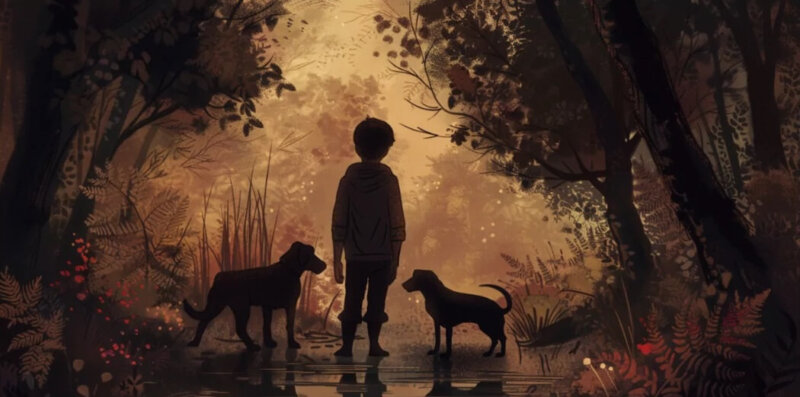
“My dog is probably going to die today,” she tells me through her tears. Mostly in vain, I try to comfort her, but what can I say? Her dog is probably going to die today. There is nothing that I can do about that. It is not a heartache that I can take away from her. Still, I do my best—and after a few more minutes, Mia’s tears begin to subside.
Four hours later, the bell rings and the lunch period arrives. I walk into a loud, bustling cafeteria. It’s a warm day, so I dismiss the students to eat on the sunny lawn outside, leaving only a few scattered boys and girls who remain to eat their lunches inside. As I pass by one of the long tables, I see a twelve-year-old girl sitting by herself, knees drawn up to her chest, wearing a sour expression on her face.
“Are you okay, Izzy?” I ask. Her frown deepens as she shakes her head. “What’s going on?”
She informs me that she cannot eat her lunch because she is still recovering from food poisoning—and to make matters worse, all her friends are eating lunch outside, but she can’t go outside because of her allergies. As if to punctuate her rant, she sneezes loudly at the end.
I offer my condolences, and ask her if there is something she can do while she is sitting in here alone—perhaps whether there is a book that she can read. Instantly, her face brightens. She reaches inside her bag and shows me the children’s science book that she is reading. For a minute or two, I sit next to her as she thumbs through the illustrations, showing me all of her favorites. Eventually, I leave her to read the book—but when I circle back around the room, I find her still sitting at her table with a smile on her face, munching on an apple and thoroughly engrossed in her book. If only adult problems were so easy to solve.
While Izzy reads her book, I make my way over to a table crowded with sixth grade boys.
“Hello, gentlemen,” I declare to announce my approach. They look up at me with a total lack of surprise. They know what is coming, because we have this same conversation almost every day.
“Did anyone vacuum the floor yesterday?” I ask. Of course, I already know the answer, given that the floors are filthy. The boys must know that the answer is obvious, because they are totally honest with me, shaking their heads solemnly to indicate their failure to vacuum. I inform them that someone needs to vacuum today or else I will make all of them stay inside tomorrow during recess and vacuum the floor together—but as I explain, one of the boys is jumping up and down at my elbow, trying to get my attention.
“Mrs. Belloncle!” he shouts in my ear. “Mrs. Belloncle, look!”
“Not now, Jimmy,” I say. “Let me finish.”
“Wait, no!” he cries. “Look!”
Finally, I look down. There is a giant piece of shepherd’s pie squished into the carpet. Someone has obviously stepped on it.
“Who dropped this shepherd’s pie?” I ask in horror. The sixth grade boys tell me that one of the seventh grade boys did it. I walk over to the seventh grade boys and ask them who dropped the shepherd’s pie. They tell me it was Billy, one of the sixth grade boys. I walk back to the sixth grade boys and ask them where Billy is. They point at the door all the way across the room, where the criminal they have aided and abetted is in the process of fleeing, just about to escape from the consequences of his crime.
I shout his name. Reluctantly, he turns around. We have a brief conversation with nothing but hand gestures and facial expressions.
Billy returns to clean up the shepherd’s pie. Several dirty looks and disgruntled complaints later, the carpet is clean once again and Billy is angry, because he has missed half of recess.
My anecdotes are not nearly as horrifying as Ivan Karamazov’s. In fact, they consist mostly of simple problems that do not rise to the level of the difficulties that adults face every day. My students do not struggle to pay bills. They do not have to maintain a house or property. They do not juggle the complexities and politics of a difficult workplace environment. They only have to go to class when they are sad, find something to do while their classmates are outside, vacuum the floor after lunch. From an adult perspective, it can be easy to dismiss their suffering.
Wow, we might be tempted to think, everything was so easy when I was a child. I didn’t realize how painless my life was. But this is, perhaps, the greatest lesson I have learned from teaching: that being a child is not easy, and it is certainly not painless. When you are a child, you must encounter the suffering of the world for the first time in a thousand little ways every day. As adults, we grow numb to the injustices of life—but the children don’t. The children feel the unfairness of the curse far more acutely than any grown-up does, because they are encountering it for the first time.
By the time you have reached adulthood, you have almost always come face-to-face with loss in some form. You have grappled with mortality. You understand that everyone and everything must die. But my student Mia cannot come to class because she is sad—because her dog is probably going to die today. The ancient adage that the wages of sin is death may be a truism to adults, but it is a novelty to her. Death is real, it is inevitable, and she must grapple with this reality now for the first time. Is it any wonder that she weeps in the back of the classroom?
Meanwhile in the cafeteria, Izzy is wrestling with the inadequacy of human love. Her friends love her, or at least they claim they do—but when faced with the choice between basking in the glow of a warm autumn sun or sitting in a basement cafeteria to keep Izzy company, they have chosen the great outdoors. Now, as a result of human frailty, she has to sit here alone and suffer the consequences of friends that betray and a body that gets sick when it eats the wrong kind of food, that cannot breathe in pollen without internally combusting. Of course she does not remember the book in her bag; of course she stews for a while in the injustice of it all. It is not her fault that she is here all alone, and yet she must suffer the pain of being alone anyway.
And what of my sixth grade boys, who hate to vacuum the floor after lunch? What of Billy, who tries to escape cleaning up the shepherd’s pie he spilled? “Cursed is the ground because of you,” God said to Adam in the wake of the fall. Just as Adam tilled the ground in pain and the sweat of his brow, so these little boys also must vacuum the carpet in the cafeteria. All they want to do is run and shout and throw a frisbee in the sunshine, and instead they are forced to toil for a few minutes in the field. They might protest, perhaps, that unlike Adam, they did not eat the fruit. So why should they have to suffer?
Indeed, the curse of life is that humans must vacuum the floor over and over and over again until they die. Adults are used to this fact—but not the children. The children have not yet come to terms with it. They do not understand, and why should they? There is, after all, something fundamentally disturbed in the fabric of the universe.
What do you mean, my dog has to die? Mia might well ask.
“Because of sin,” we might answer if we are wise.
But my dog didn’t sin. Why does he have to die?
As it turns out, this objection is actually very difficult to answer. It is the same objection that Job made when he asked God why he had to suffer even though he had not sinned, the same objection to which God responded by telling Job that there are more mysteries in heaven and earth that he could ever possibly understand.
There is a great wisdom in the anger and sorrow of a child—the wisdom of not yet being old enough to forget. “Grown-up people…have eaten the apple,” Ivan Karamazov says, “and they have become ‘like gods.’ But the children haven’t eaten anything.” Someday they too will learn to accept the suffering of the world. They may even become numb to it. But not yet, not now, as they encounter and wrestle with it for the first time.
How, then, do we respond to the problem of suffering when we have grown old and forgotten—when we have eaten the apple? In the words of Ivan, “But then there are the children, and what am I to do about them?”
In response to Ivan’s argument about children, Alyosha does not make a logical argument—and neither will I. Instead, I will tell a story, and that will have to suffice as an answer. Maybe it is the only possible answer.
The day after Mia breaks down in tears in my classroom, I walk through the cafeteria at lunchtime, just like I always do. I look over at Mia’s table and notice her sitting with her friends, laughing and smiling with a sparkle in her eyes. She glances up and catches my eye.
“Mrs. Belloncle!” she calls across the cafeteria. “My dog didn’t die after all! She’s okay!”
And we both break into wide grins, and a wild joy springs up in both of our hearts, because we are here together for this very little while on an earth with so much suffering and yet, inexplicably, so much mercy. In spite of all the sorrow, we live somehow in the continual presence of love and miracles, in a world where God may rightfully speak out of the whirlwind and ask, “Where were you when I laid the foundations of the earth?” Buried hidden beneath the suffering lies something mysterious, something beautiful—and if anyone doubted it, here is the proof: that at least for today, the dog did not die after all.


Related Posts