
2001: An Allegory of the Violence of Technological Evolution
At the beginning of the 2016 film Arrival, the scientist Ian remarks to the linguist Louise that language is not the foundation of civilization. Rather than language, he asserts that “science” is the foundation of civilization. The film plays with, among many other themes, this theme established in their introductory conversation: Whether science or language is the foundation from which civilization springs.
It is unsurprising, given the rise of science, that scientism now pervades our consciousness. But any student of history, philosophy, and even science (at least those who are not masochistic enough to be the handmaidens of the dream for a techno-scientistic utopia), would know that the assertion of science über alles is a fantasy and completely misguided. Even film and pop culture before the 2000s reflected this reality better than the likes of Sam Harris, Steven Pinker, Richard Dawkins, and their online mobs.
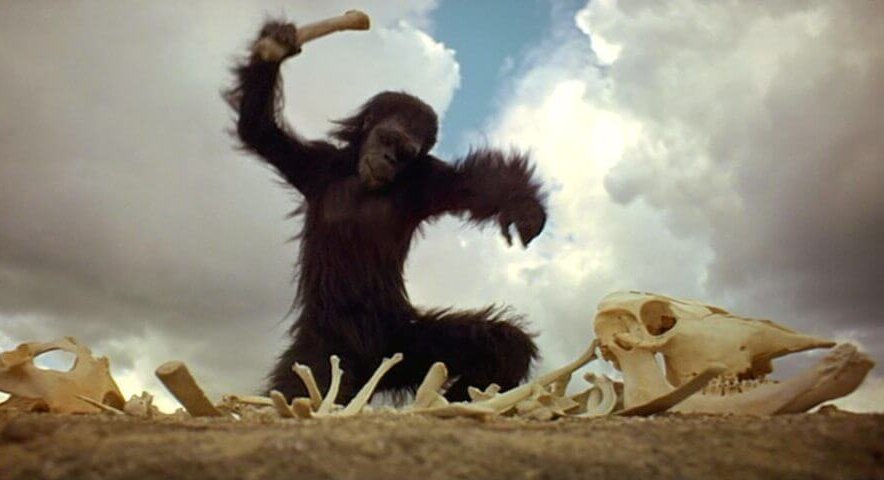
Stanley Kubrick created the modern science-fiction film genre with 2001: A Space Odyssey. Kubrick’s film is rightfully considered a masterpiece. But the film is less a triumphant and optimistic portrayal of science as it is a cautionary tale of evolution and the spectral revolution. In the most famous cut-scene of the film, and perhaps in cinematic history, the great ape hominid on the plains of Africa throws the bone-tool into the air and it cuts to the contemporary space-ship which houses the astronauts and HAL. The scene is crucial, as were the scenes leading up to that moment.
What 2001 got right is that science is not the axiomatic foundation for the so-called scientific discipline and enterprise. Science is the outgrowth of something far more central and practicable. Tools. Without tools science cannot get off the ground as the film poignantly and softly shows in that scene of tool become spaceship. Moreover, evolution is not driven by science (per se) but by tools and our use of tools for self-advancement, most specifically by using tools to conquer nature and other primordial lifeforms to become the “apex predator.”
Again, 2001 got this right. When the two great ape tribes first meet the invading tribe forces the original tribe to abandon the water hole and venture out in the harsh savannah. Having been expulsed from their primary source of survival, the great apes struggle in the desert until one comes across the carcass of an animal. The ape’s cognition advances into a higher sphere of consciousness when he utilizes the bone as a tool. The ape tribe returns to the watering hole to drive off the invaders using bones as tools.
This scene is particularly magnificent for several reasons. First it captures what Saint Augustine called the libido dominandi—the lust for domination—inherent in humans. Second, it captures the struggle for survival and the spirit of collective self-preservation in the state of nature (a subtle nod and critique to Hobbes who rejected the tribal and social nature of man but explained the drive to self-preservation and the conflict for resources in the state of nature recaptured in the opening sequences of the film). Third, and most importantly, we see the evolutionary changes of man because of tools. The great ape tribe that wields the bones as tools are homo habilus, or handy man. When the two tribes first clashed, they were both hunched over on all fours. Now, when the two tribes clash again, the tribe utilizing the bones as tools stand erect, upright, while the tribe at the watering hole remains hunched over. Why? The now homo habilus tribe has evolved to stand erect to better utilize the tools. The great apes who lack the usage of bones as tools remain hunched over.
The emphasis of technology and evolution, rather than “science” and evolution, is the underlying theme of 2001. An advanced piece of technology propelled heightened consciousness leading to the apes becoming homo habilus with the use of tools. So too, by film’s end, do the various technological forces evolve Dave into the Star Child as the next stage of this technological evolutionary journey which ultimately culminates in the extinction of what it means to be human as humanity transcends itself through technological tools into a new existence just as the great apes had done. 2001 is, therefore, a modern epic of evolution, depicting such a world and understanding of life as it really is: bleak and cruel. We might also add that it is honest in its depiction of the modern mythos.


Related Posts