Is Kubrick for Real? On Another Magic of the Extreme
mobiles ad superstitionem perculsae semel mentes
(minds once shocked are prone to superstition)
~ Tacitus, Annales, 1.28.
The title of this piece implies two questions: what is real art?; and, can cinema at all produce real art?
The first question is enormous, and will be approached through two relatively recent and important works. The first is Alfred Gell’s anthropology of art,[1] published posthumously, but to great acclaim, and considered as a pathbreaking work not only by anthropologists, but even art historians – for e.g., by Caroline van Eck,[2] who is Professor of Art History at Cambridge University, and was also Panel Chair at the ERC, the most important pan-European research funding body.
Gell starts by a Husserlian bracketing, asking the question what art is, anthropologically and historically speaking, if we ignore the inherent value of an artifact and focus solely on the manner in which it exerts an effect. In this way we come to the corollary that a particular artifact is a work of art if it is made for no other purpose than to exert an impact on the mind. Gell thus manages to establish an anthropologically – and sociologically – most important connection, through enchantment, between art, magic, and technology. All these endeavors are fundamentally common in having a striking, overwhelming, enchanting impact on our mind, captivating, abducting, or kidnapping us, leaving us spellbound. While Gell was obviously not discussing cinema, his work has fundamental relevance for the second question as well, as more than any other works of art movies are technological products, while the magical character of the cinema was emphasized by all commentators since the start – in a particularly memorable manner by Thomas Mann, in his Magic Mountain. And this makes the question whether cinema can produce a real art meaningful, beyond purported “unmodern” and “undemocratic” prejudices, as a painter can paint on his own, a writer can write a novel for a drawer, but nobody can make a film without needing millions and millions of dollars. It also has its relevance that, not unconnected to the magical, captivating effect of movies, the cinema was considered to be “the strongest of weapons” by Mussolini, and as the “most important art” by Stalin.[3]
The other work is a recent book by Patrick Curry,[4] reviewed on VOEGELINVIEW,[5] which takes the opposite and yet connected approach, focusing on enchantment in a different, valued or positive sense. According to him, the main feature of good work of art – and he starts by being interested only in good works of art – is to generate a genuine, uplifting wonder in the beholder, comparable to the experience of falling in love, evoking both participation and presence. It is something more mystical than magical, and is radically different from something that captivates our mind merely by shocking it, no matter how effectively. Thus, Curry rejects much of modern art as mere provocation, though a very effective one – in the sense of Gell –, siding for e.g. with Matisse against Picasso, or even with Bonnard, who was Picasso’s whipping boy; or considering Tolkien, especially but not only through The Lord of the Rings, as one of the greatest novelist of the 20th century, in contrast to its deprecation by professional and academic literati.
In his book Curry stays at the level of aesthetical experience, but it can be given an appropriate ethical reading. His ideas are close to and compatible with the most classical European “humanist” (in the sense of Sándor Márai, for e.g.) vision of art, according to which the “function” or “purpose” of art is to elevate the soul: to help us to become better human beings. This is not only the real sense of art, but the sense if which art is real, even realer than reality; as, in the words of W.B. Yeats, “Art/ Is but a vision of reality” (Ego Dominus Tuus). Any other presumed work of art is merely a distraction, in the precise negative sense as attributed to it by Pascal: it serves to hijack and mislead out attention, so that it can be deviated, seduced or perverted, into specific, hidden, and often explicitly dark purposes, as it happens with magic – or, in our days, with technology. Technology is the modern equivalent of magic, in its effect mechanism, and if Victor Turner, another great anthropologist considered theatre the modern equivalent of tribal rituals,[6] in its analogy we can safely consider cinema as the modern equivalent of sorcery.[7] The ever darker powers behind Hollywood are keenly intent to maintain and increase their grip on us; and if a dust gets into their finely oiled machinery, like the genuinely uplifting enchantment produced by the film version of The Lord of the Rings, so faithful in spirit to the original, then they try to move all stones to eliminate its impact – for e.g. by luring the main actor protagonists of the film into sexually explicit roles, thus destroying their aura.
We can now turn to Kubrick, and assess the character of enchantment his films produce. While I have not seen all of his films, I claim to have seen enough to form a judgment. This will be helped by an article of Eric Voegelin, one of his last and also most important ones, “Wisdom and the Magic of the Extreme,” one of his last published papers, originally presented in a 1977 Eranos conference; and also a 1967 book by the Florentine thinker Ferruccio Masini, on the “Alchemy of the Extremes.”[8]
Kubrick’s Magical Alchemy of the Extreme
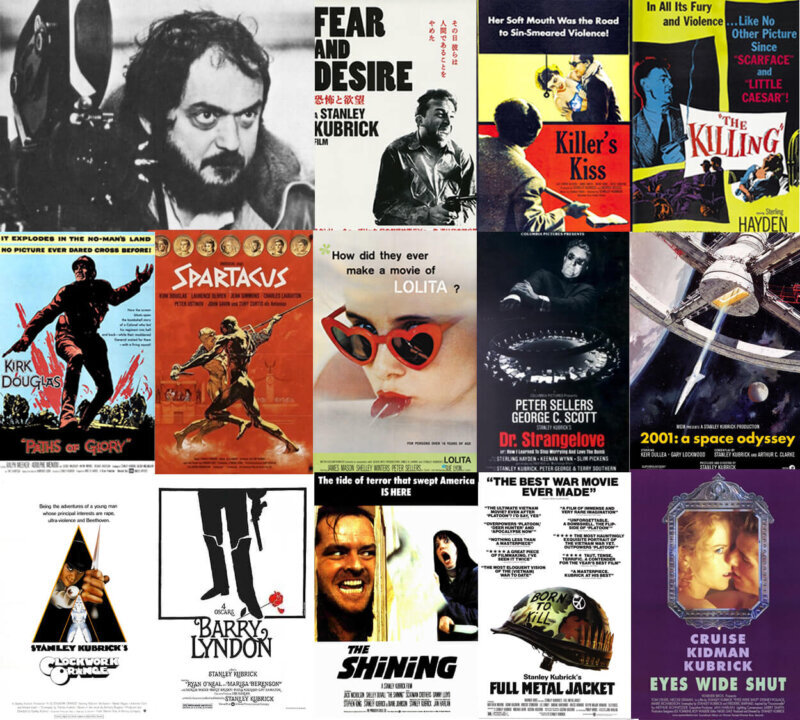
Stanley Kubrick is generally considered as one of the most important American film directors, present in all such lists of famous directors, and usually close to the top. Thus, while the value of such lists is of course questionable – in a list of the best 200 American directors Frank Capra is absent: one wonders according to which contemporary ideological measure was he failing – Kubrick’s qualities as a professional filmmaker cannot be questioned. But are his films works of art? And in what sense?
Making joint use of the ideas of Gell and Voegelin, Kubrick can be safely characterized as a filmmaker of the extreme – of the “magic of the extreme”.[9] His films focus on the most extreme human experiences, violence, warfare and sexuality, with frequent apocalyptic affinities and allusions. A focus on violence and sexuality, of course, is characteristic of most films, which only re-evokes the question posed at the start: are films works of art, or even can they be? However, the question that will be approached here is different: how exactly these extreme human experiences are presented in Kubrick’s films.
Sexuality
Sexuality is the protagonist in two of Kubrick’s most important and influential films, Lolita (1962) and Eyes Wide Shut (1999). Here one must start by paying careful attention to the context of his direct sources. Both Arthur Schnitzler’s ‘Dream Story’ and Vladimir Nabokov Lolita were extremely controversial, even at the time of their appearance. But, even further, the background experiences of both authors were quite uniquely extreme. Schnitzler was living in fin-de-siècle Vienna, was one of its artistic protagonists, presenting sexuality in his works in a way that anticipated and in some ways went beyond Freud, his exact Viennese contemporary. This specific chronotope (Bakhtin’s word for a coincidence of a significant time and place; it could also be called liminal) was quite unique in its atmosphere of decadence and decay, one of the only two moments in which Austria made significant contributions to European culture, though in a highly problematic way, with analytical philosophy and Popper, neoclassical economic theory, and Austro-Marxism, not forgetting Freud and psychoanalysis – the other being the moment of Beethoven, Mozart and Haydn, or a quite different art of genuine grace. Schnitzler’s 1926 ‘Dream Story’ was thus a par excellence ‘flower of evil’. But the experiences of Nabokov were no less unique, as he was 18 at the moment of the Russian Revolution, fleeing the country and living in exile since 1919. The first version of what later became Lolita was the short story ‘The Enchanter’ written in 1939, in Paris, a liminal time and place on its own, which was also the last literary work he wrote in Russian, and which remained unpublished in his lifetime. The quite extreme sexual experiences these writings captured thus were matured through their own extreme experiences.
Still, they were brought together solely by Kubrick. In themselves, both writings, though the former much more, raise legitimate concerns. In Nabokov’s Lolita the protagonist becomes not simply enchanted, but obsessed by a 13-14 years old, just barely adolescent girl, leading to the eventual destruction of both. In Schnitzler’s ‘Dream Story,’ in the context of a minor marriage crisis, the male protagonist witnesses the sexual orgy of a secret society, where all kinds of sexual acts are performed by masked people. Schnitzler’s work is actually more problematic, and his short story is only part of a series of provocative works with explicit sexual content. But why make a film of both, making images out of words which in themselves are quite destructively captivating? And why in that particular way? Making such an explicit staging of nudity and sexual acts that both films became particularly controversial – in the case of Eyes Wide Shut, this happening in 1999, thus when the showing of nudity or sexual acts on the wide screen was not exactly a novelty. But Kubrick, in both times, managed to venture beyond what was then accepted. And so the choice is clearly due to Kubrick’s own preferences – or obsessions. Similarly, the word “destruction” is also fundamental, and helps to establish tight connections between the at once “magical” and “alchemical” character of Kubrick use of extremes, beyond simple magical captivation, as alchemy is a type of knowledge based on producing something out of destruction. This point will be revisited in the Conclusion.
The full answer for the nature and reason of Kubrick’s choices is offered by the ending of Kubrick’s last film, Eyes Wide Shut, and so the last image, and word, he left behind. It is a common four letter word, starting with the letter “f”. This is pronounced – significantly – by the female protagonist, explicating to her husband what should absolutely be done right now, according to her, in order to help redeem what was happening with them before. This is fully Kubrick’s ending; Schnitzler’s short story was finished in a quite different way. There the male protagonist was on the verge of saying “forever” – which in the film is actually stated, though much before – but she stopped him uttering it and advised instead not inquiring too much into the future (which is also pronounced before in the film), and so they end by simply dozing off. That was not good enough for Kubrick, who wanted to end – not just the film, but actually his entire life-work – by a most extreme, and absurd, Freudian advice, as if the mere performance of a sexual act would be the solution to any ill, marital or not. This is because, in the film, this word is uttered in a particular context, between particular people; but by becoming the ending, and quite emphatically – the screen becomes dark after, evoking the void – it is made into a general symbol, just as the mask on the bed, one of the other main symbols of the film, and similarly destructive, as it implies that everything we do, even in our own bed at home, is just a masked performance – giving a particularly dark interpretation to an otherwise nasty last word.
That all this should not necessarily be the case, both concerning the explicit representation of nudity and the sexual act, even in a love story, is demonstrated by two other films, somewhat contemporary – though earlier – than Kubrick’s last work. One is Peter Weir’s 1985 Witness, where the female protagonist, an Amish women, falls in love with the accidental house guest played by Harrison Ford, and the director focuses on the headdress she takes off before going to bed. The headdress thus becomes symbol of her conscious and deliberate act, breaking the rules of the community, but due to a genuine attraction and not an obsession – and the director leaves it there, does not show more: in general, it is difficult to find nudity, not to mention explicit sexual acts, in Peter Weir’s films. The other is Norman Jewison’s 1987 Moonstruck, which is a comedy and a love story, and where the quite intense attraction developing between the two protagonists, played by Cher and Nicolas Cage, is quite explicitly characterized, in discussions – but without showing nudity, or sexual acts, and thus being much more genuinely and “erotically” involving. In both films, beyond presenting the love story, the directors also place emphasis on restoring the integrity of the respective communities. In Witness, detective Book leaves, while Rachel stays home, with the Amish: they belong to different worlds; while Norman Jewison’s film ends by evoking, through photos, the family to which now both protagonists came to belong, traced back to an elderly Sicilian couple, evident “ancestors”. This ending, while not done by a director high in the modernist canon, directly recalls Tarkovsky’s Andrei Rublev, arguably the best film by the best film director of all times, which at its ending lingers over, for long minutes, Rublev’s ‘Trinity,’, considered by Pavel Florensky the most important painting of all times.
Violence
Another major film by Kubrick, Clockwork Orange, is noted for its extreme violence: easily one of the most violent films of all time, especially by then, while it also combines violence with sex. It also has a major literary source, the novel by Anthony Burgess. While the film quite faithfully follows the novel, there are still two major problems with this. First, there is a major difference at the ending: while in Burgess’ novel the protagonist changes there, outgrowing his pathology, such a “happy ending” evidently was not compatible with Kubrick’s philosophy of life. Second, in the book the explicitness of the violence was somewhat muted, and aesthetically transcended, by the use of a particularly slang, developed by Burgess on the basis of Russian, giving a very particular color, and aesthetic experience, to the novel. While this is kept in the film, there the violence of the images dominates this soothing effect.
In order to explain why this is so we need to discuss the mimetic character of art. But first, we need to mention another Kubrick film of extreme violence, Shining, which was outright a horror film: another apotheosis of violence, in which gang rape has been replaced by wanton murder. With Shining, Kubrick completed his move to become the Howard Hawks of his time, demonstrating that he is capable of making all possible kind of movies. However, while Hawks managed to make movies in every major genre – gangster films, screwball comedies, war films, Western, detective stories, film noir, science fiction, boxing drama, aviation films – Kubrick directed all possible kind of extreme films: about sexuality, horror, violence, apocalypse, black comedy, Vietnam War.
The mimetic character of art
Modern rationalism is based on a series of staggering omissions and errors. One of the worst of these concern the link between imitation and the arts, arguing that art is, or should be, the imitation of life. This, of course, makes no sense, as why would anyone need an activity that would simply copy or imitate reality. As a result, modern “art” is obsessed with refusing that it is engaged in such as base activity as “imitating life,” Picasso’s absurd cubism being a prime example. But art, of course, has a basic relationship to life, and to imitation. I have no space here to discuss the first point, can only repeat that genuine art, real art, is of course more real than reality itself. But the second point is fundamental here, as art, instead of just “copying” reality, rather itself interferes with it, can modify reality, altering it, even to the point of undermining and destroying it. This is expressed with particular poignancy by W.H. Auden: “For if the intrusion of the real has disconcerted and incommoded the poetic, that is a mere bagatelle compared to the damage which the poetic would inflict if it ever succeeded in intruding upon the real.” (in “The Sea and the Mirror: A commentary on Shakespeare’s The Tempest”; and Auden of course explores in his long poem the consequences that this has already happened). This was originally the problem of Plato with art; and this is why he considered any artistic activity as being potentially dangerous. And this is why he founded philosophy, as an effort to mobilise the power of reason against the dangerous and potentially lethal modalities of imitation.
Thus, the radical contrast between Plato and modern rationalism must be stated here, as clearly as possible: for modern rationalists, we humans are rational beings; this is an anthropological constant; only children imitate. So art, as being only an imitation of reality, has no weight; only a matter for recreation; something to be done in one’s leisure time. Anything that offers some diversion, or divertissement, is legitimate, as it does not really matter at all. We are rational beings, we can take care of our interests, before and after taking some time off to contemplate mere “art”.
For Plato (and Aristotle, and Augustine, and the line can be continued), all this is simply absurd. Humans are fundamentally imitative, both for good or bad: whatever they hear, and especially what they see, leaves an impression on their memory, on their souls, and so influences and alters the way they behave. Art, instead of being an area of easy irresponsibility, just a nice tickling of our senses, is the realm of hyper-responsibility: works of art, especially those that are particularly successful, involving, effective, lead us to imitation, and thus alter our ways of seeing, even our being, without us even being aware of it.
This is true for words, of poetry or literature; even more true of images; and particularly, frighteningly true for theatre or cinema. A comedy is not a true representation of reality; it could not be, because then it would not be comic, just outrageously boring. Life can produce comic scenes, but if represented on the stage they would not be comic, as it would require hours to explain who are the people represented, and why what they were doing is comic. A comedy is the condensed essence of real and unreal modes of conduct; but what is thus represented can – and indeed does – have an impact on real life in all kind of ways, modifying the perception and conduct of those who see it: they can be infatuated with the heroes, heroines, or singular ideas. This is why, practically in all times, women could not act in a theatre, as they were particularly liable to generate such obsession – due to the inherent character of “human nature” – both “male” and “female,” though of course differently. And this was a truth – in contrast to our modern, rationalistic and egalitarian ideologies, where women have as much “right” to step on the stage as men – as if such an act had anything to do with “rights,” in any of the manifold senses of this important and complex word. One of the firsts to realize this was Shakespeare, according to René Girard not simply a playwright but a theorist of mimetic desire;[10] and who, at the height of his success, first abandoned the writing of comedies, and then the theatre itself – in the figure of Prospero, a magician, as he realized that theatre was magic.
Modern rationalism, by eliminating the responsibility of artists, not only made them irresponsible, but a slave of their own personal idiosyncrasies and obsessions. Nobody questions that Kubrick, or Picasso, were extremely talented. But when using their talents, liberated – or deprived – from the obligation of responsibility, they fell victim to their personal obsessions. And in depicting such obsessions, catering solely for success, for effect, for the appreciation of the public – or the “critics,” dealers in life and death among artistic circles, as it was best expressed, strangely enough, by Bulgakov in his Master and Margarita – they followed what was appreciated or required by them, giving a free rein in their work to what they should have held back even from themselves.
Beyond the world
Kubrick followed up his apocalyptic dark comedy Dr. Strangelove with a sci-fi movie, 2001: A Space Odyssey. The tight connection between the two, but also the problematic character of this, was revealed by his claim that he chose the theme as he became impressed by Arthur C. Clarke’s novel Childhood’s End, “about a superior race of alien beings who assist mankind in eliminating their old selves”[11] – revealing his own deep Gnostic inspiration. Kubrick spent five years on the project, and the film, like all of his works, became extremely controversial: while from some receiving great acclaim, and even gaining the rare honor of being the number one film of all times in a 2012 ballot of the influential Sight and Sound magazine, published by the British Film Institute, as voted by of 480 directors, it has its serious detractors, who accused it of being dull, impersonal, and lifeless – a very serious accusation against any film. Most importantly, such a view was formulated by Andrei Tarkovsky, who has claimed in a 1970 interview that the film was “phoney on many points,” being “a lifeless schema with only pretensions to truth,”[12] and who reputedly made his own science fiction film Solaris against Kubrick’s film. While – and I excuse myself to repeat this – the technical brilliance of the film cannot be questioned, the impersonal, if not outright dehumanizing or inhuman character of its message is also obvious.
This becomes especially clear if again seen in context, this time of Kubrick’s own life-work. A Space Odyssey was central part of what arguably was the great decade of Kubrick’s life-work, the four movies he made, between 1961 and 1971, or his ages of 33 and 43, arguably the most important, creative decade in the life of any artist. He was then already in England, escaping the limitations of Hollywood, and when, from Dr. Strangelove on, he became not only director but also writer and producer of his films. With the previous film, Dr. Strangelove, A Space Odyssey shared a deeply apocalyptic character: as if on the back of world destruction, due to nuclear war, the scene with which that film ended, he had to move the very location of the film outside Earth. He would only return to our planet with Clockwork Orange, to combine and summarize the apocalyptic violence and sexual aberration of the previous films.
Conclusion
Kubrick was evidently not at home in this our world, considering humans, in a true Gnostic manner, as colossal cosmic failures, products of a disastrous experiment with creation, to be eliminated or at least improved – something which in our days has become the privilege of “creative artists,” and the like – and whose real nature is revealed under such extreme conditions as sex with adolescents, gang rape, wanton murder, or a mass orgy.
But what does all this mean? I cannot say; I don’t know. But this is a most important question. Kubrick’s life-work is a drop in the ocean, the ocean of our destruction, or at least intended destruction, and so we should investigate everything about him, his background, his formation, the manner in which he came to nurture, with so much talent, so destructive, and exclusively destructive ideas. We must find ways to avoid our self-destruction – as the forces that are way beyond and above us, and care for us, need our own efforts.
[1] Alfred Gell, Art and Agency: An anthropological theory, Oxford, Clarendon Press, 1998.
[2] Caroline van Eck, “Living statues: Alfred Gell’s Art and Agency, living presence response and the sublime,” Art History 33(2010) , 4: 642–59; and Gell, Alfred, London, SAGE, 2020
[3] For the first, see Daniel Gati, “The failure of democracy in Italy: from Berlusconi to Salvini,” in Agnes Horvath, Arpad Szakolczai and Manussos Marangudakis (eds.) Modern Leaders: In Between Charisma and Trickery, London, Routledge, 2020; for the second, see Mira Liehm and Antonin Liehm, The Most Important Art: Eastern European Film After 1945, Berkeley, University of California Press, 1977.
[4] Patrick Curry, Art and Enchantment: How Wonder Works, New York, Routledge, 2023.
[5] Stephen H. Conlin, “Love of the Other as Other: What is Enchantment and Wonder?”, VoegelinView, https://voegelinview.com/love-of-the-other-as-other-art-and-enchantment-patrick-curry-review/
[6] Victor Turner, From Ritual to Theatre: The Human Seriousness of Play, New York, PAJ Publications, 1982.
[7] The connection of not just art and technology, but even of modern science with magic has been recently made by Agnes Horvath, in Magic and the Will to Science: A Political Anthropology of Liminal Technicality, New York, Routledge, 2024.
[8] See Eric Voegelin, “Wisdom and the Magic of the Extreme: A meditation,” in Ellis Sandoz (ed.) Published Essays, 1966-1985, Baton Rouge: Louisiana State University Press, 1990; and Ferruccio Masini, Alchimia degli estremi: studi su Jean Paul e Nietzsche, Parma, Studio Parmense, 1967.
[9] Note that it is in this precise sense that the Tacitus motto should be understood. In his time superstition was meant not in the soft modern sense, but in the precise sense of a “religious belief based on fear or ignorance and considered incompatible with truth or reason.” (Online Etymology). Applied to our modern age, this implies that works of art meant to shock viewers lead to the formation of views that drive them away from truth or reason – and so a cinema of the kind becomes the exact modern “equivalent experience” (referring again to a main essay by Voegelin) to the one produced by sorcery.
[10] René Girard, A Theatre of Envy: William Shakespeare, Oxford, Oxford University Press, 1991.
[11] https://kubrick1928.wordpress.com/; visited December 12, 2024.
[12] https://www.openculture.com/2015/07/andrei-tarkovsky-calls-kubricks-2001-a-space-odyssey-a-phony-film-with-only-pretensions-to-truth.html; visited December 12, 2024.


Related Posts