28 Years Later: Death and Rage in the Satanic Wilderness
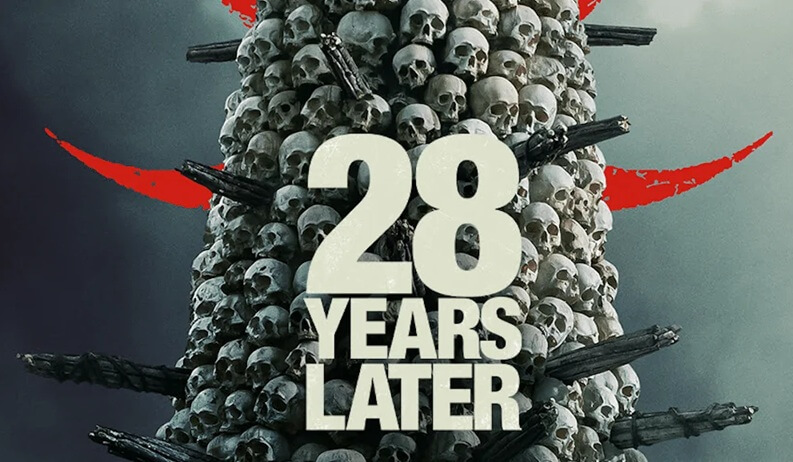
28 Years Later is a film of which the founding father of the zombie horror film, George Romero, would have been proud. Unlike most modern zombie films, which tend to combine excessive, over-the-top gore with dull, platitudinous, politically correct melodrama, the entire 28 Days Later franchise has been consistently faithful to Romero’s core principles. All three films so far have been extremely provocative, socially critical and with a true air of the apocalypse, one that positively radiates hopelessness.
In an atmosphere of ideologized film-making and manifest lack of creativity, and the even more pronounced lack of grit which must accompany any truly creative endeavor, Boyle (the film’s director) and Garland (the film’s screenwriter) have opted to sail rather close to the wind. What we have here is a very deep, yet skillfully concealed critique, and final condemnation, of the modern West’s culture of death, at its very core.
From the very beginning, one detects a re-statement of a classic theme, first introduced by Romero’s Living Dead films, but one which we can see even in The Walking Dead series, at least to a degree. The last uninfected people in England, that is the survivors of the zombie apocalypse, are not the sort of people that would be immediately welcomed by high society with open arms. If Romero’s survivors were coarse and vulgar rednecks, bikers, criminals and renegade police and military personnel, those in England, as portrayed in the film, are equally unclubbable.
They dress rather modestly, almost as if they are visitors from the Middle Ages. In their town hall and school, they have portrait of a young Queen Elisabeth II, likely from the fifties or sixties. There is no modern technology of any kind, and the only weapons available are bows and arrows. Only blue-collar jobs are on offer, and the young are actively encouraged to pursue them. St. George’s flag flies in the very center of the town. Genteel, middle-class, white-collar suburbia is dead and buried (in the literal sense), and it is as if it never existed.
To make matters worse (from the point of view of today’s intelligentsia, best exemplified by the BBC and the Guardian) the last survivors live on Lindisfarne, also known as Holy Island, with its ancient Abbey and Castle, and the resting place of St. Cuthbert. It is also an erstwhile center of Celtic Christianity, the monastery having been founded by St Aidan, an Irish monk.
In 793, Holy Island was raided by the Vikings, an event described in almost eschatological in the Anglo-Saxon Chronicle. That merciless, cruel attack of the heathen raiders resulted in the destruction of the monastery and death and enslavement of the monks. At the time, this was seen as an unprecedented, sacrilegious act of extreme savagery against England’s holiest place.
The island is only connected to the mainland via a causeway, which can only be crossed at low tide. By choosing this tidal island, with its very unique, particular history, as the last bastion of the survivors, Boyle and Garland have made an ingenious aesthetic choice.
The last bastion of humanity in England is one that touches upon Anglo-Saxon, Christian England and its forgotten history and beliefs. It is a reference to an English identity which now appears so distant and shrouded in mystery, that it would likely be treated as nothing more than a fairytale by most modern audiences.
Paradoxically, this is precisely what gives the film a distinct sense of realism. There is an undeniable feeling that if any iteration of England could survive a zombie apocalypse, only something approaching this kind of England could achieve it.
Somehow, a new layer of insularity is added, in circumstances where the mainland itself is, in fact, an island. With the marked disappearance of the white-collar, high-tech world, reality itself is re-enchanted. Holy Island, aesthetically representative of an older England defined by an almost mystical nobility, is contrasted with the mainland with its forest, a true satanic wilderness worthy of a Miltonian description, emotionally reminiscent of Hawthorne’s dark forest of clandestine meetings and transgression. The mainland has become one vast woodland of evil, the sinister realm of monsters and wild beasts.
What makes this state of affairs even more fascinating is that the virus that has caused the zombie apocalypse in England is confined to it. The rest of the world is unaffected and has imposed a policy of containment on the British Isles, with NATO ships on constant patrol, ensuring no can get into or out of the British Isles.
Thus, provocatively, Holy Island and its inhabitants are isolated from the satanic wilderness of the mainland as much as they are from late modernity, concealed behind the veil of the NATO blockade. These parallel universes become almost indistinguishable in their cruelty and hopelessness as the story unfolds.
28 years after the spread of the virus, all the children born on Holy Island have never experienced the modern world, and all they can go by, are photos of the past.
It is in this re-enchanted universe that Spike, who is 12, has to undergo a coming-of-age ritual, which involves going to the mainland and killing one of the infected. On this quest into the dark forest, he is assisted by his father, Jamie. His mother, Isla, is seriously ill and bedridden. She does not want her son to go, yet, given her condition, she can do very little to prevent it.
Initially, the story bears superficial resemblance to Cormac McCarthy’s The Road, where a father and his son are trying to survive in a post-apocalyptic American landscape, plagued by death, destruction and cannibalistic scavengers, in the aftermath of a nuclear fallout. However, this quickly turns into a very different kind of story.
On his way to the mainland via the causeway, we see flashbacks of what appears to be the Battle of Agincourt, with an unapologetic focus on the exploits of the English longbowmen. When Spike experiences certain misgivings about the post-apocalyptic rite of passage he is about to undergo, we are treated to black-and-white footage of top-hat-adorned public school boys from the beginning of the 20th century and young soldiers making their way to the trenches of the First World War. In the background of each step Spike takes, we hear Kipling’s rhythmically-militaristic, imperialist poem Boots.
This is the England that Spike romanticizes in his mind. This eclectic and nostalgic mélange of poetic and cinematic imagery carries with itself an irresistible sentiment: that the England of Spike’s dreams must have disappeared much earlier than a mere 28 years ago, sometime just before the Second World War, never to return. It somehow feels almost as distant as the events that took place on Holy Island in the 8th century.
Although Spike does end up getting his first kill, matters do not go according to plan and he and his father have to escape back to the island, pursued by hordes of zombies, including by a specimen of the very athletic Alpha type. Spike fails miserably in his attempts to assist his father during their retreat. Nonetheless, upon their return to Lindisfarne, he is treated to a hero’s welcome.
It is at this juncture where this post-apocalyptic epic pierces through the heart of modernity in a much deeper way than Romero’s films ever did. For Romero, the zombie apocalypse is a metaphor for, and consequence of, the stupidity, immorality and ineptitude of the institutions of modernity, to include the military-industrial complex, the scientific establishment, the banks and the media. For Romero, the zombie apocalypse exposes institutional failure and the collapse of science (and the whig-Darwinian philosophy which underpins it) as a guiding principle for humanity, with the end result being the irreversible extinction of mankind.
The 28 Days Later films go to the roots of the problem, which is not merely ideological. The disease is a bottom-up one, not the other way round. As implied both in this film and its two prequels, the main reason for our destruction is not so much the exhaustion and collapse of our liberal techno-scientific civilization, but rather, the inversion, subversion and death of the father. The family unit has turned on itself, in a cannibalistic fashion, leading to the collapse of civilization.
In 28 Days Later this was stated obliquely, with the girl’s father getting himself infected through a fit of anger, and exposing her to danger due to a residual, misconceived belief in institutional authority (in that case, the army). In 28 Weeks Later the theme of the weak, dishonest father as the great betrayer of his family and true destroyer of civilization is beyond conspicuous.
In 28 Weeks Later, the father and husband character abandons his wife to be eaten by the zombies despite her cries for helps, in order to save himself. Once the infection has apparently died out in the country and he is re-united with his children, he lies to them he had seen their mother die and that he could do nothing to help her. Later, it turns out she had escaped and, though infected with the virus, she is somehow immune to it. When the children find out their mother had, in fact, been alive all this time, they confront their father, but he can do nothing more than to continue lying to them.
Eventually, he goes to see the wife he had betrayed and kisses her whilst she is restrained on a hospital bed. As a result, he infects himself and turns into a zombie, proceeding to kill his wife by devouring her, after which he spreads the infection to all survivors, resulting in the US Air Force having to incinerate all that moves. Until the very conclusion of the film, the rage-infected father pursues his own children in order to eat them alive, only for them to end up killing him in self-defense.
What we have here is the final, absolute inversion and subversion of the role of the father: from role model to coward, from protector to betrayer, from provider to a self-absorbed egotist, from a builder and head of the household to its destroyer. The message is that this inversion is the true virus that has infected modern society, with fatal consequences for humanity as whole. With the father corrupted to the point of total depravity, there is no one to save his forlorn children from the clutches of our ubiquitous culture of death.
The process of inversion is complete, for the children can only find (temporary) salvation through their father’s death. This situation also leads to a role reversal- the children are compelled to become what their father was meant to be, but never was, in order to stay alive. The family is dead, murdered by its progenitor and head, and all children are now orphans, forced to survive, all alone, in a world of absolute cruelty and hopelessness.
In 28 Years Later, Spike gradually realizes that his father, to whom he used to look up and who is clearly a competent warrior and survivor, is morally weak, dishonest and unfaithful- both to his professed principles and his wife. Spike, having grown up in relative innocence on Holy Island, is also rather unimpressed with his father’s drunkenness and use of crude, vulgar language, all of which serves to further undermine his father’s authority and standing in his eyes.
Not only does his father exaggerate and lie about Spike’s actions during the retreat, making him appear as a hero which he knows he is not, but Spike also sees him having a sexual encounter with another woman, Rosie, Lindisfarne’s children’s, schoolteacher, at a time his mother is on her deathbed. The last straw hits when Jamie tells Spike nothing could be done to save his mother, only for Spike to be informed there was a doctor on the mainland.
Rosie’s and Jamie’s fall from grace through their affair is truly symbolic. On the one hand, they are supposed pillars of the community and responsible adults who behave in a way that undermines the entire structure of society. On the other, in the eyes of Spike, this amounts to a significant revelation: the inhabitants of Holy Island, at least the adults, are just playing make-believe. The external imagery of a quasi-medieval, noble England is just a façade. Underneath, the adults have remained thoroughly modern in their values and tastes, which could not be more incongruous with the virtues and beliefs of the monastic founders of Holy Island.
It is from this point on that Spike, just like the children in the film’s immediate prequel, rejects his father and his entire community, in order to save his mother from his father. Spike feels he has no choice, as he realizes Jamie is quite content to allow Isla to simply wither away and succumb to her illness, so that he can replace her with his mistress.
Unlike the father in The Road, who is paragon of virtue, willing to sacrifice himself for his son no matter the cost whilst protecting his innocence in a cruel, desolate world, Jamie cannot even recognize that his actions have destroyed his family. Instead, he reacts emotionally and unapologetically, in a manner defined by immaturity and self-absorbed conceit. Spike, at the age of 12, is forced into the satanic wilderness, acting as his mother’s protector and savior, in place of his fallen father. This quest is as poignant a metaphor of family disintegration as any.
On his quest to find the mythical doctor, who takes on the peculiar role and appearance of a dark wizard and a New Age spiritual healer, Spike simultaneously encounters the evil of the wilderness and the unserious, clown-like vacuity of our Instagram/Tik-Tok-infused reality.
Upon yet another close encounter with the infected, Spike and his mother are saved by a Swedish soldier, Eric, who acts as a metaphorical ambassador of the world beyond the naval blockade-our world.
Despite their high-tech NATO weapons and technology, Eric’s Swedish comrades- in- arms are quite easily overwhelmed by the zombies and look amateurish when compared to the English survivors with their bows and arrows. Eric himself, as a character, is the epitome of the emptiness of the modern world, with the image of its futility reinforced by Eric’s subsequent actions. The practical hollowness of our world’s alleged achievements, so impotent at addressing, or even understanding, the threat at hand, is brought to the fore.
Eric tells Spike he had joined the Navy to prove a point, and that, in hindsight, he would much rather be a delivery driver. A soldier without a cause or calling, without courage or loyalty, he is a mere employee.
Eric’s appearance shows a marked change in the degeneration of the imagine of the soldier in the films. In the first film, though portrayed as corrupted by bestial lust, the British soldiers still have a true man of honor among them, their sergeant, who remains honorable and virtuous until the end, which costs him his life. In 28 Weeks Later, there are plenty of examples of men and women of honor and integrity in uniform, who pay the ultimate price to save the two children from the infected, the broader inhumanity of the military machine and their own father. Eric, in contrast, is a tragic-comical figure, and does not look like a soldier even when wearing a uniform. This modern NATO soldier passes, at best, for a paintball enthusiast. His demeanor tends towards that of a frustrated teenager.
At one point, he refers to himself as a Viking, and wonders if he will start resembling one if he becomes infected, an ironic comment in clear recognition he is no warrior. Eric’s sanitized, antiseptic Sweden can produce no true Vikings, whether as protectors or invaders.
Eric spends an inordinate amount of time on his dying smartphone and the last image he shows Spike is an Instagram photo of his fiancée, who, we are shown, has clearly enjoyed all the benefits modern cosmetics and filtered image-making can offer.
Eric’s defense of his fiancée from Spike’s comment that she looks unwell due to her artificially inflated lips, is half-hearted. She never becomes his princess, muse or inspiration to survive, as a even black-and-white photo of a sweetheart might have done for a soldier in days of yore. When speaking of his fiancée, Eric is utterly devoid of passion or any romantic feeling. She is, therefore, destined to remain a mere Instagram photo, a battery-dependent, static mask of pixels, forever.
Shortly before its battery runs out, Eric tosses his smartphone into the filed- a symbolic act, demonstrating the uselessness of the item itself, and the culture it represents, in this re-enchanted universe. Or any universe.
Eric’s demise is a gruesome one. Spike’s mother suddenly hears a child’s cry and enters an old train. Therein, an infected female gives birth to an uninfected baby girl, whom Spike’s mother saves from her own, infected, mother.
Eric, though he clearly sees the child is uninfected, immediately points his weapon at her, intending to kill her. Curiously, it is in his intention to kill the baby, that we first see any kind of intensity, even a certain indignation, in the otherwise passionless Swede. He feels enraged when he sees the baby (and we must not forget that rage is the name of the virus in all the films). One can only suspect that he feels that way as he himself was raised in a culture of death, though a more sanitized one. It seems the only resemblance between Eric and his Viking ancestors, who raided and pillaged Holy Island in the 8th century, is their shared cruelty towards the weak and innocent.
Here we find yet another oblique expression of the underlying theme of the film. Eric, though not a father, is a soldier, someone expected to be an example of honor, loyalty and a defender of the weak, an embodiment of masculine virtue. In a world of failed fathers, Eric is a failed soldier-cowardly, weak and trigger-happy only when it comes to newborn babies.
Before he can kill the baby girl, Eric is decapitated by an Alpha zombie, who is presumed to be the baby’s father. He then goes on to pursue Spike and his mother, and seeks them out on several occasions.
Yet again, there is a clear ambiguity in this, which feeds into the broader concept of the film. Though the Alpha technically saves the baby from Eric, his pursuit of his daughter’s saviors brings this physically imposing zombie’s motives into question. Is he going after the baby to save her, or, to kill her by eating her alive? This riddle remains unresolved, for Spike saves the baby in the end and takes her to the island to be looked after by the community there.
But before he does so, he and his mother finally find Doctor Kelson, brilliantly portrayed by Ralph Fiennes. The erstwhile doctor has become a veritable death cultist, seeking out corpses, burning them and then preserving the skulls, which he then uses to build a pyramid-like skull temple. His mantra is memento mori – the Latin for “remember death”.
The portrayal of the last doctor in the country as the High Priest of a death cult is not incidental. He quickly and competently diagnoses Spike’s mother with cancer. However, this representative of medicine is clear he cannot help cure the disease, and will not even attempt to do so. All he can offer Spike’s mother is a “peaceful death”, which, as we know, is a euphemism for euthanasia, which he duly carries out. Thus, Spike’s last illusion dies. The doctor, as Spike’s last idol of hope, crumbles and collapses even more quickly than his tower of skulls.
Just like the inverted, and by extension and consequence corrupt, images of the father and the soldier, we have now reached the final stage of the transvaluation of values whereby the doctor, who is supposed to save lives, can only offer, and deal in, death. What’s more, this medic not only sells, but worships death, and has even built a temple dedicated to it. With the abolition of true medical ethics, medicine has become its opposite-a death cult.
What makes the character of Dr Kelson even more disturbing is that this film came out, almost as if by design, around the time Parliament voted in favor of legalizing euthanasia in Britain, which was preceded by a successful vote to effectively decriminalize abortion in all cases. As a consequence of such and similar legislation, death has been declared the highest virtue and the greatest expression of freedom in our societies- formally, legally and totally.
In Orwellian terms, death now stands for dignity and life for suffering, the very philosophy Dr Kelson promotes in the film. Dr Kelson is no longer just an aesthetically shocking, fictional portrayal of the transvaluation of medical ethics and morality, at the most fundamental level. He is a real-world character, the living embodiment of our culture of death.
Ultimately, Spike fails in both of his coming-of-age quests. The first, due to his father’s betrayal and mendacity. The second, due to the depravity and weakness of all the other father-figures along the way.
After leaving the baby on the island, in secret, Spike returns to the wilderness to live alone and fend for himself. At the end of the film, he is attacked by a number of infected but is saved by a gang of tracksuit-wearing youths, inspired by the look of the infamous BBC entertainer Jimmy Savile popular during his lifetime, but plagued by allegations of multiple instances of sexual abuse, only investigated after his death. In Britain, Savile is a figure held in utter contempt and has become a symbol of sexual depravity and institutional cover-up.
The leader of the Savile- inspired gang is called Jimmy. In fact, the film starts with a young Jimmy who escapes an attack of the infected, to which his entire family succumbs. He goes to his father’s church, with his father being the local vicar, longing for the safety both the church and his father implicitly promise. Instead, his father is convinced this is the Second Coming and allows himself to be consumed by the infected.
In the end, we have Spike, betrayed by his father and all authority figures in his life, shaking hands with, and joining the gang of, a person, himself abandoned by his father in his hour of need, who styles himself after a notorious sex offender.
The film leaves its audience with a very bitter taste of the true nature of our culture. With gangs taking over the role of the now lifeless family, with an all-embracing culture of death as the only guiding principle and a vapid pop-culture, acting as a superficial plaster for what is a very deep wound, what is really left? The only real coming-of-age ritual in such a world is joining a gang, or as in 28 Days Later, becoming so cruel and merciless that in one’s brutality, it is difficult for others to tell whether one is a man or a zombie.
All three films taken together communicate that in our world, a satanic wilderness of aimless, hapless orphans, thoroughly betrayed and abandoned, there are only two realities left: rage and death.
Dr. Kelson, unlike today’s duplicitous propagandists of “dignity” and “mercy”, demonstrates refreshing frankness in his open, unapologetic worship of death, both on a personal and professional level. In light of recent events, it may be worth following his approach. An imposing skull temple in Trafalgar or Times Square would be a truthful, honest monument, to what our culture truly stands for.


Related Posts